Whose Brain Is It? [Jan 2012 – Leena Prasad]

Whose Brain Is It?
by Leena Prasad

“Chai tea,” Tina says to the woman behind the counter.

Hema tries to suppress a chuckle.

“What’s so funny?” Tina asks.

“Nothing. It won’t be funny to you.”

“Try me, anyway.”

“Well chai in hindi means tea.”

“Oh,” Tina says and giggles. “Yeah, we like to appropriate other cultures words without considering what it means.”

“I don’t really care. But it does sound funny. I’ll have some tea tea please.”

“What makes something funny?” Hema says, as they sit down at a table wither their drinks.

“Well, maybe it has to do with something absurd. Like tea tea.”

They sip their drinks, considering the question.

“You know, I read somewhere that if a certain part of the brain is touched, it can cause laughter.”

“You mean, like in the inside, by a brain surgeon?”

“Yes, yes, during surgery, or when they are examining the brain.”

“So, the humor circuits are hardwired? I guess that makes sense. Everything is hardwired, I suppose.”

Hema could be describing the case reported in Nature magazine by neurosurgeon Itzhak Fried of University of California at Los Angeles. Fried made an accidental discovery while studying the brain of an epileptic patient, a 16-year-old girl. He was trying to diagnose the reason for her seizures by using an electric probe on her brain. Every once in a while, the girl would start laughing for no apparent reason. He realized that when the probe touched a specific area in her left frontal lobe she would laugh. If he increased the electric current, the girl would laugh with more intensity.

Much of research on humor has been done on brain abnormalities that cause inappropriate laughter. It is difficult to study “normal” humor because the definition of humor varies. But, researchers can look at the result of humor, i.e., how the laughter resonates within the brain circuits. Excluding laughter caused by tickling, laughing gas, or simply as social contagion, some recent studies examine the result of laughter on a healthy human brain as it responds to everyday humor.

The area that Fried was touching inside the 16-year-old girl’s brain is less than an inch-square and it’s called the supplementary motor area. In a study cited in the Brain journal, a PET scan revealed an increase in the blood flow in the supplementary motor area while subjects responded to humorous film clips.

“Do you think women laugh more than men?” Hema says.

“Hmmm… I’m tempted to say, probably yes, but I wonder if anyone has actually studied something like that?”

The answer is not as simple as per a study cited in the Proceedings of the National Academy of Sciences.  It’s not the quantity of laughter but the qualitative differences in the integration of the response in the male versus the female brain. A group of 10 men and 10 women were shown a series of cartoons and asked to rate the cartoons as being funny or not.  An fMRI scan showed that the left prefrontal cortex was activated more in the women than the men for the cartoons that both genders found to be funny.

“Whatever happens in the brain, I’ve read that laughing is good for you,” Tina says.

“Sure, it certainly feels good.”

Laughter produces generous release of the feel good hormone dopamine and activates the reward circuits of the brain, the mesolimbic region. This was also discovered by the fMRI scan in the experiment that evaluated the differences in gender-based reactions to funny cartoons.
“We now have laboratory evidence that mirthful laughter stimulates most of the major physiologic systems of the body,” says William Fry, M.D., a Stanford University psychiatrist. He says that twenty seconds of laughter, real or fake, can increase the heart rate for a few minutes.  Fry also says that laughter can potentially reduce the risk of heart attacks by reducing tension, stress, and anger and that it may even help in making people less susceptible to some diseases by warding off depression.
Yes, laughing feels good. More studies are required to map the exact brain areas complicit in causing this response. But, we can rest assured that a little laugher is indeed a “good medicine.”


References:

B. Wild (2003). Neural correlates of laughter and humour, Brain, 126 (10), 2121-2138 DOI: 10.1093/brain/awg226

E. Azim (2005). Sex differences in brain activation elicited by humor Proceedings of the National Academy of Sciences, 102 (45), 16496-16501 DOI: 10.1073/pnas.0408456102

http://www.justlaughter.com


Please send feedback and suggestions for future columns to leena@fishridingabike.com. Links to past columns are available at WhoseBrainIsIt.com and Leena’s writing portfolio is available at FishRidingABike.com. Leena has a journalism degree from Stanford University.

Dr. Nicola Wolfe is a neuroscience consultant for this column. She earned her Ph.D. in Clinical Psychopharmacology from Harvard University and has taught neuroscience courses for over 20 years at various universities.
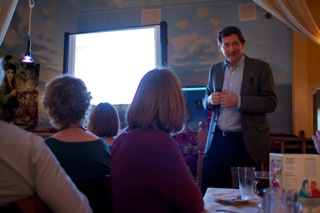

Aerial Photography Lecture hosted by the Northern California Science Writers Association


Wednesday, December 7, 2011: I was privileged to attend yet another Northern California Science Writers Association (NCSWA) dinner and hear yet another wonderful lecture. Conversation, as always, was titillating, witty, and provocative; especially with many guests representing the American Geophysical Union (AGU) in attendance while in town for their annual conference. It was all about science, folks, not about political agenda.

Charles (Cris) Benton, Professor of Architecture at UC Berkeley, was the guest speaker.  He spoke not of architecture, per se, but his passion: aerial photography using kite-lofted cameras. Entertaining and informative was his lecture; breathtaking and inspiring were his photos.

The history of Aerial photography goes back to 1850. Through the years, eccentric and creative scientists, such as Cris, found ways to attach their cameras to such objects as balloons and carrier pigeons as well as kites. The heaviest camera, flown by George Lawrence in 1906, weighed fifty pounds and took seven kites to lift it to a grand height of 1,200 feet!

Professor Benton himself has 7 or 8 kites ranging in size from 8 square feet to 60 square feet. His camera weighs in at 3.5 pounds and there is the added weight of the frame and radio controls. Cris reports it’s rather like playing golf; it’s about wind direction and speed to determine which kite to use. He also reports that aerial photography with kites trumps babies and puppies for attracting attention. During his 15 years of experience, Cris has killed 2 cameras and retired 12 more due to obsolescence. His photos are taken at altitudes that are too low for conventional aircraft and serve to pick up the focus below what is available for Google Earth.

Besides some purely entertaining photos of children, cities, architecture, and landscape, Cris gave a slide show on photos that he has been taking over the Southern San Francisco Bay Salt Flats. Since 2003, many of the salt flats have been in the process of being restored to wetlands. He has found that many of the marsh channels documented by an 1850 survey are still following their original channels. As salt pools evaporate from sea’s 2½% salt solution to the 35% salt solution in the flats, the representative colors are fabulous. Reds, greens, and golds; the photos are artistic as well as scientific in nature.

Professor Benton has been working with special use permits from the Don Edwards National Wildlife Refuge and the California Department of Fish and Game. His photographs are documenting the result of adaptive management of the area. As pools are opened up to the tidal flow, his photographs are documenting the slow return of flora and fauna. Returning they are! Quite amazing and reassuring to see that saline land can be reclaimed.

Don’t take my word for it.  Go peruse the photos on his site.  They are absolutely stunning: http://arch.ced.berkeley.edu/kap/index.html And while you’re at it, go to NCSWA.  They schedule special explorations, tours and workshops all year long.  Fun and intelligent people of all ages.

Photos courtesy of Chuck Jones


——————————————————————————————————–

You can reach Suzanne Birrell at Suzanne@thisoldhippy.com.

Poetry by Linda Allen

Fences


Fences make good neighbors, but fences are better for your enemies.

You cannot forever make me cry.

I will put a fence between you and I

A fence so tall and tight that even you will never get through


Fences

I need a fence

To keep you out

Fences

 To block the pain

To keep you from making my heart hard and cold

Fences

To keep you from making me colder inside

To keep you away from my heart

Fences

Fences

So I can finally be rid of you

Fences

That keeps out hate and only allows love into my heart

Fences

To protect my heart and soul from those who seek to harm

Fences

Fences

To help save me

To help save my heart and soul


Fences make good neighbors, but fences are better for your enemies.

You cannot forever make me cry.

I will put a fence between you and I

A fence so tall and tight that even you will never get through


Fences

That protect everyone

Fences

—————————————————————————————————————-

Linda Allen may be reached at lindaallen4119@att.net.

Poetry by Danny P. Barbare

The Janitor and the Mop


As

the

mop

says


you

have

to

be

humble


before

the

floor

shines.

—————————————————————————————————————————

Danny P. Barbare lives in Greenville, SC. He works at a local YMCA on the weekends. He attends Greenville Technical College.


Book Review: “Portrait of a Girl and Her Art”, by Elena Caravela

[Reviewed by J’Rie Elliott]

As a society we set a concrete definition for every word we use; the word art is defined as the quality, production, expression, or realm, according to aesthetic principles, of what is beautiful, appealing, or of more than ordinary significance.  The book, Portrait Of A Girl And Her Art, by Elena Caravela took this definition the breaking point.

This breathtaking book is a combination of beautiful art and the beautiful girls who bring this art to life.  On first inspection of an art book, generally the reading of the words are surpassed by the overwhelming impulse to view the creative works held within the cover—this collection is no different.  The first eye catching piece I saw was not the actual art being displayed, but its creator; an astonishing young woman with eyes of a brilliant shade of aquamarine.  Her quote on her art was “When I finish a piece it feels like I have just given birth to a baby!”  Now this statement is probably more figurative than literal, however it does prove to make a point; to bring something from nothing, to fill space that was once empty with a thing of intrigue and beauty is art.

Every time I turned to a new page, my eyes were infiltrated with one amazing young female after another; while their art is impressive the portraits of the girls tell parts of their stories before you ever get the chance to see the expressions they created.  Seeing these faces start the story and then seeing their art fills in the blanks.

One of the endearing parts of this book is the ages of the girls within vary from very young child to young lady. One of the younger girls is a gorgeous African-American gem named Ayanna; her smile shows the imagination and creativity that is just bubbling beneath the surface.  While her art is juvenile in nature, the art she inspired is by no means juvenile.

Discovery is the title of one section of this art story– it is featuring a young woman by the name of Katherine; a striking face with emerald eyes, eye brow piecing and care-free hair.  Her art is in tune with nature and the world that surrounds her.  When discussing her art she said, “Think of things in a different way and show the importance of the seemingly insignificant.” To this writer, this line spoke volumes; we walk through this world with our eyes only half open and our minds always half closed – if we would just slow down to enjoy the amazing world around us art would become than just a word—it will be a lifestyle.

I definitely suggest that time is taken to view, read and enjoy this amazing collection of artistic works—if not for the art itself, than for the amazing depictions of its creators and the story it tells.

——————————————————————————————————————————————————————-

J’Rie Elliott is a poetess and ongoing contributor of Synchronized Chaos. To contact her, send an email to dixiepoet@gmail.com.

Book Review: “Solidarity With The Flesh Eating Mosaic And Other Poems”, by Raj Dronamraju

[Reviewed by Nicole Arocho]

More than Solidarity with a Mosaic of Mind-Eating Poems

Raj Dronamraju’s Solidarity with the Flesh Eating Mosaic & Other Poems is a book full of poetic surprises. His take on poetry is a fresh one, and his unconventional metaphors are proof of this. As I was reading his poetry, I was constantly pushed out of my comfort zone, not only as a reader but as a poet as well, in order to understand his original compositions. I am not implying that it was hard for me to understand his writing but, rather, that his poetry is an exercise of the mind in which the process of reading becomes a process of understanding as each verse comes along your eyes; the metaphors and poetic images come together in one compilation of words that make total sense as one written piece.

With this book you never get bored. Dronamraju writes within many subjects; the ones that struck a chord in me the most where his poems portrayed society’s negative inputs in humans as a whole. His criticism of today’s society in “No Need to Buy Apples” is light and humorous, but still delivers the message against conformism and the lack of new, creative ideas in society. I here provide the last strophe of such poem:

If I could see the blood in my veins x-ray style

I would notice it slowing down for a rush, a flood to a steady hum

The horizon is limited

The scope of vision is limited

Ambition’s being baked into a pie and served in small, easy to eat slices

It is an apple pie of course

Another poem that I read more than twice is “The Elephant Symbol”. The personal connotation of this poem is very clear, and the author uses the elephant to portray the embodiment of religiousness in his culture as a Malaysian, and how such religious ties weren’t where he was headed in life. Here’s an excerpt of the last strophe:

The pachyderm that means so much

Strength, fertility, creator, this world and cycle

Is prodded with sticks when it wants to do something on its own

How disappointed I was

To be prodded with sticks

When I tried to go in a different direction from the rest of the herd

Solidarity with the Flesh Eating Mosaic & Other Poems is divided in two parts. However, to me it has three divisions within itself, according to the context of Dronamraju’s poems. First, there’s the category of third-person poems, in which the poet writes from the eyes of some character in society whose point of view he wants us to see, to get into, to feel his/her own pain and emotions. Such is the case of Madwoman, in which the poetic voice talks about women’s role in centuries past and how different it is now:

Her 19th century words

“It’s like being in a jail”

Her 20th century curse

“I can’t lower myself to feel happiness

Stroking his carcass, at the beck and call

When they identify the ritual sacrifice, it will be the family

Second, there is the group of poems construed as pieces of criticism towards society and humanity’s negative behavior in general. Apart from “No Need to Buy Apples”, I very much liked the poet’s take on pop culture’s escapist nature under the title “A Simultaneous Scheherazade”. By finishing with the verse “There is no escape from escapism”, the author presents us in a clear fashion the consequences of the media’s “filters blocking the imagination”. It entertains us but, in the end, we can’t “remember a thing” for “it is too much” because “our minds have not developed at the same speed” as they used to before mass media offered us an unlimited escape from reality as technology progresses.

And third, but not least important is the category of personal poems, intrinsic pieces of the puzzle the author creates in this book. These poems are the most emotionally moving and their passion and power registers with the reader more strongly (without making the rest of the poems any less exciting to read). Although I state that these are personal poems, I say this in the sense that the poet is using the poetic voice to portray situations in life that may have happened to him, or that his writing has being influenced by events or observations surrounding his life. Such is the case of “Friends of Your Own Age”, where the author writes about the journey of life delimited by the age of 35. Before such age, he was “still not accepted as part of the tribe”, and after, he felt that he may not be “going out and meeting people”. To the author, he was never fully accepted in society, and he doesn’t think this fact will change anytime soon. But the “personal” poem that struck me the most for its blunt approach was “Planet Sexy”. The use of the space and planets as a metaphor of his position in society is very clever and fresh, and his writing feels very accessible and very relatable, at least to this reader. The last verses “Circling the galaxy in my head/I can only stomach a world very different from this one/I won’t survive re-entry” made me think of the “other” world writers go to, where we travel in order to get our words on the page, where we feel safe and in control instead of the whirlwind life in society can be.

I cannot finish this review before talking a bit about the author’s choices of titles. Every title was interesting, and pulled me in right away into the poems. As a writer, it is very important to get the reader’s attention from the start so that he or she may continue reading and become interested in the author’s work in general. In poetry, the role of the title is of utmost importance, for the poem, as it is in Dronamraju’s case, may be short, but the title draws the reader in with curiosity of what the poem is really about, and surprises us with either confirming our first suppositions, or, as it is more often, the author gives us a bigger surprise by presenting us a piece dealing with a completely different subject than the one we were expecting. Dronamraju starts the job very well, but also continues it and finishes it in such fashion, leaving the reader no choice but to finish the poem in order to get the whole sense of the piece.

As a reader, I enjoy being surprised. Dronamraju’s poetry delighted my curiosity as a reader and stimulated my senses as a writer. His vocabulary was enriching, and his poetic language and images were of high standards; this way, he dares the reader to keep up the pace with him, to get on his level and contemplate on life’s many mysteries and everyday life situations with short but very powerful pieces of poetry that give life to the “mosaic” the author has created for us.

———————————————————————————————————————-


About the author: Raj Dronamraju currently lives in Ipoh, Malaysia where he teaches English at a local university. He was born and raised in the United States, but has lived in Malaysia for almost ten years after marrying his wife.

You can contact the reviewer, Nicole Arocho, at narocho3@gmail.com.

Performance Review: Marines’ Memorial Theatre’s Production of Michael Londra’s “Celtic Yuletide”

[Reviewed by Bruce Roberts]

Elbow pipe?  What on earth is an elbow pipe? Oh, of course, that’s the little piece of plastic or metal that you get so your plumbing can roundcorners. Right? WRONG! According to Michael Londra of A Celtic Yuletide, an “elbow pipe” is another name for the uilleann, an Irish bagpipe, with a far sweeter and superior sound to the Scottish version.

Celtic Yuletide, playing this Christmas at the Marines’ Memorial Theatre in San Francisco, is a lively and lovely and informative variety show of Celtic music and dance and storytelling. Londra, the genial host, formerly the lead singer of Riverdance on Broadway, is a fine Irish tenor with a wealth of interesting cultural information. Because of him, my wife now wants to celebrate Women’s Christmas, January 6th, when after two weeks of preparing all the celebrations, women rest and the men must take over all the work. Londra is from Wexford, Ireland, and—among other classics–gave a hauntingly beautiful rendition of The Wexford Carol, a traditional Irish carol originating in his home town.

Also beautiful was Sephira,  Joyce and Ruth O’Leary, two immensely talented violinists, who sweep onto the stage in flowing diaphanous gowns, and play dramatic violin duets, with choreographed movements that  emphasize the rhythm and harmony and power of their music.

Backing the whole show was an 11 piece Irish band, featuring—besides the uillean—the flute, and the bodhran, an Irish drum, and a wild Irish fiddle that created clapping and foot stomping excitement with its lightning rhythms. Major world-class foot stomping occurred often onstage, with a cadre of Irish step-dancers, who punctuated the ballads and carols and violins with rapidfire dance appearances that energized the audience every time.

The Marines’ Memorial Theater, built in 1926, is an intimate theater only a block and a half from Union Square, the major Christmas shopping area in San Francisco. Its walls are lined with pictures of past performers, reading like a Who’s Who of American stage talent: Bing Crosby, Bob Hope, Frank Sinatra, to name a few. With his Celtic Yuletide show, Michael Londra deserves to join this elite pictorial company.

“Nollaig shona!” (That’s Gaelic for Merry Christmas.)
——————————————————————————————————————————————————————————–

Bruce Roberts is a poet and ongoing contributor to Synchronized Chaos Magazine. Roberts may be reached by at brobe60491@sbcglobal.net.