Poetry by Dave Douglas

Engram (a pantoum)

“A hypothetical change in neural tissue postulated in order to account for persistence of memory-called also memory trace.” – Merriam-Webster Dictionary

amid the tunnel of yesterday and tomorrow
under pressure from wait and scurry
between sleep and wake, images borrow
and collapse under the weight of memory

under pressure from wait and scurry,
times past; built with a shifting foundation
and collapse under the weight of memory –
an awry mnemonic missing base isolation

times past built with a shifting foundation
face moments of persistent efface;
the mnemonic awry, missing base isolation
within the void – without a trace

face moments of persistent efface
as engrams are stacked to the sky
within the void, without a trace,
which oddly shifts the mnemonic awry

as engrams are stacked to the sky,
with numerous pathways of inception,
which shifts even the mnemonic awry
with levels of change and recollection

with numerous pathways of inception
from room-to-room evanescence,
with levels of change and recollection
who is the builder of reminiscence?

from room-to-room evanescence
between sleep and wake, images borrow;
who then is the builder of reminiscence
amid the tunnel of yesterday and tomorrow?

You can reach Dave Douglas at carpevelo@gmail.com.

Photography by Liz Caruana

She’s Leaving Home

Artist Statement:

Liz Caruana is a San Francisco based fashion, editorial, beauty, and portrait photographer.  Her work draws strongly on themes from cinema and she creates a full story by shooting several images.  Caruana’s work has been depicted as delicate, elegant and melancholic.

This particular photo series, She’s Leaving Home, is based on the 1967 song from The Beatles.

Email liz@lizcaruana.com for more info.

Short story by Joseph Johnson

Blind Redemption

By Joseph Johnson

Adam Price woke once again from a fitful night of sleep. He looked over at the clock by his bedside and saw it was two o’clock in the morning. His head ached mercilessly, a throb that pounded on his temple, so he got up to wash his face. A picture of his wife caught his eye, the moonlight streamed in a single ray that rested on her picture. Adam was by no means a romantic, but he couldn’t help feeling butterflies in his stomach when he saw her with that gleaming smile on her face. He could even remember the first time he met her; Adam was a volcano of passion and Tiffany was a cyclone of emotion. The event that ensued afterward cannot be seen as anything less than disastrous. They were a true terror of nature; although on the outside they were a normal couple, inside they were writhing in a beautiful pain. Life, however, would never be worth living without that pain.

His house was quiet other than the heavy rain that pelted the roof, and he still found that calming and serene. He could barely open his eyes when he climbed into bed and felt for his wife Tiffany. His hand sliced through the air and Adam came back to consciousness. He found the light switch and turned it on. The room was empty besides him and two bedside tables with lamps and a book on each. Immediately he began calling her name, but heard nothing in return. Adam ran to the window and saw Tiffany’s car sitting on the street corner beside their apartment.

As he looked out into the darkness a figure appeared on the roof of the building across the street, and just as quickly it vanished. He played it off as a trick of the darkness and resumed his search. The only place left for her to be was in her office. When he entered the room he fell to his knees. Papers were scattered about the room and her work lamp lit up a symbol on the wall; a massive beast sat within a circle that bore a language Adam had never seen, it was a grotesque sight. He saw this symbol once before in an installment of five articles Tiffany was writing on a very violent and aggressive satanic cult. She was in the process of writing her last article the night before. In previous articles she explained in detail the victims, place, and consistency of the rituals. As Adam picked up the only paper left on her desk he discovered a rough draft of the final installment, where she actually pinpointed the time and place of the next ritual by using her other installments as a formula. The place was a catholic church just outside of the city roughly fifteen miles away, the time was five o’clock this morning. A knot filled his throat and tears formed in his eyes.

Joseph Johnson is currently attending Georgia Southern University, majoring in English with a minor in writing. He previously attended East Georgia College, where he published works for a literary journal called the Wiregrass. You can contact Johnson at forgivenjj@gmail.com.

Continue reading

Gaming Science Lecture by Colin Milburn, in Conjunction with the Northern California Science Writers Association

[Article by Suzanne Birrell]

Who is Colin Milburn?

Down deep he is appears happy kid-at-heart who gets paid for playing video games.   How exactly does one get a job playing video games? First go to school and get lots and lots of education.  Colin’s education (for example) includes a Ph.D. /Ph.D. from Harvard University, 2005; M.A. from Stanford University, 1999; B.S. from Stanford University, 1999; and B.A. from Stanford University, 1998.

Sounds like the penultimate nerd?  Let’s add: Colin Milburn joined the UC Davis faculty in 2005 as an Associate Professor of English.  His research focuses on the cultural relations between literature, science, and technology. His interests include science fiction; gothic horror; the history of biology; the history of physics; nanotechnology; video games; and post humanism.

Wow, what a guy.   And I was lucky enough to be able to catch his lecture on Tuesday, October 4, 2011, before the NCSWA.  (That’s Northern California Science Writers Association–I didn’t know before now either).

The subject of the lecture promised to be fascinating:  Does science fiction feed on the outer edges of scientific discovery, or does it actually lead the way – pointing the direction for researchers to follow?

You can reach Suzanne Birrell at Suzanne@thisoldhippy.com.

Continue reading

Book Review: City of Stairways: A Poet’s Field Guide to San Francisco

[Reviewed by Deborah Fruchey]

The first thing I noticed about this book was the good production values. It is pleasing to look at, to flip through, and to hold: the photos (taken by the students) are good, the artwork is fresh with great colors, the fonts are clear, the shiny, heavy paper is nice to turn in your hands. The 7 x 7 inch format is just the size and heft to be a bit more than a pocket book, but not too much. This is not a book that takes itself terribly seriously. It is meant to be a fun read.

City of Stairways is a brainchild of the WritersCorps Apprentice Program, which takes poetry to the high schools and offers an after school curriculum for advanced young writers, and the San Francisco Arts Commission and San Francisco Public Library, who sponsor WritersCorps. As such, it is as much  a tour guide to interesting San Francisco neighborhoods as it is a poetry book, and this serves the volume well.

The writers are each represented by little cartoon icons (by Hong Truong), which are engaging and add interest to the maps (uncluttered and attractive, by Adrienne Aquino). The book is organized around City field trips taken by the group, each with its own area map marked with stops and points of interest (given that these are teenagers, it’s no surprise that many of these spots are eateries!). For each trip, there is about one page of well-written description of what the group saw, did, and liked, and another page listing nearby public transport and “fun facts” about that part of the City. There are also a few source references and a quote or two about that locality by luminaries, such as Lemony Snicket, or some local notable.

The poems are generally no more than pleasant, good enough for relatives and friends to treasure, which is enough to expect out of high school students of any generation. There are two striking exceptions. Indiana Pehlivanova is vivid, insightful, surprising, and surprisingly sophisticated in both viewpoint and technique. She will clearly be a fine poet some day, and I will frankly be watching for her on the SF poetry scene in the next few years. The other winner is Robin Black, who tends a little toward the slam style, with an immediacy to his work which is refreshing.

All in all, a book to enjoy, and worth buying if you want to support the youth art programs of San Francisco. Some of their field trips unearthed city treasures I have overlooked; you may catch me poking around the SF neighborhoods sometime soon.

You can contact the reviewer, Deborah Fruchey, at lastlaughpro@gmail.com.

Poetry Review: A Dreamer in Egypt – The Poetry of Jaylan Salman

[Reviewed by Marla Porter]

A Dreamer in Egypt – The Poetry of Jaylan Salman

“If only I was not a virgin, / I’d shag the sphinx, twist & turn its lower body with force of a hundred bloody veins,” ring the words of Jaylan Salman, a young poetess from Egypt in her poem When Dreams are Just Paperwork. Her poems, which are featured mostly on her Facebook page, have a strong feminine voice, clawing for independence and freedom in the presence of a strong family presence. Her longer poems set up narratives and dreamscapes, showing a strong longing for a reality beyond the mundane.

As a poet, Salman falls into one of the pitfalls of a young poet, allowing clichés to creep into her work. This is especially apparent in her rhymed poems, such as Death on the Concrete Land, where rhymed pairs hand/land, see/me, pain/rain and belonged/longed pop up. Grabbing these overdone rhymes makes the poem read as juvenile and distracts the reader from following the poem’s story.

Some of her work also has a pedestrian quality, such as her poem Tears on her Guitar, “She plays the guitar /Her father talks about the tragedies of the world / She keeps playing /Her tears fall leaving burning marks in the mocha colored wood / Her father just keeps talking.” A greater variation of syntax and more surprises for the reader could push this poem, with its background in the news and the Arab Spring, to a very interesting place. Salman focuses on a young girl, stuck with her family to observe the changes and struggles of the world. If the poem moved further into the girl’s inner world or into a stranger description of daily life, it could have been a moving piece. Salman struggles to develop the kind of complexity of voice that is associated with a mature poet. She should push herself to explore the issues of her contemporary life from multiple angles in the same poem, and to ask questions she can’t answer.

Although Salman has not produced a compelling body of work to launch her onto the international poetry scene, I can see a kernel of a real poet in her work. Some of her imagery is incredibly fresh, albeit surrounded with other, less-surprising lines. A great example of this occurs in her poem Pavane pour une infante défunte, “No roses blossom, no birds chirp, no fertile women to plant their babies in the fields of Sodom / She watches as her people stare / She relishes the flare from the crocodiles, floating in the Nile /She throws her spears at ancestors and creepy crows looming in the sky / Silence…” Here, the overdone image of roses and birds is followed by babies being planted in Sodom’s fields; her best images can be lost because she doesn’t restrain those that aren’t new. Whenever she allows local color into her work, she is most successful at creating a memorable poem. Jaylan Salman, while not yet a strong poet, is someone to watch for as her voice and work matures.

You can contact the reviewer, Marla Porter, at feverorforgottenwings@gmail.com.

Fabric and Quilt Art at the Cinema Place Gallery in Hayward, CA

[Article by Bruce Roberts]

The Quiltessential Event

The quilt my grandmother made was warm. I could cuddle under it with my dog on cold nights, reading aloud to him until we both fell asleep. It had squares, I think, and pale colors in different designs, but I loved it for function, not design.

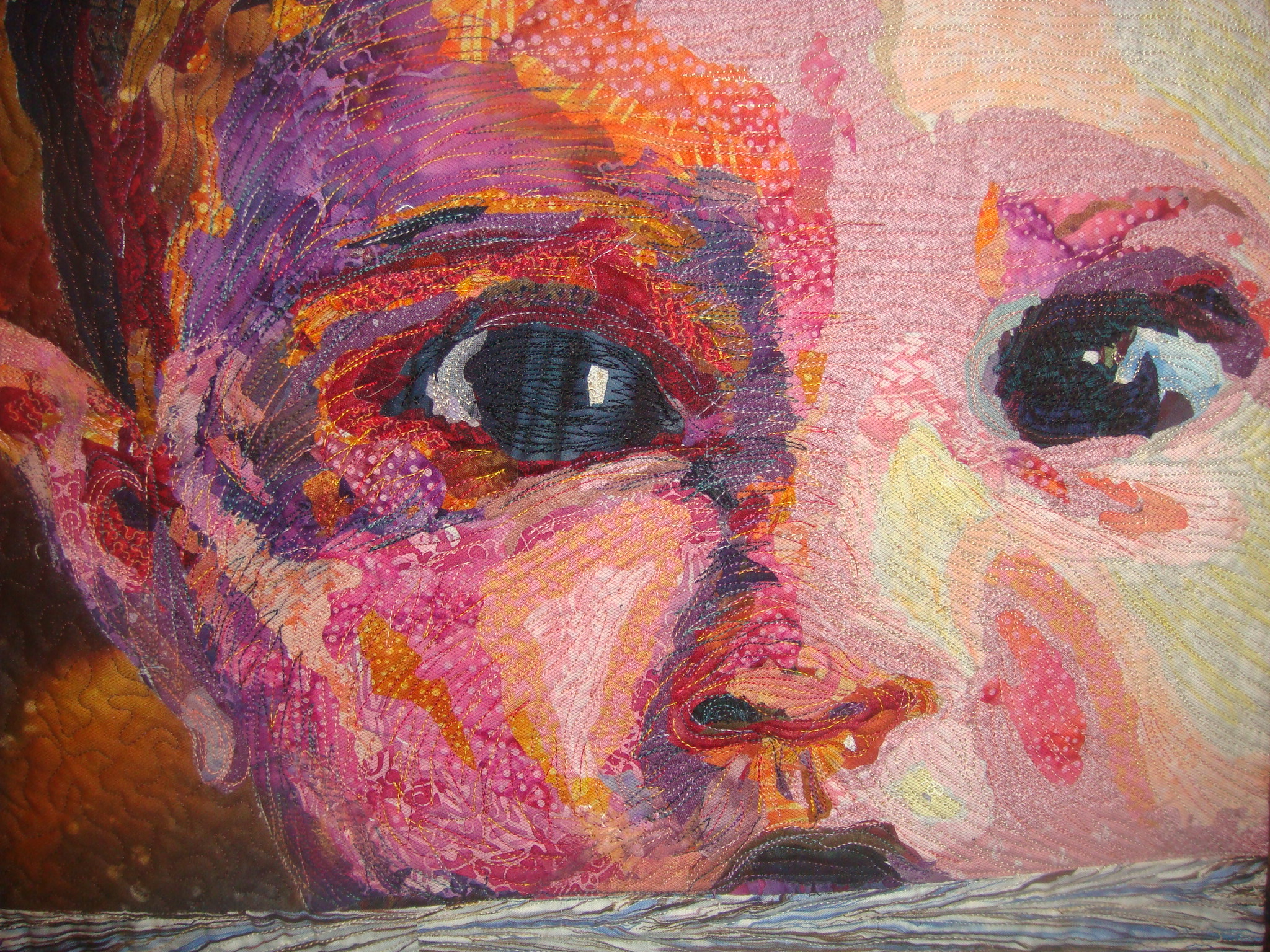
Not so the quilts at “Fabric Art plus Art Quilts: The Quiltessential Event,” an exhibit running until November 12 at the Cinema Place Gallery in Hayward, California. Sponsored by the Hayward Arts Council, the quilts here almost defy description for their beauty and imagination.

My grandmother, I am told, stitched by hand, of course, and also by foot, using her treadle powered—not electric–White Sewing Machine to stitch straight lines around each square, maintaining a consistent foot motion to ensure even stitches. The focus and exertion required, I’m told, were difficult.

However, technology today has changed the game. Electric sewing machines have dominated the craft for decades now, and I had to learn a new term—‘DROP THE FEED DOG”—to understand the artistry displayed by today’s quilters. Dropping said dog—a part on sewing machines– allows modern quilters the ability to do “free hand stitching.” No longer bound by right angles and forward and backward,  “free hand stitching” with machine enables a quilter the same freedom of movement as a paint artist with a brush: THREAD-PAINTING! Some even have quilting machines, which allow work with pieces up to 30 inches wide.

Bruce Roberts is a poet and ongoing contributor to Synchronized Chaos Magazine. Roberts may be reached by at brobe60491@sbcglobal.net.

Continue reading