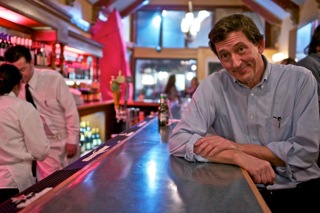
“Lush” by George Sparling

Lush

by George Sparling 

 The frat rats rushed and accepted me, Rand Adams, as a pledge into the Krappa DumDum fraternity house at  “The Harvard of the Midwest,” because they wanted their house filled with Wasps. At least that was what I thought. I unpacked my luggage, hung my up herringbone suit, sports jacket, ties, and shirts in the small closet, stashed my underwear away, put a framed photo of my high school girlfriend on the bureau, lit a Marlboro, sat on straight-back chair at a desk, inhaled just like John Wayne, and pulled out a half-pint of peppermint schnapps.

“Hi, I was enjoying the view,” I said, turning away from watching longhaired hippies playing hacky sack, kicking the footbag, doing bag daggers and ham spalts. I never played that game, preferring darts, getting high on booze, purposely missing the target, zinging the darts into a bunch of jocks with their dates.

They would get aroused from their pre-coital word-dance, come after me, they kicking holy shit out of me, I staggering outside, blood from nose dripping, my nuts screaming in pain, my body falling apart like the scarecrow in ‘The Wizard of Oz,” getting fixed up at the university clinic. I must love getting touched, the hard way.

“Want a slug?” He looked at me as if I had violated some tribal ritual. The price of being dateless: masochism and brutality.

“Hello, Rand, I’m JQ, glad to meet you,’ he said. His bright Ralph Lauren Polo shirt, Prada charcoal gray pants, and Armani sports coat glared at me. I glanced down, seeing flashy Barker Blacks Ostrich Cap Toe shoes. My dad subscribed to GQ and Esquire, the only reason I knew.

“Nope. I only like soft drinks. I’m studying Electrical Engineering. Hope you’ll study hard too.”

“I’m taking business courses, accounting this semester,” I said crisply, as I chugged the remains of the schnapps, sticky fingers I wiped on my snotrag.

Drunk on high school commencement day, letting the entire senior class see me teetering around, cursing and talking to classmates, scaring them, not the usual mediocre, khaki pants and rolled up sleeves guy nor the one picked on. Before the ceremony, as part of the humiliation treatment, I stood before a couple hundred students as well as the principal. I had a hangover but I made a trembling, sotto voce apology into a microphone. Drinking booze, my first major taboo I had broken. Degradation: cost of freedom.

Three friends and I used to play poker in one of our homes most Saturday nights, and after I losing time after time five or six bucks, I stood to them and swept the last pot off  the table. Then my next door neighbor confronted me, punching me in the gut, another guy threw a shot to my eye. I quit seeing them, watching TV rather than being scapegoated by sadists. Friends: A social lie.

JQ: six feet one, 190 pounds, muscular arms and legs, expensive aftershave, its je ne sais quoi giving him an indescribable something, bounced as he walked, erect posture, tan skin, dark eyes, crew cut black hair, steel pens clipped to his shirt pocket, charcoal gray pants tailor made, Superman psychic eyes able to reconstruct damaged structures ( my emotional infrastructure, perhaps? ), proud chest accentuated by his heads-up, striding fast walk. I had none of those attributes, but what I did have was withdrawing my life from persons such as JQ, drinking my forte.

My first DumDUM party, a jamming rhythm and blues band hired by the fraternity, their music frantic, they, too, high. JQ set me up with a girl from a nearby college, and the four of us rode in his Buick, his “steady” as he called her, in front. JQ said to me, “Sober up a bit before you meet your date.”

He drove to a drive-in and told me to get a pint of milk to go with burger and fries. I drank and ate, he saying, “The milk will coat your stomach, letting you drink more, and not get so googly-puss that your date, Millie, would get upset.”

I did as instructed, feeling alright until we started dancing, the band playing fast and hard, then I weaved and bobbed to a table, Millie following me, and I puked on the table, vomit streaming onto her fancy gown.

“Listen you, wise up, they’re nice girls here, from ritzy homes, rich families—they’re not accustomed to queers like you, Rand.” I heard the words “ritzy” and “queer,”and, with arms leveraging myself on two others seated next to us, I finally rose, and threw a punch at JQ, he blocking it with one Superman Hand, and pushed me hard, and I fell to the greasy floor. He grabbed my armpits, lugging me upright and that was the end of the party for us. He let Millie off, and as she stepped over me next to the door, again I barfed, only this time all over her pricey gown.

JQ said, “He’s sorry for what happened, I’ll call you tomorrow.” She turned, looking clinically in shock, and said, “I thought you knew what’s his face, but apparently you didn’t.” I pulled the door shut, and JQ, behind the wheel, gave me the back of his arm, not hitting me, but shoving his elbow at me. My father had done the same with me after driving me home from a high school dance, threatening me with his big arm, blaming me for his slamming into a culvert. “If you had a real date, not some gal who was pressured my other girls, embarrassed not to have a date for the Dame’s Dance, this wouldn’t have happened.”

I finally reached the upper bunk, sleeping in vomit-drenched clothes, but JQ pulled me down, undressed me, I naked, and then hoisted me into my bunk. I woke up Sunday, slowly walking to the two man shower, opposite me was JQ, scrubbing off last night’s incriminating evidence. After drying off, he never spoke about his affair with “Steady.”

I slipped on pajamas, slept for a couple hours, clean and relatively sober. Later, I had coffee and a bagel with cream cheese, licking my lips. The dining room empty, members studying.

I stopped going to classes, throwing away any chance gaining admission to the business clique. I would rather have JQ beat me up, something I looked forward to anyway. What was a blood-soaked saint if not pleading to drain away his evil?

“I’ll have to go home. There’s a funeral I have to go to,” JQ said. “My father’s part Commanche. An elderly man committed suicide, rather suffer indignities of old age.”

“I hadn’t the opportunity to go to one,” I proudly said. He had no response.

“It goes back to when they were warriors, fighting, warring their way of life. The old ceremony made the corpse as small and compact as possible, then threw the body into a pit.”

“I read somewhere about counting coup,” I said. “Did they do that rather than kill enemies?” Damn, I sounded so inquisitive, all the while grateful that JQ would absent himself from me for a weekend.

“If they touched an enemy with a stick, that meant a kill.”

He packed his clothes, put on a Glen Brae sport coat over a turquoise-blue Armani shirt, and slipped into Crockett & Jones shoes.

“You dress as if you’re going to a royal wedding,” I said.

“Oil money, I can’t help it. Our family was middle class until father made a fortune in oil wells.”

He never said goodbye, walked downstairs, and drove the Buick away from Krappo DumDum’s parking space.

Now I had the room to myself. I hid a bunch of Playboy, Penthouse, and Hustler magazines, the sequence getting more vulgar, dirty, and sleazy. My secret little habit was trimming with small sharp scissors the outline of all the semi- or -fully naked women. It took hours, this being Sunday, and I could work without anyone knowing about my hobby. It was fun shearing closely around bodacious butts, around large-nipple breasts, cutting exquisitely down the thighs and calves, the blowjob lips and jerk-off hands, the bare feet, an oh those Hustler clitorises, how finely I edged the scissors around cobra-hooded clits. Venomous, these women’s images hissed at me, making them dangerous if touched only softly, as feathery as I imagined Native-Americans counting coup.

I then scotched taped them to the walls, ceiling and doors, the room overloaded with testosterone. I turned on my tape recorder, saying the vilest words possible, working up to major eruption, the 1908 Tunguska comet/asteroid impacting Siberia, so powerful that Western Europeans could read at night, was humble and meager in comparison. Seize the day: my forebrain acquiesced and faintly whispered,  “OK.” The Grand Old Limbic System, its amygdala: I pressed my mouth close to the mic, and rasped, “OH GOD GOD GOD GOD…

Though I had at first thought Krappa was uniformly Wasp, JQ the obvious example, the frat had guys such as Huck. I had never seen him eat with others in the dining room. I was flunking out, taking only an English course, my favorite novel, “Heart of Darkness.”

JQ always sat at the housemother’s table, and I despised him for that. He always sat at her right, she at the head of the table. Why was the right hand of God so exalted, the Bible verses rife in both Old and New Testament? Latin for left was “sinister,” pernicious and apocalyptic. While JQ attended a funeral, a guest sat at her table. I had never seen him eating with the rest of us, he at her left.

After dinner, walking together upstairs, I trailing them, I heard him say, “The locksmith job eats up my time away from the books.”

She said, “We never had the do-ri- me, it’s a means to an end.”

He sat in the living room, reading “Heart of Darkness,” I glancing at the cover.

“You’re in my class but I never knew you were a Krappa.”

“I am but live with my dad, helping him with the locksmith business.”

“Do you break into many homes that you put locks in?” He smiled, his wiry body squirming a bit in the comfortable chair.

“You a pledge?” he asked cautiously. I replied I was but may not for long because I was not going to classes except for English.

“JQ told me about you, how much you drink peppermint schnapps. As long as you’re flunking out, maybe you could learn a trade like locksmithing. How about it?”

“I can’t do mechanical work. I should have gone to a vocational school, even being a mail carrier would have been fine.”

We discussed Conrad’s novella, were Kurtz and Marlow part of the Belgian Congo’s colonial empire, or was the book a psychological study. I played the native that said,“Mistah Kurtz, he dead,” JQ an unwritten Belgian character—a nothing—in the novella.

After a while, Huck got up to leave, pulling out of his pocket a key.

“Here’s a souvenir,” and Huck gave me a strange looking key. “The peaks are even, cut down to the lowest groove. If you had a hammer, you hit the key, and some locks would open. It’s a dump key”

“Why give it to me?”

“I learned a trade from prisoners in the slammer. Come to the shop,” he said, handing me a card from his wallet. People opened up, telling me things they would never mention if told to insiders: My stooped back, at twenty-five finding nothing much to talk about, drinking schnapps my only escape.

Easter break, all the bothers gone, I hanging around because I had not wanted visiting my parents. I liked their checks, though. Slightly sloshed, I went downstairs and finding myself alone, I walked to the housemother’s quarters. I borrowed a small hammer from JQ’s dresser drawers: I scrounged for money, valuables, maybe pawning them, and then fleeing to New York City, getting in the ad business, its deceit I relished as much as the schnapps.

I put the dump key into the lock, hit it, turned the knob, and walked into her rooms. I searched for valuables in closets, drawers, under her bed, under couch and chair cushions, into pockets of clothes on hangers, everywhere. I was pissed, swallowing more from the fifth of schnapps. The drunker I got, fury traveled through my body, especially my solar plexus, the “seat of the soul” to some religious believers. And this soul smashed lamps, ripped up cushions with a kitchen knife, broke chinaware, hammered out glass covering photos of friends and family, cut a Middle Eastern rug with shears, broke vases containing flowers, slashed her mattress with a high carbon stainless steel knife. I wanted to torch her apartment, the frat house going up in flames.

I found typewrite paper, writing, “Thanks, Huck, your gift has brightened my life.”

I deserved an eagle feather for vandalism, counting coup also my version of war. I was fed up with JQ’s abundance. Though indelicate, I realized my hands better suited for lush work in subways. I read about it in a newspaper, how an underground existed of men rolling drunks was outdated, but using a sharp knife set free wallets of lushes slouched and snoring on subway seats. I welcomed joining a fraternity of lush workers.

Even after thirty-seven arrests, I’m at last certain that lush work was better than college or vocational training. Like counting coup, I only intended to rob victims, not slay them.

———————————————————————————————————————————————–

You can reach George Sparling at gsparling@suddenlink.net.
“Glitter on Glue” by Brian M. Barbeito

Glitter on Glue

Plush carpets and the outsides of windows showed trees with thousands of branches, the snow on them like someone sprinkled glitter on glue. Brightness and it was alright that the purple plum trees had now closed down, their September bounty produced, picked, and eaten. A large balcony above, iron gates below and two cherry trees were planted by the fence, one sweet and one sour. Down in ravines always something was barking, fighting, or otherwise sounding in some way. In the summers when the rains came, the small stream overgrew itself and flooded the hills, bringing down the odd tree, say a newly planted Evergreen, or else carrying Garter snakes up from where they were trying to be quiet and wait in the wait that is their ordinary wait, that is their solitary wait, that is their instinctive and prayerful and prey- full wait. Music played and glasses chimed. Sometimes a man would put wine on his fingers and circle his fingers, one or two or even three of them around the top of a wine glass and it would make a strange whistling sound. At other times two men would make a drink and light something and then there would be fire on top of the glasses or cups. Laughter, lighting, and the way of things. The women talked about people, about local events, while the others, their counterparts with the fire and whistling sounds, argued about the greater world and were more externally oriented. Couches and floors were there, and stucco walls sturdy waited beyond bookshelves and strange collections of things. There was a wood chiselled carving of King Tut, a deceased dog’s identification tags, an arrow and bow that a visitor had brought from somewhere in Europe, and a collection of books by Ernest Hemingway with hard blue covers that nobody ever read. In the night, there were no lights outside really but there was one motion detector. Everything grew quiet and even the traditional howls or fights from animals in the ravine sometimes calmed or else were muted as if quarantined by some invisible barrier that said, “This is the night, and it now to be vast and quiet, calm and easy for a while, so that the snow owl can peer out from somewhere or the squirrel can run without fear now.” The wind picked up the snow-glitter, and carried it away to somewhere invisible in the slight beyond. But some snow still stayed on the branches. And the thousands of sticks waited there in the dark, patiently, for the bright hours to show themselves.

———–————————————————————————————————————————
Brian Michael Barbeito writes impressionistic vignettes, flash fiction, short stories, prose poetry, experimental novels, book and film reviews. His work has appeared at Glossolalia, Subtle Fiction, Mudjob, Six Sentences, Thinking Ten, American Chronicle, Our Echo, Ezine Authors, Author Nation, A Million Stores, Crimson Highway, Paragraph Planet, Useless-Knowledge Magazine, Exclusive Conclave of Delights Magazine, and Lunatics Folly. He resides in Ontario, Canada.


Whose Brain Is It? [Jan 2012 – Leena Prasad]

Whose Brain Is It?
by Leena Prasad

“Chai tea,” Tina says to the woman behind the counter.

Hema tries to suppress a chuckle.

“What’s so funny?” Tina asks.

“Nothing. It won’t be funny to you.”

“Try me, anyway.”

“Well chai in hindi means tea.”

“Oh,” Tina says and giggles. “Yeah, we like to appropriate other cultures words without considering what it means.”

“I don’t really care. But it does sound funny. I’ll have some tea tea please.”

“What makes something funny?” Hema says, as they sit down at a table wither their drinks.

“Well, maybe it has to do with something absurd. Like tea tea.”

They sip their drinks, considering the question.

“You know, I read somewhere that if a certain part of the brain is touched, it can cause laughter.”

“You mean, like in the inside, by a brain surgeon?”

“Yes, yes, during surgery, or when they are examining the brain.”

“So, the humor circuits are hardwired? I guess that makes sense. Everything is hardwired, I suppose.”

Hema could be describing the case reported in Nature magazine by neurosurgeon Itzhak Fried of University of California at Los Angeles. Fried made an accidental discovery while studying the brain of an epileptic patient, a 16-year-old girl. He was trying to diagnose the reason for her seizures by using an electric probe on her brain. Every once in a while, the girl would start laughing for no apparent reason. He realized that when the probe touched a specific area in her left frontal lobe she would laugh. If he increased the electric current, the girl would laugh with more intensity.

Much of research on humor has been done on brain abnormalities that cause inappropriate laughter. It is difficult to study “normal” humor because the definition of humor varies. But, researchers can look at the result of humor, i.e., how the laughter resonates within the brain circuits. Excluding laughter caused by tickling, laughing gas, or simply as social contagion, some recent studies examine the result of laughter on a healthy human brain as it responds to everyday humor.

The area that Fried was touching inside the 16-year-old girl’s brain is less than an inch-square and it’s called the supplementary motor area. In a study cited in the Brain journal, a PET scan revealed an increase in the blood flow in the supplementary motor area while subjects responded to humorous film clips.

“Do you think women laugh more than men?” Hema says.

“Hmmm… I’m tempted to say, probably yes, but I wonder if anyone has actually studied something like that?”

The answer is not as simple as per a study cited in the Proceedings of the National Academy of Sciences.  It’s not the quantity of laughter but the qualitative differences in the integration of the response in the male versus the female brain. A group of 10 men and 10 women were shown a series of cartoons and asked to rate the cartoons as being funny or not.  An fMRI scan showed that the left prefrontal cortex was activated more in the women than the men for the cartoons that both genders found to be funny.

“Whatever happens in the brain, I’ve read that laughing is good for you,” Tina says.

“Sure, it certainly feels good.”

Laughter produces generous release of the feel good hormone dopamine and activates the reward circuits of the brain, the mesolimbic region. This was also discovered by the fMRI scan in the experiment that evaluated the differences in gender-based reactions to funny cartoons.
“We now have laboratory evidence that mirthful laughter stimulates most of the major physiologic systems of the body,” says William Fry, M.D., a Stanford University psychiatrist. He says that twenty seconds of laughter, real or fake, can increase the heart rate for a few minutes.  Fry also says that laughter can potentially reduce the risk of heart attacks by reducing tension, stress, and anger and that it may even help in making people less susceptible to some diseases by warding off depression.
Yes, laughing feels good. More studies are required to map the exact brain areas complicit in causing this response. But, we can rest assured that a little laugher is indeed a “good medicine.”


References:

B. Wild (2003). Neural correlates of laughter and humour, Brain, 126 (10), 2121-2138 DOI: 10.1093/brain/awg226

E. Azim (2005). Sex differences in brain activation elicited by humor Proceedings of the National Academy of Sciences, 102 (45), 16496-16501 DOI: 10.1073/pnas.0408456102

http://www.justlaughter.com


Please send feedback and suggestions for future columns to leena@fishridingabike.com. Links to past columns are available at WhoseBrainIsIt.com and Leena’s writing portfolio is available at FishRidingABike.com. Leena has a journalism degree from Stanford University.

Dr. Nicola Wolfe is a neuroscience consultant for this column. She earned her Ph.D. in Clinical Psychopharmacology from Harvard University and has taught neuroscience courses for over 20 years at various universities.

Aerial Photography Lecture hosted by the Northern California Science Writers Association


Wednesday, December 7, 2011: I was privileged to attend yet another Northern California Science Writers Association (NCSWA) dinner and hear yet another wonderful lecture. Conversation, as always, was titillating, witty, and provocative; especially with many guests representing the American Geophysical Union (AGU) in attendance while in town for their annual conference. It was all about science, folks, not about political agenda.

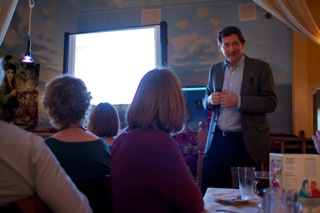
Charles (Cris) Benton, Professor of Architecture at UC Berkeley, was the guest speaker.  He spoke not of architecture, per se, but his passion: aerial photography using kite-lofted cameras. Entertaining and informative was his lecture; breathtaking and inspiring were his photos.

The history of Aerial photography goes back to 1850. Through the years, eccentric and creative scientists, such as Cris, found ways to attach their cameras to such objects as balloons and carrier pigeons as well as kites. The heaviest camera, flown by George Lawrence in 1906, weighed fifty pounds and took seven kites to lift it to a grand height of 1,200 feet!

Professor Benton himself has 7 or 8 kites ranging in size from 8 square feet to 60 square feet. His camera weighs in at 3.5 pounds and there is the added weight of the frame and radio controls. Cris reports it’s rather like playing golf; it’s about wind direction and speed to determine which kite to use. He also reports that aerial photography with kites trumps babies and puppies for attracting attention. During his 15 years of experience, Cris has killed 2 cameras and retired 12 more due to obsolescence. His photos are taken at altitudes that are too low for conventional aircraft and serve to pick up the focus below what is available for Google Earth.

Besides some purely entertaining photos of children, cities, architecture, and landscape, Cris gave a slide show on photos that he has been taking over the Southern San Francisco Bay Salt Flats. Since 2003, many of the salt flats have been in the process of being restored to wetlands. He has found that many of the marsh channels documented by an 1850 survey are still following their original channels. As salt pools evaporate from sea’s 2½% salt solution to the 35% salt solution in the flats, the representative colors are fabulous. Reds, greens, and golds; the photos are artistic as well as scientific in nature.

Professor Benton has been working with special use permits from the Don Edwards National Wildlife Refuge and the California Department of Fish and Game. His photographs are documenting the result of adaptive management of the area. As pools are opened up to the tidal flow, his photographs are documenting the slow return of flora and fauna. Returning they are! Quite amazing and reassuring to see that saline land can be reclaimed.

Don’t take my word for it.  Go peruse the photos on his site.  They are absolutely stunning: http://arch.ced.berkeley.edu/kap/index.html And while you’re at it, go to NCSWA.  They schedule special explorations, tours and workshops all year long.  Fun and intelligent people of all ages.

Photos courtesy of Chuck Jones


——————————————————————————————————–

You can reach Suzanne Birrell at Suzanne@thisoldhippy.com.

Poetry by Linda Allen

Fences


Fences make good neighbors, but fences are better for your enemies.

You cannot forever make me cry.

I will put a fence between you and I

A fence so tall and tight that even you will never get through


Fences

I need a fence

To keep you out

Fences

 To block the pain

To keep you from making my heart hard and cold

Fences

To keep you from making me colder inside

To keep you away from my heart

Fences

Fences

So I can finally be rid of you

Fences

That keeps out hate and only allows love into my heart

Fences

To protect my heart and soul from those who seek to harm

Fences

Fences

To help save me

To help save my heart and soul


Fences make good neighbors, but fences are better for your enemies.

You cannot forever make me cry.

I will put a fence between you and I

A fence so tall and tight that even you will never get through


Fences

That protect everyone

Fences

—————————————————————————————————————-

Linda Allen may be reached at lindaallen4119@att.net.

Poetry by Danny P. Barbare

The Janitor and the Mop


As

the

mop

says


you

have

to

be

humble


before

the

floor

shines.

—————————————————————————————————————————

Danny P. Barbare lives in Greenville, SC. He works at a local YMCA on the weekends. He attends Greenville Technical College.


Book Review: “Portrait of a Girl and Her Art”, by Elena Caravela

[Reviewed by J’Rie Elliott]

As a society we set a concrete definition for every word we use; the word art is defined as the quality, production, expression, or realm, according to aesthetic principles, of what is beautiful, appealing, or of more than ordinary significance.  The book, Portrait Of A Girl And Her Art, by Elena Caravela took this definition the breaking point.

This breathtaking book is a combination of beautiful art and the beautiful girls who bring this art to life.  On first inspection of an art book, generally the reading of the words are surpassed by the overwhelming impulse to view the creative works held within the cover—this collection is no different.  The first eye catching piece I saw was not the actual art being displayed, but its creator; an astonishing young woman with eyes of a brilliant shade of aquamarine.  Her quote on her art was “When I finish a piece it feels like I have just given birth to a baby!”  Now this statement is probably more figurative than literal, however it does prove to make a point; to bring something from nothing, to fill space that was once empty with a thing of intrigue and beauty is art.

Every time I turned to a new page, my eyes were infiltrated with one amazing young female after another; while their art is impressive the portraits of the girls tell parts of their stories before you ever get the chance to see the expressions they created.  Seeing these faces start the story and then seeing their art fills in the blanks.

One of the endearing parts of this book is the ages of the girls within vary from very young child to young lady. One of the younger girls is a gorgeous African-American gem named Ayanna; her smile shows the imagination and creativity that is just bubbling beneath the surface.  While her art is juvenile in nature, the art she inspired is by no means juvenile.

Discovery is the title of one section of this art story– it is featuring a young woman by the name of Katherine; a striking face with emerald eyes, eye brow piecing and care-free hair.  Her art is in tune with nature and the world that surrounds her.  When discussing her art she said, “Think of things in a different way and show the importance of the seemingly insignificant.” To this writer, this line spoke volumes; we walk through this world with our eyes only half open and our minds always half closed – if we would just slow down to enjoy the amazing world around us art would become than just a word—it will be a lifestyle.

I definitely suggest that time is taken to view, read and enjoy this amazing collection of artistic works—if not for the art itself, than for the amazing depictions of its creators and the story it tells.

——————————————————————————————————————————————————————-

J’Rie Elliott is a poetess and ongoing contributor of Synchronized Chaos. To contact her, send an email to dixiepoet@gmail.com.