Ancient Africa’s answer to the Odyssey and Kalevala: Review of Kandake Brockington’s Journey through Darkness

Journey through Darkness keeps readers glancing over their shoulders, ready to crouch and duck along with the characters at the sign of any oncoming threat. Breakout author Kandake Brockington envisions this fast-paced saga as the first in an epic series inspired by ancient African tribal cultures. Although the characters and plotline stem from Brockington’s imagination, the food, clothing, climate, weaponry, and many other details reflect extensive research and draw upon what historians know of actual people groups of the time, such as the Egyptians and Sumerians. The writer packs a wealth of description and anthropology into her short sentences, building several unique, rich worlds without slowing down the tale.


The rapid action within this novel does not interfere with character development, and several complex individuals soon burst from the pages. Right away, Azende and his female cousin Saiyasha attract our sympathy, as their elephant escapes carrying the last of their food and water supply. The last of the Tamrin tribe, they search the desert for military backup, hoping to wrest their homeland back from a brutal empire. Eventually, while grappling with bandits and wild animals, they encounter Joval, a defiant, restless female general, who attacks them to assess their origins and capabilities. Through multiple, alternating points of view, we can see both how the underdog cousins view themselves, and how they come across to Joval’s warlike Medjays.


While several people’s injuries heal, Joval reluctantly invites the Tamrin pair in to discuss an alliance. The general relates her past exploits, sharing how three years ago she bonded with Kemet’s Crown Prince Tefenon as she and her fellow Medjay mercenaries guarded him and his new bride Avaris home through a wilderness of human, natural, and supernatural adversaries. Kemet, however, had become unstable after decades of misrule and rebellion, and Tefenon and others found themselves forced to make difficult and dangerous choices about how to respond and survive.


Shifting perspectives add richness throughout the novel, bringing the diverse characters and kingdoms into three-dimensional relief. Each of Journey through Darkness’ characters, including the servants, concubines, scribes, goddesses, and demons, seems to have his or her own desire and personal quest. Even ‘wallpaper characters’ attending to scrolls in countryside temples or carrying water home from the well seek to avenge themselves on old enemies or overthrow rivals for their hero’s love. And Brockington pays sensitive attention to women’s struggles in male-dominated, violent societies. We read of the Princess left out of policy discussions and forced to marry a foreigner for diplomatic purposes, the Queen afraid of losing her sons in battle, the courtesan hoping for a marriage that will ensure her economic survival, the common female traveler worried for her safety.


No one remains safe for long within these changeable societies, where any stranger could be a potential murderer or traitor, and where one may have to assassinate one’s relatives or former best friends in order to stay alive. Characters seek protection and ultimately immortality through devotion and sacrifice to a pantheon of divinities and supernatural beings, who often seem just as jealous and fickle as the mortals they offer to shield. Through the character of the Kemetite Pharaoh Apophis, the novel suggests that dedicating oneself solely to one’s own legacy and survival can become an obsession with destructive consequences for oneself and others. Other characters, including General Joval and the Queen Mother, suffer because of death-related fears: moral judgement in the afterlife, or the loss of loved ones. Perhaps, as vulnerable and imperfect creatures, we need to come to terms with change and mortality and hold onto what we love with a looser hand.


It is a little unclear how Joval can narrate three years of history, which takes place over hundreds of miles and through many secret consultations, in such a comprehensive and objective manner. Her personal account inexplicably becomes third-person omniscient, and we nearly forget about Azende and Saiyasha as the General launches into what becomes practically a whole separate novel. The novel’s large midsection offers spectacular storytelling, yet loses some cohesiveness as the new narrator takes us to vastly different places and times without giving any nod to the present day until the very end. It seems unlikely that the cousins could safely sit still long enough to hear that much of the story of Tefenon, Joval, Medja, Kemet, and Kush by the campfire, or that Joval would have the time to relate that much information in only one night.


Journey through Darkness does leave both its main story, and General Joval’s story-within-a-story, consciously unfinished, and readers will close the book intrigued and still curious. One of Brockington’s stated purposes in creating this series is to give African cultures their own historical epic, with the force and grandeur of the Iliad or the Kalevala. With this novel as her beginning, she seems likely to succeed.


Kandake E. Brockington was born in Oakland, California. She is an author, artist, and musician. She is expected to complete degrees in English: Career Writing and Anthropology: Archaeology at San Jose State University by 2010. She lives with her husband, toddler daughter, and two cats in San Jose, California. She was nine-years-old when she wrote her first short story and has been writing ever since. She has always had a fascination with mythology and ancient cultures. Her particular areas of interest are ancient Egypt, Nubia, and Greece. It has been her lifelong dream to become a professional author. Journey through Darkness: Book I of the Journey Saga will be her first published novel.


Journey through Darkness is self-published, and available through many mainstream online retailers as a paperback and digital book. More information, the author’s blog, an original soundtrack created for the novel, updates on future books in the series, and an art and writing community geared towards the joint promotion of self-published works, can be found at the website: http://www.journeysaga.com/
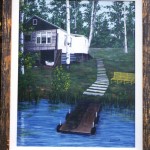
Linda Lee Smith, mixed media artist


These art pieces are original works created by Linda Lee Smith, a mother, musician, Christian worship leader, and greeting-card and mixed media artist in California. Linda Lee-Smith has been creating art for over ten years and delivers her pieces free to many less-fortunate people.

Linda is serving a 15-year to life sentence in California state prison for failing to stop her then-boyfriend, David Foster, from beating her two-year old daughter Amy to death. Linda rushed Amy to the hospital, but she was unable to save Amy’s life. Ms. Smith’s daughter, Bethany, the only third-party eyewitness to this horrible crime, has testified at Linda’s numerous parole hearings that Linda did not participate in the beating, but rather was guilty of failing to stop Foster’s abuse. Foster had a violent, criminal background, and he abused Linda both physically and psychologically when they were living together. He was convicted of murdering Amy and remains incarcerated. Amy’s death was and will always remain a tragic event in Linda’s life. Linda still mourns the death of this dear child, and wishes she had intervened more forcefully and soon enough to make a difference.

Linda has met and exceeded all Board requirements for parole. She has remained disciplinary-free during her entire 30 years in prison, she has earned a BS degree in Psychology and is currently working towards her Master of Theology through Fuller Theological Seminary. She has been part of the prison Ministry Team for 28 years, and works as a peer helper, teacher and minister in the Mental Health Department for troubled women in the prison.

You may write to Linda at this address:

 Linda Lee Smith, W-15143

CIW Miller-A 50-U

16756 Chino-Corona Road

Corona, CA 92880-9508

There is also a website set up to advocate for Linda’s release from prison, which provides some more biographical information, news updates, and pictures: http://www.lindaleesmith.net/

Reuben Rutledge, on the Kmer Empire


The Kmer Empire

The earliest date for the first Cambodian King Jayavarman 1 was 657CE. His was a peaceful kingdom that lasted about thirty years. His fall during the eighth century split Cambodia. During this time period the Kmer kings saw an increase of power. These included territories of Funan. The major Hindu sects of India coexisted in Cambodia.  This includes Shaivite and Vaishnava sects. These would play important parts during the Angkor period. Also important was the cult of Harahari, a form of Shiva and Vishnu combined. There was very little trace of Buddhism in this period. As to social structure maternal descent was of key importance.

      After the year 706 Cambodia split into two. This occurred with the fall of Funan and the early Kingships of Chenla. Chenla then split into two parts: Land Chenla and Water Chenla. The apparent cause of this was the death of Jayavarman 1 who did not leave a male heir. Little is known about the two Chenlas.

      During the eighth century Land Chenla sent out several embassies to China.  Meanwhile at Water Chenla various monuments to Mahayana Buddhism were constructed.


— Reuben Rutledge, author, philosopher, photographer, and doctoral student from the San Francisco Bay Area. He may be reached at rutledreub@aol.com

Continue reading

Reuben Rutledge: Transcendent Photographic Images of a San Jose Anime Convention

     Language is the container of Truth.


     Language is silent.


     When an individual encounters phenomena, that same individual calls forth from Language and places Truth on those same phenomena. The majority of such phenomena fall into the realm of Pure Reason. The users of that Language readily understand the Truth of such phenomena that is called out of the silence of Language. The truth that is called out from mundane existence is a part of their “everydayness.”

     Occasionally an individual encounters phenomena that lie beyond the realm of Pure Reason, and into the Transcendant. Language is no longer able to place Truth upon the phenomena in a mundane manner. Truth instead is placed upon the Transcendant phenomena in the form of a cipher, which allows the individual to glimpse at the Transcendant phenomena. Ciphers do not explain exactly, but symbolically represent the Truth of the Transcendant.

     Art is a form of cipher-script in that it represents phenomena that are beyond reason in that the artwork represents the Transcendant. The artwork does not call forth in an everyday manner. Instead it uses the ciphers, which are understandable, to refer to that which is non-understandable. The reader encounters the experience of the Transcendant by this non-understanding.

     Art (these photographs) represent the non-understandable aspects of Being. Because Existenz cannot be described in rational terms, it is in non-rational forms of the cipher that are used to understand it. Common symbols are used to represent the non-understandability of Being. The viewer as the reader of the cipher is called into the uncovering of Truth as the viewer cognizes Language and Being.


Reuben L. Rutledge is a photographer, writer, scholar, and philosopher from the San Francisco Bay Area, currently residing in San Jose, California. He may be reached at rutledreub@aol.com


Laura Lagomarsino: A Clothesline of Words, Ideas, and Pictures

I love words, to paint them, to write them, they flow to me as stories and visions and layers.  Images live with me this way as well.  The visual aspect is first, and stronger.  Words somehow intertwine themselves therein, within, like a frame somehow, or a clothesline, supporting what I’ve already seen.  These things, images, words live in different “me’s” ~ the waking ones, the wide awake one, the sleeping dreaming one, the daydreaming me watching images dance in the sun.  And one thing leads to another, and this is how I live.  One creative thought, one story, one image after another making their way from their starting place to their ending place.  And the space in between the beginning and the end is where they hang on the clothesline, patiently, until it is their time.  The clothesline of life, of my mind, of my imagination.

Tiny San Francisco studio apartments are very conducive to this incubating clothesline.  Because there is no choice, there is no space.  The drifting to sleep space is the same as the waking to morning space which is the same as the birthing of project space….dreams waft into waking thoughts which find themselves in cuttings and shapes and patterns, papers, drawings, smiles, sun, naps, more thoughts, more doodles.  All the while the clothesline remains, the current project absorbing all around it, the studio scattered with remnants, twigs, pieces parts, scraps, each piece on the clothesline embracing its cousins, the next potentialities, befriending them, watching them fondly as one of them realizes form, the others waiting gently while they drift and dream and waft and sleep and watch.

And the clothesline is built upon chance.  And chance is enhanced by repetition of subtleties, of nuances, of moments, of giggles of recognition as seemingly unrelated events and characters refer to one another in a nod of coincidence.  This is what creativity means to me, being totally open to these things.  Something shows itself to me by chance, it finds its way to the clothesline by a series of wonderments.  Wonderments know when they need to be born, and they tell me so.  Like walking along a crowded street, all the passersby coming and going, conversations blending into traffic sounds, smells, colors, combining to form an overall feeling of the day ~~ ah, but one image, one person, one thought, an idea sticks, stays, you tear it out of a magazine, or you scribble it down on a napkin ~ it stays — Clothesline.  
Laura Lagomarsino can be reached through her website, http://www.lauralagomarsino.com/
More to read, including a link to one of Laura’s original stories, behind this link:

Continue reading

Narmin Kamal: Animals, plants and women

Animal and woman. How would you kill a bear? An animal that is much stronger than man falls down when a bullet is put through its head. The bleeding wound leaves red stains on its white fur, and without understanding anything a bear closes its eyes. They take it to the cold dark shop located in A. Street and plunge the knife in the back of its head to peel off the skin. In a month Zeyneb, a woman from our neighborhood, wears this skin. She minces down the stairs, gets in her car and drives off to see her friends. They talk about her new fur coat. The woman boasts that it’s natural leather because she would never wear anything artificial. That same evening her friends make calls to contract the murder of an hare and a seal. Zeyneb’s bag is seal leather. It is the skin of a seal mother brutally killed with a metal rod last year in the North. Her baby seals have already forgotten her.

Zeyneb thinks she is beautiful and elegant. She often checks the size of her waist to be sure that her elegance and grace are not in danger. This woman makes fine facial expressions and tries to speak with a tender voice.  When Zeyneb hears doleful songs she becomes sad. Sometimes when watching a movie she cannot hold back her tears. While crying she puts her head on the shoulder of a man, who never says “no” to any of her wishes.

If you were told nice fairy tales in your childhood, you would know that Zeyneb is the bear of an artificial and coarse society. There is no bear which wears a coat made of human skin and there is no seal which carries a bag made of the skin of Zeyneb. She is the woman that peels off the skins of hares, pandas, crocodiles, and wraps herself in them. She is proud of this like a savage in a primitive tribe.

In Western countries demand for this kind of fur and leather is gradually decreasing. Famous actresses are proud to own coats and bags made of artificial leather. However, other women, like Zeyneb organize culinary contests on TV and award a fur coat to the winner. Behind the prize are heartache, suffering and death. The winner of this skin of fox, tiger or hare, leaps up and cries out with joy: “Wowww!”

In a couple of years Zeyneb lies in a dark corner of a hospital ward located in A. Street. She has an abortion because she expecting a girl for the third time. The name of the second girl is Qiztamam (Girl Over). The possibility to give such widely spread Azerbaijani names as Qıztamam and Qızyetə, Qızbəs or Bəsti (Enough) did not help this woman, she was again expecting a girl. Zeyneb’s heart aches, she cries and moans. Rude nurses say to her: “Do not groan like a bear.”

Plant and woman

Dr. Narmin Kamal is a scholar, writer, and researcher from Azerbajan. She may be reached through her Facebook profile or through comments to the website where she originally posted this article:

http://women-forum.net/index.php?option=com_content&view=article&id=122


Continue reading

Narmin Kamal: Boys Gathering Violets


My birthday was the day my father started to grow a beard. According to the rules of the village a man must let his beard grow for one week or 40 days when a close relative dies. This time nobody died but God granted my father a daughter, instead of a son… In every phase of my life I came up against constraints that prevented me from feeling like a human being. In third grade I realized that as a girl I must conceal myself. There was graffiti on the school walls: Rza + L = Love and Mammed + A = Love. In declarations of love boys wrote their names while keeping the names of the girls they admired a secret. This was done to protect the girl’s name and not to injure the boy’s pride. Our literature teacher, Nazim, used to say to us, “Do not irritate the eye like a nettle, Be a violet and let somebody find you.”

At university I studied philosophy but thought of becoming a reporter. In my first years as a student I dreamt of writing from hot spots around the world. This is when I began writing my first articles and submitting them to a newspaper. As soon as one story was published I would have another one ready. This brought me into the world of mass media. The majority of journalists working in our newspaper were men. At first I wrote on social issues but later switched to politics. My wild dream of becoming a war zone reporter was closer and clearer than before.

At 18-19 I was already used to participating in press conferences. Once, my colleague and I went to the Parliament building to gather information for an article. From far away, we saw a young girl who I knew fearlessly conducted economic and political investigations for a daily paper. I look at her and said, “She looks so small, fragile and shy but her articles are so good and daring. I think she is a nice person.” To which my colleague replied, “If a girl writes for a newspaper, how she can be ‘nice’?”

Men of all backgrounds and regardless of their level of education talked about women in a sexist way. In discussing world famous women authors they focused on their private lives and external beauty but not their work. It did not matter what I did, my gender was always a barrier. Despite this I continued to write short articles for my newspaper. They would get published with my photo at the top. From time to time I managed to contribute to other periodicals as well.

As my career began to progress I met my first love. This was an Azerbaijani man with whom we worked together at the paper. We felt a connection while reading the same book – The Second Sex by Simone de Beauvoir. Our topics of conversation ranged from European history to movies to philosophy. It seemed I found an island of Europe in Azerbaijan. And this is why I loved him.

This was a time when I was surrounded by intelligent people who worked in high places as editors-in-chief and politicians. According to many of them, the best woman was the one least talked about by the public. The social withdrawal of a woman was considered attractive. An active woman, who worked, wrote for newspapers, engaged in discussion with other men, was not marriageable. She was like a beautiful but oil-stained blouse. These people believed that women should think of marriage to a man as an award. A woman should be happy to be picked out like a Christmas tree from among other trees for her appearance. She should be happy because someone CHOSE her in marriage.

I remained indifferent to these comments because my beloved was not at all like them. I was supposed to live my life differently. And the one day, he said to me, “I don’t want you writing these short articles for the newspaper.” I asked him “Why?” and my open-minded man responded like this, “In Azerbaijan people use newspapers in the toilet. I don’t want someone to wipe his bottom with a photo of my lady from the paper. Moreover, I don’t want other men to talk about my woman. I also have pride and dignity, please understand this.”

I could not understand him and continued my work. Eventually we broke up and in a couple of years he married another girl, a school teacher. She lived her life without paying much attention to events taking place around her or the news in society. The children surrounding her at school did not threaten his dignity or manhood.

Dr. Narmin Kamal is a researcher, scholar, and writer from Azerbajan. You may reach her on Facebook or through commenting where this essay was originally posted, at this forum on women and society: http://women-forum.net/index.php?option=com_content&view=article&id=119%3Aboys-gathering-violets&catid=62%3Aessay-competition&Itemid=98&lang=en

Continue reading