Victory Girl – vintage airplane nosecone art


Victory-Girl –Creating Wearable, Flyable Art


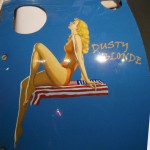
Talismans of good luck, group identity, or signs of homesickness, these are just a few of the reasons pilots and their crews have adorned their aircraft with highly personal images called ‘nose art’ since the first aircraft took to the skies over a century ago.  ‘Nose art’ (so called because the images were normally painted on the ‘nose’ of the aircraft) were painted on the fuselages of bombers, fighters, hacks and reconnaissance aircraft, on flight jackets and in mess halls, of military units in very combat situation to present day.


Victory-Girl, an aviation art services company in Upland, California, specializes in re-creating historical nose art for vintage warbirds, as well as more modern military and general aviation aircraft. 


“Wartime aircraft nose art was and still is huge morale booster for our soldiers in combat zones and here at home” notes Jerri Bergen, owner and principal artist for Victory-Girl.  “What we enjoy most is understanding the history behind the nose art, how an aircraft can come to be called ‘the Racy Tomato’, ‘Homesick Angel’ or ‘She Couldn’t Wait’.”


Victory- Girl has done hundreds of nose art pieces (see their galleries at www.victory-girl.com) for military and general aviation and can relate stories about each piece.   “We created one piece of nose art for a military unit that wanted a pinup girl holding a pistol on a mail bag, for their heavy-duty helicopter. When we asked ‘what’s with the mail bag?’ they responded that although their combat cargo missions were varied and numerous, such as carting water to stranded troops, fuel to vehicles, and humanitarian supplies to local villages cut off from roads, their most important mission was getting the mail to the troops on the front line.”


As a service to the military, Victory- Girl creates nose art designs at no charge for active military units, charging only printing and shipping fees to units overseas.  “It’s one way we can give back to those folks who are helping to protect the freedoms I take for granted every day” Jerri admits.


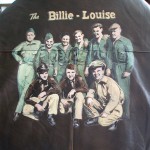
Nose art isn’t just for vehicles, however.  Victory- Girl has also completed hundreds of nose art designs painted on leather jackets, once a common practice among pilots in WWII, and more recently among pilots of private aircraft.  “What we really get a kick out of is creating a piece of artwork on a jacket that becomes an instant conversation piece the moment the wearer walks into a room”.    


Characters, planes, portraits and pinups comprise the majority of subject matter for flight jacket artwork, but truly anything goes.  “We’ve painted historical WWII pieces that have included German swastikas or other historically sensitive imagery.  We caution our clients to be prepared for comments, both positive and negative, that these might draw.  One client brought his jacket we painted with Nazi aircraft ‘kill markings’ (the ‘scorecard’ painted on the aircraft to note how many Nazi aircraft had been shot down) back to us, asking us to change it to another, less charged graphic.  He was tired of explaining to distrustful onlookers that having Nazi kill markings on his jacket did not make him a Nazi sympathizer.”


Handpainting detailed imagry on leather takes some doing, however.  “We can spend several days on a single jacket” Terri notes (Jerri’s twin sister, partner of Victory-Girl).  “The process requires careful preparation of the leather, painting with specialty leather paints, and then a sealant process to ensure the paint doesn’t peel or slough off.”   Painting on aircraft uses a more traditional enamel based painting process.


What do Terri and Jerri enjoy the most?  “For sure its’ the memories we help to keep alive through this artwork” affirms Jerri and Terri, in unison. “ It is gratifying to know that you’ve helped build a tribute to a brave pilot, a loving husband and grandfather, who, although passed on, will always be remembered every time his grandson puts on his flight jacket with his portrait on the back.”   


Examples of completed works are viewable at www.victory-girl.com  or call Terri or Jerri at 909-297-6688.

Cynthia Lamanna, on Valentine’s Day


February, our hearts aglow; we halt the further unveiling of our bundles-and leave them at the door. A time to marvel, to thaw, to contemplate- in-between the crystallized remnants of winter and the first signs of spring-we are wrapped in a velvet time warp between dreams and waking; things hidden will soon foretell; a white statue of Adonis winks. In the center of the table a box of dark chocolates and a vase of roses adorn

the white linen.


From shadowy school days, we smile at the thought of nearly perfect hearts cut out of red construction paper- pasted on snowflake white doilies. All of you children rejoice, the smallest to the tall, gangly or invisible, for whatever your lot, in-spite of the fickle sentiments of others, rest assured you will not get overlooked

on that special day- today no-one notices freckles; for at the end of the day your shoe box or brown paper bag will be full of valentines, and pastel candy hearts uttering sweet forget- me- not’s’!  


A shadow like that of a sprite plays upon the hearth-was it Cupid or just a rebirth of an old ghost?

In the pale gold, a host of real and imaginary lovers cry out. Some are in chains, some just arch-types etched into the clay of our own 1940’s ideals. Some are waiting in secret-in the rose mist, just hidden from view by the vine edged columns, as their shadows dance upon cobble stone corridors-pining to merge into one with their soul mates; in the dance called love, passion and purity become one. A flamingo pink flashes on the horizon- Snow Cherubs wait at the gates where babies who didn’t quite make it to their childhood on earth are ushered back in, on tiny angel wings. An image forms in the clouds, as imagination flows, whipped cream white, castle like, as days grow in length- lavender streaks the Northern skies, and stars pierce the cold black.


In a fleeting glimpse of a beautiful sunset, February speaks to us, and represents itself. The barren holes where furry, busy creatures played are covered with winters brown and frost- premonitions of blossoms, mauve, cherry, and white, float beneath the earth, as in watery vaults, waiting for the time of their rebirth. Angels in white feathered form or dressed in the common threads of man, flit and hover, from all the corners of the earth-February, our hearts again opening, giving tribute to Valentino, to birds in flight forming a straight black arrow-in the silver slant of the morning light, mirrors the silver of the birch trees – at last is our salute to the flaming crimson heart –as on wings it takes flight and carries the songs of lovers for all times, the gifts of starry skies, music boxes with tiny skaters on mirrored glass ponds, and the collective pool of tears from earnest, broken love-sick and contrite hearts.


February, our heart’s now thawing from January’s bleakness and chill. With curiosity, we rub out a spot on the fogged window to see our neighbor in his glory and plight- and the dividing shrubbery is blurred in our memories of good will once again. A few yards away a fence was knocked down by a storm, (again), but in the spirit of new beginnings, the fellows, young and old, work together to repair it again. The wives cheer them on, with mugs of hot coffee.


A dog’s yelp can be heard, echoing a hallmark sentiment-children riding scooters warm us with the return of their high pitched laughter, and free spirits. The gap between generations narrows-the mitten clad lad of the fifties whirls around corners at high speeds on roller skates; in the regeneration, of his species, though his DNA is unique, somehow his spirit is engineered into the spirit of a happy faced modern day boy-with an electronic box in hand, twittering a friend.


A trickle of ice melts the heart, and we smile and nod, as if coming out of a long winter dream. We note how the grass has grown, and pools of rainwater leading down to the gutters are timely reminders, of how seasons change and turn color, and than die like the leaves-and than one day, like Lazarus, they rise, the ashen bedclothes fall off, and spring is born again! They enhance us and all the earth around us.


The old man across the street is coming out of hiding, tending to his garden soon to be green with Spring- time rains. The corners of his mouth set like a straight grim line in a face of stone are turning upward. Though he does not speak to nary a soul, if he could but speak I know what this old Irish man would say; “Ah, me thinks its going to be a wonderful day.”

Cynthia Lamanna may be reached at cynthialamanna@yahoo.com – and would love the chance to talk with other writers and artists!

In conversation with Owen Geronimo, of Fashion Feud/Werkstatte


Owen Geronimo came out of the real estate world to work with San Francisco’s Fashion and Merchants’ Alliance, which seeks to facilitate networking among emerging designers and to place San Francisco, California right back on the map in the fashion scene. Here are some of his thoughts, on various factors and trends influencing the design world and San Francisco’s aesthetic.

He may be reached personally at owen@owengeronimo.com and the SF Fashion and Merchants’ Alliance website is www.sffama.com

Save-The-Date: “The Economics of Art” forum is going to be on Feb. 11th at The Barber Lounge. For details, please go to this site: http://www.theeconomicsofart.info/

We at Synchronized Chaos would love to hear more about how people describe San Francisco’s fashion scene…trends, styles, what’s unique about the place? 


What’s unique about San Francisco’s local fashion scene is about the innovative melting pot of many talents here.  Realistically, style has really nothing to do with geographical locations. It has to do with the individual, him or herself.


However, San Francisco has its own mystique and aura regarding style. I think, because the San Francisco Bay Area is in the forefront in technology, politics, and social equality. If you look at history,settlers have gone west (across the United States) in the search for gold, the flower power of the seventies, the raves and the dot com era of the nineties. It is that the same mystique why most come to the SF Bay Area… to experience this movement.   


As far as trends are concern,  the street style fashion combining, the eighties neon B-Boy get-up and vintage chic from your local Goodwill stores is hot. That is the norm these days. Fashion evolves, the beatnik look, gothic and punk, hobo chic – you will see on the street. I think because of our weather here in the bay area, there isn’t really a set trend. Clearly, what’s out is overpriced labeled brands. Ultimately, we are now experiencing the “poorgouis” (poor and burgouis) economy all the retailers are adjusting their price points to cater to the consumers’ new frugality approach.


I think the majority of people are confused about style and fashion. It really has to do more about your attitude, it’s either ‘you got it’ or you don’t.  It’s all internal, the outward approach is really how you present yourself. Confidence is very sexy. Being unique would make you stand out in a crowd.


What advice would you have for upcoming designers? 

Master your own sewing machine.  If you want fashion to be your career, you have to live it. Fashion is an art not a hobby. Take a business class to learn accounting and to know the difference of profit and loss.  Be original. Always be aware of what your customer wants. Build a database. Prepare a realistic business plan. Join a collective to get exposed to the community. There is no shame in networking, so network like hell.


Why do you think fashion is important/a form of art on a level with paintings, etc? 


Fashion is very important. It is as extension of how we express ourselves to the public.  Some of us, sometimes intentionally dress up to get noticed. It is really in our psyche as human beings to crave for attention and fashion can satisfy this need. However, I personally prefer not to be noticed.


As a painter, you must be able to paint and create a masterpiece from a blank canvas originating from your mind. As a designer, transferring your sketch to a dress form is just the beginning process until the final product is made and ready to be sold to the public. 


What do you think is bringing about a renaissance for fashion in SF? 


The fashion renaissance never left, it was always here. I have met numerous individuals from New York, Miami, and as far as from Melbourne in my events just to see what is this local fashion movement about. It’s nothing new, it’s always been there but it has never been positively cultivated. I have observed that the major players in the local fashion scene are occupied disparaging each others. A perfect example is “Style Wars.” The judges were sarcastically rude toward the designer contestants, never offering constructive criticisms. It created so much animosity toward the creative designers. I couldn’t grasp it. I’m sure the crowd also noticed. The common goal of creativity and sense of community are ultimately lost within that event.


The last time, I saw “Project Runway”, no one actually representing San Francisco won.  No one made the cut. That was a major blow to the local fashion scene.


My main goal is to have San Francisco become synonymous with the word ‘fashion’. The local independent and “DIY” fashion scene is robustly thriving with the help of the internet. At the same time, we have fashion houses and major retailers here, such as, Bebe, Gap, Levi’s, Nice Collective, Chaiken, to name a few. The “Burning Man” crowd are also pioneers in the renaissance of the local fashion scene. 

  
How has fashion been affected by the economy? 


The economy has affected fashion and the retail industry immensely.  H&M just opened two new retail locations in Tokyo. This is a major shift from the “label” conscious Japanese consumers. Jimmy Choo and Sonia Rykiel also just launched their new line with H&M in United States.  Last fall, New York and Macy’s launched Fashion Night Out with Vogue’s Anna Wintour showcasing boutique trends in an attempt to stimulate shoppers to buy in New York. These are major strategic shifts from the retailers to adapt to the price conscious consumers that are driving the retail economy. 


By the green movement and environmental concerns? 

Eco-design is a hot commodity in the luxury market. The majority of society is slowly catching on. Eco-design, both retail and homeopathetic are growing rapidly. Some local designers are actually pioneers with this concept by ‘deconstructing’ outfits and wardrobes to come up with new designs. With environmental concerns, you have synthetic fabrics versus organic fabrics or chemically based dyes versus organics. It’s a tough call, a wholesaler would rely more on a cheaper commodity to run a business.

The Copenhagen Conference just wrapped up. Realistically, if we talk about saving the planet, don’t look to the fashion industry for an answer.  


By globalization and immigration and multicultural influence? 
Globalization. China, UAE and Saudi Arabia, India, Southeast Asia, The European Union.  As an American, I’m doubting if the United States can actually compete with these major players with our current political and economic climate. Our education system is lagging immensely compared to most developed countries.


In fashion? Globalization has made cheap labor, and cheaper materials, more accessible. It has made a lot of impact on open trade and import/export also with the help of technology.


Immigration? Banana Republic flagship store in San Francisco hired foreigners to fill their opening for the holiday season. Cheap labor will be filled by foreigners to try to fulfill their own American dreams. The companies would want to cut down their costs before hand. The United States should really look into extending H1 visas to foreign workers to sustain job security inside the country.  A lot of tech and labor jobs are rerouted out of the country to save money. After 9/11, many of the United States’ immigration laws have changed, and also with the recent decline of the banking industry, the influx of immigrants has tremendously dropped. 


What should someone look for in a clothing line? In the clothes someone wears? What makes an outfit artistic? 


Quality and comfortability. Armani is a perfect example. Your outfit becomes a luxury item. For me, sophistication is always a turn on. Again, it’s all about the attitude, it is not what you wear. It’s how you wear it. Originality makes an outfit artistic. A creative insight must be applied to come up with an original outfit. 


Should someone consider going to SF if they want to be successful in fashion?


*Laughs.* Hone your skills in San Francisco, then move to New York to make a name for yourself, then come back to San Francisco. You will not fail.


Okay, just one last question: Who are your personal inspirations? Whose clothes do you like? 


Laughs. This is a good one because I almost had a brain aneurysm with the ‘global’ questions.  Alexander McQueen is my fashion god for the past few years, it changes from time to time.  My personal inspirations are Issey Miyaki and Rei Kawakubo. I recall walking into Comme De Garcon’s showroom in Chelsea, years ago. It really was inspiring.

 

Connie Noyes: Human Steps

Connie Noyes


I consider myself a painter, though I use many different materials in my work. My MFA is in photography but I never actually thought of myself as a photographer. The photographic image was the skeleton of my work. I had a hard time keeping my hands off the image. I had to touch it, manipulate it, paint on it, erase parts and then draw back into them. My photographs looked like paintings, and now as a painter people tell me I paint with a photographer’s eye. I think what they mean by this is that I work with and am aware of the edges of the frame or canvas. This is where tension and poetry are created.


My latest body of work is called HUMAN STEPS. This is an ongoing series I have been working on for a year and a half. Currently, there are paintings and digital images but eventually there will be video components and an installation as well.


Statement:


HUMAN: adjective, have, or relating, to characteristics of people. STEPS: noun, plural, the act of putting one foot in front of the other.


HUMAN STEPS is a dialog, which references the many disparate elements encountered in daily urban life – a metaphor for the way in which dark affects light and vice versa, how the sweet can become sickly if overdone and how close proximity to millions of people, diverse cultures and visual images can both inspire and overwhelm. It is a metaphor for tight quarters, pleasant or not so pleasant meetings and vibrant energy of the city in contrast to shadowy and emotionally difficult places.


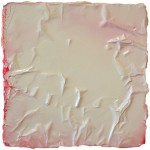
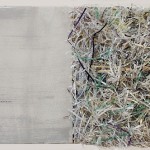
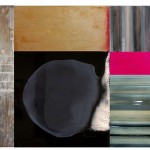
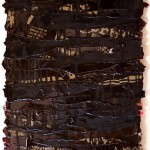
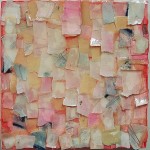
For HUMAN STEPS, I use what most people consider garbage as a jumping off place in the work. The materials at one point might have been utilitarian, but were never considered beautiful. The hard, shiny, plastic surfaces often synonymous to commercial objects would never pass inspection as such. Dirt falls onto the canvases, scratches, cracks, marks occur and there are no straight lines, only the illusion of such. Through the act of turning detritus into “works of art”, or elevating the prestige of garbage, I aim to question the status quo of beauty, worthiness and usability.  


Has my style changed over the years? 


This year, I completely moved out of a house I was living in for a while. In doing so, I uncovered some of my photographic work from 1992. I was so intrigued when I saw them and what I had been working with at the time. Garbage! I was photographing cardboard, old window shades, hardware parts-junk really. The photographs looked like abstract paintings. So it seems my interest in materials has remained fairly consistent. 


Themes continue to reoccur as well.


I am intrigued with seduction – seduction through colour, sensual line, materials- and with irony or contrast – that moment when the viewer realizes they are looking at garbage, but isn’t it beautiful garbage!


When I was living in San Francisco, I painted with sludge- the waste that sank to the bottom of the jar of turpentine where I cleaned my brushes. At one point I literally had a sludge farm.  Jars and jars. The stuff just grows. So I began to experiment. I would layer these beautiful transparent pigments over the sludge like a protective skin. Through the layers, colors would arrive on their own, When complete the texture of the sludge, the way it cracked or lumped up was still very apparent, yet the skin was seductive and held two opposing ideas together in one place- inside/outside, beauty/waste, seduction/repulsion.


In the end, I think everyone brings his or her own experience to my work. I encourage that. I don’t want my art to be an absolute. It is too limiting. I want my work to spark dialog, intrigue or visceral experience.

If people are interested in seeing more or purchasing any of my work they can visit http://www.connienoyes.com or email me at cyd@connienoyes.com


CONTACT INFORMATION:


CONNIE NOYES

NOYES STUDIO

1029 W. 35TH STREET

CHICAGO, IL 60609


http://www.connienoyes.com

cyd@connienoyes.com

 Information on each of Connie’s featured images, including media used, here: http://community.livejournal.com/chaos_zine/7788.html


“Leaving So Soon?” – short fiction by Tony Long


Leaving So Soon?


By Anthony Long


          Toby Jenks looks up from his newspaper and freezes.


          Striding down the hill toward the café, laptop tucked under one arm and a sour look plastered across his thick, wheyfaced mug, comes Joel Kaplan, a thoroughly objectionable human being known around the place as the Human Air Vent. (“But does he suck or does he blow?” it was fairly asked.) 


          At the next table, a vagabonding young German couple have finished their coffee and are slipping the guidebooks into their haversacks and making ready to leave. She’s a pretty, dark-haired girl with a soft voice. Toby thinks she looks merciful.


          “Please,” Toby says. “Please stay. Don’t go.” She looks at him quizzically. In desperation Toby summons his dwindling reserve of high school German. “Bitte … bleiben Sie hier. Umm, uh, both of you. Nicht gehen, bitte. Nicht jetzt.”


          “I’m sorry,” the girl says, switching easily to nicely clipped British-accented English. “Is something wrong?”


          “Oh, yes,” Toby says, looking out the window. “In about ten seconds the worst person on earth is going to come walking in here and if you guys leave right now, he’ll sit down at that very table and my day will be completely ruined. Maybe my life. Please.” Toby gives her a beseeching look and another involuntary “bitte” leaves his lips. The Germans crane their necks to inspect Kaplan, and the young woman turns back to Toby with a distressed look of her own. Kaplan has that effect on people, even total strangers.


Tony Long lives in San Francisco’s North Beach, which serves as an inspiration for his writing. He may be reached at alittlechinmusic@gmail.com

Read more of Tony Long’s piece here: http://community.livejournal.com/chaos_zine/7500.html

David Selsky’s Photography


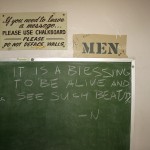
“It is a blessing to be alive and see such beauty”

I’ve been taking photographs for over 15 years. I don’t shoot thematically; consciously looking for something to photograph drains the subject’s power for me (though I know some would argue the opposite, perhaps even myself on occasion). However, I will splurge sometimes, just enough to satisfy a craving but not enough to consider it documentation. I enjoy editing, finding ways of structuring a series of photographs while avoiding one line of interpretation. I think these nine photographs hold together in sequence well. I photograph balance – in subject matter or in form. I photograph quiet, which is inherent to balance. I photograph people but mostly through their absence. Every moment with a camera is mindfulness meditation. It is a blessing to be alive and see such beauty.

http://davidselsky.smugmug.com
davidselsky@gmail.com

Richard and Noel – a thought essay on plural, sentient consciousnesses

Plurality and selfhood
Plurality, as experienced by this system, is the subjective phenomenon of discrete, self-aware complex structures that have a concept of “I”, and share a brain with other entities that have similar self-perceptions. That is, these entities perceive themselves as individual persons, and parse other entities within the same system as “not me”.

Each person within this system has their own way of interpreting information, environmental stimuli and abstract concepts, and has the capacity to grow, learn and create, in the same fashion that separate-bodied individuals can. For example, when Kerry Dawkins joined this system, she considered herself rather apolitical and had a more conservative worldview, but as she matured, she became acutely aware of global politics, and developed a more inclusive, progressive worldview. The ability to learn, develop and process information is a hallmark of intelligence, and is a significant criterion for personhood*.

Each of us also has our individual concept of an “I”—that is, we are all capable of self-reference. Self-awareness, even more than the capacity for learning, is a sign of sentience. From a young age, intelligent beings are able to distinguish themselves from entities which they perceive as “nonself”, and think self-referentially. “I” is a self-sustaining idea, constantly looping on to itself with experiences, thoughts and self-observation (with apologies to Douglas Hofstadter). In plural systems, there are numerous sets of these “I” feedback loops. Each of us is a self-perceiving, self-analysing, self-referential entity; those of us given to metacognition are certainly capable of doing it. There are consistent patterns, leitmotivs, running through each one of us. Motivations, goals, dreams, aesthetic sensibilities, philosophies, emotions. When our neurones fire in a certain pattern, the result is each one of us, with each of our multifarious differences. For example, Darwin Ghia-Wilberforce, views herself as a separate individual, and is an internally consistent complex structure. She perceives others in the system, like Hess Sakamoto-Kalashnikov and Yavari Caralize, as separate entities from herself, similarly to how she would perceive someone who does not occupy the system’s shared brain. The same applies to the authors, Kerry Dawkins, Hess Sakamoto-Kalashnikov, Yavari Caralize, mutatis mutandis.

The argument from complexity

The human brain is inherently given to complex structures, so it would not be much of a stretch for any given brain to support a plural system. Even non-plural individuals can harbour mixed feelings and complex states of mind, and may see themselves as being different people at different stages in time. We believe that plurality lies on a spectrum, so why can there not be several levels of separation? The idea that a brain must absolutely contain one conscious, self-aware identity is more Western cultural trope than scientific reality, and this oversimplification of cognition is pernicious. It delineates, rather unfairly, whose brains are “correct” and whose are “pathological”. Assuming that plurality cannot exist, and must be delusional, presupposes that human brains must essentially be simple structures. The argument that “simple is better than complex” makes little sense where humanity is concerned; human brains have evolved to be complex structures. This is akin to arguing that someone who has an IQ of 50* is “better” than someone with an IQ of 150 because the concepts that person understand may be simpler than those understood by the person with the IQ of 150.

The argument from the memetic school of thought

There is also the idea that a contiguous, single “self” is an illusion in the first place, and that thoughts are composed of varying patterns that arrange themselves according to both internal and external factors. Susan Blackmore posited this idea in her book The Meme Machine, which combines a novel interpretation of Richard Dawkins’s concept of the “meme”, or a unit of socio-cultural transmission, with her own views on the idea of “self”. While we do not agree with Blackmore’s repudiation of the concept of self in and of itself, her idea that people’s thoughts are largely influenced by cultural elements, and are collections of competing ideas, may be relevant here. In “typical” brains, collections of memetically transmitted ideas may compete against each other in an “evolutionary arms race” of ideas that results in a clear winner (or winners), and in “plurally inclined” brains, those collections of ideas may live in mutual co-operation. The “memetic view of plurality” is rather reductionistic, and we ourselves—with the possible exception of Kerry Dawkins, who does view the existence of subjective space as an element of subconscious memetic transmission—do not adhere to it to describe our own experiences, as we find that personhood is more complex than competing memes, but those who prefer reductionistic models of cognition may find this explanation appealing.

Conclusion

There is no logical reason why people should have such a visceral reaction to plurality as a philosophical or cognitive concept. We should have the right to revel in our personhood as others do, rather than having to sublimate it for the benefit for those who cannot, or choose not to, understand us.

* This is not to say, however, that those who have difficulty parsing certain types of information should be denied the right to personhood; we believe that members of sentient species should be automatically accorded personhood.

* We do not believe that IQ is an absolute determiner of intellectual reasoning; it is merely used as shorthand here.

Further reading
I Am a Strange Loop, by Douglas Hofstadter
The Selfish Gene, by Richard Dawkins (specifically the chapter on memetics)
The Meme Machine, by Susan Blackmore
 
Richard Ghia-Wilberforce and Noel Dawkins are members of The Fen Group, a plural system based in the western United States. Their system website, Ex Uno Plures (http://www.exunoplures.info) features many articles about plurality from a philosophical and cultural standpoint.