
Christopher Bernard’s review of the Cult of Beauty: the Victorian Avant-Garde (1860-1900) at San Francisco’s Legion of Honor


THE VICTORIANS’ BLISS


The Cult of Beauty: The Victorian Avant-Garde, 1860-1900


The Legion of Honor, the Fine Arts Museums of San Francisco


Through June 17


A review by Christopher Bernard


For a shining moment in the savage tale called history, pleasure was held as the highest good rather than as the road to damnation for a weak and sinful humanity. Happiness was seen, not only as a legitimate aim, but as the sole aim of human life. What was virtue without pleasure; what indeed is goodness without happiness?

We’re still not sure: our meaner impulses insist on what some may see as a preposterously heroic view of life in the pursuit of money, power, celebrity – if you’re not training for the Olympics, what’s wrong with you? “No pain, no gain” is many a person’s mantra; though to gain what, they don’t always say, or perhaps know. The pursuit of mere pleasure, the right to a happiness made of the sweetness of life, we darkly suspect are signs of laziness and a lack of courage, a romantic withdrawal from the Darwinian struggle, rather than the civilized repudiation of the mindless callousness of nature, of evolution and its economic incarnation, capitalism.
So it’s quite a revelation to be reminded of something many may remember from their art-history classes: in the middle of the era of those old, dull Victorians, the Aesthetic movement flowered for almost two generations, and pleasure, happiness, love, and their objective correlative, beauty, were honored, pursued, worshipped, even adored.

The very success of the movement led to its own repudiation by the early modernists, and much of the art and criticism of the last century dismissed many of its products as kitsch. Yet, as often happens, the impulses behind the repudiated style went underground, and continued to nourish arts less susceptible to public ridicule; in this case, the crafts, home decorations, fabric design – the domestic arts in general. In fact, the very idea of a beautifully designed home, of the “house beautiful,” with stylish but not costly furnishings, that people might actually be able to afford – an idea most of us now take for granted – originated during that time.

And now we have an ambitious exhibit of work from the Aesthetic movement and the sister movements that followed – from the Pre-Raphaelites to art nouveau – now at the Legion of Honor museum in San Francisco, that succeeds wonderfully, even spectacularly, in bringing back to the center of our attention this often-dismissed but enormously fecund movement in the arts. Not only is it about “the cult of beauty,” it is itself a feast of beauty and offers revelations around almost every corner.

The exhibit, a model in how to be richly informative and enlightening without condescension or dry academicism, unfolds historically, establishing immediately the harrowing social conditions and the peculiar circumstances that inspired, and made possible, the movement. For Aestheticism was a reaction to the industrialism of mid-Victorianism, to its ugliness and social carnage, and was one of the roots of the various progressive movements, from feminism to the trade union movement to socialism, that germinated in the rich humus of Victorian society.

One of the causes of the movement was sheer embarrassment and shame when, during the international exposition of industrial products presented at the Crystal Palace in 1851, English goods appeared shabby and poorly designed when compared to similar products from France and Germany. Well, the intensely competitive English would not put up with that. And there was, as it were, a national decision to make up for lost time.

In the following decade, such designers as Owen Jones, Edward William Godwin and Christopher Dresser were hard at work creating designs for the home meant to appeal to the eye as much as the pocketbook: wallpaper, cabinets, sideboards, chairs, tea services (regarding the last: some of Dresser’s are so remarkably sleek and functional they remind one of the height of the Bauhaus several generations in the future, and others are so avant-garde they wouldn’t see their like again until a century later, in the studios of Italian designers in the 1970s).

The early years also saw the paintings and poetry of Dante Gabriel Rosetti, the poetry of his sister Christina, the paintings of Edward Burne-Jones and Frederick Leighton, the domestic designs of William Morris (several spectacular examples of which are show highlights) and Frederick Hollyer, Thomas Jeckyll, Philip Webb, and Lewis F. Day, and later on the flowering of the greatest artist of the lot, James McNeill Whistler, two of whose “Symphonies in White” are on display along with a satisfying offering of work by artists and artisans already mentioned, as well as Whistler’s etchings (a deliciously sensual sleeping Venus rests permanently in the mind), and several of the famous Nocturne, Harmony and Arrangement series, not least the famous portrait of Thomas Carlyle.

One gallery is devoted to the influence of the newly discovered Japanese aesthetic and the ancient influence of classicism, now more frankly hedonistic than the usual nod to Roman virtue and Greek grace. Elsewhere there are small gatherings of photographs from the period, in particular the romantic portraits of Julia Margaret Cameron.

Some of the furniture deserves special mention, including “The Seasons” cabinet, by Godwin, of mahogany, satinwood, brass and ivory, with painted and gilt panels (of medieval peasants in seasonal poses of sowing and reaping, possibly painted by Godwin’s wife, Beatrice); the masterly “Ladies and Animals” sideboard by Burne-Jones in trompe-Renaissance style; a tall folding screen, decorated with images of cherry blossoms and birds, by William Nesfield; and another piéce de resistance of pre-emptive modernism, a grand, black Mondriaanesque sideboard by Godwin.

In fact, the most satisfying artwork in the show tends to be in the domestic crafts: a pair of cast copper candlesticks by Philip Webb, of a kind of stout elegance, colored like honeyed gold, and originally designed for William Morris’s Red House in Bexleyheath, Kent; a black wall clock of ebonized mahogany and pained en grisaille; Morris’s big, shimmery, almost statuesque tile panel for Membrand Hall, Devon, richly colored in dark and light greens with pale-brown branches woven among them; a hanging fabric by Lewis Day of faded yellowish narcissi (a favorite flower, emblem and motif of the Aesthetes) against an almost-black background; a nobly subdued study of lilies by Hollyer; simple but elegant, and reportedly comfortable and affordable chairs by Webb and Morris, and a throne-like armchair by Alma-Tadema; and swatchbooks and “grammars of ornament” and books of designs for wallpapers and other domestic uses.

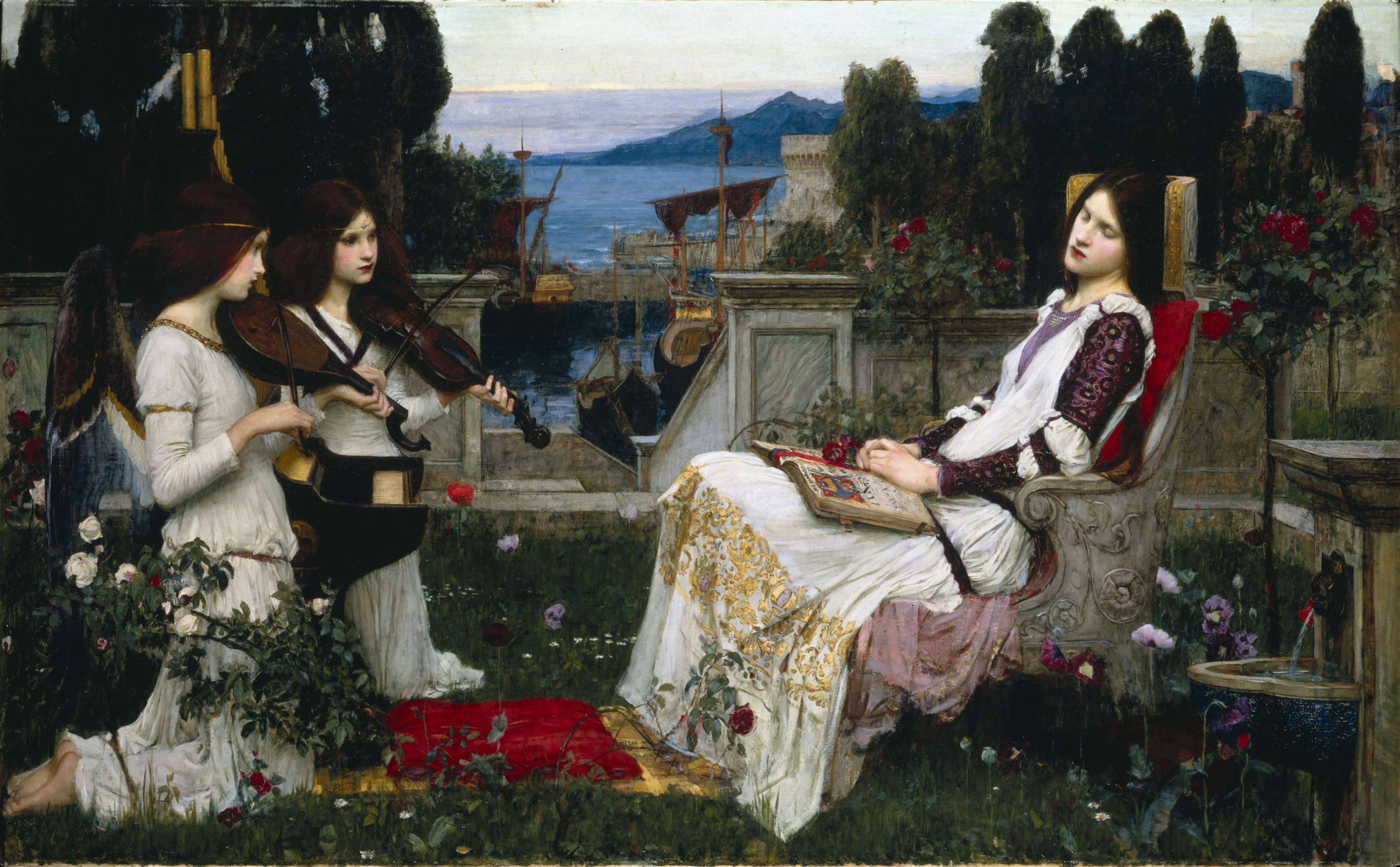
Not that the “high arts” are neglected: besides the Whistlers, there are some fine paintings, including Rosetti’s “Bocca Baciata”; a nude by George F. Watts that presents an Eros frank among the Victorians; Leighton’s study in serene sensualism, “The Bath of Psyche”; and John William Waterhouse’s sweet, if a little overly elaborated, masterpiece, “Saint Cecilia,” where two angels kneel, poised over their viols, wondering whether they should continue playing for the saint sitting in a chair across from them, asleep.

This wonderful exhibit is curated Dr. Lynn Federle Orr, of the Fine Arts Museums of San Francisco, and Stephen Calloway, of the Victoria and Albert Museum, in London (the exhibit was seen at the latter museum and at the Musée d’Orsay before coming to San Francisco, its sole U.S. venue).

After spending some time here, you may find yourselves agreeing wholeheartedly with the quote from Richard Jeffries: “The hours when the mind is absorbed in beauty are the only hours we live.”


Christopher Bernard is a San Francisco poet, critic and novelist (A Spy in the Ruins) and co-editor of Caveat Lector magazine (www.caveat-lector.org).


 

Poetic essay from a Bay Area writer

Look closely, judge what you think I am, hear clearly my voice, then judge once again, I’m making this noise, because I need a friend, who wont judge but accept, what I am in this world because, the glares from the ones, who appear to be them, burn deep in my soul and I cannot pretend, that this beam is just part of this strange alien, so judging, so smart, so feel my stem, the roots of my brain, we’re all the same lens, perceiving diversity and focusing then, on the adverse unity some let-be progression, when the lines between you and me are clearly prisons, and we’re all just prisms, so lighten your load my hands are your friends, and my smile’s the brightness through darkest tunnels, because all i promote, is energy, zen, and the peaceful zygote, regardless of race, gender or hope, all blossoms from one love-balancing flow, and the one who has written this piece has chosen this callous deceit & wrote with its feet for you to be freed, from violently hateful destruction & malice, because the you and the me that were once little kids, still have the same powers, imagination and time, but they’re memories not hours, so let’s set aside, the lack in our lives, that has drawn us to all this chaos inside, we can still seek and hide, just don’t loose the sight, of this vision of mine, for distracting the hunter, when peer prey falls behind, because my back is your back, we both have a spine, we’re all just friends here, the enemy’s mine, so the only war that exists is the one within mind, a vortex from our cortex where we share the same lives, how many times I’ll implore this, same state of mind, repeating ‘its formless’, before you begin to decide, that the dreams that you see, regardless of height, are the same as the difference, between wrong and right, or the end and the start, there really just isn’t, but a concept of time-timing constants, mere choices from which, beliefs have derived, and beliefs become real, but now these words have arrived, from your heart now ‘s the time, release all the pain that could ever reside, & you’ll find new loving-logic to lead you, extremely precise, to the dream that’s your life, where both spirit and science coexist throughout time, how do I know this? What are you, what am I?…

— From a San Francisco Bay Area writer who goes by “Quest Forself.”

Stop, Thief! May’s Whose Brain Is It, a monthly neuroscience column from Leena Prasad


Stop, thief!

topic anger
organ amygdala
chemicals adrenaline, dopamine, serotonin

The vibrant colors of the murals in Clarion Alley in San Francisco awaken my senses. The twilight is perfect for capturing the mood via photographs.

I finish planning a composition and am about to click when a man on a bike rides by and snatches the camera from my hand. For a few split seconds, I do not comprehend or accept what has just happened. Then I start to scream: He stole my camera! He stole my camera!

I feel violated. I have several months of photographs in that camera. My camera!

I run after him, screaming, as he turns right onto Mission Street. I realize that I have lost my photos and will not be getting them back but I am unable to accept this fact. I continue to scream. Then a strange and unexpected series of events occur.

The man who has stolen my camera comes back into the alley on foot. He holds up the camera as if he is going to give it back to me. I reach for it, unsure as to what is going on. He runs with the camera tightly held within his large hand. What happened to his bicycle, I wonder but I do not have time to consider this. He is running now in the opposite direction from Mission and towards Valencia Street. He is running towards the Mission Police Station! I doubt that he realizes this, however.

I start screaming at the top of my lungs and run after him. I am not saying anything this time. I am simply making a deep guttural sound, primitive language-independent screams of distress.

A policeman on a bike rides by me and asks what happened. He is headed from Mission to Valencia, the same direction as the thief. I tell him and he rides after the thief, who has already disappeared around the corner on Valencia. Another policeman on a bike also chases after the thief. I wonder if this might be why the thief has abandoned his bike, to perhaps find a route that does not allow a bike passage. Or, perhaps his bike is stolen also.

Then I hear sirens.

I slow down and start walking instead of running. I am out of breath and feeling calmer. A group of people walk towards me “You are lucky, they got him,” one of them says.

Why do I react with so much aggression and without any consideration for my safety?

Surprise or fear can trigger an adrenaline rush. The quantity of the adrenaline released and thus the degree of reaction is determined by chemical factors. A low quantity of the “happy” neurotransmitters dopamine and serotonin in the brain triggers a higher degree of adrenaline production. In other words, the less happy the brain, the higher the level of adrenaline it produces.

When the thief ripped the camera from my hand, my adrenaline level probably shot up. The level of adrenaline might have been exacerbated even further by the fact that I was in an unhappy mood. I had left my apartment a few hours ago in an angry mood because I was upset with my boyfriend. This would have resulted in a depletion of dopamine and serotonin.

In a different state of mind, would I have screamed less and potentially let the thief get away? Or would I have not made the primitive guttural sounds that, in retrospect, seem to be an over-reaction to the loss of some photos, as precious as they might have been.

Low dopamine and serotonin and high adrenaline do not activate a response but only contribute to the activation. The response is activated in the limbic system specifically in the amygdala. The amygdala is one of the major organs responsible for the perception of threat and for triggering an emotional response. It can hijack the potentially rational responses from other parts of the brain and cause irrational reactions. In my case, I did not consider my own safety because I was furious that my personal space and property had been violated.

Later that day, when I am in the Police Station talking into a tape recorder and going through the story of what has happened, the police inspector asks me if I want to press charges.

“It’s wrong to steal and he should be punished. But he must have been really desperate to want to steal a camera,” my thoughts tumble out of my mouth. I decide not to press charges. Technically, it is not my decision because the district attorney will press charges anyway because the man was arrested. I did not know this at the time, however, and despite my conflict, I made a decision to not punish the thief any more than he had already been punished.

Perhaps I was being kinder because the dopamine and serotonin levels in my brain had surged back up when I found out that justice had been done and that I would get my camera back. Also, my boyfriend came to the police station and held my hand and kept me company while the inspector was talking to me. His presence might have contributed to the raised levels of the “feel good” hormones.

This is all hypothetical, of course, based on my knowledge of neuroscience and research on the neuropathy of anger. I would have had to be hooked up to an fMRI (functional magnetic resonance imager) to prove my hypothesis about the actions of the amygdala and the levels of adrenaline, serotonin, and dopamine in my brain. Nonetheless, it is fun to try to guess the biological triggers for my actions when confronted with a “fight or flight” situation.

References:

Dr. Goulston, Mark,Usable Insight, The Neuroscience of Anger, Monday, April 18th, 2011, http://markgoulston.com/usable-insight-the-neuroscience-of-anger/

George Teseleanu’s review of San Francisco Beatnik poet Mark Schwartz

 
This month’s assignment was to write a review about Mark Schwartz’s poetry. Although the information about him is scarce on the internet, I managed to find a few poems and some word about him. About the author I managed to find out that he was born in the Bronx and that he graduated from Cornell University. He started to be a regular at open poetry readings from ’81 forward and his style is influenced by the 1950’s Beatnik movement.
 
The poems that I found are a mix of a weird, funny sense of seeing the world and an acute social sense. He places sensitive matters in an amusing setting and so the reader isn’t upset when he reads the poems, but it’s pleasantly amused. The author likes to juggle with words, and to use them in unlikely scenarios, for example “will you wear my eyes” or “chewing a cop’s ear”, but this helps him to create a surreal world where he can easily hide sensitive problems.  His writing style is a relaxed one, since he uses a playful and informal tone.
 
Also, he is not afraid to use slang words in his poems, for example “doobie” or “stash”.
For the last part, I would like to share with you, one of my favorite poem by Mark Schwartz from the few that ones I found:
 
One thing that is good about the war
is that it took one’s mind off the earthquake
which took one’s mind off the drought
which took one’s mind off the homeless
which took one’s mind off of sex 
which took one’s mind off.
 
Mark Schwartz is a Beatnik performance poet in San Francisco, California. George Teseleanu, the reviewer, may be reached at blana_de_maimutza@yahoo.com
 

Bruce Roberts reviews Michael Sunnafrank’s Three of a Humankind

Three of a Humankind, a Review

By Bruce Roberts


Three of a Humankind, by Michael Sunnafrank, is an interesting book, filled with ideas relevant to human thought the world over. But is it a novel?

This book takes place in Napa, California, a world class tourist attraction, famous everywhere for wine and wineries, symbolic of “The Good Life.” Yet throughout the book, problems between the characters exist, endemic problems that undercut the euphoric tourist attraction world created by the Chamber of Commerce–something to remember when we’re in vacation mode, visiting pleasant places where real people live. Indeed, Napa here becomes a microcosm of class strife in the world. The town is dominated by the rich. They own the wineries, the country clubs, and earn everyone else’s hatred with their arrogant behavior.

In this book, driving these behaviors, on all sides, are spirits and demons. Yes, actual demons, who control the rich and see to it that they are properly greedy and arrogant at every turn. The chief demon is Mamona—the Biblical epitome of arrogance and greed– and he is upset—and vengeful—when two rich characters try to change their ways, for he fears to offend the head demon—The Master. Mamona is counterbalanced by a variety of spirits who advise and inspire the non-rich characters: The Grandfather, The Enemy, the Hawaiian god, Pele, a man in a hat, even an eagle. Toward the end of the story, even Ronnie, a long-dead friend, materializes in an old white jeep yet. Who knew spirits could drive? In fiction, of course, anything goes, but this infestation of spirits and demons does not make the story more believable.

In teaching writing all my life, the standard rule, for fiction at least, has been “SHOW NOT TELL.” This author missed that lesson in junior high. He “TELLS” 90% of the story, so it’s really more like a political and philosophical treatise than a novel. There are a few scenes where he attempts to let action “SHOW” what’s going on, but even those are heavily framed in “TELLING” the philosophical basis behind them. His is a total third person, omniscient narrator, a style that gets old quickly. Even when the narrator is reading the characters’ minds, nearly every thought seems, again, a political diatribe.

The author and I, politically, are kindred spirits. I subscribe to The Nation, a very “liberal” magazine, and this book is like a long Nation editorial. Characters and spirits have been added for a little spice, but they are essentially mouthpieces—talking heads– for the author’s political ideas. And I agree with them. I think the author’s understanding of our nation’s problems, from a “liberal” point-of-view, is right on. Yet the fact that I’ve “heard it all before,” detracts from my interest in this as a novel.

Through all the improbable spirits, the mouthpiece characters, and the political diatribes, one idea does stand out as a different way of defining the human condition—that the root of all our problems is our self-centeredness. Any human-caused problem can be defined this way, from war to politics to sibling rivalry over the family bathroom. People look out for themselves first, instead of caring for those around them. But while some of the characters certainly exemplify this, we are mostly told about it, instead of watching it develop naturally through the characters’ words and actions.

So, if you’re interested in a beautifully written novel, the kind that makes you want to read aloud and savor every word, filled with vivid atmosphere, unique characters, and startlingly new ideas, this book is not for you. However, if you want a clearly-written dissection of America’s problems, from a liberal point-of-view, with a trip to Napa and myriad demons and spirits thrown in for spice, then take a chance, and read Three of a Humankind, by Michael Sunnafrank.

 Bruce Roberts may be reached at brobe60491@sbcglobal.net and is an accomplished sculptor and schoolteacher from Hayward, California. 

Poetry from J’Rie Elliott

“…Some endings are not nice…”
By: J’Rie Elliott
He watched her through her window pane,As she moved in her room;Her body drove his mind insane,

He would put her in her tomb.

The night drew on as he stood and hid

He never made a sound;

Just watched her dress, then watched her sleep—

While no one was around–

The sun brought light and daytime warmth,

As he slept in the bushes outside—

She dressed and made ready for the day ahead;

Unaware she should run and hide.

We never think of the things so simple;

That alter each day of our lives.

If she had she never would have agreed,

For him to give her a ride—

A year ago to the day

She sat inside his car;

A friend of a friend or a cousin of a friend

She thought she was safe by far.

That night had been without event;

A blown out tire without a spare—

So she climbed inside and said “Take me home”

Her life was without care.

She saw him at the coffee shop,

She saw him at the store,

And then again at Sunday church;

You see it was her he did adore.

He planned it out,

To the last detail;

How they would spend their special day.

Roses, wine some soft candle light—

Then with him she would lay.

The day it turned and twilight fell,

And as always she journeyed home.

To her cat, her dog and little goldfish–

She always came home alone.

He waited until she was in the bath,

To make his presence known.

Her face was covered as she rinsed her hair.

When came time to make his presence shown.

He grabbed her by her arm and then,

She screamed and slipped away

He grabbed again at her nakedness—

This time his grip did stay.

He professed his love for her,

And said “I know you love me too.”

But fear was there inside her heart,

Yet there was nothing she could do.

He pulled her from the soapy tub–

And into the room he prepared.

How had she not known he was in her house–

Oh how she was so scared.

He wrapped a towel around her breast,

As he sat her down to wine.

She tried to do just what he asked,

Hoping things would be fine.

He ranted and he rambled on,

About all the times they shared;

The laughs, the dance, the midnight dreams—

Things that were never really there–

Then her fear turned to dread,

As he said, “Let’s go to our room.”

She knew what he wanted and what to expect;

Her head began to swoon.

He caught her as she swayed to faint,

And slapped her face awake.

“Wake up my love.  You’ll miss the fun.”

He was not about to wait.

She would not go silently into the forever night,

Nor would she let him take her with ease.

Now it’s time to put up a fight,

And make him say “No please.”

She threw her head into his face,

Breaking his nose with the blow.

Then grabbed the lamp and cracked his head,

Time seemed to move so slow.

He dropped to the floor with blood on his face,

She jumped to flee the room;

He grabbed her foot and pulled her down—

This fight would not end soon.

He called her names and screamed in pain

As she bit him on the arm;

He slapped her face and knocked her down—

Now he would do her harm.

This story ends with a death—

There is no reason why.

There is no moral to be derived from here,

Just a family left to cry.

I relayed the facts as known to me,

Simple and concise—

Some outcomes we cannot change;

Some endings are  not nice.

J’Rie Elliott is a mother, wife, daughter, and accomplished horseback rider from Alabama, USA. She can be reached at dixiepoet@gmail.com

Poetry from Justin Karfs

Old Proposal

I just want someone, to be there with me
Stick through defeat, and victory
Through the highs, and past the lows
There to help me handle the blows

Cause life is tough, the world unkind
Id like you there for peace of mind
Because I think your just divine,
Would you please, be mine?

Yes, the word I hope to hear
Being alone, my only fear
To never ever have you near
Hell, Id rather cut off my ear!

Id rather not swear us to secrecy
Not just smooch at the speak easy
I really do love you so much,
Your kisses sweeter than the dutch
I don’t mean to feel so much,
But being without you life’s on a crutch

So at last I get upon thine knee,
And solidfy our bond, I to she
I certainly believe this meant to be
So darling will you, marry me?


Never Say Forever

You’re beautiful
I heard him whisper
As his soft hands touched my gentle heart
Forever he says
Such sureness in his tone
Forever right now I respond
For the future is putty
No definite shape

Coffee? He asks
No, I swiftly respond
Why would I want to wake from this,
Dream
An adrenaline shot
Preventing me from entering the peace of death
Twisted comparison?
Thats what you do baby, I say
You twist me up inside

Forever always, he replies
There goes that word again
7 letters, isn’t that a lucky number?
Lucky, ha, for a word that cause heartache
Like a man who spends his money on the lottery
Once in a while you get a winner,
But for the most part, disappointment
Sorrow
Anger

Too many heavy promises
Broken, rope cut
Smash into my already fragile heart
State of mind, red, blue
Strange, our world, rivals
In the emotional spectrum of life,
Copilots
Sadness, the calm before the storm
Anger, one mean motherfucker

Stop, I say quickly
Because underneath I see
I, just a notch in the belt
You, another knot in my noose

Before the floor drops
I drop you instead
Out I shout
Or You’ll be dead

Tears run down
As you leave my house
While I lay here
Quiet as a mouse
Cliché?

Forever baby,
More like
Forever on guard.


Justin may be reached at jkarfs@gmail.com