Laura Weinbach of Foxtails Brigade

[Article by Jaylan Salah]

Ever since they started making music in 2006, the Foxtails Brigade have created their own individual style as an acoustic band emerging from the crowded streets of San Francisco. Founded by Laura Weinbach, Foxtails is a band with a voice, combining string-heavy folk with chamber pop, accompanied by the angelic, deep voice of lead singer Laura.

For Synchronized Chaos, we had the pleasure to interview Laura Weinbach, asking her various questions on different kinds of topics. Laura started by saying that her musical influences mostly come from within her intimate group of family and friends. She was greatly influenced by her brother Brent Weinbach, her band mates Anton, Joe and Josh, and her close friends Billy, Tony, and little Freddy Fuckface. In a broader sense, Laura was also influenced by the great Billie Holiday, Joanna Newsom and Faun Fables.

Laura was a typical funny gal from SF, with a sharp wit and a great sense of humor, as shown through our interview. Although the band’s distinctive musically by their lack of a traditional drummer and their emphasis on handpicked guitar, intricate violin and cello arrangements, Laura stated that the uniqueness of their band came from her costumes; plaid shirts, tight jeans, and Converse, and the fact that she had a beard.

Moving on to Foxtail’s song choices, Laura started by thanking God, then Miller Light for cracking a cold one for her every Disney afternoon. She also mentioned her family, her producer Harvey Ozwald and everybody else at Miramax films, and her deepest gratitude went to her director Tupac “whose words of wisdom I will always cherish and use as a guidance counselor”. Being the free spirit that she is, she stated that her song inspiration came from her experiences in substitute teaching, fairytales, Target, and PH Bullet use.

“I go to Target and skim through the bathroom section,” she said. “They usually have some pretty good deals on PH Bullets and lyrics there. It’s always good when lyrics come out first because it makes the music flow a little more smoothly. But it’s different pretty much every time.”

PH Bullets even got her through tough times and depressing moments when she thought she would completely give up.  But that wasn’t what made her become more daring in expressing her music. She grew balls in terms of her expanding her musical style when she teamed up with her Foxtails buddies; with herself on guitar and vocals, Anton Patzner on violin, Joe Lewis on bass, Josh Pollock on percussion, and Geoffrey on jockstrap. The team played hard last year and she added, “We’re gonna get back out there next year and break some sweat, break some ‘straps.”

Foxtails Brigade has been touring some European cities and playing in the streets. Their best experience so far was Reykjavik, Iceland, after that they headed to Paris and later they were going to visit Japan, Historic Filipino town, Sao Paulo, San Pablo, and Grant Lyon.  When asked about the reason behind choosing music as her preferred medium for self-expression, Laura said that although she once attended The Orpheum Theatre in Memphis to see “Poetry of the Penis” she was not a huge fan of the spoken word. She added that she hoped to “achieve music XL one day.”

Aiming to satisfy the curiosity of our foreign readers, we asked Laura if she ever expanded her music style by listening to some worldbeat music, maybe something Afro-Asiatic. She replied that she loved the Aladdin soundtrack and would have loved to be Jasmine and go on that magic carpet ride, or to become a genie and sing “Who Ain’t Never Had a Friend like Me”.  Also her band mate Anton had become obsessed with Afro-beat music and had gotten her into it. She added that the band was always up for new music challenges and adventures.

On what makes watching “Foxtails Brigade” live different from just listening to their CDs, Laura said that she did a unique “defecating on stage” routine as a shout out to the late “Punks Pumps” and their legendary “Here’s the Pump”.  Their songs convey eccentric themes and messages, such as life, Steph and the sweet hereafter or as Laura named it “Steph by chocolate”.

Since they were on tour for a long time, many funny or strange incidents have happened to them on the road. About a certain captivating memory in Iceland, Laura says, “On our last night [in the country] while we were playing our set, the Northern Lights appeared unexpectedly and left when we finished playing. We thought we missed them but they came back about an hour later and were in full-fledged action moving across the sky like giant angels taking in codes. It was awesome. ”

Laura finished her interview by implying how Foxtails’ music has grown over the years “by developing breasts, some pubic hairs and a third nipple for the devil to suck on” and she hoped that would be enough to take them to the top of the charts. Let’s hope for that, too.

Don’t miss out on Foxtails Brigade’s third album, released on December 3rd, 2011, entitled “Time Is Passed” – www.foxtailsbrigade.com.

——————————————————————————————————————-

You can reach Jaylan Salah at vigilante171@yahoo.com.
Performance Review: Cutting Ball Theater’s Production of “Tontlawald”

LOST IN THE GHOST FOREST

Tontlawald

Reviewed by Christopher Bernard

This premiere of a collaborative performance piece, with a script by Eugenie Chen, by the adventurous and brilliantly talented Cutting Ball Theater, has moments of great beauty and genuine poetry as it takes risks with an audience’s ability, and willingness, to disentangle a more or less straightforward story from a complex of music, movement, simple but evocative sets, and an oblique text that waxes and wanes between genuine poetry and unhelpful obscurity.

There’s much splendid singing, some skillfully stylized movement, and a sometimes willfully unclear script that can leave the audience feeling as lost as the main character in the ghost forest, or Tontlawald, of the title. The collaborative aspect may have been taken a bit too seriously: I sensed the absence of a single strong vision to bring the often wonderful parts into a securely successful and meaningful whole.

“Tontlawald” is less a play, or even a drama, than it is a staged dance-cantata with spoken word, based on the not-entirely-digested principles of Grotowsi’s “poor theater” (the essence of theater is body, voice, movement; everything else is décor) as exemplified by the Polish company Teatr ZAR, which performed in San Francisco last year and inspired co-director Paige Rogers (who directs with Annie Paladino) to this first effort at incorporating their principles. And as with many a first effort, it’s not quite there yet; by trying to do too much, it sometimes does too little, yielding satisfactions that are sometimes more the intellectual kind of solving a puzzle than the emotional kind that only art can yield. But it’s certainly a promising one, and one can only hope Rogers will continue down this path.

The piece is based on an Estonian legend, detailed in Andrew Lang’s Violet Fairy Book, published a century ago, about Lona (played by the accomplished Marilet Martinez), a young girl tormented by that standby of many a classic fairy tale, an evil stepmother (exemplary characterized by Madeline H.D. Brown), and neglected by an indifferent father (a thankless role ably taken by Wiley Naman Strasser). Her family lives near the edge of a mysterious forest inhabited by spirit-like creatures thought to be fatally dangerous by the locals: exemplars of a society’s ever-feared “other.” But one day Lona, while strawberry picking, ventures deep into the forest, thinking that nothing she could find there would be worse than her home life. And in the forest she is met by a maiden (played by an endearing Rebecca Frank) who befriends and takes Lona home to live with her, where Lona finds a happiness she couldn’t have hoped for in her “real” home.

The maiden’s mother, who takes Lona in as a second daughter, makes a copy of Lona, a kind of golem, out of mud and a drop of the girl’s blood, but also containing a black snake sealed up in its breast, who returns to Lona’s family home and takes her place, to be beaten and berated by the evil stepmother but incapable of being harmed. One day, the evil stepmother is so enraged, she tries to kill the clay Lona; the black snake emerges and bites the stepmother, and she falls dead. Later, after lamenting the death of his wife, the father finds the piece of bread on a table, which he eats, and the next morning his corpse is found, stark and swollen.

Lona lives happily in the enchanted forest until she reaches womanhood, when, much to her sorrow, she is forced to leave the Tontlawald, to take on the burdens and joys of adulthood.

So far, so good, at least in terms of clarity. However, the Cutting Ball’s performance relies too heavily on the audience knowing a fairy tale that will be unfamiliar to most, and it sometimes becomes difficult to care about Lona’s misery or her joys. And the author couldn’t resist the temptation to throw in undigested, if tantalizing, ideas that are never developed: for example, in an allusion to the ghost-forest stage set – a hulking, box-like mesh – there is a reference to strings, dark matter and quantum entanglement that is dropped as soon as it is mentioned, and thus seems gratuitous: the sort of thing an audience should be led to think of on their own, and not pointed out to them unless it is going to be seriously engaged (an elementary rule of contemporary theater: never, ever, mention string theory unless at least one of your characters is a physicist).

On the other hand, the music (of which there is much) has no weak spots and is made up of a mélange of haunting European folk singing (reminiscent of “Le Mystere des Voix Bulgares” recordings that were a hit in the 90s), classic American pop songs, an excerpt from Mozart’s Magic Flute, and other pieces. The music is sung (and occasionally strummed on a child’s cello) by the eight-member cast with admirable vigor and sensitivity. Standouts include Cindy Im and Sam Gibbs.

——————————————————————————————————————————————————

The Cutting Ball Theater

The EXIT on Taylor
277 Taylor St.
San Francisco, CA 94102

Christopher Bernard is the co-editor of Caveat Lector magazine and author of the novel A Spy in the Ruins.


Performance Review: “Voices of Light: The Passion of Joan of Arc” from Cal Performances

OF LIGHT AND MUSIC AND PASSION

Voices of Light: The Passion of Joan of Arc

An Oratorio with Silent Film

Music by Richard Einhorn, film by Carl Theodor Dreyer

Baltimore Symphony Orchestra, UC Choral Ensembles and soloists

Conducted by Marin Alsop

Reviewed by Christopher Bernard


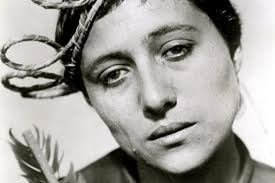
Carl Theodor Dreyer’s triumph of the terror and beauty of art, “The Passion of Joan of Arc,” a silent film premiered in 1928, and believed for two generations to be, in its original incarnation, lost, was voted by the curators of the Toronto International Film Festival two years ago as the most influential film ever made.

Cal Performances – founded when Sarah Bernhardt performed a benefit for the survivors of the 1906 earthquake, and since then one of the liveliest presenters of theater, music and dance groups in the United States – has once again risen to the occasion in bringing to UC’s Zellerbach Theater, for one performance, on March 31st, one of the musical and cinematic hallmarks of the last two decades: Richard Einhorn’s “oratorio with silent film,” “Visions of Light,” performed to a screening of that silent masterpiece now triumphantly restored thanks to the more mundane but no less impressive miracles of digital technology.

The film’s history is a drama in itself: based on the transcript of the trial for heresy by a court of English and Burgundians of the young shepherdess from Domremy whose visions of angelic voices (awakened by the tolling of the village bells as she sat at watch in the local pastures) led her to take up the sword to defend 15th century France against the invading English, it was made using many of the same technicians and even several actors as Abel Gance’s work of total cinema “Napoleon,” shot the year before (and which, coincidentally, was also screened with a full orchestra in the San Francisco Bay Area on the same weekend as “Joan,” creating a embarrassment of riches, and a paralyzing choice, for many a cinefile). It featured Renée Jeanne Falconetti in, in the opinions of many, one of the most searing acting performances ever committed to film (so searing for the actress that she vowed never to act in a film again – a vow that, unfortunately for us, she kept) and the young Antonin Artaud as her defender at trial.

Received with mixed reviews at the time (and suffering from the same historical turn that sent “Napoleon” into history’s deep-freeze for decades: the premiere of “The Jazz Singer,” which almost immediately made silent films seem obsolete, technology once again giving art an almost mortal wound), the film’s negatives and most of its prints were subsequently destroyed in a fire. Dreyer laboriously pieced together a print from outtakes and pieces of remaining prints, but the Danish director died thinking his original masterpiece had been lost. Then in 1981, long after the deaths of the film’s principals, a print was discovered in a janitor’s closet in (in a curious example of poetic justice) Denmark: a complete print, in almost pristine condition, with Danish intertitles, of the original film.

The experience of the film with Richard Einhorn’s music – an extraordinary act of loving creation and recreation – is of the highest intensity. The richly inspired oratorio was premiered at a now-legendary screening in 1994 and has been performed since more than 200 times, both with and without the film. Einhorn’s score is based largely on the modal scales of medieval music and the motivicly based repetitions of so-called “mystical minimalism” made popular by Henryk Gorecki and Arvo Pärt, with a text based on extracts from the Bible and writings of women writers and mystics of the time – from the redoubtable proto-feminist Christine de Pizan, who eulogized “La Pucelle” during Joan’s brief and glorious career, and the 10th century lyrics of Hildegard von Bingen, to more recondite texts by Umiltà da Faenza, Angela da Foligno, Marguerite d’Oingt and Na Prous Boneta (alternating with anti-female scurrilities from the patriarchs of the era), and including letters dictated by the illiterate Joan bearing news of her near-miraculous – and perhaps truly miraculous – military victories.

The experience of music and film together is of an amazing power and beauty, not least thanks to the forces performing under the inspired control of Marin Alsop, music director of the Baltimore Symphony Orchestra, which performed with equally magnificent singing from the UC Choral Forces. Not to be forgotten are the contributions by the soloists, of whom the quartet of sopranos and mezzo-sopranos – Elinor Broadman, Stacy Rutz, Genoa Starrs and Michelle Lee – must be singled out for their singular, and collective, magic.

Alsop has been taking “Visions of Light” on a world tour with the orchestra as part of the BSO’s season-long project featuring “revolutionary women.” At the head of that battalion the spirit of “la Pucelle” (a word often translated as “maid,” but meaning more a soul good and pure) bravely marches.

——————————————————————————————————–

Christopher Bernard is author of the novel A Spy in the Ruins and co-editor of Caveat Lector magazine (www.caveat-lector.org).

Performance Review: “The Abduction from the Seraglio” (Mozart), presented by Pocket Opera

[Reviewed by Jessica A. Sims]

Pocket Opera opened yet ANOTHER season (35 in all, but who’s counting?) triumphantly with founder Donald Pippin’s adaption of Mozart’s 1782 masterpiece The Abduction from the Seraglio, expertly chosen cast with an amazing backing from the opera’s philharmonic, I was entranced from the second the hero, Belmonte (played by Jonathan Smucker—imagine a Ken doll that sings, beautifully, and that’s Smucker) raced through the crowd, asking random opera-goers if they had seen his friends. The stage was sparse, with only a few accents thrown in, really allowing the singers (and Donald, forever present as the unofficial “time keeper” one  can get so lost in the opera!) to tell the story properly

The Abduction from the Seraglio waxes poetic on the power of love, being lost in a foreign land and most importantly, the epic human capacity of forgiveness, no matter our background, no matter our position in life, we can all forgive. Playing the lovable Pedrillo, Michael Desnoyers did NOT disappoint, his tenor as clear and crisp and his comedic timing was better than most I’ve seen lately, while William Neil (a Pocket Opera veteran) was just amazing as Osmin, the mean old police watch dog to John Nichols’ Pasha Selin, who was dignified and commanding every time her stepped on stage. Each man was truly a leading man from where I was sitting.

But I have to give it to the ladies on this one: Elise Kennedy as Blondie was just pure pitch perfection, and a breath of fresh air during some of the heavier moments. And bravo to Suzanna Mizell as Constanza—her numbers were absolutely breath-taking, a true delight for the ears.

I have always loved opera and I cannot applaud the Pocket Opera enough for making it accessible to the masses, with affordable tickets, accessible locations and ENGLISH lyrics. My only regret? It was over too soon.

——————————————————————————————————————————————————————————–

You can contact the reviewer, Jessica A. Sims, at jessica.sims12@gmail.com.

Performance Review: Chanticleers’ Production of “Moon Over Buffalo”

[Reviewed by Bruce Roberts]

I love a good farce. I can never get enough of sight gags, pratfalls, faulty hearing, slapstick, mistaken identity, rapid-fire and exaggerated movement, and multiple doors through which to appear, and disappear — all laced together with incredibly witty dialogue. These thoughts whirled through my head recently as I enjoyed a wonderfully animated performance of Ken Ludwig’s Moon Over Buffalo at Chanticleers, the excellent community theater in Castro Valley, California.

Directed by Jim Colgan and Bill Chessman, the plot is simple. An acting couple, George and Charlotte, played masterfully by Randy Anger and Dana Lewenthal, relegated to doing repertory, small-time theater in Buffalo, and other such acting backwaters, gets another chance at stardom. The famous director, Frank Capra, casting for a movie, is coming to watch them perform. The chance is theirs to mess up, so of course they do, because characters who do everything right just aren’t funny.

Comic complications arise because the relationships here are like accordions — constantly moving in and out. The main couple is at each other’s throats one moment, on the verge of breaking up, then madly in love the next. Their daughter Ros, played by Cynthia Lagodzinski, was in love with Paul (C. Conrad Caty), but left him for Howard (Frederik Goris) before finding Paul again. Howard was in love with Ros before meeting Eileen (Audrey Carstensen), who almost broke up George and Charlotte’s marriage, but now loves Howard. Love’s instability is a key part of the comic shtick here.

This is a cast of show-stoppers all. Every action and word was performed over-the-top, from the wildest argument to the most passionate kiss. A stare, a raised eyebrow, a double-take — all could put the audience in hysterics. Lindi Press, as the grandmother who sometimes wore her hearing aid, but mostly not, played subtle contrast to her wildly dramatic co-stars, thus stealing most scenes she was in. Randy Anger, George the leading man, shifted gears smoothly throughout the play from volcanic anger (no pun intended) to warm, sincere love, to a wonderfully comic drunk. His voluminous Shakespearean voice, and his quick, articulate delivery of complex lines provided an eloquent base on which this hysterical comedy was built.

In short, anyone feeling blue should scan the drama news for Ken Ludwig’s Moon Over Buffalo.  It’s usually playing somewhere and guaranteed to lift spirits. Anyone interested in quality community theater, should get tickets to most any performance at Chanticleers, Castro Valley, California. Put them both together, and a terrific theater experience awaits.

——————————————————————————————

You may contact the reviewer, Bruce Roberts, at brobe60491@sbcglobal.net.


THE PINE BOX — A New Stop in Seattle

[Article by Bruce Roberts]

Take three friends, with varied skills and background, but one unified dream.   Add in a beautiful building, iconic in the history of Seattle, Washington.  Mix with a thriving Seattle population that loves beer even better than Starbucks, and create a surefire recipe for success. Opening in Seattle at the end of March, 2012, a terrific new pub and restaurant — The Pine Box.

Built in 1923 as Butterworth’s Funeral Home, then resurrected as The Chapel, a bar/restaurant in 2003, this beautiful building has been vacant since 2009. In 1973, it achieved cult status forever as the site of Bruce Lee’s funeral. Hollywood stars Steve McQueen and James Coburn, martial arts students of Lee’s, were pallbearers as action-movie fans the world over mourned.

Now, however, it has been resurrected as The Pine Box, thanks to the incredible hard work of three friends: Mark Eskridge, Dean Hudgins, and Ian Roberts. Mark is the finance expert, a man with a business degree from Cornell University. Dean is the builder, a man with many years of experience as a manager, a sculptor, a builder. Ian, long-time manager of popular Brouwer’s Belgian Pub/Restaurant in the Fremont district, has the practical experience of actually running a pub. Plus, as the co-founder and promoter of Seattle’s successful Beer Week for the last three years, he claims to know every beer drinker in the state, and is sure they will patronize The Pine Box.

With former church pews available for bench seating, and solid tables and the bar built from old fir found in the basement’s casket room, this new pub will combine the elegant accoutrements of a classy mortuary, with the more down-to-earth elements of wooden bench seats and hand-made bar and tables. There is even balcony seating, for those who like to imbibe with a view.

The menu, overseen by experienced chef John Macafee, will focus mainly on gourmet pizza, with such exotic toppings as Arugula, pecorino, andouille, buffalo mozzarella, and roasted jalapeno garlic sauce (not all on the same pizza — unless you want it that way).  The brand-new, state-of-the art Wood Stone ceramic pizza oven will easily crank out enough pizzas to keep up with an active, munch-hungry crowd.  Or, have a salad, made with fresh greens bought daily at Seattle’s famous Pike Place Market.

And the draft beer selection, from local to international, will certainly give patrons cause to munch. The Pine Box will feature local brews, such as Fremont Brewery’s Brother Imperial IPA and Port Townsend’s Nitro Scotch Ale. San Francisco’s Sierra Nevada contributes Hoptimum, while Lil Sumpin’ Wild from Petaluma, California’s Lagunitas Brewery stretch the Pine Box’s beer sources, which run internationally too. Belgium’s St. Bernardus’ Abt 12 and Guinness’ Irish Stout are just two of several European brews on the menu, which provides a broad beer selection for every taste.

Anyone who knows Seattle knows that it is a chain of neighborhoods and districts, each containing outstanding  restaurants,  coffee shops (and not ALL Starbucks), book stores, cupcake shops, dogs, pubs, and the best clam chowder everywhere:  all the requirements for a mellow life. With the opening of the Pine Box officially on March 26, the Capitol Hill neighborhood will once again have a complete array of small businesses to complete life’s essentials for its residents.

Stop in some time.  Say hi to Mark, Dean, and Ian. Have a beer. Have two! Prost!

—————————————————————————————————–

You may contact Bruce Roberts, at brobe60491@sbcglobal.net.

Whose Brain Is It? [April 2012 – Leena Prasad]

Whose brain is it?

by Leena Prasad

Presented within the flow of the lives of fictional characters, this is a monthly column with a journalist’s perspective on brain research.


I catch a glimpse of rice and mackerel. She is holding a small piece in-between her thumb and index finger. That’s the authentic way of eating sushi, instead of using chopsticks, I think.

But something else happens in my mind also. My friend and I have just been seated at the Japanese restaurant and have not even looked at the menu. Yet I can almost taste the saba (rice and mackerel) and memories of the sour salty taste make my mouth water. I recall a class lecture from my neuroscience class about mirror neurons.

I am not in the medical profession but studied artificial intelligence as part of my computer science curriculum and later worked in the field. This led to an interest in neuroscience. I use my graduate school training as a journalist to research and explore the brain using what I learned in the introductory neuroscience class as a basic foundation for my journey.

But, this is not a story about me or about sushi.  It’s about specific neurons in my brain and in yours – nerve cells that help us connect to each other’s experiences. These neurons are helping to answer questions ranging from feeling hungry while watching someone else eat to feeling the pain of another person to the excitement felt by sport audiences, to learning by watching someone do something.

When I see the saba, the occipital lobe in the back of the brain, processes the visual information. The hippocampus and other parts of the brain retrieve the memory of my own experiences with saba. When I eat the sushi, neurons in the premotor cortex, in the frontal lobe of the brain, enable me to use my fingers to pick up the sushi, bring it to my mouth, and to eat it. Every single action, from the details of the movement of my arms and fingers to the complexities of biting and chewing are handled by the premotor nerve cells.

But if I am not eating the rice and mackerel myself, how is it that my mouth waters as if I can taste the sushi?

As human beings, most of us (excluding people with autism and other brain related diseases) understand empathy. Now, neuroscientists are exploring the coding of empathy within our brain. They have discovered nerve cells which mirror the actions of other people as if we are experiencing what we see. These neurons reside in the premotor cortex along with the premotor neurons which cause motor reflexes. Mirror neurons are a special subset of the premotor neurons and they fire whether we perform an action ourselves or watch others perform the action.

Mirror neurons were discovered by researchers in Parma, Italy in 1992. The scientists had placed electrodes in the brain of a monkey to record and study nerve cell activity by amplifying the sounds made inside the brain when a neuron fires. By chance, they heard the same set of premotor neurons fire off both when the monkey was picking up a peanut and also when the monkey was just watching someone else pick up a peanut. Similar experiments were repeated in monkeys and humans by several follow-up studies conducted by the scientists at Parma and by other scientists around the world.

“I predict that mirror neurons will do for psychology what DNA did for biology,” says Dr. Vilayanur Subramanian Ramachandran, a Professor in the Department of Psychology and the Neurosciences Graduate Program at the University of California, San Diego. In a recent TED lecture entitled “The neurons that shaped civilization” Dr. Ramachandran theorizes that a lot of human learning, and thus evolution, probably speeded up due to mirror neurons.

There are two types of mirror neurons, according to Dr. Christian Keysers, a Professor at Netherlands’ largest medical faculty, the University Medical Center in Groningen. The two types are: strictly congruent and broadly congruent. The strictly congruent neurons are activated for very specific familiar actions. So, when I watch someone eat saba or eat it myself, I’m using strictly congruent neurons. The broadly congruent neurons are activated for actions that might be unfamiliar to me. For example, if I start taking classes in auto repair, I would be using broadly congruent neurons since I do not know much about this topic.

This is an exciting discovery. I found many articles and books and videos on the topic.  A lot of the current research is speculation and excitement with a smattering of data to backup the assertions.  There are ongoing discussions and experiments to locate mirror neurons in other parts of the brain, in addition to those in the premotor cortex. This trendy subject has been used to explain a range of behavioral phenomena such as language learning, empathy, and lack of emotional intelligence in autism. I look forward to learning more about these neurons as scientists gather more data and develop theories on how the knowledge can be used to understand and fine-tune human behavior. For now, at least I understand why I can taste the sushi by just looking at someone else put it in her mouth.

 —————————————————————————————————————–

Please send feedback and suggestions for future columns to leena@fishridingabike.com. Go to WhoseBrainIsIt.com for links to past columns and to FishRidingABike.com for Leena’s writing portfolio. Leena has a journalism degree from Stanford University.

Dr. Nicola Wolfe is a neuroscience consultant for this column. She earned her Ph.D. in Clinical Psychopharmacology from Harvard University and has taught neuroscience courses for over 20 years at various universities.

References:

Ramachandran. Vilayanur Subramanian. Ph.D. The neurons that shaped civilization: VS Ramachandran. TED Talk, January 4, 2010

Keysers, Christian, Ph.D. The Empathic Brain. Social Brain Press, 2011