Shadowscapes: Stephanie Pui-Mun Law


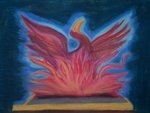
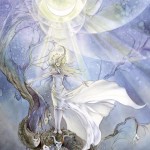
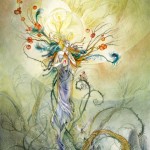
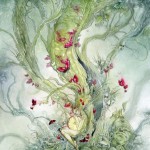
Descriptions, from the top left:

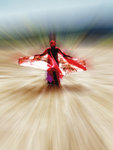
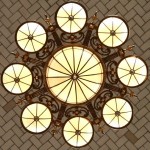
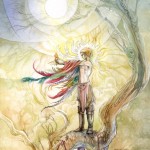
Like a strange blossom, or a butterfly emerging from its cocoon with crumpled and still-damp wings; she stretches out her tendrils. Uncoiling, unfolding, unfurling so slowly you might not notice it. She shakes her filaments, and reaches to the firmaments.

She tilts her head up. She closes her eyes. She feels the pulse within her: no ends, no beginnings.
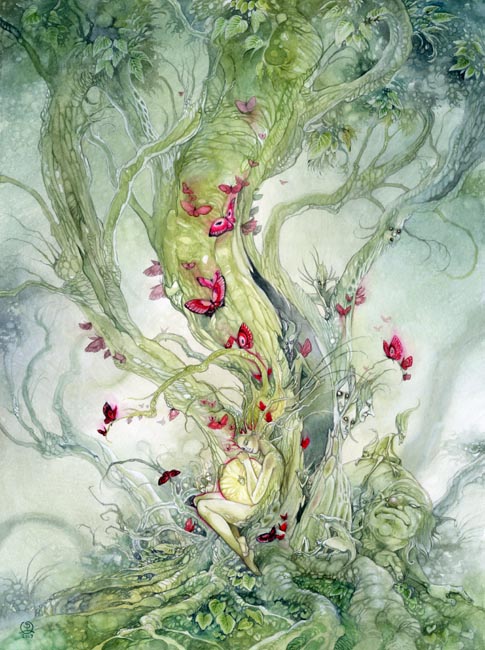
The first spark of life:
a murmur
a thought
a wish
a hope
maybes
might bes
the swelling of dreams
the thrill of potential tucked in a seed

Sunworship and Moonbathing (companion pieces)

Stephanie Pui-Mun Law has been painting fantastic otherworlds from early childhood, though her art career did not begin until 1998 when she graduated from a program of Computer Science. After three years of programming for a software company by day and rushing home to paint into the midnight hours, she left the world of typed logic and numbers, for painted worlds of dreams and the fae.

Her illustrations have been for various game and publishing clients, including Wizards of the Coast, HarperCollins, LUNA Books, Tachyon Books, Alderac Entertainment, and Green Ronin. She has authored and illustrated Dreamscapes (2008, North Light Books), a book on watercolor technique for fantasy. Her work also regularly appears in Realms of Fantasy Magazine.

In addition to the commissioned projects, she has spent a great deal of time working up a personal body of work whose inspiration stems from mythology, legend, and folklore. She has also been greatly influenced by the art of the Impressionists, Pre-Raphaelites, Surrealists, and the master hand of Nature. Swirling echoes of sinuous oak branches, watermarked leaf stains, the endless palette of the skies are her signature. Her background of over a decade as a flamenco dancer is also evident in the movement and composition of her paintings. Every aspect of her paintings moves in a choreographed flow, and the dancers are not only those with human limbs. What Stephanie tries to convey with her art is not simply fantasy, but the fantastic, the sense of wonder, that which is sacred.

While most of Stephanie’s work is done with watercolors, she experiments with pen & ink, intaglio printing, acrylic, and digital painting as well.

::Contact the Artist::

 Artist Blog
http://shadowscapes-stephanielaw.blogspot.com
Stories Growing Up Portuguese – Didacus Ramos

The Lesson

By

Didacus Ramos


(Best read with a Guatemala “Casi Cielo” (“Almost Heaven”) and a maple oat nut scone.)


Uncle Frank was pissed.


He slammed the gearbox of the ’41 Pontiac coup and it lunged forward across Winton Avenue.  Richard and Craig grabbed the back of the front seats and the hand loops next to the doors to hang on.  I fell back into the front seat, my feet flying off the floor boards.


Richard and Craig.  I always said the names together—Richard n’ Craig—like it was one word.  My cousins’ names were more an idea than just people’s names.  We all had been raised together more like brothers and sisters than cousins.  But, our homes were named after who we played with.  I called it Richard n’ Craig’s.  My sister called the same place Kristine’s.


Early that day I left home to walk around the block to their house.  My mother admonished, “Be home by dinner.”  Now I wondered if I’d be late.  Didn’t make much difference.  There’d be hell to pay today.


Craig saw them first.  His arm shot past my head like a spear, finger sharply pointing.  “There they are!”  The punks had upturned a wooden baseball backstop.  The one with the mouth was bouncing on it trying to break it.

You may read the rest of the story here: http://community.livejournal.com/chaos_zine/3661.html

Didacus Ramos’ writing is loosely based on stories from his family, friends, and childhood, dramatized for the full effect. He lives, and grew up, in Hayward, California (then a blue-collar, mostly Portuguese area of San Francisco’s East Bay Area.) Didacus may be reached at didacus90035@yahoo.com and is writing an entire book of these stories and would love to hear from interested agents and publishers!

Katie Quenneville – dream-inspired artwork

Katie Quenneville, on how she creates her distinctive images:
My creative process, hmmm, that depends on what I’m doing.
For my 3D work, I generally go off of something I’ve seen, either a picture or a dream. From there I do research and rough sketches. Once that’s done, I start the modeling. Everything is done in Maya, with the occasional exception of textures and bump maps, the aspects that make everything look pretty. Otherwise it’s a gray model.  I personally choose to model everything in a separate file, then combine it all into one once each piece is finished. The last stage is adding lights and cameras and rendering it out to composite. As easy and simple as it all sounds, the whole process from start to completion can take up to three months.
My photography is generally spur of the moment. I always keep a camera with me, so if I see something interesting or the sunset/sunrise is particularly beautiful, I take a photo. When it comes to pictures of people, I’ve tried the “create a backdrop, fix the lights just so and pose the person” route; but I find that the best photos of people come when the person is comfortable, in their element and not aware of the exact moment I take the picture. 
Katie Quenneville is on Deviant Art here: http://castle-kate.deviantart.com/gallery/#_featured and also on Facebook under her name.

Mummies in Buddhism, Hindu cannibals: Dr. Reuben Rutledge’s cultural anthropology essays


Mummification in Buddhism

This paper is written about the obscure but very important practice of the mummification of lamas and other important monastic figures. The primary focus will be on the Tibetan and Mongolian traditions, but the similarity with other Buddhist traditions will also be examined. As there is very little information on the topic of Tibet itself the author has decided to extend his study to all Buddhist countries. It is interesting to note that this practice is common throughout Buddhism.

One of the most significant achievements is self-mummification. This practice is found not only in Tibet, but also throughout the Buddhist world. Mummification by others, typical of the Egyptians, will be also explored, along which natural mummification, where no mummy was intended.

You may find the rest of the article here: http://community.livejournal.com/chaos_zine/3169.html

The Batak of Sumatra

      During the time I was working on the Encyclopedia of Hinduism I spent time writing about Indonesia.  I had already researched Bali and had written about it. Accidentally I discovered the Wong Tenggar of Java. This was another leftover of the period when South-East Asia was Indian.  I decided to discover other remains in the Island of Indonesia. Eventually I focused of Sumatra where I discovered the Batak. They were a sophisticated culture with a system of writing. They also turned out to be cannibals. The Indian influence on this people created a fusion between native culture and Hinduism. In fact, they were actually Hindus.

      As to their eating habits, they were primarily agriculturalists. Rice and maize are the two primary crops grown. Taro, yams, and potatoes are also grown along with coffee and tobacco.  Cattle and pigs are also raised, and they eat beef and pork, unlike Indians. Meat and fish are not regular staples of their diet. Frogs, mice, insect larvae, and ants are also known to be eaten. In fact the Batak diet is so unrestricted that ‘if it moves, they will eat it.’

     Of course one thing that moves which is eaten is their neighbor. It is one of their most striking and notorious customs. 

Find the rest of this article here: http://community.livejournal.com/chaos_zine/3337.html

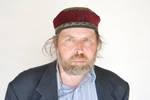
Reuben Rutledge is a Ph.D. candidate at California’s Institute of Integral Studies and specializes in the anthropology and history of various Eastern cultures.  He frequents the vibrant San Jose art scene and has spoken at the Kaleid Gallery downtown. He may be contacted at rutledreub@aol.com

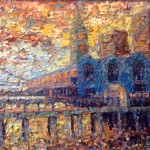
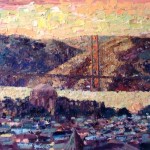
Eddie Freeland: Taking a Palette Knife to San Francisco


Edward’s passion for painting and creative inspiration has always been driven by his Northern California surroundings. While working as a freelance painter, at the age of 11, he began to focus his energy on the vineyards of Livermore, Napa, and Sonoma. Most of his work from this early period was created in watercolor and has received high marks at juried competitions, and earned him various scholarships over the years.

More recently Edward is drawn to the diverse and international influences that converge within the city of San Francisco. They have encouraged him to travel the world and proliferate his artistic expression. From these experiences, along with his time studying Fine Art at the San Francisco Academy of Art, Edward has continued to expand his approach to the creative process. His most recent works have been impressionist paintings, crafted with oil and pallet-knife on canvas, capturing San Francisco’s urban city-scapes with rich and layered tones. He displays his paintings throughout the world and continues to be available for commissions and charitable events. To view Edward’s most recent work please visit his blog at EDWARDFREELAND.BLOGSPOT.COM or the Artist-Xchange Gallery at 3169 16th Street, San Francisco, Ca.

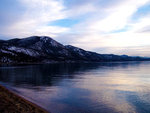
Lisa Amato: Photographs from a Beautiful World


“I was born and spent my early years in Niagara Falls, New York. I moved
to Northern California as a teen and found that, even at that young age, I
was in awe of the vast and diverse scenery. Now, along with my husband,
two sons and Bella, my beautiful dog, we enjoy hiking, going to the beach,
and anything that involves the great outdoors.

Living in the Bay Area, I am witness to this area’s ability to traverse
both the minute wonder of a ladybug resting on a sunflower petal to the
overwhelming expanse of a Pacific sunset. Everywhere I go, an opportunity
to capture a truly breathtaking moment presents itself; whether it be the
rugged peaks of the Sierras, the almost surreal Northern California shore,
or the opulent colors of the wine country.

It was the limitless beauty of the natural world that first inspired me to
pick up a camera, and thus began what came to be not just a casual hobby,
but a passion for capturing the world around me through a camera’s lens.

I am a self-taught photographer who has learned through trial and error,
taking untold numbers of shots to find that one that is just right.”

Lisa also creates cards designed to raise awareness and funds for breast cancer research.  It has pictures of all 5 cards included in the pack as well as a photo of the back.  All proceeds are donated to Susan G. Komen For The Cure. http://www.etsy.com/view_listing.php?listing_id=20548826

Lisa may be reached through her website http://photoamato.com Her work is also available on Etsy: http://photoamato.etsy.com.

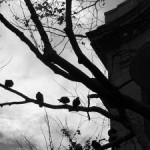
First Exposures – creative projects of San Francisco photography students

First Exposures: Youth Opportunities

Through Photography


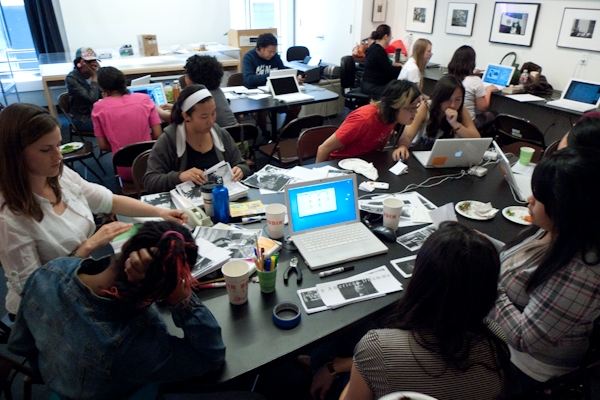
Group of aspiring photographers working with mentors to produce real zines with an authentic do-it-yourself feel. Each piece reflects a personal interest or theme: the experiences of an autistic brother, dogs, cityscapes, school, traveling. Photographers work on their pieces over several months, mastering the use of the cameras as well as stylistic compositional elements such as balance, contrast, foreground and background.


Artworks in themselves, the zines incorporate commentary and captions in the style of the photographs and their subjects. Adobe Books in SF’s Mission District, a musty old eclectic used-book store where people still make time to sit in armchairs and discuss Immanuel Kant and Goethe and modern politics and enjoy free pastries left as offerings to wooden figurines of Hindu and Buddhist deities, showcases the work of the First Exposures students.


From First Exposures:


First Exposures: Youth Opportunities Through Photography is a special interest mentoring program where academic skills and life skills are developed by combining the benefits of mentoring relationships with art education. The volunteer mentors are professional, commercial and fine art photographers with a commitment to youth and to education. Their students are creative young people, aged 11-18, with backgrounds that include homelessness, foster care or low-income living situations. The students and mentors work together in one-to-one partnerships in a group setting. First Exposures fosters supportive intergenerational relationships in a stimulating environment of active learning.


First Exposures is a demanding program. Both the students and their mentors agree to attend each Saturday class from 10:00 to 2:30 PM for at least one academic semester. Most students and mentors stay in the program for one year. Students develop photographic skills and get exposed to a larger world than they may otherwise know. We meet at either SF Camerawork (a nonprofit photography gallery) or RayKo Photo Center (an excellent community darkroom). We reinforce our class time spent in experiential learning environments: field trips to local newspapers, major museums, alternative art spaces, commercial photography studios, and local colleges or universities. Once each semester we go on a “Photo Safari” field trip to locations like San Francisco Zoo, Fort Point, the Hyde Street Pier, the Marin Headlands, or SF Botanical Gardens. The students use their cameras to explore and interpret these places along with sites and people closer to home.


First Exposures was initiated at Eye Gallery in 1993 and was redeveloped under SF Camerawork’s sponsorship in 1996. SF Camerawork is the base of a support network for the partnership between the student and his or her mentor. This network includes the support of the youth service providers who work collaboratively with SF Camerawork and First Exposures, Bay Area mentoring organizations, professional child care workers, and the student’s families or guardians.


For additional information, contact Erik Auerbach at 

(415) 512.2020 x10⁷


  Continue reading