Future Office – Opportunities for Youth Development
In today’s world, where science and technology are rapidly advancing, it is natural that young people strive to achieve success.
But an important question arises: how can we develop? Where should we begin?
Nowadays, artificial intelligence, technology, and social media have become an inseparable part of our lives. At the same time, many young people fall into laziness, lack of discipline, and become distracted by endless streams of information and videos. As a result, questions such as “How do we succeed? Where do we start?” concern not only me but also many younger people.
While searching for answers to these questions, a project called “Future Office” opened a new door in my life. When I learned about the project, I felt it was exactly the opportunity I needed, and I was accepted into its second season.
The Project and First Impressions
The project began online via a Telegram channel. On the very first day, 140 participants were accepted, divided into groups, and each was assigned a curator. I found myself on the 5th group’s list and eagerly joined the group chat. Without waiting for opportunities to come to me, I was one of the first to introduce myself and connect with everyone. To my delight, my teammates were active and open-hearted — we quickly bonded and built a strong network.
Our group was tasked with choosing a name, logo, and slogan. Everyone contributed ideas, and most importantly, we respected one another’s opinions. In the end, we named our group “Renaissance” and came up with a slogan together. These tasks helped us adapt quickly to new people and new environments.
Another task of the day was reading Camus’ “The Stranger.” Albert In the evening, we attended an online training by Shohjahon Urinov, a recipient of the Zahiriddin Muhammad Bobur State Scholarship, on “Conducting Scientific Research and Applying for Prestigious Scholarships.”
We young people often don’t know where to start, what the right path is, or what documents we need. What are the stages of selection? What common mistakes do candidates make? These questions are very important. But who do we ask if we have no acquaintances or access to specialists, especially for youth like me living far from big cities?
This project gave us answers to all these questions and more. Since the project was online, everyone could participate from their region. The group chat allowed free communication and networking. Now, I have friends from different regions, and that is amazing. Being surrounded by like-minded peers helps us compete, learn from each other, and push one another toward our goals.
The best part was the online training from experts. First, they shared their knowledge with us, then answered all our questions. Now we know what to do and how to do it — we have taken one more step closer to our dreams.
Day Two – The Battle of Ideas
This day took place in the “ThinkLab” workshop. We were given a poem by a famous writer and debated it in the literary arena, defending our perspectives. The “ThinkLab 2” and “Quick Battle” sessions truly tested our intellect and wit — just as the saying goes, “The brave are tested in the arena.”
I’ve always loved critical thinking. I have a habit of analyzing things from different angles, giving reasoned judgments, and making thoughtful decisions. The ThinkLab was made for people like me! Fortunately, my teammates were also well-read, sharp-minded people. I learned so much from them, and they learned from me — like paying attention to details and seeing things from different perspectives. It was amazing to share knowledge with each other.
I’ve always had many friends, but exchanging deep ideas with them wasn’t easy — we often didn’t listen to one another. But with an audience united by one goal, everything became easier and full of new insights.
Day Three – Movie Time
“Movie Time” wasn’t just about sitting on a couch with popcorn. It was about living the story with the characters and learning life lessons. The film was deeply emotional, showing how someone with physical challenges still achieved their dreams. It made us realize how many healthy people live in fear instead of pursuing their goals.
I had actually seen this film before. At first, I wondered, “Do I really need to watch it again? Won’t it be boring?” But then I remembered a phrase that often comes up in my life: “Repetition is the mother of true learning.” Surely, the organizers had chosen this film for a reason. Watching it again, I noticed details I hadn’t paid attention to before. Instead of just following the characters’ stories, I imagined what I would do if I were in their place.
After the film, we discussed it as a group. 140 people shared 140 different ideas and experiences — it felt magical, like unlocking another secret on my path toward my goals.
Later that evening, we had a seminar with Davron Ergashev, a multiple grant-winner, on “Create Your Own Opportunities: Winning Grants, Writing Motivation Letters and Preparing a CV.”
This training taught us essential skills like writing CVs, crafting motivation letters, and applying for grants — real keys to achieving our dreams. Everyone actively participated, asking questions without hesitation. By the end, we understood that everything is truly in our own hands.
Day Four – Quiz and Reading Time
The day began with the “Quiz for the Smart” — a movie quiz. Three rounds, fifteen questions, and 140 delegates competing in teams. Intellectual games always attract young people; they reveal the talents not only of bookworms and researchers but also of movie lovers.
After the quiz, we returned to “Reading Time” and analyzed “The Stranger” in a voice chat. Each participant shared their golden thoughts. This wasn’t just reading a book; it was about self-discovery and understanding life’s true purpose. Personally, I always empathize with the characters when I read — I cry and laugh with them. That’s why I actively participated and shared my experiences with the group, knowing it brought me closer to my goals.
Day Five – Plastic-Free Day
As part of the “Plastic-Free Day” campaign, each participant collected 20 pieces of plastic waste in their area. It may seem small, but it’s a crucial step toward protecting our planet.
At the end of the day, we attended an eco-training by Husan Tursunboev, the founder of “EkoNur.”
I’ve always enjoyed participating in eco-campaigns. I know my efforts alone can’t influence everyone, but when my younger siblings see me cleaning up, they do the same with their friends, who then influence their families — like a chain reaction. It feels amazing to contribute, even in a small way, to spreading ecological awareness. After all, how can we stand by and watch our beautiful planet be destroyed?
Conclusion
-During the “Future Office” project, I learned many valuable lessons:
-Don’t wait for opportunities — create them yourself.
-Personal development requires books, films, intellectual games, and practical actions.
-Most importantly, teamwork and exchanging ideas help you discover yourself.
If every young person made good use of such opportunities, they would not only develop themselves but also uplift their communities.
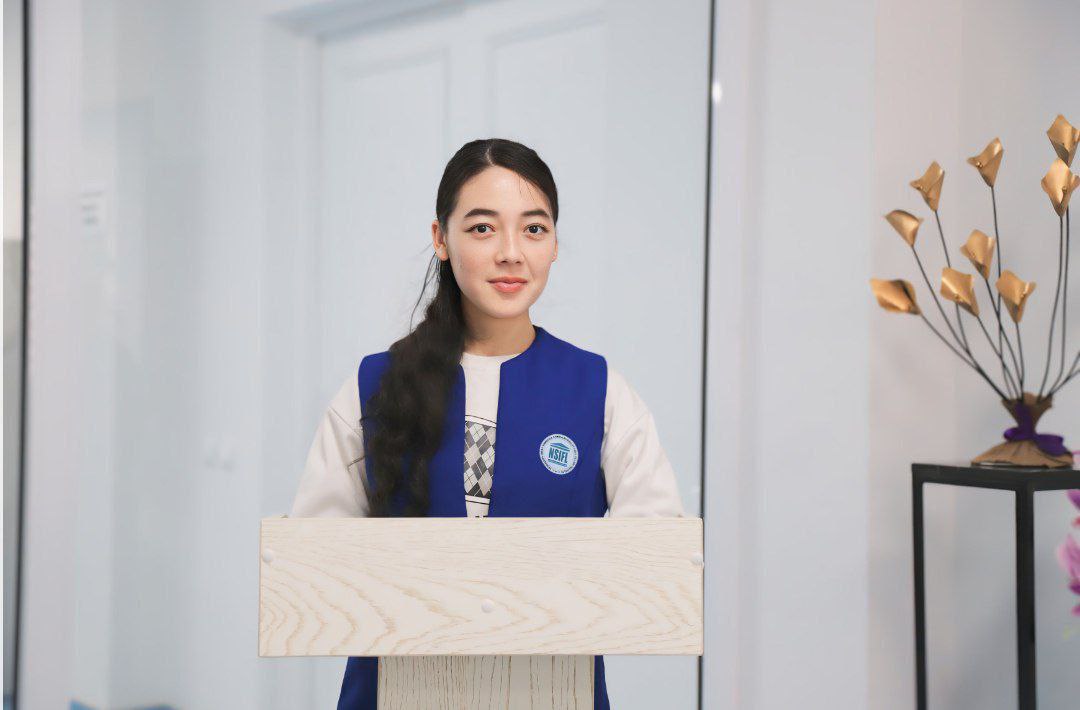
Mushtariybonu Abdurakhimova, 3rd-year undergraduate student at Namangan State Institute of Foreign Languages
Active Volunteer | Recipient of the Uzbekistan Volunteers Association Badge of Honor | Creative Writer | Avid Reader | Public Speaker | Social, Environmental & Cultural Activist | Founder of the “Ibrat” Volunteer Group | Leader | Amateur Artist | Presenter
Born on March 26, 2006, in Dangʻara district of Fergana region, Uzbekistan, Mushtariybonu Abdurakhimova is an inspiring young leader actively engaged in education, creative initiatives, cultural and formal communication, public speaking, as well as social and environmental projects. She not only participates in various training sessions and video programs but also organizes and leads them herself.
Mushtariybonu completed her secondary education at School No. 2 in Dangʻara, where she developed a keen interest in literature, foreign languages, culture, critical thinking, and public speaking. Driven by these passions, she was admitted on a merit-based scholarship to the Faculty of Philology at Namangan State Institute of Foreign Languages, where she is currently a third-year student.
From the moment she entered university, she became an active member of volunteer movements, contributing energetically to social and ecological projects. She successfully completed the DXM Volunteers program and earned the Badge of Honor from the Uzbekistan Volunteers Association. Earlier, her university team won first place in the collective reading competition, earning the title of “Most Well-Read Team.” She also served as the coordinator for the female students’ division within the Youth Union, organized numerous projects and competitions, spoke as a guest and trainer in various video programs, and successfully published her first scientific article.
In her spare time, Mushtariy enjoys reading, critical thinking, analyzing podcasts, intellectual videos, and films. She is an amateur artist, a skilled home cook, and has a knack for handicrafts. Her volunteer roles include guide volunteer, eco-volunteer, UNDP volunteer, “Istiqlolli Avlod” volunteer (working on human rights, children’s rights, and anti-violence programs for women), U-Report volunteer, participant of the “EcoAvlod” Season 2 project, and participant of the 4th season of the International Ecology and Tourism Congress.
She actively supports the elderly, provides assistance to lonely seniors and people with disabilities, and is known for her adaptability, sociability, and strong communication skills. Mushtariybonu loves engaging with people and is a quick learner, always striving to make a positive impact through social, environmental, and cultural initiatives.
Despite her young age, Mushtariybonu Abdurakhimova stands out as a talented, proactive, and socially responsible leader, contributing to meaningful change in her community and beyond.