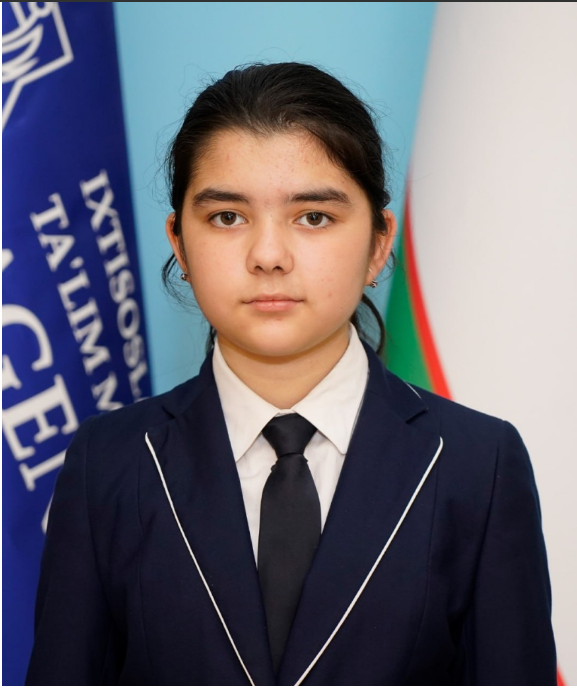
Essay from Mashhura Ochilova

The Girl with the Silk Scarf

The family was all together. Everyone had gathered in one room, watching a TV series. The voices coming from the television, the laughter and cheerful chatter filled the room, as if to say that life was alive and warm in this house. The stove hummed softly, slowly chasing away the shadows of the cold night.

The girl was sitting there too. Her silk scarf fell gently over her shoulders, not setting her apart from the others—on the contrary, it made her look even more ordinary, even happier. Among people, she always smiled. That was why no one ever thought she might be carrying pain in her heart. No one. But in truth, her inner world was completely different. Inside her lived unspoken words, accumulated questions, nights without answers. She could not tell this pain to anyone. Even if she did, would they understand? She was not sure. Depression lived quietly within her—it did not shout, it did not cry, it simply pressed on her heart, slowly and relentlessly.

She gently twisted the edge of her silk scarf between her fingers. To her, this scarf was not just an accessory. It was a curtain. A delicate barrier between the happy face people saw and the ruined world inside her. Silk was her silence—hiding her pain. A funny scene appeared in the series. Laughter filled the room once again. The girl tried to smile too. The smile was there on her lips, but her heart could not reach it. In that moment, she felt a truth once again: sometimes a person can feel lonely even among the closest people. Sitting near the warm stove, she took a slow breath. The heat touched her face, yet the cold inside her remained. Still, seeing her family’s happiness brought a faint light into her heart. At least they were happy. Perhaps her silence, her patience, was for them.

The girl slightly lowered her head. Inside, she turned to the Creator. No sound came out, no words formed on her lips—because some prayers are spoken only by the heart. “I am enduring,” she said within herself. “I am still standing.”

She knew that tomorrow everything would not suddenly change. Pain does not disappear overnight. But in that moment, she felt one thing clearly: she had not let go of hope. The silk scarf rested quietly on her shoulders as she slowly closed her eyes. The warmth spreading from the stove felt as though it was fighting the cold inside her. She sensed a tiny—very tiny—spark burning in her heart. Perhaps it was that spark that would push her to live one more day.

The girl slowly opened her eyes. Laughter in the room continued. She adjusted her silk scarf and joined the others once again. Because sometimes, to keep living, a person chooses to look strong. And silk—that was her silent strength.

Mashhura Ochilova was born on August 14, 2001, in Sherobod district, Surxondaryo region, Uzbekistan.

She is a graduate of the Faculty of Philology at Samarkand State Institute of Foreign Languages, majoring in Korean and English philology.

Mashhura is an educator of Korean and English languages and a regional-stage participant of the prestigious Zulfiya State Prize competition.

She is the author of more than twenty international scholarly articles and has actively participated in academic presentations and conferences held in countries such as Qatar, Egypt, Turkey, Azerbaijan, and the United States. Her research papers have been translated into English and Turkish and published in international journals indexed on the Google Scholar platform.

   Fluent in Korean and English, and proficient in Russian and Turkish, she demonstrates strong multilingual competence. Currently, she serves as the Director of the Yumyong Academy Online Learning Center, where she teaches nearly 200 students in Korean and English languages, contributing to cross-cultural education and linguistic development.

Poetry from Qozoqboyeva Husnida

To My Future One.. 

For you, I gave up countless things, So come deserving, my destined one. For you, I kept my soul pure and clean, So keep yourself pure for me, my only one.

Every word within my heart is yours, All my dreams are light that leads to you. I live for you, I long for you, May we meet one day in sacred truth.

Your absence has worn my heart away, I cry your name — where are you now? My waiting eyes are fading day by day, My heart grows tired of asking how.

Even the nights ask of my pain, The stars reflect your gentle face. Each breath repeats your unknown name, Each moment without you leaves a trace.

I watch the roads with endless hope, “Perhaps today you’ll come,” I pray. Waiting for you is my hardest test, But loving you — my brightest fate.

Each dawn I wake with thoughts of you, Each moment dreams your presence near. I place my pain in God’s safe hands, And let my patience conquer fear.

Come blessed like my midnight prayer, Come beautiful like dawn’s first light. Even if late, just come, my love — My heart still waits through darkest night.

But come unwavering, faithful, true, Unchanged by time or passing years. For you, I’ll wait as long as fate allows, Yet come sincere, without fears.

Come loyal, never to be replaced, My lifetime’s lawful, destined part. For you, I’ll wait till endless days, O come, my soulmate, to my heart.

Essay from Turg’unova O’g’iloy Ravshanbek qizi

INTEGRATING THE METHODOLOGY OF TEACHING BIOLOGY WITH OTHER SUBJECTS

Kokand State University, Faculty of Natural Sciences and Economics

Teacher: Isabayeva Mashhuraxon Muxiddinovna

Third-year Biology student: Turgʻunova Oʻgʻiloy Ravshanbek qizi

ANNOTATION: This article analyzes the theoretical and practical foundations of integrating the methodology of teaching biology with other subjects. It highlights the role of an interdisciplinary approach in improving educational effectiveness and developing students’ systematic thinking. The possibilities of organically connecting biology with chemistry, native language, geography, computer science, and mathematics are considered through examples. Methods of organizing integrated lessons and the advantages of pedagogical technologies are discussed. Furthermore, this approach is justified as a means of shaping students’ scientific worldview and developing practical skills. The article also provides recommendations for implementing interdisciplinary integration in modern education.

KEYWORDS: integration, method, interdisciplinary integration, teaching methodology, scientific thinking, pedagogical effectiveness, synchronous, asynchronous, practical skills, critical thinking

The methodology of teaching biology is a branch of science related to the processes, principles, and laws underlying the biology educational process. Proper organization of learning processes and understanding these principles allow teachers to structure and manage educational activities in accordance with modern education systems.

The goal of the methodology of teaching biology is to organize the content, teaching forms, methods, and tools of biology lessons in a coherent and effective way. Its main task is to provide students with deep knowledge of biology, develop their overall growth and improvement, and create teaching content, tools, forms, and methods that support this development. The teacher’s personality plays a crucial role because the more passion, knowledge, skills, and experience a future educator has for their subject, the more they can stimulate students’ interest in it. A teacher effectively imparts profound knowledge and practical skills, helps students understand the essence of the subject, and consequently fosters respect and engagement in students during lessons.

The connection of biology teaching methodology with other subjects serves as an important pedagogical tool. In this context, students’ knowledge and skills acquired in other subjects are linked to biology—a process called integration (from Latin integratio—“to combine,” “to complete,” “to unify”), which involves connecting separate parts, elements, or subjects into a single system. In practice, this means linking biology with chemistry, geography, native language, and mathematics, and applying this integrated knowledge during lessons to provide students with effective and systematic learning experiences. This pedagogical method enhances the teacher’s professional qualities and deepens their mastery of subject knowledge.

For example, a young teacher may encounter some difficulties in the learning process, such as organizing lessons effectively and systematically according to State Educational Standards. In this case, students’ prior knowledge and skills from other subjects can be integrated into biology lessons. Initially, the teacher should:

Study the students to understand their interests and preferred subjects. Knowing students’ knowledge and skills in other subjects is crucial for effectively engaging them in biology lessons.

For instance, in an 8th-grade biology lesson:

Topic: Digestive System

The teacher can explain the topic using students’ knowledge of their native language to ensure proper understanding.

This approach not only strengthens interdisciplinary connections but also develops students’ comprehensive understanding, critical thinking, and ability to apply knowledge across different domains.

Turgʻunova Oʻgʻiloy Ravshanbek qizi was born on September 26, 2004, in Rapqon village, Beshariq district, Fergana region.

She is currently a third-year student majoring in Biology at Kokand State University (enrolled in 2023).

Essay from Shuhratova Mohinur Abbosjon qizi

Dangʻara District, Fergana Region

First-year student, Faculty of Humanities and Languages, Uzbek Language and Literature Department

Linguocultural and Semantic Features of the Concept of “Ko‘ngil” in the Uzbek Language

Abstract

This article examines the place of the concept of “ko‘ngil” in the linguistic worldview of the Uzbek language and its linguocultural characteristics. It analyzes the connection of this notion with the mentality of the Uzbek people, the manifestations of the word in phraseological units, and its semantic scope in literary texts based on the principles of cognitive linguistics.

Keywords

Linguoculture, concept, ko‘ngil, linguistic worldview, cognitive linguistics, mentality, phraseological unit, semantics.

Introduction

In modern linguistics, studying linguistic units in close connection with the human factor, human thinking, and culture has become a priority direction. In particular, as a result of the formation of the anthropocentric paradigm, language is interpreted not only as a means of communication but also as the cultural code of a nation and a tool for understanding the world. At the center of this direction stands the notion of the “concept.”

One of the most important concepts reflecting the worldview and the spiritual and moral world of the Uzbek people is “ko‘ngil.” While in Western languages (for example, in English – heart, in Russian – serdtse) the “heart” is more commonly used as the center of emotions, in the Uzbek linguistic worldview the concept of “ko‘ngil” possesses a much broader and deeper semantic scope. For the Uzbek people, the concept of “ko‘ngil” is not merely a feeling, but a linguistic phenomenon expressing a person’s faith, morality, intention, and entire spiritual being.

Main Part

In the lexical layer of the Uzbek language, the unit “ko‘ngil” is interpreted as the place of a person’s spiritual world, emotions, and inner experiences. According to the Explanatory Dictionary of the Uzbek Language, this word expresses not only a spiritual source but also a person’s character. The Uzbek people express their joy or sorrow through the dynamics of “ko‘ngil.” The examples provided in the dictionary clearly prove this:

Ko‘ngli buzilmoq — a state of being upset, becoming deeply saddened, or immersed in grief.

Ko‘ngli ko‘tarilmoq — a feeling of relief, joy, or happiness.

Ko‘ngli g‘ash — a feeling of worry, anxiety, or inner disturbance about something.

“Ko‘ngil” is also regarded as a moral measure and the center of social relations. In the Uzbek mentality, people are often evaluated through this concept:

Ko‘ngli ochiq — used in a positive sense to describe a sincere, open, and courageous person who does not conceal their feelings.

Ko‘ngli pok — refers to a pure and innocent heart that wishes no harm to anyone.

Ko‘ngli qattiq — used in reference to merciless, cruel, unkind, and heartless individuals.

It can be stated that in the works of Uzbek writers, the concept of “ko‘ngil” is depicted as the foundation of human existence. For example, in Oybek’s works, the expression “ko‘ngli oq” emphasizes the inner innocence of a character. In the works of the great representative of classical Uzbek literature, Alisher Navoi, the concept of “ko‘ngil” also occupies a central place. The poet interprets the “ko‘ngil” as the spiritual world of beauty and a treasury of divine secrets. This can be seen in his famous couplet:

“The ko‘ngil is a treasury of rubies and pearls,

Its key is a pearl within the mouth of the world.”

Here, Navoi likens the “ko‘ngil” to a treasury where precious jewels are kept. The concepts previously mentioned, such as “ko‘ngli pok” and “ko‘ngli ochiq,” are directly connected with this treasury — the inner beauty of a person.

Conclusion

In conclusion, the study of the concept of “ko‘ngil” in the Uzbek linguistic worldview demonstrates that it is not merely a lexical unit, but a phenomenon that defines the spiritual identity of the nation. Overall, the semantic scope of the concept of “ko‘ngil” is so broad that it proves the richness of the Uzbek language and the remarkable subtlety of our national way of thinking.

Essay from Shahobiddinova Sevinch

Shahobiddinova Sevinch

December 31, 2004

Student of Namangan State Pedagogical Institute

Primary Education Department

DIDACTIC GAMES IN PRIMARY GRADES

Shahobiddinova Sevinch

Namangan State Pedagogical Institute

2nd-year student, Primary Education Department

Abstract. This article presents views on a modern approach to the educational process, the importance of using didactic games in increasing the effectiveness of primary education, didactic games used during lessons, their types, and the procedure for their application.

Keywords: education, approach, lesson, game, student, task, action, didactic game, class.

A new, systematic approach to upbringing requires fully utilizing the socio-pedagogical potential of families, preschool education institutions, general education, secondary specialized vocational and higher education institutions, and local communities in guaranteeing the formation of core qualities in children, as well as raising scientific and methodological continuity among them to a new level. [1]

When a child enters first grade and takes their first step into school, play occupies a central place in their activity. Play is their favorite activity, and they try to combine any lesson with play. Therefore, without removing play—their favorite activity—from students’ lives, a teacher can effectively use it to increase the efficiency of the educational process. Play is an integral part of a child’s life. Through play, children become familiar with the surrounding environment, natural phenomena, landscapes, objects, plants, and the animal world. In primary education, didactic games are of special importance in organizing students’ intellectual and physical activities. During didactic games, students learn to strictly follow rules, develop a sense of cooperation, and broaden their worldview. Didactic games used in the educational process should be organized according to students’ characteristics. This facilitates learning, ensures visualization, and prevents students from becoming tired or bored.

Didactic games used in the educational process are classified into two types.

To better understand the content and significance of didactic games in the educational process, we would like to define and clarify concepts such as education, play, didactic task, and game task. Education is a systematic process of providing students with knowledge, skills, and abilities, enabling them to acquire and reinforce them. The educational process enriches children’s memory and develops their speech and thinking through various methods and techniques. Play is an activity deeply ingrained in children’s consciousness and hearts; depending on its type, it reflects objective reality and life to a certain extent. Play is a continuation and reinforcement of classroom learning activities. Practice has proven that play is a vital necessity for primary school children. A didactic game is a teaching method aimed at achieving specific educational objectives, such as clarifying, reinforcing, and deepening learned material. Each didactic game is conducted with a specific task in mind. For example, the didactic task of the game “Theater” is to reinforce students’ understanding of the number 5 learned in previous lessons. In the game “Circular Examples,” the task is to reinforce counting skills within the second ten. The didactic task constitutes part of the general lesson objective. Like any game, each didactic game has its own rules. If these rules are not followed, the educational and psychological value of the game is lost. Game rules are included in the game task. The game task involves explaining how the game is played and determining the winner. In the game “Silence,” students are required to count the objects shown by the teacher mentally and indicate the result with their fingers. The rule requires them to act without making any sound.

The following didactic materials are used: pictures, tables, desk theater stages, abacus (counting device), toys, counting sticks, nuts placed in a bag, handmade paper boats and caps, charts with geometric shapes, diagrams, counting materials, and boxes containing geometric shapes.

Games used include: “Keep Counting,” “Remember What You Saw,” “We Have Decreased,” “Who Left? (Review),” “What Changed?,” “Theater,” “Find How Many,” “Find the Table,” “Find Your Neighbors,” “Who Can Continue Counting,” “Knock-Knock,” “Who Enters the House First,” “Who Is Quick?” [2]

“Counting Objects up to 10”

Didactic game: “Silence”

Didactic task: to identify and reinforce children’s understanding of simple counting.

Game task: mentally count specific objects and show the required number with fingers.

Course of the game: The teacher acts as the leader.

Teacher: “Children, we will play the ‘Silence’ game. I will show you different objects. You must find their number.”

The children begin speaking all at once.

Teacher: “No, children. Before answering, you must raise your hand.”

The teacher counts circles and sticks with the children.

Teacher: “Now I will show you objects. You must count silently and show the number with your fingers.”

When the teacher shows 4 dolls, all students raise four fingers. The classroom becomes silent. All attention is focused on completing the task.

Teacher: “Well done, you all counted correctly. Now I will move the counting sticks from one hand to the other. Count silently and show me how many there are.”

The children observe and show ten fingers.

Teacher: “Now count the squares,” says the teacher while placing squares in sequence on the board.

The children count and show six fingers.

This helps determine students’ level of knowledge about the first ten and strengthens their ability to show the number of objects with fingers. It also develops their mental counting skills without speaking. At first, children cannot immediately count silently without repeating aloud, but the game rule requiring silence compels them to do so. This ensures that their full attention is focused on the task. In subsequent lessons, the game conditions are made more complex. Through this game, students develop quick reaction skills and it becomes possible to determine who completes the task quickly or slowly. [2]

In primary grades, mathematics lessons should be conducted using modern, advanced pedagogical technologies. The use of didactic game methods meets today’s educational requirements. For example, the game “Step by Step.”

Didactic task: to reinforce students’ ability to calculate operations correctly and quickly in sequence.

Game task: to determine the winner by completing tasks step by step.

Game description: The game broadens students’ knowledge and sharpens their thinking by reinforcing concepts related to number order and arithmetic operations. Students master number sequences and comparison methods thoroughly.

The following tasks may be used:

What types of examples are shown while going up the stairs?

What types of examples are shown while going down?

Read them and provide the answers, and so on.

Students are taught to read examples as “the sum of 3 and 2” or “the difference of 7 and 3.” The game lasts 10–15 minutes. The examples can be written on cards and replaced periodically. This game helps students solve examples quickly and accurately and master number comparison skills. [3]

Conclusion. The role and importance of didactic games in the educational process are significant. Didactic games are effective tools for reinforcing, deepening, and reviewing students’ knowledge, skills, and abilities. Each didactic game has a clearly defined objective, encourages students’ learning activity, and helps conduct lessons in an interactive and engaging way. Following game rules increases their educational and psychological value and develops students’ attention, thinking, and creative abilities. The materials and tools used in didactic games enable children to gain knowledge through experience and perception. Thus, the importance of didactic games in education lies not only in knowledge acquisition but also in students’ personal development.

REFERENCES

Resolution of the Cabinet of Ministers to ensure the implementation of the Decree of the President of the Republic of Uzbekistan dated May 3, 2019, No. PQ-4307, “On Additional Measures to Increase the Effectiveness of Spiritual and Educational Work,” aimed at educating youth as broad-minded and active citizens prepared for independent life.

“Didactic Games.” Department of Psychology, Pedagogy, Management, Preschool and Primary Education. Urganch – 2011 (pp. 3–4).

Didactic Materials in Mathematics: Methodological Guide “Didactic Games in Primary Education” (p. 19)

Essay from Odiljonova Mohlaroyim Iqboljon qizi

THE SOUND OF THE DO’MBIRA AND THE POWER OF THE WORD: UZBEK EPIC TRADITION IN THE SCHOOLS OF BUKHARA, KHOREZM AND FERGANA

ODILJONOVA MOHLAROYIM IQBOLJON QIZI

Kokand State University, Faculty of Humanities and Languages

“Uzbek Language and Literature” Department, Group 102, First-Year Student

Abstract:

This article is devoted to the study of the differences and commonalities among the three great centers of epic art, which constitute a fundamental layer of Uzbekistan’s national culture — the schools of Bukhara, Khorezm, and Fergana (Qashqadaryo–Surkhandaryo). It analyzes the historical conditions of each school, their distinctive performance styles, including musical instruments and vocal techniques, as well as the thematic characteristics of the repertoire of their leading representatives (bakhshis). The main objective of the research is to highlight the powerful role of this unique heritage in shaping the “national spirit” of the Uzbek people through a comparative analysis of epic schools from the perspective of modern literary studies.

Keywords: Schools of epic art, Bukhara, Khorezm, Fergana, do’mbira, power of the word, bakhshi, jirov, epic, melody, oral tradition.

During the years of independence in Uzbekistan, large-scale efforts have been undertaken to preserve the masterpieces of intangible cultural heritage created on the basis of our people’s rich artistic creativity, to revive the ancient traditions of oral folklore, and to consistently develop national values. In cooperation with creative associations, the best examples of bakhshi and epic performers’ works are being widely promoted. At the same time, there remains a need to thoroughly study the history of bakhshi and epic art, to conduct fundamental research in this field, and to implement further measures for collecting and publishing monuments of oral folk creativity.

Epic art is a literary genre that figuratively expresses the dreams, struggles, love, and beliefs of the people and has been performed orally by bakhshis. In different regions, epic performance developed in distinctive ways, forming unique styles of performance, repertoire traditions, and bakhshi practices. On this basis, epic schools emerged. These schools not only preserved oral literary examples but also played an important role in developing them and passing them on to younger generations. Schools such as Kokand, Khorezm, Sherobod, and Namangan (Fergana Valley) are among these rich cultural centers. By the 20th century, the demand for bakhshis and epic performers in cities gradually declined. However, in rural areas, this ancient tradition has continued to thrive. In particular, epic recitations became customary during major national projects such as the construction of the Great Fergana Canal and large reservoirs, as well as during festivals. Many epics were not created by a single author; they were shaped among the people based on oral epic traditions. For this reason, epic schools developed in certain regions.

The meaning of the word “bakhshi” is explained in some sources as deriving from Mongolian and Buryat “bakhsha” or “baghsha,” meaning teacher or enlightener, and from the Sanskrit “bhikshu,” meaning dervish or ascetic. In Uzbekistan, it refers to an artist who memorizes and performs songs and epics, transmitting them from generation to generation. The term “bakhshi” is sometimes also used in the sense of a shaman. In general, epic performers are also referred to as yuzboshi, soqi, sannovchi, or jirov. Bakhshis are mainly divided into two categories: performing bakhshis and creative bakhshis. Performing bakhshis render the epics they learned from their masters with minor variations, while creative bakhshis compose new epics based on oral epic traditions. Such bakhshis are also called poet-bakhshis. Among them are Ergash Shoir, Fozil Shoir, Po’lkan Shoir, Abdulla Shoir, and Xidir Shoir. Bakhshis perform epics and songs accompanied by instruments such as the kobyz, do’mbira, and dutar.

The harmony of word and melody in bakhshi art has played a significant role in raising young people to become brave, courageous, and patriotic individuals. According to oral accounts, military leaders would take bakhshis with them on campaigns to inspire soldiers’ bravery, courage, and devotion to the homeland.

In our country, the tradition of epic performance historically developed in three directions.

The first direction was in the Bukhara epic schools, where epics were performed solo with do’mbira accompaniment, using a guttural voice.

The second direction was in Khorezm, where epics were performed sometimes solo and sometimes in pairs, accompanied by instruments such as the tor, dutar, gijjak, bulamon, qoshnay, and doira, using an open vocal style.

The third direction was characteristic of the Fergana Valley, where epics were performed in an open voice accompanied by the dutar.

1. The Bukhara School – A Bright Expression of Eternal Tradition

The Bukhara epic school represents a tradition where the custom is sovereign, and the bakhshi is its faithful representative. For a Bukhara bakhshi, the epic text is like a jewel polished over centuries; it is impossible to add or remove even a single word. They believe that even if the world changes, truth remains unchanged. In this region, heroic epics such as “Alpomish” and “Go’ro’g‘li” resound powerfully. Rather than melody, the emphasis is placed on high spirituality and the intense struggle of brave heroes. Even in romantic epics such as “Tohir and Zuhra,” human dignity stands above mere lamentation.

2. The Khorezm School – The Harmony of Heart and Melody

The Khorezm school transforms words into melody. While Bukhara relies on the firmness of the text, Khorezm immerses it in a river of lyrical emotions. The plaintive sounds of the dutar and tor turn the epic from a mere narrative into a living spiritual experience. The Khorezm bakhshi feels the hero’s pain as his own and conveys it deeply to the listener. Figures such as Ergash Jumanbulbul o‘g‘li and Po’lkan Shoir are widely known in this region. Moreover, bakhshis such as Yakka Ahmad, Quronxon, and Oysuluv performed “Alpomish” with unique refinement. They not only performed the epic but also recorded it in written form, making it part of literary heritage.

3. The Fergana School – The Brightest Example of Improvisation

The Fergana epic school is characterized by lively dialogue and free expression. This style is dynamic and flexible, drawing strength from life itself rather than strict textual rules. In Fergana, the bakhshi is a skilled conversationalist who engages directly with the audience. Rather than only recounting ancient heroes, he incorporates contemporary joys and concerns into his verses, creating new lines spontaneously according to the mood of the listeners.

The village of Ko‘libuqon is considered a cradle of this art. Masters such as Beqjon Bakhshi, Cho’tboy Bakhshi, and Mahmud Buva have passed down the rich traditions of this school from generation to generation.

Conclusion:

Uzbek epic art is a unique heritage formed over centuries, reflecting each region’s socio-cultural life, historical past, and popular beliefs. The Bukhara, Khorezm, and Fergana epic schools examined in this research demonstrate the multifaceted and diverse nature of this art. The Resolution of the President of the Republic of Uzbekistan dated May 14, 2019, “On Measures for the Further Development of Bakhshi Art,” laid the foundation for in-depth study of the scientific-theoretical and practical aspects of bakhshi art, restoration and development of master-apprentice traditions, and preservation of distinctive performance styles. As a result, the “Republican Center of Bakhshi Art” and the “Fund for the Development of Bakhshi Art” were established (although one of the main locations of the Center is the city of Termiz, its activities cover all epic schools).

The Bukhara school is distinguished by Islamic epic plots, religious-didactic spirit, and rich Sufi symbolism. Here, epics served as a means of conveying deep spiritual meaning.

The Khorezm school stands out for its maqom traditions, complex musical instruments such as the tanbur and gijjak, and its high level of professional performance. It harmonized epic and lyrical narratives with instrumental music, enhancing their artistic value.

The Fergana school, mainly accompanied by kobyz and dutar, vividly reflected daily life and heroic ideas through various genres such as tales and lyrical-dramatic epics, with a strong tradition of storytelling.

Each of these three central regions contributed its own style, themes, and performance traditions to epic art, creating a unified yet ideologically and artistically rich panorama of Uzbek epic heritage.

The sound of the do’mbira and the power of the word represent not merely the union of music and text, but the memory of the people, the national spirit, and a means of spiritual education passed from generation to generation. They have played an incomparable role in preserving the spiritual independence, devotion to values, and worldview of the Uzbek people to this day. Preserving this art form and supporting its schools means ensuring the continuity of our national culture.

In conclusion, every epic performed to the sound of the do’mbira is the poetic response of the Uzbek people to existence. The true power of this art lies in its ability to connect the past with the future, offering each new listener the opportunity to find answers to fundamental questions of time, space, and self.

LIST OF USED LITERATURE:

Safarov O., Jamilova B., Safarova N. Children’s Literature and Folklore. – Tashkent: Turon Zamin Ziyo Publishing House, 2015. – 256 pages.

“20th Century Uzbek Folklore Studies.” Anthology. Compiled by O. Turaboyev and others. Tashkent: State Scientific Publishing House of the National Encyclopedia of Uzbekistan, 2017. – 592 pages.

Masharipova Z. Uzbek Oral Folk Creativity. – T., 2008, pp. 24–40.

Essays on Uzbek Folklore. Vol. 1. – T.: “Fan,” 1988, pp. 25–35.

Madayev O., Sobitova T. Oral Poetic Creativity of the People.

Jumaboyev M. Children’s Literature and Folklore. Textbook. – Tashkent: Publishing House of the Writers’ Union of Uzbekistan, 2006. – 216 pages.

Shodiyeva G., Sobirova O. “Uzbek National Instruments of the Late XIX and Early XX Centuries.” International Journal of Early Childhood Special Education 14.7 (2022).

Shodiyeva G., Sobirova O. “Uzbek National Instruments of the Late XIX and Early XX Centuries.” International Journal of Early Childhood Special Education 14.7 (2022).

Ahmedovich, Turdiyev Shavkat. “From the History of Preservation and Recording of Samples of National Uzbek Musical Folklore.” Asia Pacific Journal of Marketing & Management Review 11.12 (2022): 59–61.

Sabirovna, Rasulova Saida. “Analysis of the General State of Music Education in a Secondary School.” Eurasian Journal of Learning and Academic Teaching 1.1 (2021): 112–116.

Odiljonova Mohlaroyim Iqboljon qizi was born on September 7, 2007, in Bag’dod district of Fergana region. She is currently a first-year student at Kokand State University, Faculty of Humanities and Languages, majoring in Uzbek Language and Literature. She has been interested in knowledge since childhood and has read many books.

Essay from Roʻzimatova Madinaxon Sherzod qizi

In my creative work, I analyzed the work “Ming bir jon” by the prominent representative of Uzbek literature, Abdulla Qahhor. In this work, the author artistically portrays human life, patience, emotional experiences, and social issues. During the analysis, special attention was paid to the content and essence of the work, its ideological direction, and the system of characters. Through this creative work, my goal was to gain a deeper understanding of the work and to develop my skills in literary analysis.

The Human Psyche and Philosophy of Life in Abdulla Qahhor’s Story “Ming bir jon”

Ro‘zimatova Madinaxon Sherzod qizi

Kokand State University

Faculty of Humanities and Languages, 1st-year student

Abstract. This article provides a scientific-theoretical analysis of Abdulla Qahhor’s story “Ming bir jon”, a prominent work of Uzbek literature. The story explores the issues of human love for life, physical weakness, and spiritual strength. The study examines the ideological and artistic characteristics of the story, the system of characters, psychological depiction methods, and the writer’s mastery of realism. Through “Ming bir jon”, the author demonstrates, on a scholarly basis, the human will to live and the virtue of patience.

Keywords. Abdulla Qahhor, “Ming bir jon”, realism, human psyche, philosophy of life, literary character, psychologism, Mastura, Akramjon, Hoji aka, educational significance.

Abdulla Qahhor, one of the leading representatives of the realism movement in Uzbek literature, portrayed human psychology and the harsh realities of life in a profound and expressive manner. His story “Ming bir jon” is among the significant works that vividly reflect his views on humanism, love for life, and the power of will. In this work, the author creates the image of a physically weak but spiritually strong person, emphasizing the value of life.

Ming bir jon was created in the mid-20th century and reflects the psychological state and attitude toward life of people in the post-war period. The main theme of the story is the struggle of humans for life, the boundless desire to live, and patience. Through this story, Abdulla Qahhor depicts a person who, despite serious illness, hardships, and suffering, never gives up on life, illustrating their spiritual strength.

The ideological center of “Ming bir jon” is the value of human life and the will to live. Qahhor conveys this idea not through direct advice but through the emotional experiences and life circumstances of the characters. The story shows that, despite physical weakness, a person preserves their inner world and spiritual wealth through mental strength and willpower.

The main characters who reveal the ideological foundations of the story are Mastura, Akramjon, and Hoji aka. Mastura has been ill for ten years and receiving treatment, while Akramjon takes care of her with devotion. He even serves her in the hospital for five months, which demonstrates the human love and loyalty that manifest the characters’ spiritual strength. Hoji aka, as a symbol of human compassion and empathy, observes Mastura in the hospital, shows concern for her condition, and provides her with emotional support. Ideological analysis shows that the story presents inner strength, patience, and the desire to live as the main idea. Through this work, Qahhor interprets life’s meaning, human love, family loyalty, and the value of human life as a philosophical whole.

For example:

“Mastura seemed to live not with one soul, but with a thousand souls.” [111]

At the same time, the story emphasizes that the worth of life lies not in its duration, but in its content, in a person’s spiritual strength and their capacity for love toward others:

“She was not afraid of death, she just did not want to give up living.” [112]

The ideological analysis of the story shows that human values, patience, and love are at the heart of its philosophy of life, leaving a deep spiritual impact on the reader. The central character is Mastura, depicted as physically weak but spiritually resilient and determined. Through this character, Qahhor shows that inner strength surpasses external conditions. The following passage illustrates the character’s psychological state:

“Though her breath was short, her eyes shone with the determination of a person who had not given up on life.” [111]

As Qozoqboy Yo‘ldoshev notes: “Qahhor’s characters live not through action but through their state.” [68-69]

Mastura’s character is a vivid example of this psychological approach. Her husband Akramjon cares for her consistently; he has been attending to her in the hospital for five months. This is a strong expression of human love, courage, and willpower. Another figure, Hoji aka, shows human kindness by checking on Mastura’s well-being, a type of person rarely seen today.

A distinctive feature of Abdulla Qahhor’s language is simplicity, clarity, and conciseness. The story employs short, comprehensible sentences that direct the reader’s attention to content and psychological details. Qahhor makes extensive use of colloquial expressions, everyday life details, and natural dialogues, enhancing realism and naturally conveying the psychological state of the characters.

As Naim Karimov notes: “The power of Qahhor’s language lies in its naturalness, able to convey deep meaning without excessive embellishment.” [55-56]

The poetics of silence and psychological detail affect the reader’s inner contemplation, allowing deeper immersion into the characters’ psyche. In the story, psychological realism is the central poetic tool. Qahhor depicts the inner experiences of the characters accurately and naturally, allowing the reader to access their spiritual world. Through psychological details, each character’s inner world, decisions, and emotions are conveyed to the reader. The poetics of silence serves as a non-verbal means of expression. Qahhor communicates feelings and psychological states through silence, unspoken thoughts, and small gestures, enabling the reader to experience the emotions of each scene internally. The following free citation demonstrates psychological realism and the poetics of silence:

“She spoke little, yet in every silence, the hope to live could be felt.” [113]

Poet Abdulla Oripov assesses this feature as follows: “In Qahhor’s prose, one word of silence can sometimes have a stronger impact than an entire page.” [82-83]

Ming bir jon teaches readers patience, love, loyalty, and the appreciation of human values. The love between Mastura and Akramjon, and Hoji aka’s compassion, cultivate notions of family, humanity, and mutual assistance in society. At the same time, the work demonstrates the importance of not surrendering in the face of life’s hardships, maintaining spiritual endurance, and striving for life. These qualities enhance the story’s artistic, educational, and social significance.

In conclusion, Abdulla Qahhor’s story “Ming bir jon” is recognized as a mature example of psychological realism and the poetics of silence in Uzbek prose. The story reveals subtle nuances of the human psyche and perfects the depiction of human love, loyalty, and compassion. Through its central characters, the author shows the complexity of life, the balance between physical weakness and spiritual strength, as well as the importance of patience, love, and spiritual resilience. Therefore, “Ming bir jon” is a work of both artistic and educational significance, providing deep moral lessons and encouraging the appreciation of human values.

References:

Qahhor A. Tanlangan asarlar. — Tashkent: G‘afur G‘ulom Publishing House. 2005

Karimov N. Abdulla Qahhor ijodi. — Tashkent. 2010

Yo‘ldoshev Q. Badiiy tahlil asoslari. — Tashkent. 2002

Normatov U. XX asr o‘zbek adabiyoti masalalari. — Tashkent. 1996

Oripov A., Vohidov E. Adabiyot va hayot haqidagi maqolalar. — Tashkent. 2000

Teshayev S. O‘zbek nasrining rivojlanishi va problematikasi. — Tashkent: Fan va Texnologiya. 2010

Mirzayev A. Psixologik realizm o‘zbek adabiyotida. — Samarkand: Sharq Publishing. 2000

Xolov D. Badiiy uslub va til xususiyatlari. — Tashkent: Ma’rifat. 2001

Sobirov F. XX asr o‘zbek hikoyachiligi. — Tashkent: Adabiyot Publishing. 2002

Yusupov R. Adabiyot va ma’naviyat masalalari. — Tashkent: University Publishing. 2010

I, Roʻzimatova Madinaxon Sherzod qizi, was born on December 31, 2007.

My father is Usmonova Sherzod, and my mother is Usmonova Tabrakxon.

Currently, I am a first-year student at the Faculty of Humanities and Languages at Qoʻqon State University. I consider obtaining an education and improving my knowledge and skills to be one of the most important goals in my life.