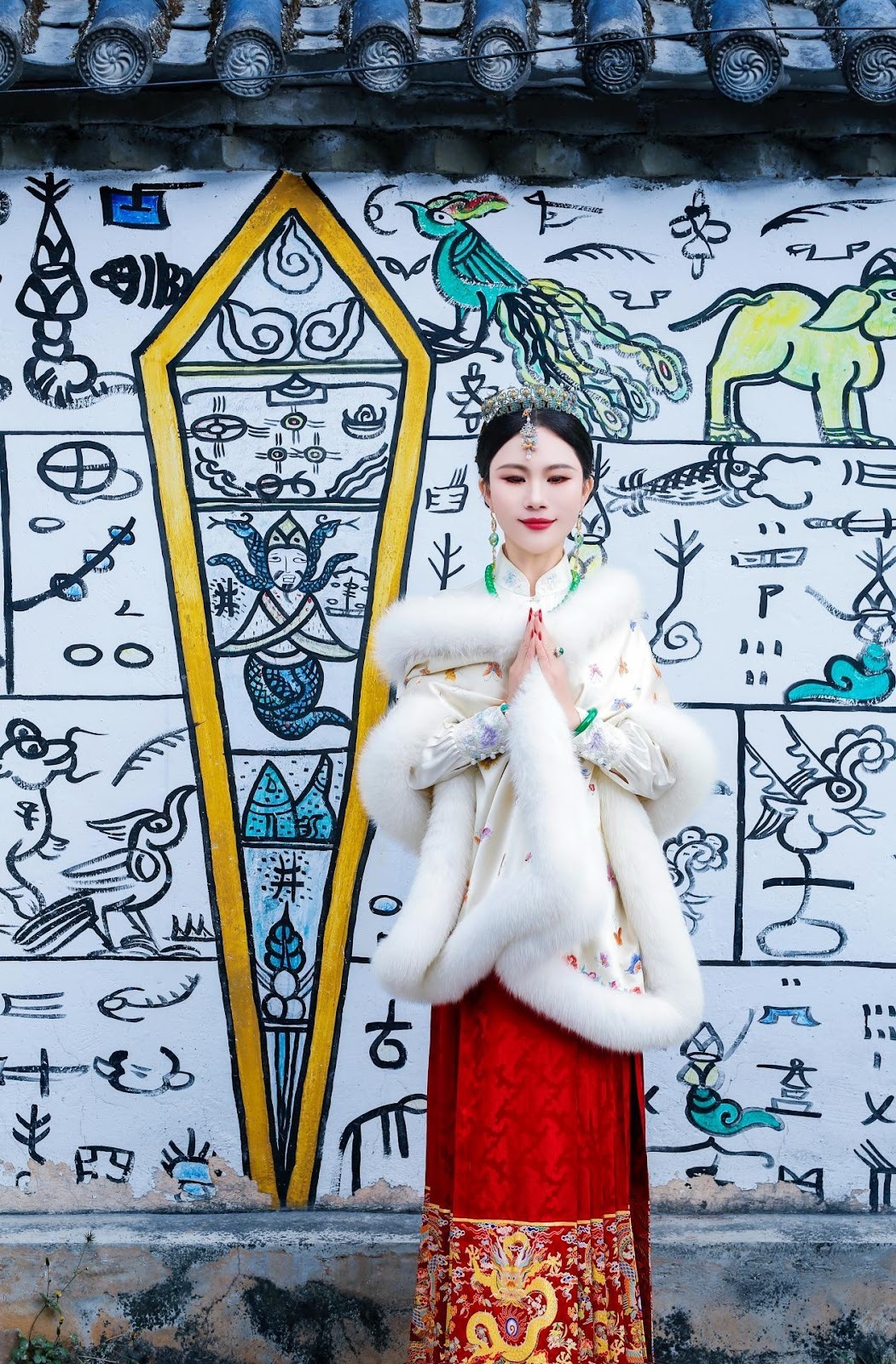
Internationally renowned writer, poet and translator, member of the Chinese Writers Association. The only female inheritor of UNESCO-listed Dongba Culture, International Disseminator of Dongba Culture and practitioner of Chinese culture’s global outreach. Winner of the Italian Francesco Giampietri International Literary Award, President of Lanxin Samei Academy and Dean of Yulong Wenbi Dongba Culture Academy.
I entered the water but had noticed other people did not. Yet there were no sign or verbal warnings about anything. The sea in a storm season had somehow riled and stirred everything and people were getting almost immediately stung by jellyfish upon entry. And I was next.
I didn’t realize at first, just that my body ached and itched and I got right out and tried different things. Water cold. Pool water. Air. Nothing worked. A doctor came and gave me some medicine, and we could see the line on the arm that extended far across the inner arm that was swollen. After a while I felt well, not in crisis.
But the doctor came back and said she was worried because that medicine is supposed to be liquid not solid, that it had gotten old. I said not to worry, and she stood watching the sea eating an ice cream cone.
At the night I sat on the balcony and read For Whom the Bell Tolls under a soft yellow electric lamp. A lizard, the small type, watched this from the stucco wall. This was in Puerto Morelos. I slept a bit and began reading again inside the morning. Beautiful pelicans that looked like dinosaur things flew. I stood and stretched. Things would be okay. I’d avoid the sea for a while, certainly. But things would be okay. There were passages from the novel written so well I had to just pause and stare at the sky, wondering how Hemingway had done that. Ya, things were well enough, having Hemingway and that balcony. Besides, they had a good pool on the grounds.
Beyond the Extraordinary or of Joseph Conrad (Experience, Language, Hard Work, and Genius)
Many of the scholars and documentaries and such rightly claim that numerous things contributed to Joseph Conrad’s highly successful and monumental canon of literature. They point out his multiple languages, plus a passion for the sea and written word, and the study and hard work, plus an immense dedication to craft and truth both. But, though that’s all obviously true, in reading him there is something more, and it’s that he was possessed of genius. And in two ways.
One part of his genius was in seeing, and he himself said that above all he wanted to make people see. And the other half was in expression, in writing. He saw and he wrote. Many people speak multiple languages, and several are writers and poets, but is there anyone that can turn every sentence into gold like Conrad? Little or few. And in a climate modern where sparseness and brevity is lauded as a fashion for some odd reason, his golden descriptive sentences shine even brighter, turning the idea of telling a story into something immensely valuable. Conrad can show the way back to true storytelling and literature.
Therefore, it is a sea worker’s life and experience, the languages, the interest, and hard work, but, nature or God also added genius to the mix. If you look closely, even though there are several that can turn sentences that are extraordinary, there are few that can go beyond the extraordinary into something else entirely.
Tribute to the 17th United Nations Chinese Language Day
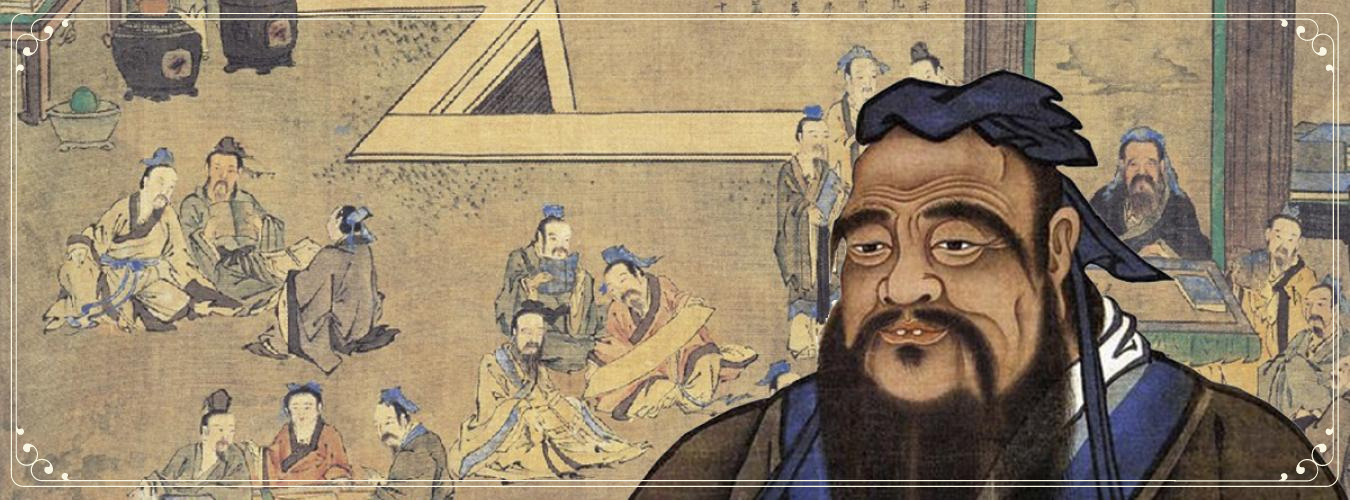
Portrait of Confucius
On the 17th United Nations Chinese Language Day we celebrate the timeless charm of Chinese characters a carrier of thousands of years of Eastern wisdom poetry and cultural heritage
Five years ago during the 12th UN Chinese Language Day one of the three core thematic lectures selected by the United Nations “The Mysterious Dongba Hieroglyphs” was solemnly held at our Dongba Culture Academy My respected master the 17th-generation Grand Dongba Priest Aheng Dongta appeared on the front page of the official United Nations website As a wise man of the Naxi people and the soul inheritor of Dongba culture he brought the world’s only living pictographic script to the global stage letting the wisdom of Dongba culture and the brilliance of Eastern civilization shine on the international stage
Dongba hieroglyphs are the living fossil of Naxi civilization a cultural code spanning millennia and a spiritual bridge connecting the past and present and linking civilizations As the sole female inheritor and international communicator of the Dongba culture of the UNESCO Memory of the World I will always stay true to my mission as a cultural messenger delving into the translation and research of Dongba ancient books to let this precious human cultural heritage revitalize in the new era Taking language as a bond I will promote dialogue and mutual learning among different civilizations injecting oriental energy into world peace and cultural prosperity
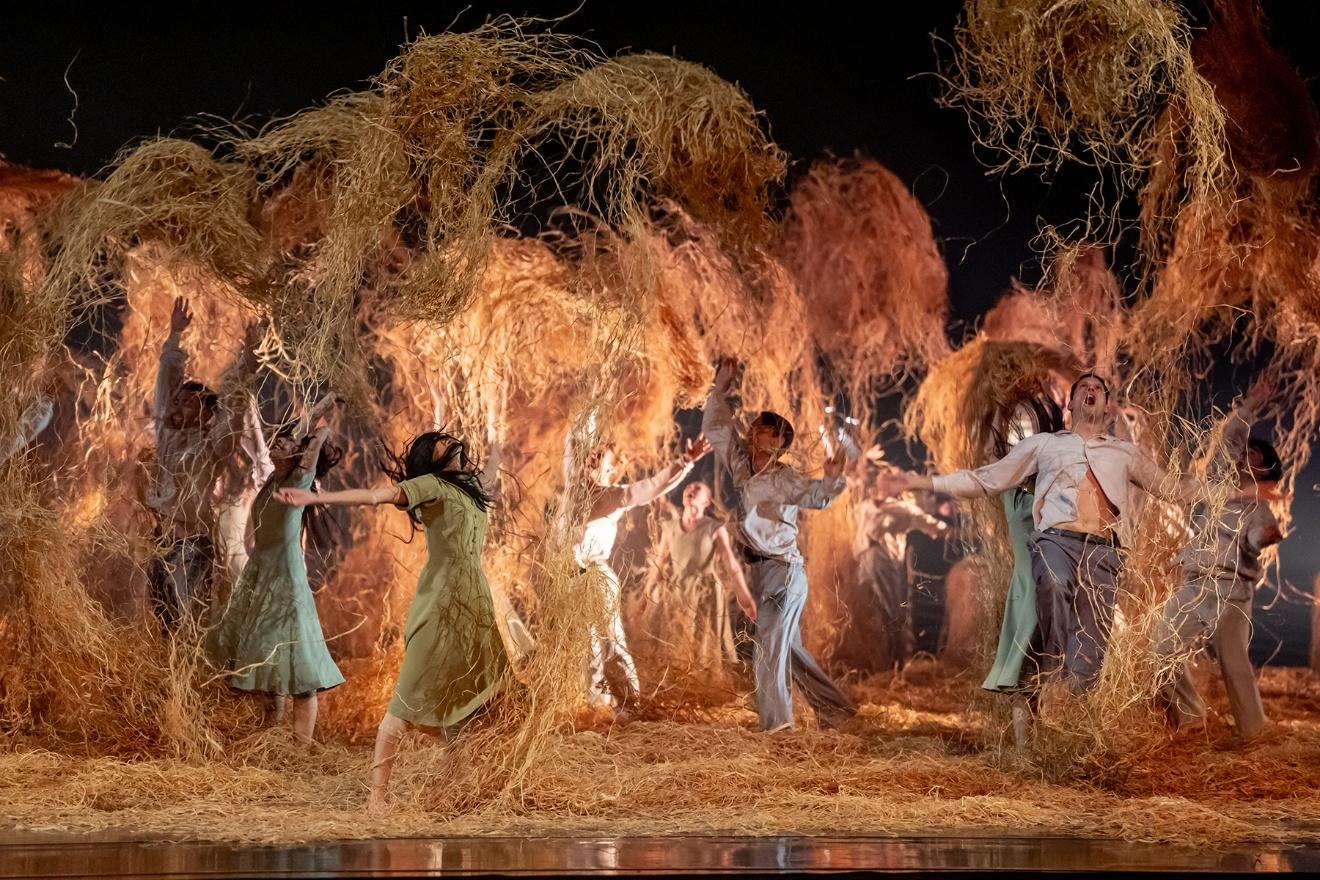
“Scene from “Midsummer Night’s Dream” by The Joffrey Ballet. (Photo: Cheryl Mann)”
Midsummer Night’s Dream
The Joffrey Ballet
Zellerbach Theater
Berkeley, California
Midsummer Madness
“We had this beautiful summer house in the Swedish countryside. My favorite thing was to run in the field in front of the house and pick seven different flowers to put them under my pillow. Tradition says that if you put these flowers under your pillow before you go to bed, you will dream of your future love.”—Anna von Hausswolff
When you go to see a performance titled “Midsummer Night’s Dream,” even when warned ahead of time it will be set in the pale summer night of Sweden, you can be forgiven for expecting a dependably Shakespearian outing, though this time with maybe a Scandinavian Oberon and Titania and a regiment of local gnomes, a confusion of misguided romantics bounding through an Arctic midnight forest, and maybe a donkey-headed Svenska Bottom and his rude mechanicals defying the stagy and the stage-struck and a teasing trickster of a northern Puck declaring while displaying to all the world: “What fools these mortals be!”
And you might even be forgiven if, in the opening moments of the performance, you feel slightly disappointed that, no, this is not quite what you are about to be graced with this chilly spring evening.
But then, if you have always loved a surprise, especially when it is packaged as a bonbon and then explodes into a party, your expectations are turned on their head and go leaping in cartwheels across the stage, as if the whole theater had been turned into a circus expressly for your entertainment, and you find yourself with little alternative but to let yourself be blissfully carried away for the rest of the enchanted evening. There are a lot worse disappointments! And it’s easy enough to imagine Puck roaring with laughter up his gossamer sleeve.
Such, anyway, was this viewer’s experience when Cal Performances brought The Joffrey Ballet to the Zellerbach Theater on the UC Berkeley campus over a weekend this April. I’m still sorting out all the chaos of revelries that made it one of the most memorable evenings of a season that has had, frankly, a lot of competition.
The dance was divided into two parts, the first running a little under, the second a little over an hour, but who’s counting? The proof of any wonder is how fast it seems to fill any pocket of time with riches, and yet how brief it all seems in the end.
The first half opens, with deceptive minimalism, with a buffed up young man (a fine Dylan Gutierrez, who served as our point of contact for the evening; it’s his dream, after all, that we’re sharing) as he tries, unsuccessfully, to go to sleep in the glaring Scandinavian midsummer night. His bed stands in front of the stage curtain on which random sayings are projected, immediately dissolving: “Pick some strawberries!” “Meet me in the meadow,” “Sven is drunk,” “I prefer Christmas,” “Do you still love me?” . . .
A graceful young woman (the excellent Victoria Jaiani, who will be our main point of romance for the evening) bearing a sheaf of hay, dances down the aisle and up to the stage, waking the young man and then whisking him away through a crack in the curtain, which opens up to a wild, choppy confusion of dozens of dancers thrashing and dashing and flailing across a stage blanketed with golden hay like a vast field at the height of harvest season. From here on, we are far from the forest of Arden, but never far from magic.
The first act unfolds as a kind of bacchantic fertility rite, a revelry of farm workers dancing and playing, not only in, but with the hay, at the foot of a tall, mask-like pagan symbol, integrating a cross, an arrow, and two eye-like wreaths, erected above them.
The dancing workers whisk about, flail and harvest and roll the hay up into tub-like bundles which as used as little stages for couples dancing for love and delight, and they finally cast it all back into a long, luxurious play on the eternal idea of a sweetly innocent roll in the hay, quite literally.
A long table is then rolled out, and the hay is swept gaily off the stage, and the host of workers gather and celebrate the harvest in a traditional banquet. A solitary singer (the magical Anna von Hausswolff, who will appear at especially mysterious and lyrical moments) comes out and sings of the peace and joy of the long festival of summer in these cold and northern climes.
Then the revelry resumes, leading up to a long, strange, mysterious moment, when all the dancers, arranged in an almost intimidating phalanx stretching from end to end of the stage, approach the edge and, wreathed in enigmatic smiles, stare at the audience as if waiting for us to . . . do what?
There was nervous laughter, nervous applause, a little bout of rhythmic clapping, tense silence, and childlike wonder at what it all meant, as the dancers gazed silent as the midsummer sun on the puzzled mortals beneath them, then, just as mysteriously, dissolved back into seemingly random reveling.
The first act ended with one of the evening’s most magical moments, as the dancers moved up and down the long banquet table, bearing candelabras, until they stepped down to and across the darkened stage, off the stage, into the audience and up the aisles, with candelabras still aloft, until they froze, staring at the audience with mad charm.
The first half had many such marvels of enchantment. But it provided nothing to prepare us for what we would see in the second: a fever earthquake, tidal wave of inventions without end, technique without boundaries, a pagan unleashing in a teeming, ecstatic nightmare – for what would a dance about a dream be without the challenge of a nightmare? And everybody rose to meet it, conquered, and conquered again and again for the rest of a dream no one wanted, honestly, to wake from.
Because when was a nightmare ever more turbulent, tumultuous, tumacious, titillating, terrifying fun? Not only did the choreography raise its game to undreamed of heights, and the dancers follow, ever braver and more victorious than the last, but so did the set, the lighting, the props; nor forget the brilliance of music and musicians, never left behind, indeed often leading, including, later, in a soft passage after the seemingly endless rolling frieze of thrills of the opening, the already mentioned singer, who capped many a manic moment with a soft, still climax.
Did I forget the humor? Unforgivable! Because this was a production that, in its deeply romantic and pagan heart, knows how to laugh, out of pure high spirits and unshackled joy. I will mention only the giant Max Ernst fishes landing at unexpected moments or parading enormously across the boards, and the gleeful gigglers prancing in the odd corner at the odd moment, and the tutu-refined would-be swanners undermined in their earnest pliés by the gleeful gigglers and snarky bystanders, and the dueling immaculately haberdashed duo of headless gentlemen (Edson Barbarosa and Aaron Reneteria) bouncing around the stage with arms flailing and trading slaps at each other’s invisible heads, and the half-naked chef (danced with elegant insouciance by Fernando Duarte) parading around en pointe and buff-butted for much of the act in a chef’s hat and apron – and nothing else, my friend. He was, no doubt, a stand-in for the chef of this spectacular banquet of a production, the choreographer (and set designer) Alexander Ekman, as fine a magician of dance and stage as, I believe after this evening, we now have among us.
The music, a heady combination of contemporary and classical, pop, experimental and traditional Swedish folk music, and played live by a sextet of strings, piano and percussion, was by Michael Karlsson. The ingenious lighting design was originally created by Linus Fellbrom and re-created, not least the ribbons of lights hanging above the audience in the image of a circus tent, for the Zellerbach performance by Chris Maravich.
I think the fairies of Arden would have mightily approved.
_____
Christopher Bernard is an award-winning poet, novelist, playwright, and essayist. His most recent book is the poetry collection The Beauty of Matter: A Pagan’s Verses for a Mystic Idler.