I wasn’t there when the lightning struck the top of the fireworks stand out on HW 80, the year we were broke and had lost our apartment. Peddling silver salutes and cherry bombs was a dream come true. We started selling three weeks before the 4th and slept on the grass of our locked fireworks stand. Each night after we closed at midnight, I put the cash box in a hole I dug near my sleeping bag and covered it with a box.
We were hippies then, in our late twenties, peddling rockets and silver salutes. We hoped to take in enough cash to spend spring and summer in the mountains near Santé Fe, New Mexico, on national forest land.
I’d taken the pickup to get change at the bank. Katherine ran out the back door when the lightning struck with a boom, and high up the structure began to burn. Everything we had tumbled off the shelves, but not one rocket took flight or one firecracker snapped, crackled or popped. Nothing even smoked. The fire up top on the Mr. W sign went out by itself.
Katherine said she was rather disappointed by such a tepid divine intervention. There should have been a bigger show, happenings more impressive. It sprinkled dribbles of rain only a minute or two.
She waited for about ten minutes, went back inside the stand, cleaned things up, and waited for the cars to start pulling in. The lot had been empty with the lightning hit. I thought that was divine intervention enough.
Soon Katherine was again smiling and selling.
—
Paste into your browser the following website addresses to either view Chuck Taylor’s photographs or to learn more about Slough Press:
after the smoke cleared

outside my window
somebody in a car
is blasting the clash
& a pack of motorcycles
is revving in unison
& a woman is feeding
her dog an ice cream cone
right below in the square
& the blue night is coming
on ever so gently
& all the voices floating up
to the second story
are telling me all is well

————————-

sometimes i remember springtime like this

mother pulling marigolds
from crinkly plastic trays
digging holes for roots
no gardening gloves
just earth-stained hands
father sinking wooden
stakes in turned over soil
for waiting tomato plants
beagle loose running
back & forth along chainlink
yapping w/ neighbor’s dog
soft spears of green grass
welcoming bare soles
grandmother visiting from city
sitting in lounge chair
beneath maples full of sap
humming to old music
on radio
no hands swinging
no hammers shattering
no tongues spitting
no leashes choking
no knees pleading
no limbs snapping
no points jabbing
no feet stomping
etc…
just hearts like bright
bouquets of grace

——————————-

prayer for the unborn

stay in the trumpets of the daffodil

stay in the tears of the wisteria

stay in the grit of the anthill

stay in the spots of the monarch

stay in the posture of the frog

stay in the network of the oak leaf

stay in the wind thru the wheat

stay in the flatness of the shadow

stay in the nerves of the sand flea

wherever you might be just hold, stay


———————————————

tonight

w/ each poem
i take the risk
of reaching
my hand out
in the dark

& placing
a flower
behind
the ears
of each
of my
monsters

i think
i see teeth
flash

their mouths
open
but
only to
sweetly hum

this time
Ecological culture is the foundation of the future
Nature is sacred meat for all living beings on earth. Nature feeds them, clothes them, protects them from heat and cold. In turn, a living being also loves nature. This love can be considered real only if it can be combined with the feeling of protecting nature and increasing its resources. In the recent past, we pretended that we love nature, but we forgot that we are responsible for its preservation. This irresponsibility has created a new science known as “Ecology”. The word “Ecology” is derived from the words “eko” – home, dwelling, “logos” – science, and it is the development of measures to prevent environmental destruction and the factors that cause it. explores the basics of exit knowledge promotion.
It is the need of the hour for a mature person of the new century to be able to show the elements of ecological culture. Ecological culture is an in-depth knowledge of the environment, a sense of protecting nature, caring for plants and animals, rational use of natural resources, and their reproduction. is a high indicator of practical activity aimed at grieving.
A person who can reflect these qualities can be called the owner of ecological culture.
Do not allow excess water from consumption to flow from taps, do not pollute water bodies, do not throw garbage around. Keeping places tidy, not breaking seedlings and flowers and planting them, taking care of animals, taking care of birds, turning houses and alleys into flower beds are the simplest manifestations of ecological culture.
In the current period, there is an imbalance between man and nature, scientific and technical development and the environment, society and ecology. All this puts the question of further improvement of ecological culture.
It is known that everything in nature is harmonious. And the person who is making good use of scientific and technical achievements is breaking this harmony, treating him cruelly. Improper use of natural resources: water, land has changed the ecology. Improper planning of agricultural crops, excessive use of chemical fertilizers have a negative impact on soil fertility and human health. Toxic effluents from factories pollute water bodies, primarily causing harm to animal and plant life. The smoke and gas coming out of vehicles spoils the air quality. All this requires ecological culture from a person. Everyone can enjoy nature. But this does not mean love for nature. Love for nature begins with understanding it, understanding its beauties, and entering into a relationship with nature.
On the other hand, nature nurtures feelings such as observation, sensitivity, and tenderness in a person. This is manifested in a person in two ways: in relation to nature and to himself. Zahiriddin Muhammad Babur described what he saw and experienced, the nature, wealth, animals, plants and people of the places he visited, and the customs of the peoples. It has many ideas related to earth, water, air, various natural phenomena. Babur respected and valued people who knew the country and always consulted with them. In particular, he paid attention to the breeding of flowers, decorative and fruit trees.
We leave to future generations our spiritual and material wealth, the nature that existed before us and our attitude towards it, that is, our ecological culture. Ecological culture means not only not to harm nature, but also to contribute to its restoration, beautification, and prosperity, and to fight fiercely against those who plunder the environment.
Mamatkasimova Sitora Bakhtiyar’s daughter was born on May 8, 2000 in Mirzaabad district of Sirdarya region. One of the active students of Gulistan State University. His creative works are published in the anthology “Parvoz”, on the international site synchchaos@gmail.com, in the republican magazine ” Creators”, in the international magazine “Raven Cage” of the German state, in the international newspaper “Page 3 news” published in America, Thailand, India, Canada, Australia. , published in the international anthology “Charming pearls of Uzbek amateur poets and writers” of the state of Moldova. Currently, he works as a propagandist and teacher in the 34th school of Boyovut district on creative and cultural issues.
the escape velocity of panicked sparrows


nearly all of me sitting with the sunny low-hop clover


how the green of the forest waits


a tall man standing in a field of radiant canola flowers


the deep night loss of hard geometries


cosmos dizzy with raindrops and breezes


out of the sun beneath the pines a change of scent


one less croquet player today


getting didactic with the pigeons in Takinosawa Park


a praying mantis born with her dukes up


the farmer's hands on his hips stretching back


apple blossoms eloping with the breeze


another boy has discovered a rainbow in an oil slick


back up pen after back up pen my arithmomania
Tiny Rods
After Jumoke Verrisimo

Rain wraps eager souls in a damp embrace,
quells the perturbing mind and shuts weary eyelids close.

Rain calls to the pictures behind shut lids
& wipes them off like cleaning swipes.

Rain whispers loudly salvation songs;
“a mouth must muse melodies of fortune.”

Rain summons me to a realm where my limbs can imitate his-
insistent ardour, like a drummer’s fingers tickling over *gbedu.

Rain calls upon the east and asks the west to sit still,
forces me to repose though any boisterous force.

Whether here and there it pulls, whether piercing into a scream,
rain nudges on my heart a salvation song.

Yea, if I tilt my face to the raptures of splattering rain,
each drop will come to me hastily as tiny wise bulbs.

* A percussion instrument traditionally used in ceremonial Yoruba music in Nigeria.


#Memory is how What is Left Unsaid is Said

we stepped forward but
twice you reclined & we faded
like a passing wave/
like two ends of a scarlet, now-
clothesline apart.

#I remember the way you smiled in my face;
how creamy bulbs of pictures held the day in them,
in you, I saw a me I didn't know &
this was the first evening I knew you were a beautiful…

did you say we shouldn't be strangers? But
 we can never be 'knowers' either/ maybe
our memories are too seeped
in red/ each film vivid still/
even as one, two, three, we count in many…

#I remember the warmth of you beside me,
the scents and sweat after each race with a ruby rubber roll,
I wished I could press my head on your taut back,
this was the first evening I knew you were a pleasant…

I have you hinged on my memory's (ies) hints/
you have written your name with ruby ink/
on the face of time/ like
a tombstone/
here lies the adoration that never was/
should the moon forget to smile/ another show of broken bravado I despise…

#I remember the letter that had your heart,
each word kneaded by the same reason for
a girl to jump at night,
 & a blazing fire that lit throes of passion,
 this was the first evening I knew you were a love…

even this night/ there is no peace that comes with it
you are a dark ink splattered on the sky/ my sky/
you are the sound of grief/ the tune of pain from a fluter’s flute/
you are a vicious remedy; a painful cure to all joy/
this flowing sea can see…

#I remember the times you owned me as a writer owns his thoughts,
you wrote the world to a stop, asked it to bow at your pen,
 tradition is but a worship of the dead,
this was the first evening I knew you were a happy…

you said we shouldn't be strangers/ when time
sojourns against us/ but haven't you said our love
hangs on the sky; a star unreachable &
that your heart is a coin?
I can never be the head nor the tail/ & I will never…

again, the night you broke the mirror-
it was at midnight, the sun was sorely in slumber
the birds- corpses of the night
& the stars cheered in silence
you became my silent song & I became a distant merry rhyme.
this was the first time I knew you were a painful…

a lover isn't buried too soon in the hades of memories/
this heart cannot call you a stranger/ but
when my lips seek to muster the memories of passions had/
you cease from being a friend/ because
my heart may turn into a racing car/ & my belly- a blooming garden/
even if I tried.

 these creamy bulbs must now close
 the warmth must be put off
 the words must be rubbed out
 the songs must embrace stilled lips
 this is the story of you
and I- who are
neither lovers
 nor strangers
 nor friends
 nor foes…
Damilola Oyedeji (Ariella) is an educationist, a creative writer, and an advocate for self-discovery and inclusion. As a poet, she has learned to navigate life through hope’s compass. This is evident in the thematic focus of her works. She is currently a fellow of the SprinNG Writing Fellowship.
Do you think the comic scenes in Doctor Faustus are a deliberate diversion or do they have any substantial significance? Discuss.
Over-solitariness and over eating of Faustus’s tragic ending in horrible doom points towards the gross humour by the brethren of scholars leaving the former to his lifeless melancholia. Marlowe’s pungent satirical irony is staged by turning the papal court and ridiculing Pope as a mere name. He devalues sovereignty and political activity diminishing the Vicar of Christ from the Emperor to the Duke and eventually descending to private life. It is undoubtedly comical farce when Pope should be boxed in the ear and exclaim in sinisterish threats of damnation in the papal court palace, “Dam’d be this soul forever for this deed.
Wagner’s conjuring to invoke steward Robin who would not surrender his soul for the paltry prize of a shoulder of mutton unless it was well roasted and flavored by good sauce parallels Faustus’ conjuration of Mephistophilis in servitude of a servant. Wagner chants magical spells to transform Robin into a dog, a cat, or a mouse or rat or anything splendours of clownish comic relief.
Faustus’ casting role of a minor court entertainer or conjurer in the Emperor of Germany allegorises satire of anti papal activities to further extent of Elizabethan Renaissance Miracle and Morality conventions. In the setting of Charles V aspiration to see that famous conqueror Alexander the Great and his Paramour and the Duke of Vaholt’s Duchess’ longing for out of season grapes manifests pageantry. Faustus’ ambivalence with trifling brood of enemies whether the clowns of Vanholt or Carter the horse courser and the hostess; disbelieving knights of the emperor. Faustus’ life is enmeshed in the trivialities and sunken beneath the level of the clown and the horse courser.
Lastly Faustus ‘ restoration of dignity and brilliance from being a sadly tarnished magician is the happening of the last act.
“Marlowe brings in all the elements of morality play machinery; but without any of the consolation of morality vision.” Do you agree with the statement? Give reasons for your argument. Or Discuss Doctor Faustus as a text which embodies the contradictions of his age. Elizabethan and Jacobean Marlowe becomes a morning star of the 1890s a harder and more gem-like Oscar Wilde because of his establishment as a religious free thinker and rebel toward social conventions. “Leave these frivolous demands that strike terror to my fainting soul” Mephistopheles the agent of the Devil’s disenfranchisement of evil magic and witchcraft necromancy invokes Faustus with indiscriminate self-expression. “Learn thou of Faustus manly fortitude” To posses or to strive for Helen was the loftiest bliss of chivalry and heroism.
Faustus’s sweet embracing of Helen might work wonder to alleviate his tormenting suffering that do dissuade him from his vow to Lucifer by that Peerless Dame of Greece and classical paragon of beauty. “Was this the face that launched a thousand ships, Burnt the topless towers of Ilium? Sweet Helen, make me immortal with a kiss…Thou art fairer than the evening…hapless semele…shalt be my paramour.” Faustus is a strawman or a scapegoat for Marlowe’s demoniac longings and in this sense his character has traits of Machiavellian spirits or in other words subversion through transgression.
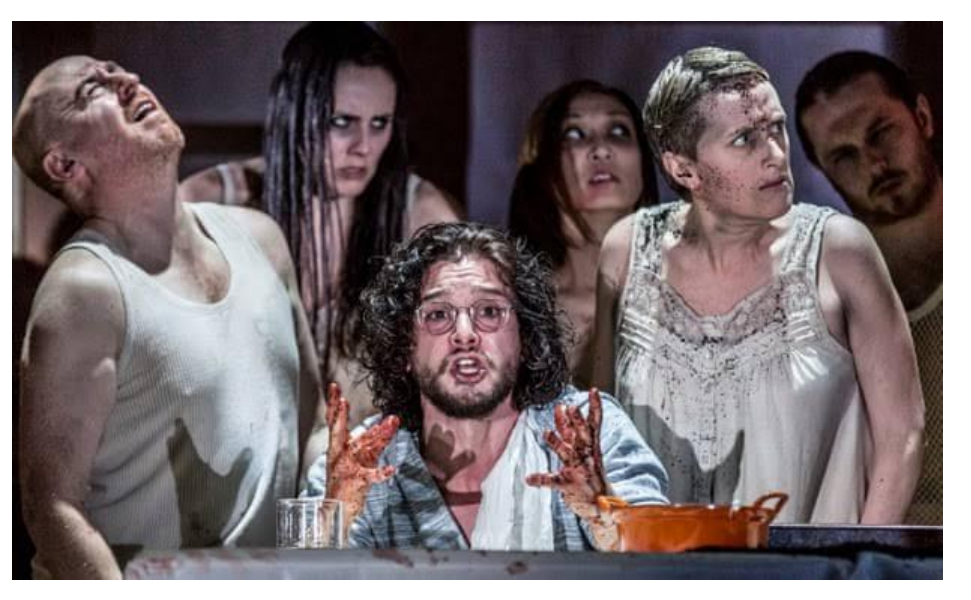
Scene from Faust
Give a comparative analysis of between Faustus’ first soliloquy and his last soliloquy and trace his journey from competence to confidence to damnation. Trace the development of Faustus from a position of heroic grandeur to damnation.
Faustus as a Witenbergs’ flowering pride changes from Doctor of Divinity to a necromancer pestered by the swarm of infernal bees. He achieves pleasure upon the subjugation of all other beings for his personal gratification. Obsessive preoccupation of power for monarchising enforce his singing of the pact in allegiance with the Lucifer. Humour of monarchising through power over the forces of nature-winds, storms, air amd water, power over national and international destinies (The Emperor shall not live but by my leave), power over store houses (I’ll have them fly to India for gold/Ransack the ocean for orient pearl); dispositions of the continental land-masses and movements of the celestial bodies.
Vainglorious ostentations intrigues Faustus to pursue the devilish exercise by aspiring to be the shadow of Agrippa, whose shadows made all Europe honour him. If we consider this of Marlowe’s rhetorical poetic, we are reminded of the quickened impulse, evaluation of a diseased mind or enactment of a kindling or soaring imagination, of a man awestruck before a new universe of meaning and potentiality: “O, what a world of profit and delight// Of honour, of power, of omnipotence, Is promised to the studious artisan? All things that move between the quiet poles/ Shall be at my command:”
Faustus renounces medicine and surgery to cure thousand maladies and be eternalized. Even laws to him are expounded to be paltry and petty. Faustus stoops in the divinity of knowledge for the sake of witchcraft: “These metaphysics of magicians/ And necromantic books are heavenly;/Lines, circles, letters and characters: Ay, these are those that Faustus most desires”/ Faustus is thus changed as a damnable Promethean hero of the Enlightenment. “A sound magician is a mighty God” : The deity of Doctor Faustus is not the God of Love, the Good Shepherd, but either the avenging Jehovah of the Old Testament, or his Christian offshoot, the Calvinist tyrant of mass reprobation.
Faust dramatized
“Ay, you accursed spirit, go to ugly hell” Faustus waves farewell to Mephistophilis abhorred by the repellent face of the latter in the demonic world. The fiend’s abrupt departure and his subsequent return with Lucifer and Beelzebub at precisely the moment when Faustus calls upon Christ is, as James Smith points out an apt representation of the emotional upheaval which the very asking of the question provokes in Faustus’s consciousness. The vain trifles of man’s souls and merely old wife’s fables of afterlife springs in the doubt of the reality of Heaven and Hell.
Faustus as a sound magician and humanist aspirant of power fantasies travel the papal court, kingdom and dukedom to “search all corners of the new-found world” in pursuit of “pleasant fruits and princely delicacies.” Helen, the resuscitated body of classical antique learning extinguishes clean those thoughts that dissuades Faustus from his vow to Lucifer. This hedonism and epicurean self-indulgence allegorises the Faustus cardinal sins of lechery in satire.
This damnable nature of Faustus’ ambition can be justified in the language of the critic Helen Gardner, “The great reversal from the first scene of Doctor Faustus to the last scene can be defined in many different ways. From presumption to despair, from doubt into the existence of hell to belief in the reality of nothing else. From aspiration and deity, and omnipotence to longing for extinction. At the beginning Faustus rises above his humanity but at the closing he sinks below it to be transformed into the beast or little water drops. At the beginning Faustus attempts usurpation upon God but at the closing he is an usurper upon the devil.”
Faustus estranged and suppressed humanity have risen to demand the due fruits of harvest. His hardness of heart and stiffness of mind –Despair in God and trust in Beelzebub/ the escapist frivolities of pageant of sins becomes dwindled by the cosmic forces. It is the consummation of the Puritan imagination as J. B. Steane points out “lurking sense of damnations precedes the invocation of hell”. The apotheosis of Helen is supposed firmly to be placed as a narcotic which extinguish clear his thoughts that do dissuade Faustus from his vow, nevertheless overflows the moral banks Marlowe is constructing:
“O thou art fairer than the evening’s air/ Clad in the beauty of a thousand stars,/ Brighter art thou than the flaming Jupiter/ When he appear’d for the hapless Semele;/ More lovely than the monarch of the sky/ In wanton Arethusa’s azur’d arms,/ And none but thou shalt be my paramour.”/
These flames of passion so fiercely flare up is transfigures even so moral epithet as wanton. The conflict is sharp in this scene, for these lines are immediately succeeded by the Old Man: /“Accursed Faustus, miserable man,/ That from thy soul exclud’st the grace of heaven/ And flies the throne of his tribunal seat/