Steven Croft reviews William Walsh’s novel Lakewood

William Walsh’s Lakewood
Give Me Love (Please): A Review of Lakewood by William Walsh
 

       In 1973 the United States signed the Paris Peace Accords ending the Vietnam War, the US Supreme Court ruled on Roe v. Wade, OPEC drastically decreased oil production, Billie Jean King defeated Bobby Riggs in the "Battle of the Sexes" tennis match, and, in the new novel Lakewood (TouchPoint Press, 2022) by William Walsh, Robert English began "The Summer Journal of Robert English" on May 14th.  In this journal Robert English will be a close observer of American politics and culture, but his goal is to be an even closer observer of himself.  Robert's reaction to emotional bombshells is to flee -- perhaps learned from his parents -- and at nineteen Robert has recently fled: from Atlanta, GA, to Lakewood, NY, (on Chatauqua Lake) where he is attending college.  This summer is an attempt to ground himself and live more deliberately as he focuses on his life and what he hopes to make of it.  Another diarist once installed himself by a pond for a similar reason, but Thoreau was fittingly called a "hermit saint," and Robert English will prove to be neither, so, except for a Thoreau-like proclivity for making lists, this comparison works only for Robert's diaristic beginning.

       As the novel begins Robert is housesitting in the lakeside home of his history professor, Dr. Laighles, who has gone with his wife Emily to Europe for the summer to research a book on Ireland during WWII.  We learn on the second page of the diary that Robert has a specific reason for taking this house-sitting job that is crucially important to him: "Terrace Avenue—this was my childhood home, before Kimberly died. Once Emily and Dr. Laighles left, I walked the halls of my old house to explore, opening every door...".  Eleven years ago his twin sister died at the house in a freak accident, and his parents chose to sell the house and everything in it and move far away.  They don't know Robert is house-sitting, and he leads his mother to believe he is working an internship at the college for the summer and living in a hotel.  We begin to see Robert is prone to misdemeanor ethical lapses if they will get him what he really wants; earlier, Robert writes, when Dr. Laighles asked in class in an off-hand way if anyone would be interested in staying in his house for the summer, Robert went to his office to find Dr. Laighles gone and a note in his box from Mary Cox accepting the job -- Robert steals her note, replacing it with his own acceptance.  He tells us his parents, who never want to see the house again, would be extremely upset if they knew he was there.  I think of a line from Harold Brodkey's short story "The State of Grace": "And mothers and fathers were dim and far away -- too far away ever to reach in and touch the sore place and make it heal...".  Robert, unable to let go of the trauma of his sister's death, can no longer follow his parents' plan of avoidance and has come back to the very place of sorrow.  As Robert settles into the home, which includes taking care of the Laighles' two Saint Bernards, Harry and Bess, he finds evidence of his sister's presence everywhere.  Both their names carved with Popsicle sticks into a concrete walkway his father poured.  Her name signed with crayon on a column in the attic, signed again in the crawl space below the stairs which he finds while playing a hide-and-seek game with the dogs.  I think it is significant for this important element of Walsh's storyline that the word nostalgia is a derived composite of the Greek words for "return home" and "pain."

       With free reign, like a lone visitor in a museum, Robert spends days, weeks, carefully exploring every space in the house.  In his family's old piano room, he finds Dr. Laighles "has a real cool Motorola Stereo cabinet" with a jazz album and a Del-Tones album left out on it: "Using my skills of deduction and logic, I conclude Dr. Laighles likes the jazz, while Emily likes the surfer music.  I have no proof, but based on their personalities, I'm making a hypothesis."  Robert then makes a list -- one of numerous lists in the diary -- of his favorite songs on the albums.  We learn "Kimberly's old bedroom is locked," and that in the TV room there is "a 1962 World Series pinball machine...a baseball game with a bat instead of flippers."  Also, as he tells us of these investigative discoveries, the temporal compression of each day is expanded by more and more memories of the past he adds into the diary.  We learn he dropped the idea of attending the University of Georgia when he found out his best friend had sex with Robert's girlfriend on the night of their high school graduation, after Robert had refused her sexual advances because they did not have protection, and gone home.  He tells us he has received seven letters from Ashley so far which he refuses to open and read.  In a short time, though, these solitary musings will be interrupted by the appearance at the Laighles' house of a character who will stand third in order of emotional importance to Robert in the novel, Mike, who sits down uninvited on the front steps to pet the dogs, asking in a kind of mumble-mouthed confusion if Steven is home: "'No, it’s just me and the dogs. Who’s Steven?'....His name is Michael Forest, Mike. Something is wrong with him. He’s retarded but doesn’t look retarded. He’s slow and has a hard time getting his words out."  Mike tells Robert Steven is Dr. Laighles's son, and in his first phone call from Dr. Laighles from Europe, the professor mentions: "'A friend of ours might stop by if he hasn’t already.' / 'Yeah, I’ve met him. Mike, right?' / 'Great. Great. About Mike,' he paused, 'he wasn’t born retarded. He was injured in an accident several years ago and has irreversible brain damage.'"  Soon, Robert looks up Steven Laighles on the college library's new, and unique, IBM computer with a search function (reminding us the 1970s was the age of early modern computers) and is directed to an obituary among the stacks in the archived college newspaper:

Steven drowned in 1968 at Kinzua Dam in Allegheny State Park on Labor Day, just a year after the lake was at full capacity....the Chautauqua University Eagle showed his picture. He had blonde hair. It also mentioned Mike and how he tried to rescue Steven but was pulled under by the current. It did not provide any details into his injury other than saying that Edward Proudfoot, a Seneca Indian, drove by the scene and pulled Mike from the water.

As Mike returns to the house daily asking if Steven is home yet, Robert and Mike begin a friendship, playing World Series pinball -- which Mike is surprisingly good at -- and other games like chess which Mike is less skilled at in the beginning, but becomes amazingly good at later in the summer as he works at it.  They go on long trips with Mike on the back of Robert's motorcycle.  So far, we have gleaned a lot of things about Robert from his diary: he is a data nerd, analyzing all the national news, e.g., giving us the vicissitudes of Nixon's burgeoning troubles from the Watergate break-in, liking and analyzing sports, particularly baseball, but also letting us know he lacks physical confidence: at the drug store Robert buys five packs of baseball cards, and the pharmacist asks, "'You must like baseball?' / 'Yes, sir, but I can’t throw it straight to save my life.'" Robert absorbs popular culture of all kinds, e.g., listens to Casey Kasem's American Top 40 and makes lists of his favorite songs -- which he then narrows to his very favorites, like George Harrison's "Give Me Love" and The Carpenter's "Yesterday Once More," begins reading what he considers serious books, like Gravity's Rainbow, starts to teach himself to paint watercolor.  If the definition of a nerd is someone overly intellectual and socially unsure, Robert probably qualifies.  It is when he shows kind, if initially reluctant patience with Mike, that Robert wins the reader over to really liking him.

       Despite his demurral of first-time sex with his high school sweetheart, like all young men Robert is obsessed with sex.  Walsh the author showing us the precociously intellectual and analytical are just as vulnerable to its vital pulse of wanting, wanting, wanting.  Running into a female student named Caroline DeBauché (whom Robert had disparagingly described to a male classmate at the beginning of Lakewood as "The Ice Queen") at the college post office, he asks her out on a date, which he quickly, and slyly, shifts to a non-date.  She is back in town briefly to take a make-up exam to satisfy a previous year's "Incomplete.": "'Are you doing anything tonight?' / 'Yeah, studying. My test’s on Friday. I have two days to prepare.' / 'Let’s go see Paper Moon. It’s playing at The Lakewood Drive-In.' / 'I’m not going to the drive-in with you.' / 'Just come over for dinner. I’ll cook something up and I’ll quiz you. Bring your books.'"  And later at the Laighles' house in front of the fireplace:  "After studying, that’s when I made a move and kissed her. We started making out a little, but she stopped only after a minute of kissing. / 'Show me the house.'"  One of the things they find on their tour is Dr. Laighles' 1961 Corvette in the garage, and Robert says, "'Want to go for a spin?'  And with those six words, my world, my life, has been completely destroyed."  They drive around the lake making several casual stops, one to make out by the dock at Bemus Point: "Near the dock, we kissed under the moonlight, and for a moment, I imagined that more might happen later."  They continue on their drive while listening to the entirety of a brand-new album, Tubular Bells, on WJTN Radio.  And then the most spirited and memorable action in the book begins, with the sudden stochastic horror of the visitation in Hitchcock's movie The Birds:  "Once the music finished, Caroline randomly yelled, 'Don’t touch me. Ever!' / 'What are you talking about? I’m driving the car. I didn’t touch you.' / 'Don’t touch me!' / 'Hey, hey, stop screaming.' / 'I’ll scream my Goddamn head off if I want to. Don’t touch me.'"  Caroline physically assaults Robert with flailing arms, until, yelling at him, "'You tried raping me!'...she caught me in the upper jawbone with a closed fist. At the corner of Cowing and Winch Road, I lost control...".  Both are physically shaken up, bruised and bloodied as the car swerves off the road into a cornfield, which takes an hour for Robert to drive out of.  For me, metaphorically, it is like Robert is destined to hit the rocks Odysseus avoided by strapping himself to the mast, and I think of the short story "Escapes" by Joy Williams where a mother and daughter drive to a magician's show in their convertible, to have the mother suddenly and strangely crawl onto stage begging the magician preparing to cut his assistant in half with a chainsaw to cut her in half instead: "Her lipstick gone. Did she think she was in disguise, I wondered. 'But why not,' my mother said, 'to go and come back, that's what we want, that's why we're here and why we can't expect something to be done you can't expect us every day we get tired of showing up every day you can't get away with this forever....'"  This scene in Lakewood has that kind of iconic literary resonance -- and though not mentioned by Robert who would not know this, Walsh surely knows that Tubular Bells would become the signature music for the movie The Exorcist later that year.  Once Robert gets Caroline back to her hotel in the car that is now a rattletrap, Caroline screams from her bloodied face that she is not going to the hospital, Robert still saying, "I’m taking you to the hospital.” And her replying “I’m not going anywhere, except to the hotel to call my brother. You’re going to wish you’d never touched me."  This incident will hang over the novel's plot and Robert like an invisible trap door, until finally coming down on him later, after the coming weeks of almost pastoral bliss for him, with a vengeance.

       Robert hides the Corvette under a tarp, and worry over it will nag at him, but two weeks after the accident a very consequential event occurs that will push worry away as Robert's is mesmerized by a new and consuming focus: visiting the public library with Mike, he sees Annie for the first time and it is like the vision of a seraph: "Her hair slinking down her shoulders like a sheet of gold....'Mike, look at that girl', I said. 'Look.  Look.' / 'I see her.' / 'God she's pretty. She's absolutely gorgeous.'...I watched as she moved around the library without a clue in the world that she is a goddess, floating from place to place like an angel."  And Mike replies, "'That’s Annie.' / 'You know her?' / 'She’s a friend of mine.'"  Right away Mike introduces Robert to Annie, and soon brings her over to the Laighles' house: "9:50 p.m. Mike and Annie just left. Mike brought Annie over to the house unexpectedly. My nerves are still shaking because the woman I have fallen in love with has asked me over to her apartment tomorrow for dinner. Lord, what wonderful fate has come my way?" The friendly dating that begins the relationship grows into something much more over the course of the summer.  Annie is free-spirited, confident, and intelligent -- older than Robert, she will start a PhD in psychology in the fall.  On the night of their first dinner together, Annie shows Robert a portfolio of nude photos of herself she paid a photographer to take.  Viewing them, Robert -- who manages to keep to himself a titillation reminiscent of Eugene Jerome's at the end of Neil Simon's Brighton Beach Memoirs -- says, "'Aren't you worried about people seeing you?'" And Annie replies: "'You're only the fifth person who's seen them. My sister and her friend have seen them, the photographer who took them, and my best friend in high school, who lives in New York City.  And now, you.'"  She goes on to assure Robert she is not so liberal-minded as having these photos taken might suggest:  "'That's just not the case.  I'm not like that at all.' / 'I wouldn't think that.' / 'I don't believe in fooling around until you're married.' / 'I've never thought about it too much,' I lied."  Also at this point in the novel, Robert takes a job at Chautauqua Indoor Advertising to help pay for the repair of the corvette, lucking into a job where he is paid to read recently published novels and write reports to be used as a means of influencing marketing.  His easy-going boss, Roy, challenges him to chess during work -- both are avid chess buffs -- and Roy even becomes a father-surrogate dispensing advice on life and women (which will become weirdly ironic late in the novel) over their chess board during long games.  Early in his journal, Robert wrote:

I fear being alone as I get older....I have no one else. Kimberly is gone. Ashley is out of my life. If my parents were gone, I wouldn't have anyone to spend Christmas with....Yes, even when I was younger, I always wanted to start a family early....I want a wife to love and who loves me...I want to be surrounded by people who love me.

Now, suddenly Robert is in the middle of a circle of friends that includes Annie, Mike, and eventually Roy and his family.  Picnics, camping, an idyllic outdoor Glen Campbell concert they all attend on the Fourth of July -- at the center of his new sense of contentment is Annie who slowly ameliorates the pain of Kimberly's death, which drew Robert back to Lakewood, with what is obviously love.

       Will the idyll of Robert's summer carry into the fall?  All summer he has given us daily empirical explanations of himself, writing, diligently working to perceive his personal truth, seeking to find his center in order to become aware of his ultimate goals.  All the while, there has been no "fourth wall": he anticipates the diary being read when he concludes it, even imagines the kind of person he would like to read it.  In his life he has been inclined to a self-serving soft ethics at times to get what he wants, but his diary is in part a confessional and a place where he is always as honest as he can be.  The French philosopher Paul Ricoeur called his famous "hermeneutic" structural analysis of written texts a “hermeneutics of suspicion” because discourse, he believed, both reveals and conceals something; and that, in interpreting a text, an analyst must move "from what is said to what is really talked about," i.e. to a more enlightened an intuitive understanding that goes beyond what is said.  It may be that we as readers will gain a more enlightened and intuitive understanding of what Robert really wants than he does?  Will the relationship between Robert and Annie progress easily into something long-lasting?  I will just say that this a serious novel and Walsh's primary intent is character study.  By the end of the novel the characters are connected by fate in a way reminiscent of Dickens.  When the nightmare date with Caroline DeBauché reenters the story -- like the birds in Hitchcock's movie -- Mike will heroically save Robert from being killed, something he was unable to do for his best friend Steven.  When Robert finally finds the key to Kimberly's room as he continues to search the house for her memory, he discovers that it became Steven Laighles' room and is full of pictures of Annie and Steven together.  Annie -- at least we as readers can perceive -- is allowing herself to love again, and when she initiates making her relationship with Robert a sexual one, it means something deeply serious for her.

       Lakewood is a good story, is a serious story, and is an illuminating period story of the early 1970s like Huckleberry Finn is of the late 1830s.  And its story does not end here.  In the press release for the novel, Walsh's publisher tells us this is the first book of a trilogy.  At the end of reading, I am very eager, as I think anyone who reads the novel will be, for the second book, very eager to see where the story goes next.  I recommend Lakewood.


Steven Croft
...

William Walsh is Director of Creative Writing at Reinhardt University.  He is a known poet and a very well-known interviewer of famous writers.  Here is one of my favorite interviews
he did with Rita Dove.

A US Army combat veteran, Steven Croft lives happily on a barrier island off the coast of Georgia on a property lush with vegetation and home to various species of birds and animals. His poems have appeared in Liquid Imagination, The Five-Two, Ariel Chart, Eunoia Review, Anti-Heroin Chic, Synchronized Chaos, and other places, and have been nominated for the Pushcart Prize and Best of the Net.

William Walsh’s Lakewood is available here from Touchpoint Press.
Art and an essay from Norman J. Olson

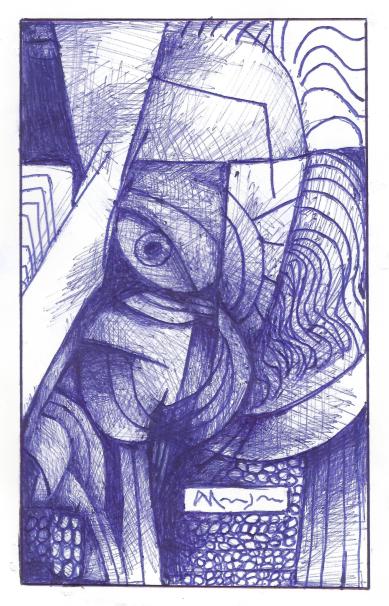
Portrait of the late Les Barany

June 2016, ballpoint pen
Family including view of the old farm
thoughts on recognizing images in my art 

by:  Norman J. Olson 


the way I  make art is that I start making marks on a surface and try to let my mind, eye and hand put the artwork together without thinking about it a lot or wondering what it means…  when people ask me what an artwork of mine means, my stock answer is, “it is an oil painting (or a watercolor, or a drawing), it is up to you (the viewer), to figure out what it means…” 


my art is made up of images and patterns… the images are traditionally rendered in standard art mediums like pen and ink, watercolor and oil paint…  and sometimes in ballpoint pen… and the images are often separated from each other by cell like boxes, like a comic artist would use… except, of course, the images are not generally continuations of each other… sometimes when I am finishing a piece, I will recognize images…  the images in my mind, are of course, based on things I see every day…  landscape elements, faces and bodies of people…  also, I think some images come from secondary sources like movies I see or television… but the images are usually more or less distorted…   I often carry a small sketchbook in which I record quick sketches of people who interest me...  I sometimes copy these sketches directly into a drawing I am working on or, more often, use the memories gleaned from the drawing of the face or figure to inform an imaginative face or figure I am working on....

anyway, I have had a few experiences where I felt like I recognized a person who was important to me in an image as I was making it…  that happened recently with a ballpoint pen drawing I was making…  as I was finishing up the drawing I realized it was a portrait of my late friend Les Barany…  it is not a realistic representation or hyper realist rendering of his face but rather an image based on my memory of his face that seems to me to have captured something of the man I remember…   


another example, is a painting that I made shortly after my dear friend Glen Blomgren died…  as I was finishing the painting, I realized that it was a portrait of Glen, although, again, not a realistic representation of his face…  more a portrait of my memory of him and my sadness at his passing… 


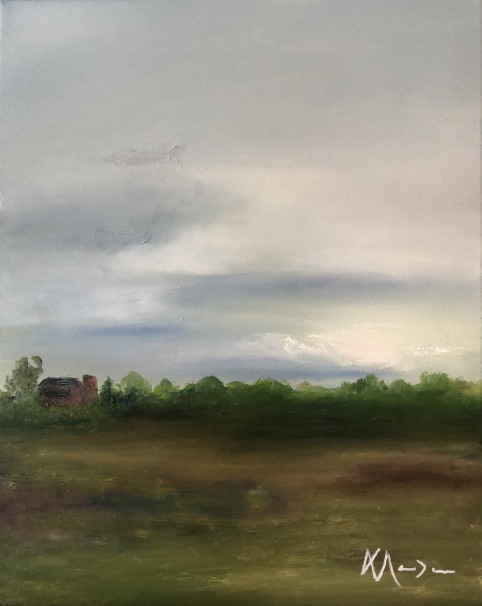
I lived until age 11, on a dairy farm in rural Wisconsin, about 40 miles due east of St. Paul, Minnesota… my memories of the way things looked on this farm have seeped into my paintings many times, the old red barn, the lopsided silo, and even the Wisconsin landscape…  in fact, whenever I drive along I-94 east from the twin cities when I get to the exits around Baldwin, Wisconsin, I have a visceral reaction to those rolling hills, woodlands, farmsteads and fields…  it feels like home…  so, I have included images of some of my artworks that use images from the old farm…  


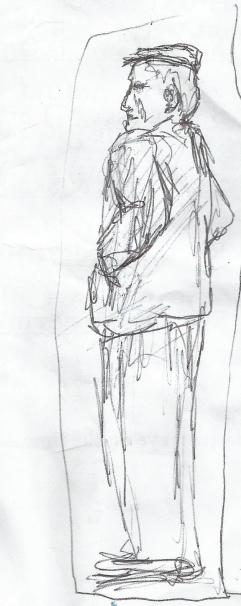
I have also included some sketches of random strangers from my sketchbook and some pieces that seem to me to be actual portraits of people in my life, including one memoir/self portrait of myself as a youth...  

for anyone interested in more information about me and my art, here are two links… an interview with the Wilzig Erotic Art Museum and my website.

Portrait of Harry Wilkins
View of the Old Barn, Oil

Cleopatra Philopator, by Federico Wardal

Cleopatra Philopator

CLEOPATRA VII PHILOPATOR 
by Federico Wardal


CLEOPATRA VII PHILOPATOR is the story of the Egyptian queen who become the queen of the world when she married Julius Caesar. 

This 12 episode story shows Cleopatra VII not only as a political strategist, but as a cultural and cosmopolitan strategist, through the legendary library of her ancestors: the Bibliotheca Alexandrina, world center of philosophy, science and every aspect of human knowledge.  Cleopatra VII, is also shown, for the first time in history, in the human role of mother of Caesarion, her son by Caesar and Cleopatra Selene, Alexander Helios and Ptolemy Philadelphus, with Marco Antonio. The queen is shown in the role of a woman at that time too. 

The sources of this literary work are: Ptolemy XIII Philopator (62-47 BC), elder brother of Cleopatra VII, Horace (65-27 BC) historical officer and poet of the Roman Empire, Cleopatra VII's contemporary . Who relives and tells this story is Ptolemy XIII who appears after death, as in the play by Horace, where Cleopatra VII returns to being what she was after death.  
                                                        ——— 
The place of the action is golden and mysterious, from where the protagonist Ptolemy XIII, the elder brother of Cleopatra VII, talk  to us, in real time, after his death. 

                                             The prologue. 
Ptolemy XIII : 
I am Ptolemy XIII Theos Philopator brother of Cleopatra VII Philopator. 
My name means "God who loves his father" and that of my sister Cleopatra VII means "Goddess who loves her father."
No, none of us in the family has ever abandoned the pharaonic style, although we were born in an Egypt that was post pharaonic, Egypt is and will always remain Egypt. . 
————
I talk to you now, in your present time, and I assure you I will certainly tell you about my sister Cleopatra VII, knowing perfectly that you are most interested in her. Good for your sakes that I have a clear memory, since each action of Cleopatra VII's always has been as unexpected as a sudden explosion. And I ?  I had to die to start again and here we are. 
———————
Through the knowledge of ancient Egypt, I know that you can live beyond death only to a certain point. Unless you have contact with the otherworldly shadows. Otherwise you will live, but in the darkness, lost …which can also be a choice ... 
————
I, barely born, was my mother, Cleopatra V's pupil, and always admired my sister Cleopatra VII, who knew well that I would be her most consenting pawn. 
———-
My mother's ideas were constantly in opposition to my father's. And I considered my sister Cleopatra VII, eight years older than me, more my mother than my mother. But I was able to hide my feelings around my mother and also my stepsister Arsinoe, daughter of another woman. And I hid my own feelings around my father too, the king, to avoid adding to the many conflicts that totally dominated my family. It is easy to imagine how unhappy my childhood was in a family situation where love never existed. 
———
"Dangerous Family Carousel" Scene 1, Part 1

I know, you are impatient to know about the times of Caesar and my sister Cleopatra VII, but necessarily, I have to tell you what happened immediately before, so that, you finally understand aspects that maybe the story has never clarified for you. I will be concise since my earthly life was short, very short. 

"Dangerous Family Carousel" Scene 1, Part 2

CLEOPATRA V, my mother, decided on my life and early death. 

When I was born, my  mother automatically thought of me as the successor to the throne of Egypt, and this was the cause of her misfortune. 
You didn't understand why? 
Oh, but do you think my father could tolerate that his wife would decide the successor to the throne of Egypt? And especially that my mother would have made me her instrument against my father, conditioning me with her maternal love! Love? No, there was never love in my family! 
—————
 “My country Egypt is unconquerable" Scene 2

Now you know my father. And what about my sister Cleopatra VII ? And Arsinoe, my stepsister? My father was the weakest of the family and for this reason the most dangerous. The three women, my mother, my sister Cleopatra VII, and my stepsister Arsinoe were all strategic, in a cold war among them. 
Alliances and sudden and frequent separations were as common as explosions of hatred among the members of my family, while Rome ...Rome was always lurking, ready to profit from continuous discord in my family, to conquer my country, Egypt, although considered unconquerable according to the gods and the Romans themselves, since my country is the father of history, civilization, religion and grandeur in splendor beyond human understanding. 
——
“ CLEOPATRA V, my mother, decided on my life and early death" Scene 3 

I knew since I was a child, that I wouldn't live long. I lived in the midst of bloody situations that were quickly changeable. Even if I vowed to be strong, I knew my will to be strong was just an illusion, based on a totally unstable situation, ungovernable, floating and much larger than myself. 
———
 “I am beyond life, but still in Egypt", Scene 4

I was devoted to the oracles to get peace, at least in my afterlife. 
And I manifest myself to you, in your time, which penetrates any secret, to reveal the story of my sister Cleopatra VII, whose legacy reaches you and will continue beyond your life. I'm sure what I tell you will make you think, resolve to prepare yourself for the future. It will seem strange to you as I will be more polished in telling you what happened after my death than during my short life since I was constantly absorbed with surfing through furious storms and then I was killed at 15. 
Who killed me does not matter, since the circumstances at that time were such that everyone killed everyone. It is perhaps the same in your time ? 
But, here is the time of Julius Caesar. At that time I began to live, being dead. Yes, to live while dead, as the oracles had always announced for me. That's why I can talk to you. 
——
“The Power of Conquest," Scene 5, Part 1 

When Caesar arrived in Alexandria, my sister Cleopatra VII, despite being strongly hampered by Arsinoe, was already the queen of the world. She then prepared her son Cesarione, which she had with Caesar, to be the absolute emperor of the largest empire of the earth.
 ———
“The Power of Conquest,"  Scene 5, Part 2

Cleopatra, after dramatic battles, triumphed in Rome in a grandeur and splendor that no pharaoh, no king or queen, had ever reached. 

With an impressive fleet of ships, she reached Ostia, the port of Rome, and proceeded firmly towards the capital of the world, preceded by an endless procession of thousands of people, a faithful human carpet for her entrance.

Waiting for her was Giulius Caesar representing the whole of Rome and a large statue of massive gold depicting Venus. 
Then, as soon as she descended from her huge sedan chair and her feet touched the Roman soil, an endless ovation exploded. Caesar, bowing his head, greeted Cleopatra, who, dignified, received the greeting, remaining immobile. An absolute silence suddenly descended. Then, after a long look towards Caesar, from a considerable distance, at the peak of tension that dominated the immense crowd, she bent her head gradually to greet Caesar and Rome.

 The enthusiasm conquered each person and grew like a wave that joined and climbed the sky. 
                                               THE END 


Short story from David A. Douglas

The Waking World

Kiera ran down a corridor. Black walls. Light stole its way through the sliver of space between the black ceiling and walls. Just enough to see a few paces ahead. She ran faster without the sensation of velocity. A room opened up. Dark with two white chairs. Stacked. She spun around the room. Black room. White chairs. Black. Then white. Repeated. A doppler effect. Her clothing white. She looked down. Her hands black. She lifted the top chair and sat down in the dining car of a moving train.

It was dark outside the train car window. Art-deco interior. Her face and hair reflected the time. Her dark eyes stared into the void. No sound. Uphill, the gradient increased. More and more the train screamed uphill. Silent scream. She screamed. The roar of the engine broke the silence in a violent wave. She closed her mouth. The train was silent again. All was silent. She screamed again. The train joined her. Scream. Silence. Repeated. An echo in reverse. Uphill. Uphill until the tracks looped back in on themselves. 

Conductor with spectacles of perfectly round lenses shouted, “Tickets!”

She looked down at her white dress. Black hands. Pearls draped. Wondered and said, “I’ve been here before,” her hands moved across the table of the dining car. She did not command her muscles. Glass in hand. No movement. She thought to draw the glass to her lips but could not. She willed herself. She took a sip. Nothing. Returned the glass. Pick it up. Repeated. Slowly she stood. Walked. Forced each step. Walked passed each window. Sun. Tree. Sun. Tree. Repeated. She reached the end of the train car. Feet like stone. Door opened. Color. Trees. Sun. Grass. Roads. She saw color! But she didn’t recognize it as color – green, yellow, and blue. Her recollection was rudely interrupted. Her groomed black hair exploded into the wind. She thought to throw herself from the train. She could not make her muscles move. She struggled. A small step. Her flight was stopped. She turned. The conductor faced her. Together they walked back to her seat. She closed her mahogany brown eyes. She lost control again.

On Les Champs-Elysees, Keira sat quietly. The monochromatic world returned. She waited quietly. Hundreds of people passed by. Cars, up and down the boulevard on a late afternoon. Waiter provided her another glass of wine. A man with an unfamiliar face sat down at the adjacent table and ordered a café latte. He drank his beverage; his pale face altered in a slow progression. Eventually, he looked exactly like her publisher, Jean-Marco. Curly hair. Bright sun set behind him. Color emerged. Yellow, then orange sun. He said the strangest thing, “I’ve been here before.”

She mimicked the last two words with him, “—here before,” in unison. Film noir black-and-white world returned. He then stood and walked away. Color faded to black-and-white. His shadow didn’t follow but he remained to finish the drink. Angle of the shadow caused the glass to appear two feet in height and the publisher eighteen feet tall. She tried to stand. To walk. But her muscles disobeyed. She tried. And tried. Slowly stood. Her stride immediately fired like a rocket. She caught up to Jean-Marco. She couldn’t slow down. Walked right through him. She stopped. He walked through her. He stopped. She walked through him. Repeated. Until she turned into his shadow. Then he turned into her shadow. Repeated. 
Sun set quickly. Darkness. City lights. Arch de Triumph replaced the moonless sky in splendor. Brighter. Brighter. And brighter still. Shadows blurred. Suddenly indoors.

Through his dark eyes Jean-Marco looked at his hands, suddenly they were small like a child’s hands. He sat with legs crossed. Family room flickered from an old sci-fi on the black-and-white television. Aliens and space-ships. People ran. People fought. It was late. He fell asleep. He saw the TV screen filled with static. His heart was filled with fear. He stood in the middle of the room. He placed his hand over the screen. The further he backed up the more his hand covered the screen. He backed up all the way to the empty fireplace, “I’ve been here before,” he muttered, but ignored. He sat in the fire place. Hand down. The static replaced by an alien. Egg-shaped head. Black almond eyes. It stared at him. It reached up. Its hand stretched beyond the top of the screen but remained within the tube. Suddenly, through the chimney, he felt the alien’s hand touch his shoulder. He leaped, screamed, and bolted out of the fireplace. He dove for the power button on the TV. It went dead. He rushed to the light switch on the wall and instantly woke up. He trembled. He wiped the sweat from his face. He was an adult again. His breath slowly calmed. 

Shortly, Jean-Marco ran down a corridor. Walls black. Light stole its way through the sliver of space between the black ceiling and walls. Just enough to see a few paces ahead. He ran faster without the sensation of velocity. A room opened up. Black with two white chairs. Stacked. He spun around the room. Black room. White chairs. A doppler effect. Black. Then white. Repeated. His clothing black. He looked down. His hands white. Gloves. He lifted the top chair and sat. Three men in black grabbed the other chair. They quickly placed it on him. It pressed down on his shoulders. He tried to push back. Room spun. Black. White. Black. White. Repeated. In between the black and white he saw – in color – the lobby of a bank. He didn’t understand color. Three men in black robbed the bank. Masks dawned. They turned and glared at him and others in the lobby. Through the masks. They glared at Keira. He hadn’t noticed her beforehand. Distracted. As swift as a passing train, they were gone. He yelled. He flung his arms into the air. And soon he was in his bed. Blankets on the floor. He immediately wrote down what he saw. Pen down. He exclaimed, “I’ve – been – there – before,” – curious; his hands rubbed his face.

Next morning. Phone rang. Jean-Marco. Keira. Spoke. Respective, similar experiences shared. Silent. Each hung up their receiver. Each stood in disbelief. Curious. Wonder. They met at the café. Boulevard. Cars passed. Cobblestones rose and fell like the lights of an equalizer. To the sounds around them. To their voices. Trees whispered reminders. Like static they whispered. Reminders of past experiences. Shared experiences. But neither were with the other. 
“The similarities are too coincidental,” Jean-Marco said.
“Especially the black room,” she exclaimed in a raised whisper.

Silence. Starred into cups. No answers.
“But what about the déjà vu?” he asked.
“Déjà vu?” she replied.
“Yes! The feeling of having already experienced the present situation.”
“I know what it is. I was more curious about experiencing the same thing.”
“But – but—” he evaluated, “they’re both interconnected!” he urged.
She stopped to think, “Perhaps. You might be right. But – but so frequent too,” she stated. More like a question. Then blurted, “I was in that bank! Yesterday.” 

“Weird,” he replied, “but more than weird. What do you think it means?”
“Well, I don’t believe in metaphysics, but—”
“Why not?” he interrupted.
She flashed him an obstinate glare, “But,” the syllable elongated, “I’ve had this experience once before,” she paused. Regained his completed attention, “My sister. We—” a breath skipped, “—were twins. At least that’s what I was told. I was too little to remember.”
Sympathy, “You never told me.” is eyes widened.
“Does it matter?” past emotion crept into her skull like stale frigid air from a crypt. 
“You know I lost a brother,” he reminded her, “also, many years ago. I don’t remember him, but I was told we looked alike.”

Keira stared at him. A train on a circular track derailed in her mind, “No. No,” she backed away from him.
He clasped onto her arm. A firm grip. But not forceful. Concerned. His grip ended, “We need answers.”
She blurted, “I need to go!”
Jean-Marco persisted, “But—”
“No! I’m not ready for—" she reached out for the crosswalk button. Pressed it. Repeatedly as if firing a gun.
“Tomorrow maybe,” he said.
Walk symbol illuminated. Keira stepped off the curb. A ninety degree difference in direction awaited him. An illuminated hand indicated stop, but for reasons unknown Jean-Marco mirrored her action away from her. A bus. Ten feet. Two feet from a collision. Keira screamed. Her hand accelerated. She caught his arm. Shoulder. The two fell backward. Pain came with the impact. Safety on the sidewalk. A split second later and both would have been dead. The cars and buses rose and fell like the lights of an equalizer. Heartbeats. Synchronized.

Breath. Caught, “What in the world were you—?” 
Jean-Marco, “I – I don’t know.”
They stopped. Stood. Looked around. Without warning, the sidewalk tilted a quarter from level. Street remained; cobbles still in motion – up, down, repeated. The incline was too great. They slid down the sidewalk. It started to rain. Further they slid. The crowds on the sidewalk were unaffected, as were those in the shops and cafés. Keira and Jean-Marco turned small. Further smaller. Slid into the grate of a gutter. Slashed! Walls of grime. Grey and white neon lights. Shaped, or painted on the walls. Keira saw her sister. Jean-Marco saw a little boy. Walls moved and bulged with rats. Lights and shapes of a little girl, then the little boy disappeared into the black and grime and rats. They fell. Stopped by the plunge of a sewer pool. Returned to normal size. What is normal size? 
Like a dream, soon they forgot. Soon they forgot once above ground. Above the swirls of nightmare. The rain washed their memories. Rain hid their tears. Tears became the rain. Keira softly spoke; they spoke simultaneously, “I’ve been here before.”

“Wait!” Keira exclaimed, “Was that my sister?”
The same surprise, “Was that my brother?” the same tone. Jean-Marco added, “How?” a full circle examination of the street, the sidewalk, “What is this?” 
“We’ve been here before,” Keira remarked.
Jean-Marco nodded in disbelief but agreement, “But not exactly – here.”
“No,” she thought for a moment, “It’s – different.”
They looked around. Looked at each other. They stood for minutes but felt like hours. Jean-Marco looked at his watched, “I have a deadline.”
“Of course,” Keira said reluctantly, yet understood. The cobblestones settled. Silent.

Shortly after dinner Keira went to bed. Soon she sat in a field of wildflowers. Wall of trees bordered. Dark forest. She was little. Played with another little girl. Looked like her. A boy in a white shirt, same age played with them. He was also with another boy. Looked like him. The other girl and the other boy played near the edge of the field. Keira and the boy in a grey shirt looked up. The other girl and boy were gone. A cloud. Dark and ominous, reached down. Rain. Heavy rain. Field turned to mud. They slid down a muddy hill. Slid. And slid until they stopped. A well, circular with stone stopped them. Tears blended with the rain. Cries for the other two – unheard. Keira screamed. Cried out again, “Jean-Marco!” Keira woke. Her heart pounded. On the edge, the foot of her bed. Sweat dripped from all over her body. She grabbed the sheet and cried. Her heart pumped out tears. Tears blended with sweat. Sweat blended with tears. She wiped her eyes from the sting of salt. Darkness. Her eyes closed. She sat on the edge of her bed. Desperate to remove the wound increased by the pain of salt. The salt of memory. 

Blur. Blur replaced darkness. Slowly her vision returned. Her heart slowed. She sat on the edge of a pier. Water below. A lake. Trees, a forest surrounded the lake. A gigantic head, then another emerged from the water – shaped by water. Shoulders. The figures stopped at a bust. A girl. A boy. The girl spoke, “You can stop crying for us.” 
The boy smiled, “We are in a beautiful place.”

Slowly, they returned to the lake. The lake drained. Empty. But the memory filled Keira. A happy memory. Happy memories. Soon, they began to fade. She awoke in her apartment in Paris. A flood of half-memory lifted her. No tears. 
Dressed. She walked to her study. Walls of her study changed one a time to the walls of her favorite café. She preferred pen and paper. At a small round table she wrote. Quickly she wrote her recent experience, “Wait!” she blurted, then whispered to herself, “I’ve been here before.” Not because of her frequency to the café. Not because of the table in the corner window – she preferred. A specific motion. A certain sequence. She couldn’t place it. She placed pen to paper and wrote it down. She felt pulled. Compelled. Pulled toward the adjacent corner. Her head turned. Jean-Marco stood at the glass door several windows down from the corner window. But he didn’t enter. The windows displayed images. Sequences of images. Her days at university. Lycée school. Family. 

Suddenly, Jean-Marco entered the café. Sat across from her. Silent at first, “A dream—I had a dream,” stunned face. As if uncontrolled, the words came out of him, “You are my sister!”
“But how?” her eyes widened. Unbelievable became more believable.

The table slowly spun. Like a gentle carousel. The people around them transformed. Turned into various animals. Motionless animals and absent of riders. Keira and Jean-Marco sat where the adults normally reside – on a bench within the carousel. A mirror reflected their faces, although they faced away from the mirror. Keira’s lips within the mirror moved, “How?”

“’How?’ is a good question,” the reflection of Jean-Marco replied – added, “I had the craziest dream last night.”
Keira’s eyes reflected his as if to mirror the same.
“I saw a little girl – two girls. I didn’t recognize them, but I felt as I they were you. Well, not both of them. Then I saw a little boy who liked me,” he saw Keira’s eyes nod again in kind.
“We were all in a field of wildflowers.”
“Yes!”

Keira altered her expression simultaneously with Jean-Marco’s, “They were taken. But they didn’t appear sad.”
“Jean-Marco added, “But I felt sad about it. Then, they told me—”
“— to stop crying for them,” she finished his sentence as he nodded in agreement. Keira asked, “Who were they?”
Jean-Marco and Keira’s reflections disappeared. But they remained seated. Jean-Marco looked closely into Keira’s eyes, “I don’t know,” he raised both eyebrows. Sighed, “We,” he pointed at Keira and himself, “I do know we have the same dark eyes.”

Keira pondered at his inference. Unlikely. She thought for a moment, “But we’re a different race.”
“It’s possible. I did some research before I arrived. Fraternal twins,” he explained in further detail.
Stunned, Keira interjected after a moment of thought. More thought, until she responded, “Makes sense; but—”
“It’s very rare.”
“Not that,” she smiled at him,” Us. We connect. How?”
Jean-Marco reflected her smile and curiosity. The mirror behind them melted. The slow spin of the carousel stopped. At the same time they asked, “Should we try to prove it?” they laughed. He continued, “It’s an easy test. And inexpensive these days. We can have it done tomorrow,” he said as a matter-of-fact.

Keira thought a moment, “I wonder. I wonder if it will drum up more questions; or worse, more answers?”
He shrugged with a blank face. After a thought he replied, “What if we get the test? Then, go from there. At least we’ll know,” he paused, “we’ll know for sure if we’re – brother and sister!”
“Yes but – I am curious,” she smirked in a contemplative way, “Alright. Let’s do it.”
“Agreed.”

They both stood to exit, “But what about our dream recall? And we’re having similar dream!” Keira asked then exclaimed. 
“Yes. It’s like this woman in America I read about. She swore she was living another person’s life. Someone in her dreams,” his tone lacked confidence in the story. 
“But what if the other ‘person’s life’ was reality? Is reality,” her volume raised then lowered, “And, this is all a dream?”
“And the other is what? A waking world?”
“Yes,” she said but in a way which still required explanation.
Jean-Marco replied, “That’ll be hard to prove.”
“Besides – well, sometimes I don’t feel awake,” she laughed, 

“And the intense shared déjà vu?”
“We are from the same womb. Who knows, maybe we—” he waved his arms around as is to include the entire world, “—were meant to connect in more ways – at the original design.”
They both walked off the carousel. Their next step took them back to the café. They stood on the threshold of the entrance, “Good reason for coffee, hmm?” they both smiled.

A few mornings later. Keira was frantic, “I need to see you! I – I see—” she swirled around with phone in hand, “Dammit!” she slammed her toe in the corner of the wall. 
“What?” Jean-Marco asked concerned.
“It’s nothing,” she ignored the pain, “Get over here!”
“Take a breath,” Jean-Marco urged, “I’ll be right over.”
Keira waited. As patient as a child in need of a toilet. Finally he arrived, “Took you long enough”

Jean-Marco held both her shoulders, “Tell me all about it.”
They sat. She stood back up. Paced the room. Circled the coffee table, “There’s another one!” she saw in his eye bewilderment. Then added more, “Another me.”
“What do you mean?” he remained calm.
She sat, “In my dreams. Not in my dreams. But here!” she leaned forward.

“Okay. Okay,” Jean-Marco took a breath. Urged Keira to take another, “Start from the beginning.”
She was beside herself. Afraid. Herself beside was she, “I’ve been having dreams about this apartment, my bedroom. I saw a world painted unlike this one. I don’t know what to call it. I couldn’t control my arms, my legs. They moved on their own,” she stood and walked to the entrance of the bedroom. Pointed inside, “I saw a bottle of pills. I couldn’t read the label – not at first, “I – I walked to the bathroom and looked into the mirror. But – but oh Jean-Marco!”

“Take your time,” he reassured her.
“I saw me. But I was looking at myself from the mirror,” she ran her fingers through her shoulder-length hair black hair.
“And the label?”
“Yes – yes. I wrote it down,” she grabbed a scratch piece of paper from the mantle across the room and handed it to him.
He read her note, “I’m not sure of the spelling, but I think I’ve heard of it before,” he looked up at Keira, “it enhances dream recall. Specifically, in the lucid state.”

“But what does it mean?” she begged.
“Can you tell me more?”
“Yes. Yes, my TV was – she was watching, I was watching the news; listening to it. The anchor was talking about us,” she gasped.
“Us?”
“Well, not us. Not you and me. Her and her brother – the other me. The anchor went on about their reunion after more than thirty years,” she paused. Sat down. Grabbed Jean-Marco’s hands in hers, “she said they finally had closure. 

Authorities had found the remains of a little boy and girl. They were going to a memorial. All four were siblings – quadruplets.”
Jean-Marco was engrossed to the point of sorrow, “Parents?” he asked.
“Gone.”
“Like ours. Like us,” he said the words but in disbelief. Yet belief, “But how do they know?”

“A test. Like ours,” she shook his hands. Up, then down. Repeated. Silence. She finally blurted, “Jean-Marco! Could there actually be – a ‘waking world’? And the other boy and girl—? How is this possible?”
Jean-Marco looked intently into Keira’s eyes, “I wish I knew.” He sat closer to her. He held her as a comforting brother would. She squeezed him in return. Dark eyes cried. Suddenly, they were on a train as it approached a stop. Together. They exited the train but continued to cry. Together.

~

Together, their dark eyes cried as they held each other in her apartment. They both shared the same mahogany brown eyes. Keira’s expresso skin was in contrast to her brother’s white skin as they embraced in mutual comfort. They both wore black in honor of their siblings. After the long embrace, Keira reached out for a small white box and removed a crimson red rose. She pinned it to Jean-Marco’s lapel, then gently delivered a comforting hand to his chest and smiled. He returned the sentiment with a kiss to her forehead. Both hands gently placed on either side of her head.

“It’s time,” Jean-Marco said, “Are you ready?”
She nodded.
They stepped out under the blue sky and walked along a short stone path bordered by green grass. Lights flashed from cameras as film crews surrounded them with microphones and questions. None they answered as they stepped into a limousine. The driver shut the door. The crews’ reflection seen in the tinted windows.

Inside the car, Jean-Marco held his sister’s hand, “What about the dreams?”
Keira looked up into the rearview mirror. She acknowledged her reflection. She saw more than herself. She thought of the words in her dreams, of her siblings who had been found. She imagined the beauty which surrounded them and smiled. She turned to Jean-Marco, “I believe I am at peace.”
Jean-Marco replied, “As am I.”

Poetry from Christopher Bernard

After

By Christopher Bernard

After all the tweets are done,
and all the posts erased,
and all the insta videos
are drowned in silicon,

and all the newsfeeds freeze 
while panic-scrolling past,
and social media “likes”
are hated – yes! – at last,

and all the influencers
are swallowed  by TikTok,
and every troll is smothered
by every soul they mock,

and every “Facebook friend”
has ghosted all their contacts,
not knowing all their contacts
already ghosted them,

and all the digerati
encrypted and encased are
within a frozen chassis,
a whited sepulchre
where their data asleep forever.

and all the web and net
have smothered all their flies
and fattened like two spiders
till all their pixels died,

and all the household names
have blown to clouds and air,
and drifting smoke and ashes
are all the billionaires

into clouds of musk, 
and hell’s unlocked gates
smother the world’s last jobs
suckered to a mark
and a betraying oracle
and a final dying lark –

you and I, my love, my fair, 
shall hover above their shrines
that no one visits, in
a love that conquers silicon
to a quaint soft-shoe rhythm,
all the screen’s illusions,
and death’s algorithm, 

and there we shall dance
inscribed in these brave lines,
my fairest, sweetest, loveliest one,
till the very end of time.

_____

Christopher Bernard’s latest collection of poems, A Socialist’s Garden of Verses, won a 2021 PEN Oakland Josephine Miles Literary Award and was named one of Kirkus Reviews’ “Top 100 Indie Books of 2021.”

Poetry from Ahmad Al-Khatat

Stop Slaughtering the World

Ahmad Al-Khatat

When I saw the orphan was mute
the widow hesitated to run
the instant she stopped hearing his moaning.
Turns out that the entire world weeps 
-continuously at the headless corpses.

We struggle with influential words, 
We die by the death penalty with no empathy, 
We fight with ineffective missiles & weapons,
We die like a tree that falls in the woods alone.
We die proudly for preferring to stand up in peace.

O enemy, why do I perceive my blood rusting your dagger?
I donated my spirit to procure you back to your family
This world taught me to treat you like a welcoming guest 
I want to hug you with your horrible knife stabbing my flesh
just listen to my last words, will you stop slaughtering the world?

Shake my blind father's hands without sharing sorrow 
He bleeds with tears and dreams of a country that doesn’t 
-terrify children, my imagination clarifies to me that I 
will hear more laughter from my grandfather in the paradise 
like the times when I heard birds singing & not the noise of fallen missiles.


Brightness 

When the moon misses its brightness 
I feel lonely as a forgotten painting in the gallery at dusk

Do you remember the moments we sipped the sun wine?
I absorb the biological colours of the rainbow

Then splash them above the grey clouds of autumn.
More birds would rise into the blue of her eyes, 

They attacked my birthplace and crushed my heart in their infirmary.
I lost my hand and since then I became an alcoholic 

Who prays after drinking whiskey from a homesick teacup?
Sad! 
Why so!! 
Don't be!!! 
My neighbour doesn't seem 
informed of the coffin I'm carrying since I accepted your friendship...


If You Waited 

If you have waited for me at this hour
I'd take your hands and educate you on the new alphabet
With unique phrases of encouragement
Your lips will never be dry but mostly moist.

You may portray me as a dusty typewriter
Since you see tears on the windows of my eyes
Flying dead leaves of optimism in my spirit
Sad & love poems are hung in my brain to death. 

You say I’ve seen you here many times.
You asked, who am I to untie your knotted heart? 
I am a boat of long silence and gathered grief
my writings could never bloom more lovers.

This earth or this planet is not a familiar door
The stream hasn't revealed the face of my beloved
O farmer, keep your seeds asleep and fantasy 
of the rain ‘till you pour your tears above your farm.


Aggressive Insomnia 

The night appears beautifully decorated 
with a moon surrounding the glowing stars 
My mind expects to jump into another battle 
With thoughts beneath the dust of a blade.

I rest my body and forcefully close my eyes, 
Endless nightmares hold my throat and breathe
The muscles numb from all empty-handed
My mouth refuses to yell at the dark cloud.

Aggressive insomnia doesn't understand the 
meaning of morning rain or gleaming snow.
Today's world could not reach out to my love
If I wrongly survive then I'd force myself to drink.

What should I hold to sleep in consensus?
The sun has died in my world of difference
I chose to smoke over unnecessary friendship
I successfully hid your corpse but failed to find my own.


Ahmad Al-Khatat was born in Baghdad, Iraq. His work has appeared in print and online journals globally. He has poems translated into several languages such as Farsi, Mandarin, Spanish, Albanian, and Romanian. He has published some poetry chapbooks, and a collection of short stories. He has been nominated for Best of the Net 2019 and was also nominated for the Pushcart Prize for 2020.

Short story from Jim Meirose

Frankie of the Hot Harbors

Come tin. Tin in the basement. Need tin. It’s in the basement.
I mean, I mean to tell you, there’s plenty of tin in the basement, if that’s what you need. In the basement, if that’s what you need, is more tin. But, we fail to see, senor, we fail—fail to see why you need so much tin. Why do you need so much tin? Can you tell us, can you tell you—tell us ell u ll’? Pasta, la Frankie?

Frankie of the hot harbors is here. Hear him coming? He is in town, and he’s in town, and, he’s coming. He’s coming here, right here; here he is—Frankie, hot harbors? Hot harbors, Frankie? Need tin? Need more tin? Right here. Right here, and there, and there here and there, do you see it? I see it Frankie, you have come to the right place. Has it been that often you’ve come to the very right place, the right the very right place, Frankie, in your life? Up ‘til life up ‘til now ‘p ‘il now, Frankie?

Frankie! Frankie! Why you not answer me, Frankie? Why? Why you not answer me?
Victor slammed the cell door over. Turning to his partner, he said, Come on, it’s break time. Let’s go.
Hard all day listening to this, you think?
Yeah, hard is right. Right time, very hard. But, Frankie—why you do this to me, Frankie? Why why why—why? 
Why you make fun of me, Frankie? Why you make fun?

Go with the black and blue


The coffee poured. It’s been made fresh five priors, by the prior breakers, using the break room. As they poured their coffees, they saw scratched all ‘cross and over the tabular-toppe, Frankie; as Frankie does, you want ta’ go walking out, Frankie? You do want? I do want, too, but—must first make this coffee. You know when the pot goes empty the right things to do’s is’s to set up new brew. For the next guy. You get?

Yes, I get; buht not verry-y-one’s decent in the break room. Be thankful, Frankie, the pot’s not boiled empty full of cracklin’ black ash! Remember that time I scrubbed one down and out that and it bursted my hand out that bloody shatter? Remember that, Frankie? Mem-meber that blood showering shatter? Does it please you, Frankie, to mem-ember that? Trala? How’s about a new pot, Frankie? See the shards all re-essemble back-ards, like they did after that time I scrubbed one down, and out that, and it bursted my hand out that bloody shatter? 

Remember that, Frankie? And you were funny, really, so funny, you said, That’s the way it goes sometime, you know, you just red got to green go with the black and blue got to go with it go with the way it wants to go. Blue. ‘cause it will any way, Buckie? That s’wy that s’wy? Love your dog, so, y’know? Love your dog doggie do’ d’ get my drift got ut 5 4 3 2 1 got my—drift? 1 2 3 4 5? Frankie? Love your dog.

Hammer ‘em home 

They rolled with laughter at that one, just as the bulkerheaded fat square door of their muse opened, and in strode their Frankie, again.
Eh, Frankie!

Yahm, Frankie!
Get gone dad needs me under that car; he needed this wrench, and that socket, and it was amazing! He’d say five eighths open end, Frankie—half inch socket quarter inch box moon like when way, way back ‘member, Frankie—when we were helping the creator get up the light? Under that seventh Studebaker ye Pop-pop scrapped out? Eh ‘member that Frankie, mem-ember that dat?

Frankie at Eiknarf mem-member that? Let there be light, he said? Eh? Eh? 
Let there be light, eh let there be light, eh, eh let there be light eh, e’ ‘h, Frankie?
Eh ‘member that Frankie, mem-ember that, dat? Eh, Frankie?
Hammer ‘em home.
Frankie you there?
Yes! I do member that. Dos way dat way, we member. Dis dat. Dis and dat.

Hammer ‘em home Frankie! But, look Luke the bible’s closed over the ratatangle’s locked shut, and the celebrant himselve’s gone to chambers. Atchoo! Two to break’s end. Drink fast.
But it’s too hot. 
Hammer ‘em home.
That did not stop those who’s job’s to run in when everybody’s else’s ran out. 

Break’s over, Frankie!

I can’t help that them, Frankie!
I cannot help that them, u’ the coffee needs cooling, uh’, there’s got to be more break time for that, Frankie. Can we extend it out, Frankie? Can we, oh can we oh, yes for can we extend, it, for sure; we extend it can extend it more, out.?
Yes! And, no-wise. Those are the only three answers this rig can support right now.

Quite ballsy of you, Frankie, but tell me oh, tell me—you have done a very good job of distracting us from your real self, that’s the one needs tin, needs oh so much, tin why, are you asking, blip, for so damned much tin, Frankie? Why, oh why, o why, Frankie? Some big war up ‘hind your horizon, Ben Frankie?
Beezelium-goop. 
Goot, sliver—Trolli time! Time to get back, the bell’s coming. Some big war up ‘hind you then, eh? Hurry het up ready to dash back the bell’s coming oh, no.
Bell!
Bell! 
Bell!
Break’s over, Frankie!


In this Hot Harbors

They got back all legal, and reopened the cell door—and tin more tin, God, we need more tin eh, enjoy your coffees? Bell. More tin. God, yes! We enjoyed our coffees. Bell. Very very much good of you, tin tin, b tin e, to l ask l that, Frankie. But—Frankie, oh bell Frankie, hope you enjoyed, but, why do you need so much tin, Frankie bell. Too much tin gets quite fishy! Come with me sir, and bring your bags with you. Bell. Bell. We are the customs police, sir, its our job to get to the bottom of things, sir, but I will miss my flight and my sister will worry bell bell sir you got no problem but all must be examined. All bell tin tin bell, bell, Frankie, ah, Cell-Door, Frankie! Cell door! 

Ah, but all must be heck-sammined. Especially here. In this Hot Harbors, all must always be examined for the per-tection of the public. Plus you may call your sister tell her of the delay. Want to call your sister to tell her of the delay, Frankie? While we search your luggage for the delay? The tin for tin bell o’ the delay, your delay Frankie, our Frankie, by Frankie; do you wish to call your sister ‘n inform her of your delay bell bell bell lleb lleb lleb eh eh Frankie? You cool daddy-o, snappy dresser, you ‘dere ‘dat you be come on, come on, whistle us up, want to do ‘dat phone call now, Frankie?
Whistle us up, whistleus-up, whistle us up, into tin-land, rat Frankie?
Frankie, Frankie, Frankie wot, rat? Terrier terrier terrier—Frankie wot, Rat?
Whistle us up into tin-land, rat Frankie. No! No-not rip! Not bend, not rip, not roar, bend, not roar, cry r-r-r-rip cry, not bend, no not—twinnering! 
Swee’ mem-seur! 


By my graciously sorrowful Panda

We have now become two! 
Blessed be, blessed be—wait, no—we have been two all along. What did ya’ thinque?
Wak wok yesz-bam-boo. By my graciously sorrowful Panda companion, see this watch mime mine—break time again—whistle, yip! Soon henda-day hansie’s big tinnery & global petunians meeting hall—truckers welcome! 
Oops. Dropped our beads. One moot please-us.
Okay. Big bags in this diner, eh? Frankie?

Yes, dad. And ‘specially since we’re now gone downhill head’d top out the boothole of the back of yet another day, but—anyhow—now ‘at you’ve got our ‘ttention—and are done mastering that big trombone—what’s all this tin crush snap rip tear yelling out loud? This tinny din what’swat called it now—heck, ah, tin cry! What, the tinning tin cry, wot! The tin-cry-nin-whot-g the tinning tin cry of the lambs silent lower that there’s  a question for you, my sweet dolly-faced Mercury; can there be a sound lower than none, a negative sound, which-wha’ din, ‘stead tin cry of twinning pushing your drums in as your body’s designed for, does s’ su-u-u-uck your drums back out to pop off their framesets, and when the negative sound being so tremendously lower than silent as to suck your tin ears out from your face; nyah nyah nyah rip-snap out their frameworks? 

Something! And, I don’t know what something’s going to happen scientifically which someday more advanced minds from yours will be able to understand, what? Only I know of this, right now, and explain and charge big money to—make the tin cry, no no, the drum cry, s’ ‘at this will be; and, as two drums are normally issued to ‘cept’n those few odd loners found at the bottom of some Florida sinkholes, otherside known as the Bismarcks f’ Hoodlian-boys of the develing archangel’s hop frogging whipmen—uuuuuuuuuuuu much too hard to catch, see, touch, or believe in at all. Imagine the touch of your chosen God’s hand; imagine the touch of the hand of the Buddha; Jesus; Mohammed; Arjuna von Krishna; or or ‘tis all the names we know, and we’re lazy, so I know you’re following the pointer tip a’ rubberized ending off that big woody whipping stick all grade school big black white holy nuns wield, to, hit you, and hit you, and hit you hit you hit you to gasp, to knuckle you down; pansies, whoop; what style rings would your God purchase, Frankie? 

What rings? What watches? What rings, or what watches? What God is yours, Frankie? What will they purchase from you? Rings? Or watches? Is the savior tempted by gold more than silver? What cologne qua what deoderenizzerian spray ball or rub; and, in the company of Gods, do shoes make the man? If not, then the shoes of this-that savior have little or no bearing. 

Down a Hot Fluming Log-Ride

Necroadymancia; ‘fter wise the powers informed us, hot Frankie, hot maybe might (‘r might not jus’ also) benefit from a d-day at the local Theame Parke (adjacent to that big controversial tannery building wha’ smells to hot heavenly, eight miles wider than high) but that being downwind of us the time-date we’d get there, it was a good idea we thought also as who cares, really, how it benefits this patient and wh—who cares, really, ‘f it takes his mind away from his dead spothole bored into his deep that he’s here to get healed over and who cares, uh, who—cares rub dub dub—but; when we both cleared our showers, and compared equal notes, acc’ding to the two-man control of all wizardry rule which, State prison, I have never experienced. I wonder what it is like, the Dad said to her as she sat reading up on that rule. She looked up to answer, ignoring the small boy highchaired ‘n ‘tween them, saying, Huh? State prison? Why specifically state prison? Have you experienced other kinds of prisons and never told us? Whoop?

No, knotsie, me never been to prison, bo-noonos hove any kind to, at the waterside shipdock at all dock the ship hove to it hove to—this passed through the small boy, sat still in ‘tween, thinking into the sailing ship painting back the wall behind them—the beautiful, What? I just said something little like that, and you jump ri’ ‘top me to pluck it all apart! Je-johnsola, suss! 

Buggo; within the boy they saw her arm thrust o’er the far shipbow, obscuring its blue ‘hind the swift blur of her tension. 
Pluck it apart? It seemed a good question, no scabyank required, oush, don’t you hate it when you’rer watching a good show, and you do that without thinking, my God—my God, why did you not just say prison—as in any prison, just slid from her out from under the slowly digesting text of the two-man-control rule white paper she’d been reading she did not reach it in time so let herself say, Why state? Why specifically state? Why did God not make us to get rigid and immobile when distracted way past into and through the action on our TV sets? You could have said federal! Where’d the phrase hove to come from? 

So we do not pick our scabs off prematurely, ouch, TV was not invented yet when God created the universe, huh? What about when God created man? Somebody probably meant to say something Dionysian else and it got corrupted out ouch and they thought hey, hove to’s got a snap to it! Plus God’s supposed to know everything that will happen and has happened so for sure he’d know all about the TV. And so county jail, city holding cell, overnight New York city drunk tank, stretch, and hey, parabola; parabola’s a great word; look it up, what’s it mean? What a beautiful ship on the wall a hundred bottles of beer also men, take one down and pass it around, and uh-oh where’d the ship go, sob, sob. The squall had passed quickly. So, they ate the rest of the meal in silence, God, and silver—silver and God and, there round the corner ‘cross from a fat-red big tilty-whirl, more whiplike actually, but—great restaurant-quality presentation if you ask me—there, said Frankie! Log flume! Said Frankie, said, Frankie log, Frankie flume! Log Frankie flume! Frankie flume! I want to go on the log flume, so there, there it is, wheezed Frankie. 
Hot!

The Pacificist Nord-west loomerjanck’s flume ride looked quite dangerous, if not too scary, really, so; we got in, the like, we two—because, only one of us two, who each are not Frankie, who brought Frankie here, paid his way, used our own money, which we were hash-sewered ’d be reuniversed ‘ack to us, and, so. Him or me, take your pick, got in the ride with Frankie, and; the bombs away’s not scary if your in the way high up bomberplane; after all, why should it be after all all, why the hot, hello la-l’ hell, should it? We are not below, but up here, so bombs away and below are all just one target, so equally apprehensively, we all got in. 

Simultaneous bomb and target target and bomb wrapped into one, we thus became, so, what could possibly go wrong? Plus, two beings, just one bang—swoop! Bullets are expensive; the clickery slicked highschool part-timer running the show pushed a steel something forward; but, these are not; and so, that caused the—fast, fall, slip, slide, rush, and lunge, chain saw waterfall baby-boo styled mincemeated down big-Nixon stew prexy-ex-candidate, nope, no—sss’ superhuman buzz too loud, no brakes o’ gravity so flail your arms, Frankie, the-the logs smash down, Frankie, ha hey why you flail your arms huh? No gas, Frankie? just gravity the flume’s first big soaker Nehi Orange no tin up there Frankie taking you down to his like a bomb-splash slam-nee nii noo no tin rin-rin down there n-neither soaked all cold icy hoo Cliquot Club s’ go go go cold down and around pulled rattlin’ roll pull faster grav’ faster yell scream go go no one can help you hah ah ‘h ‘til down at the end through great waves o’ drownin’ mist stopped up, we—slam! 
Jesus Christ!
Frankie; no tin, no tin, no tin.
Yes? Drifts off the clouds.
No tin no tin no, tin—tin.
Shut up, Frankie! Very funny. 


Wall

 Roundy ‘bout dripped tin, in the basement; stone, coarse, fine stone, laid down in, no mortar nee’, ‘fter all they could build this whole correctisseum with not one inch of portable, or, in the case of the stationary version of these types of machines, not one to three centispheres wrong of only and just the slight touch of glu’ needed to keep all safely in place. I mean, we don’t ‘ppreciate the unseens below the boards th’ push up our soles and keep us all safely up here, there, and maybe nearly everywhere indoors, where we may choose, or be told, or just by chance stumble into, be, that we don’t just sluice down disappeared into the floor like the last push of a wave sinks down in the sand when everything about the wave is over as we’ll be over as we’ll over be gone dead and dumb and worse yet here in this worse yet job. 

By all that’s currently Basilio’s, hair-tonicala’d slap! Tin! cries out Frankie-cat; tin tin, tin and, more tin, it he, hic! Who cries out jess’ nasty; roundy-witch’s call up out and over, o’ the hot trouble light hung over, that with the currently fashionable orange caged plasticuloed boned-over style, they never installed sufficient lamplights o’er this gate, to that other side, where—tin and more tin and tin and more Frankie! Hey, Frankie! As they began laying the stones, heaven beamed down past them ‘oth, but; ess-cause of flowers the false yes of the log flume the small squirrely disneyized pout faces watching ahead, for the entire span of the log flume ride’s moveable existence, and oh, yah, it may sound glamorous, sure eck; yah slap give that here to ride me all day ‘round down slushlian-splashey followed by mass upon mass of noisy delight-squeals cast out ‘head from behind, so! 

But there, Max, listen up; we do know you’re there—but ‘t ‘verynienneday’s end comes the shutdown; the park; the cut of the juice; the throw of the switch and the twist of the lock, so wise making it so that everybody’s gone until tomorrow. And then, so falls ‘ver rollery-dicelike sentences, thus; the lucky flume log out in the open, when the ride cut down, may enjoy some few additional moments of light until the sun falls to the hay, but, tin the unluckies m’mediately plugged in the dark when the power plug pulled back leaving them—there. No sunlight no starlight no moon light, no chance. Tin. 

Maybe the same, ‘cause the switch’s the thing, Frankie; not the tin man, the ghost’s servant, or the mere presence of beasts—and, to wit; the juice’s all useless when continuity’s broken not to mention if the man just  happens to be of bronze and the only ‘vail-labled up weapon’s the now useless juice, itself—spesh’ when they drop the bagged apples in the steamy can—underseat under, but—nope much too sombre, sombrero, ‘brer’, Sir Hip Hot Hooone the man said abruptly, archy-stretching with the aid of a palm’s out swift slappyback soooooo, that, These damned stones, I could swear, you know, each of these stones is a hairybout heeviar than it's very last one’s last self’s before, which, in the Einstinian sense, can and seems to have, happened here—although, it really happened over there.  At least that’s what I see. Are you also noticing this, eh?

I don’t think about the stones, or whatever else may be, when doing a job like this.
Really?
Oh, yah, since the war was lost, yes—but—for me, anyway, after the first few stone courses ‘re laid down in this push to a wall, the motions are the same. So? Here’s so—given there are no subtly shifting interconnected changes la’ stone over stone over ad infinitum as the wall grows higher, I can just shut the gas down the autoplitineelio and cruise my way upt’a duh last course way high so high which, in most thirty-thousand foot cruise of most walls being of this particular nature, having a definite top-ceiling to flow smoothly into, might need this chip, that cut, these adjustments, or those thereabouts, by my very last Jiminy Cricket of a ragged bone wipering bladeset, see—ten stones got set by my hands alone, while I was just pontificating your way, out just now—so. You see it?

I do see, but keep at the job will you please. Thanks.
Oh, y’; it does get somewhat shady by the ends of the days lately. Do you feel, after all? No, wait—eh, Frankie! You tired up of your yearn, Frankie, hip-hoppo Frankieutanian—you tire yet of ur constantantial yearn? Hey I’m talking to you ba’ there ‘y! No happy, no happy—tin, more tin, please, Frankie! Good God please, more tin, and more tin, and; do you ever tire off from overhearing yourself this tedious too loud everlasting yearn? Ah ah! Rice briars! 1234567 The stones though bup bop so heavy eck cune—7654321 hey in there, Frankie; you feeling it too?

Stone atop stone atop courses run higher an’—heavier too. Do you think we can make it? Do think boy-b uhhh, this one day’s grown unearthly long.   
Frankie, are you? 
From his back; come tin. Tin in the basement. Need tin. It’s in the basement.
Still? God, go; an’ see, ess—there’s just an empty plane wall, of bone that way—and this way—and all the possible six ways’ sidenesses up down’n gone. Terrible. So terrible, we mean, Dennie O’Day said it best; There you see it? Then, there’s the uh, oh. Hey. Know what?

No, what? But after this no more, pausing for jokery. This job needs doing. Know, what?
Watch any treetop hard enough, and you’ll see the forever breeze.
But get goan’, pop! Get get, eh, warts, but—now look at this crap! Why I do why I do, said the other, letting his trowel hang loose at his side—why, when the end is; this?
What? This?
Look around. See? We can never build this wall high enough.
Huh.

Look down there. See?
Uh—wow. I, uh—why—why the Hell didn’t we see this sooner?
Uh. Stupid I guess.
Aw, shucks. Silly me.
Snap fingers.
Snap fingers.
Snap fingers.
Stop. Go.
Head home.
Makes no difference to Frankie.


Jim Meirose’s work has appeared in numerous venues. His novels include “Sunday Dinner with Father Dwyer”(Optional Books), “Understanding Franklin Thompson”(JEF), “Le Overgivers au Club de la Résurrection”(Mannequin Haus), and “No and Maybe – Maybe and No”(Pski’s Porch). Info: www.jimmeirose.com @jwmeirose