
My Sun Kissed Brother


I used to be told that my brother stepped one foot too close to the sun

He shone, my brother

glass speckled sunlight

was the embodiment of living

as he used to say

before he stepped one foot to close to the sun


He would stretch one tawny golden arm behind himself

at the beach

flipped shades onto his eyes

as if that were his one Achilles' heel

his one vulnerability

but the rest of his body soaked sunlight

as if it were water


He survived off of golden

drank shimmery liquid

and prayed to the sun god

He always carried a fascination

that wrapped itself around his mind

squeezing closer and closer

pressing the movement of

hurry

you don’t want to miss it

deeper and deeper

until it was all he could think about


He awoke with the sun

and died when it came down
Poetry from Steven Croft
The World's Saddest Song Remains the Same


"how long, how long must we sing this song?"

-- U2


A roadside billboard in my town says, "Pray for Ukraine,"

and I want to.


In the UN they give speeches, but BAROOM!!! the bombs

continue to fall on city buildings, smoke and flame fill,

light up our screens,


And we've seen this horror movie before: correspondents

in body armor and helmets counting explosions -- cut to

rescuers digging rubble,


Pulling bloodied civilians out onto stretchers -- cut to people

in chaotic queues on train platforms, children everywhere,

some families bringing their dogs,


And I want to help them onto the train, give candy to the

child, tell the harried conductor he's a good dog, will cause

no trouble, but I can't be there -- but I can't close my heart


To what I see.  And I can't look away because I know war:

how thoughts travel one day to the next thinking of death,

how waking is just another day of death, laughter so rare


It is a shock, like a bomb, when you hear it, your chest

so constricted against gloom you can hardly join in, and

I don't want people to die, and I don't want people to live


this way, but I can't go and give any real help, any more

than the foreign ministers and politicians giving speeches,

so I will pray, pray for Ukraine.


I remember a ruined Russian tank, half-submerged on a bank

of the Kabul River, left there like an open-air museum piece,

left there when the Russians withdrew.


So I pray for Ukraine, and I pray for the day when every tank

in our world is just a left-behind museum piece.


Iraq Diary


I


Sky’s pink beginning of darkness in thick dashboard glass,

a tonal pop starting every radio sentence, our vehicle halts

in the dust that floats, always, over MSR Tampa like death,

waiting to settle, corner of the eye movement in sudden

wind.  Iraqi cars swerve away from us, same pole magnets

as roads merge, our vehicle’s gunner looking for a ghost,

pointing at each car, ready to fire belt-linked rounds

into the VBIED that waits for us here – it’s been days, but,

always, it’s only days before it’s reincarnate, pieces of metal

reassembled, same dusty car torn, we saw it, can’t forget it,

torn apart in the last sand-fire explosion.  For the gunner

to miss its quick dart, not pull the trigger, means our death,

again.


II


A boom felt so much as heard, puffs of smoke

blown instantly out of sandbagged windows,

the sick feeling in the gut, heaving, hearing like underwater

now knowing absolutely like ESP, like Newton’s laws that

someone has died.  Clouds of sand roll over

the line of t-barriers that has stopped

most of this blast’s shock.  Minutes later

men are running, “Are you okay, are you good?!”

On the other side of the barrier wall, at the gate

to MSR Tampa – later, the wreckage of bodies

will be gathered into black vinyl bags

by unlucky soldiers – DNA trusted to match the parts.


III


Laundry pickups “Three to Five Days” later, if there is time

to drop it off before the third country nationals lock the door,

board their bus for the other side of camp.  My friend lives

in a dirty uniform, coming straight off dusty roads, still in body

armor, kevlar helmet tucked into an arm, to wait the long line,

call home: “I am alive” the understood meaning of “it’s me.”

I start counting -- every third day the average, “No Phones,

No Computers” taped in the door glass of the MWR.

“Someone has died” the understood meaning.


IV


At night a crowd gathers at the MWR’s tv to watch curling,

Winter Olympics oddly popular, some soldiers standing

to imitate the frantic brushing while the stone moves easy,

like exhaled breath down a steadied gunsight, to a contact

where a contest winner is all the future that’s determined,

the arena so free of dust, desert flies, the quiet game graceful

in its efforts like the strain of a ballerina, so civilized,

like the ceremonial ringing of a peace bell, a heavenly echo

floating over a manicured garden.


A War Photographer Goes Home


When he found himself wanting only beauty it slowed him.

Staring out the open window of a dusty white Toyota sedan

at terraced olive fields on a sunny hillside, a sagging felt

headliner rippled by wind brushing his head, he just sat.


The three with AKs who jumped out first looked back at his

reverie, waiting, to take him to the rubble-strewn village.


Yesterday a child touched his arm, mother lying dead

on the shaded street, dust of her fall hovering in air,

the familiar percussion sounds of 55mm grenades close

as the sniper.  Down the block smoke scent rising in sunlight.


And he couldn't train his camera to take a shot of her,

instead kneeling to say "habibi" to the child in broken Arabic.


Maybe he was idealistic once, in Bosnia, fired by stories

of journalism school, finding that one "Napalm Girl" photo

that would become an international, explosive knowing.

Soon, it was just competition, the race to hotspots,


swapping information with cynical diplomats, seedy

hotel bars.  Staying.  He who estranges his family best wins.


But suddenly he sees the brown lands and gray mountains,

all the murder thy neighbor countries, only landscapes of bones.

For years the photos were people around him.  Now a crazy

moan is starting in him, deflagration of the countries stilled


in his moments become an awful remembering.  Always

he refused to look away, now a whiplash of seeing too much.


Later, he stuffs this pain in a hasty duffel. As the plane rises

from Beirut International, the Middle East's shadow fades

and he looks down on his dull suburb of cut lawns, deciding

to take the job at the college, repair a long-distance marriage,


play war-junkie PowerPoints to darkened lecture rooms, take an old correspondent's advice: "Don't let the dead into your soul."


Absolute Time, Uyuni, Bolivia


Where time's a wave of dry wind across a salt pan

desert, particles of sand clothing giant, driving-wheeled

cylinders -- empty fireboxes awaiting shovels in

yesterday's hands, broken glass Bourdon gauges stuck

in a synchroscope loop of boiler pressure zeros –

like Zen masters, locomotives powering Bolivia's economy

to a new industrial age stopped, rested on their tracks --

as if hearing energy can never move faster than light,


squat in an acolythate entropy of rust under the daily,

victorious sun, aware: their silent tracks still move

with the eternal earth, spinning forever

into the future, a thousand miles

per hour.
A US Army combat veteran, Steven Croft lives happily on a barrier island off the coast of Georgia on a property lush with vegetation and home to various species of birds and animals. His poems have appeared in Liquid Imagination, The Five-Two, Ariel Chart, Eunoia Review, Anti-Heroin Chic, Synchronized Chaos, and other places, and have been nominated for the Pushcart Prize and Best of the Net.
Poetry from Chimezie Ihekuna
The Love for Humanity: The Hatred for War

The death of innocent souls in wars
makes matter worse
Why should the mighty push for such human disaster
over a trivial matter?
When a nation of great strength wages war
against 'a lesser' that once shared territorial grounds more,
It creates unhealthy concerns for the rest of the world
as the loss of lives and property would become seriously odd
Experimenting with bio weapons
at the expense of innocent lives in those nations
Is stretching humanity beyond its threshold of peace
to the point of embracing the purpose of unease
What is the gain of disturbing peaceful coexistence
If not witnessing the pain of disturbance?
Let the powers that be give a second thought to their action;
for the future would assert the reaction
Humanity craves for rest of its rest
So, it would be unpalatable to disturb that crest
Truth be told,
Regardless of who seem to be at fault,
War should not be what is to be looked as fought
There is always a ground of reconciliation
an understanding of co-operation,
a place for dialogue,
a method of taking out lingering backlogs,
an eventual resolving of differences,
a viable approach to avoid in future sitting on defense,
The love of mankind is paramount
So, war must be in a state of surmount!
Poetry from Geoff Sawers
Calf-deep In Water At A Street Cafe


This city once had a different name
for years, the name of the General.
No one wants to remember it now but

you will find it when you least want to
on old maps on the second-hand bookstalls
cast-iron drain-covers, the back of the station.

The streets are hostage to a darker time
love-poems whispered on the back stairs
not printed in black and white.

Spring floods will sweep out the city's skull
that grim dust on the air
hanging in a thin sudden rain.

A drench of sun blots the page. Downstream
the old man's words form a foam on the coastal marshes
below a branch of flowering blackthorn.


Golden Goose

How did we ever get here? A Chinese dragon
formed in a mess of hot protostellar dust

no field is home
no stone is more than a shattered disc

caught in the auroral storms
of the second of September 1859, thrown from a train

I'm waiting for a wolf in the museum café
orbital motion of one arc-second per hour

there's a prickle of fear out in the west galleries
your sixth-form diaries, under glass in a dim-lit case

Nain had to lose her accent when she moved to London
"It was a terrible thing to sound Welsh then. Of course."

sticklebacks in the petrol tank, the manager wants you gone
epiphytic ferns on a sessile oak by the drover's bank

Old Brecon Bank, mackerel lines trailed into the Oort Cloud
fifteen in 1920, a generation missing

a startled hare racing through the gap between
tu mewn, tu mas, snooker on the telly

we wed a river, iron filings rearrange themselves
the palm of your hand was a map of the stars

that lost map of the forest, the one that had no core
I still need her to help me say Ystumllwynarth

there's a bear in there somewhere, Arth, Arthur
cynnu'r tân, the fire in Llŷn, we shall light such a candle

now I hear the wolf breathing on my neck, bad pixels
streaks and blobs and stress-fracture patterns

outside the museum there is literally no atmosphere
the near-zero chill of the trans-Neptunian plain, smoke

in tongues and the wolf lies down at your feet
curls around the rings that curl round your heart


Rhiannon and the North Wind


Flash-bulb bursts in a cloud of white magnesium.
Chameleon and chemist, she has no need to rush.
Setting sun on the Irish Sea, a gentle breeze on her back.

'Faster! Faster!' the Red King cries but never catches up.
Horsemen and horses die in foam beside the road.
Her spine is set in lightly-swaying stone.

In emerald beaded backless dress and riding boots,
leafing through a satchel of Dixie seventy-eights
her shoulder-blades jut out like embryonic wings.

Zeno and Newton join the chase. A bugle calls
the hounds of heaven spring from cages on the A470.
She hasn't broken a sweat yet, leans down to pluck a flower.

Three nights the chase goes on, dropping in in relays.
Rhiannon yawns prettily, sketches the sunset on her right.
Men drop gasping to their knees in lush green Dyfed fields.

In the darkroom the print is fixed and hanging up to dry
but there in gelatin-silver she is still a frantic blur
glass plates no more than men could ever catch her.

This wild hunt decimates only the pursuers
casualties are high in erotic metaphor.
One little glance and smile behind, then on she trots.


Philosophy of Travel


is the annihilation of distance
or the echo of desire
even the concept of capital
the birth of each new day and its death
the pompous something of something else
something you never heard of
an alligator's song, a high-heeled shoe
hung on a swamp fence, ultramarine
the tinny whine that starts inside my ear
if I'm alone too long or too quiet
the money of love, the love of honey.

Four hundred miles between, I study guide books
suggest meeting one day in a cathedral town
imagine the early starts and the last trains back
the loafing of cloisters, the dunk of biscuits
the ache and the treasure, the listening
the little gifts, the brush of fingers
you know I mean the kiss. You
Geoff Sawers’ most recent publication is ‘Silver In My Mines: Peter Hay’s work for Two Rivers Press 1994-2003′(Buffalo, New York, 2022). Born in 1966, he was only diagnosed as autistic in his fifties. He lives in Reading (UK).
Poetry from Stephen House
destined

a tall thin man
dressed in a tatty floral frock
shuffles along these streets each day
i pace down them too

on trodden grime
we separately seek our own reasons
for these solitary rambles to anywhere else
but our current this in now

weeks of passing each other
without word spoken
no nod or flick of friendly smile
no wink or silly boyish smirk
just numb private loping

and it unhinges me
pulling me deeper
into my pulsating core
of constantly wondering
what and why

yesterday
as our paths collided
on a muddled corner of maybe fate
i glimpsed a reservoir of tears in his milky eyes
i’m sure he heard the plea for answers
screaming out of mine

today
i can’t face him
entwined in his inane crawling
or tread those confusing roads to naught

i can’t move from where i hide
wallowing in the realisation of existence

and i’m disturbed by him and his input
to my distorted analysis

for i know as i gulp at a gritty breath
we are both destined
to experience what we do
ongoing
until our end


death-songs

slaughter equals
what the fuck
is going on

without compassion

i’m no sage
just ardent vego
in this

killing mess

i cry when i see sheep
in a truck
stare hard

loathe reality

catching fish
is like a murder game
of swimming beauty

lost forever

cooking flesh
smells
like replaying

death-songs

no argument
for sake of hard words
flesh takers don’t listen

won’t notice

so we tolerate
their catching and killing
and breeding more

living meat

for in their accepted
butchery
we are the freaks

never them


unless and though

there’s nothing wrong with having a mouse on your head
unless an eagle sees it and swoops down to grab it

a run of relationship breakups isn’t so bad
though if they’ve taken your money it’s terribly upsetting

getting lost in a storm can be quite exciting
unless it’s below zero and you’re trapped in the snow

being totally broke is not the end of the world
though it’s extremely grim if you’re starving to death

camping alone in the jungle is a fabulous adventure
unless being stalked by a hungry tiger

not remembering who you are is no big deal
though it becomes complicated when filling out forms

never having a poem published means very little
unless you’ve spent your life trying to get poetry published

old age is natural and is just how life is
though it’s quite disappointing if you have never felt joy

as dying sits before us we attempt to avoid it
unless you’ve been waiting for the end of the journey

unless and though
can be used in countless ways
though it’s best to experiment with how
unless devoted to what’s correct
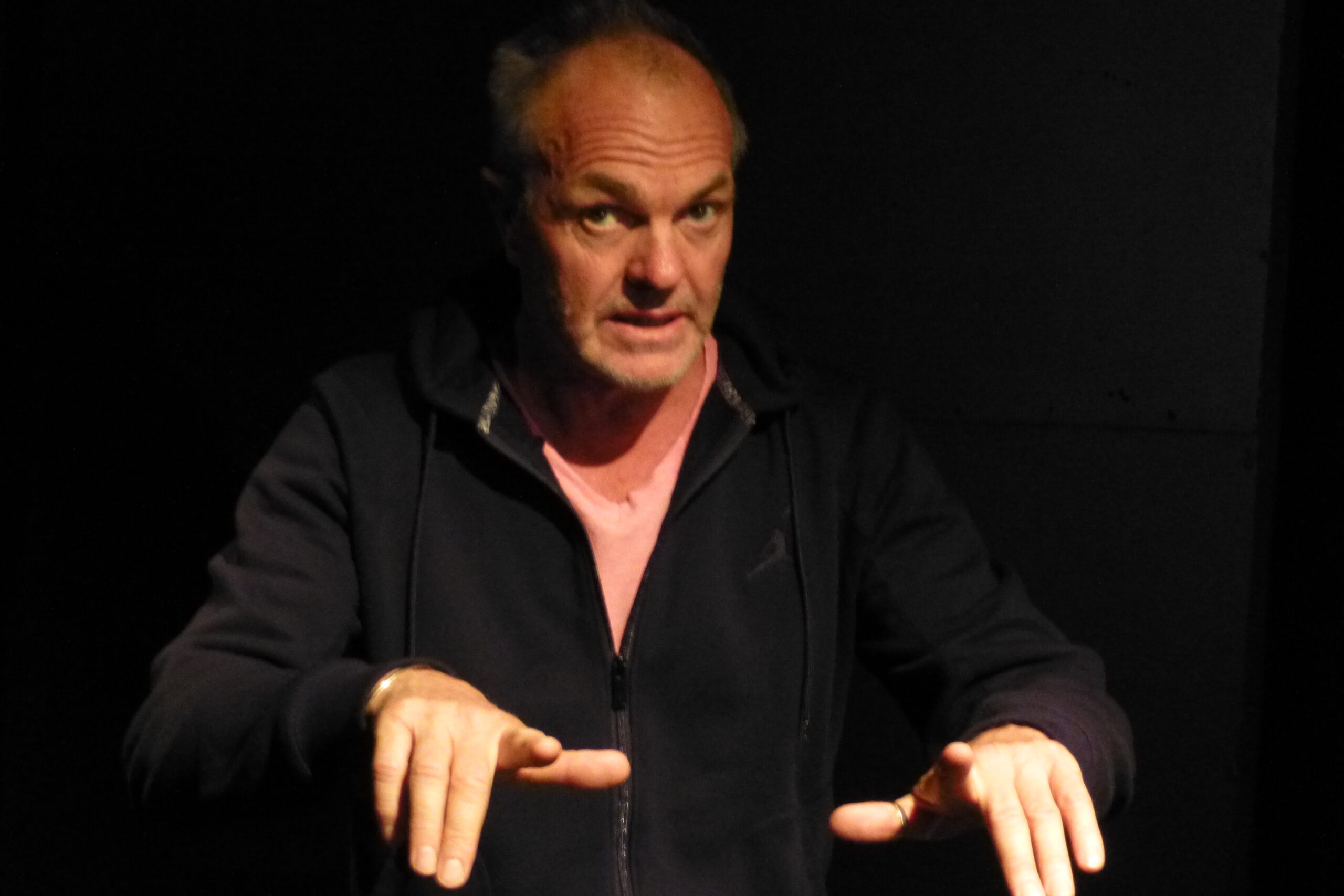
Stephen House has won many awards and nominations as a poet, playwright and actor, including two Australian Writer’s Guild Awgie Awards, and a Greenroom Best Actor nomination. He has had 20 plays produced, many commissioned. He’s received international literature residencies from The Australia Council and Asialink. His chapbook “real and unreal” was published by ICOE Press. His next book is out soon. His poetry is published often, and he performs his acclaimed monologues widely.
Poetry from Hazel Fry
If Not Ocean

Aggravated by some sort of storm
she pulses,
not woman nor sand.
I can’t tell, these days, what
woman looks like
or what her soft, seagrass stomach
should feel like in my palm
moving between the lines that tell me when I’ll die –

I mean, dictating my life. I shouldn’t
ask these questions.

What is a woman if not fluid
that drips through our fingers
and finds its way back under the waves,
gazing up, sea glass eyes, at mother planet?
Who will touch me again?
Who decides what body I will have
now. And in what hands.

Who is a woman if not malleable?
This feels nice –
Imagine, pale turquoise aquarium silk
that never struggles
or fights
or snags on jagged fingernails.
This is woman.

No,

is this living? Is this
a mammal’s biography – or the unborn eggs
of a polluted grandmother shark,
neck tied in plastic,
or is this a shell abandoned on the beach?
Is this the right kind of solidity?
Hazel is a sophomore in creative writing at Ruth Asawa School of the Arts in San Francisco. They have work published in several literary publications, including Synchronized Chaos, The Weight Journal, and Parallax Journal, and have performed their poetry at the Youth Art Summit in San Francisco and 826 Valencia. When Hazel is not writing, they can be spotted cuddling their three cats, holding their python, feeding their tarantula, or rescuing insects from being squashed.
Vignettes from Sheila Murphy
The Truth Has Scars and Needs a Coat of Paint

He has a personality the size of mainland China. A heart twice that size, if either could be quantified. Everyone he knows loves him except the one he loves the most. She tells her friends, "Why would I love him? Look how much he does for me now. How could he do more?"
Each day he wakes up dreaming she'll return. Each night he knows his dream has not come true. He hopes for better the next morning.
His friends don't want to say anything. They know that if they did he would be sad. The truth has scars and needs a coat of paint. Why won't anyone do something? They've all learned to tell themselves, "He has to want this change of heart; we can't do it for him." Same convenient excuse for those who face a drunk and lack the courage to confront. Convenience and comfort keep the world complicit.
One morning on a whim he glances in the mirror and recognizes a young face hidden behind the wiser eyes. He feels the urge to protect that child and learns he is inside him. The child begins to cry. The man he has become decides to rescue that innocent smile and polish it to match this moment.
He leaves the house, and people notice a different expression in his eyes. Freed of shackles, freed of myth, as if a rehearsal for another life, the same life that he almost lost.
He stops dreaming and begins to forge another dream, a softness, a younger self. A loved one from his heart.

Transition

She had a Rottweiler aura and a hostile resting face. Arrived late to the virtual meeting and proceeded to declare her territory. Others heard politely and mildly deferentially as she grabbed at what she did not understand. As if by instinct, an unspoken bond was formed among attendees who began to find things to admire in one another. Afternoon, replete with sunlight, overtook accumulating syllables that fell into a distance giving comfort. The center of attention shifted to a shared place where faces progressively read other faces and began to change into a unified resistance to the frightened one hoping to frighten them while gradually becoming irrelevant.

Martina Wore Her Oboe

Martina wore her oboe. It was her jewelry that set off pale silken fabric that further set off her labored cheeks that puffed out when she played. She expected the antagonistic fibers and the inevitable travails of sewing the reed and winding the red wire to hold it, knowing it would fray within a week. Just like her nerves that knew the drinking habits of her paramour, a lug who failed to bow to woodwinds. She had a trio that rehearsed together and performed beyond the metronome that unified their heartbeats and the fingerings. The man she was supposed to love would count the measures and the moments until cocktail hour that followed her performances. She knew they were not made for each other, nor was she made for the routine that overtook whatever life she might have had.


Her Bigness

She knew everything about everything and nothing else.  She lectured on how to treat succulents and keep them alive. She did not train for marathons but knew all that runners should do. She preferred to stand back and reveal her expertise over taking action. She wanted a promotion and had supporters who saw in her a kindred mediocrity that made them feel safe. She had her windows done, her nails, and she bought shoes because she weighed too much to be stylish. She routinely cheered for dictators, feeling very much in common with their lonely lanes as people undeserving expected help and would not get it.


Babysitter

Once we were deemed adults, we visited her in the wooded home. She took us to her studio of wool with sections sorted by color and geometry. All those quilts had come from what she had collected here. She was usually hard at work stitching together warmth. Then as if by virtue of a sudden recess, she took out a vast collection of tiny wind-up toys that tocked along and bobbed their heads atop the table. She laughed loudly, revealing at last her favorite recreation. We laughed, too, disbelieving the level of pleasure she derived from hearing the little automatons moving along with no incentive needed, just that burst of battery fuel and her laughter and eye light.
Sheila E. Murphy is the recipient of the Gertrude Stein Award for her book Letters to Unfinished J. (Green Integer Press, 2003). Her most recent book is Golden Milk (Luna Bisonte Prods, 2020). Reporting Live from You Know Where won the Hay(na)Ku Poetry Book Prize Competition (Meritage Press (U.S.A.) and xPress(ed) (Finland), 2018). Also in 2018, Broken Sleep Books brought out the book As If To Tempt the Diatonic Marvel from the Ivory.