

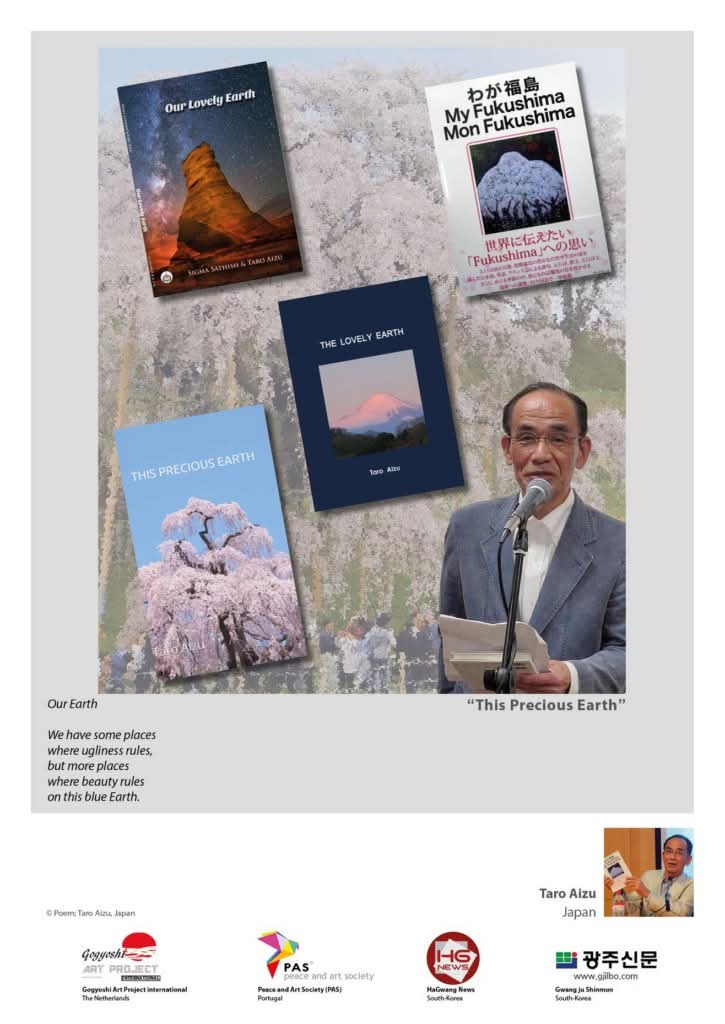

Taro Aizu’s Anthologies as a Global Poetry Bridge
.
Taro Aizu of Japan is widely regarded in multicultural literary circles as a poet editor and global cultural mediator whose work transforms personal history into a shared human narrative. Born in 1954 in the Aizu region of Fukushima Prefecture and now living in Ito near Tokyo he carries the memory of his homeland into a body of poetry that spans Japanese English and French and reaches readers across continents. His long dedication to gogyoshi and gogyohka reflects a commitment to concise forms that distill emotion memory and ecological awareness into luminous moments. Critics often observe that his voice blends regional rootedness with planetary consciousness allowing local landscapes to resonate with universal meaning.
.
The events of March 2011 marked a defining moment in his literary journey when the earthquake tsunami and nuclear disaster struck Fukushima. His trilingual volume My Fukushima emerged as both testimony and healing gesture and gained remarkable global participation through translations by readers and fellow poets across social media networks reaching twenty languages. His Takizakura gogyoshi extended even further into thirty five languages demonstrating how poetry can mobilize international solidarity through grassroots collaboration. Multicultural press coverage frequently highlights this phenomenon as an example of participatory translation where community engagement becomes part of the creative process and where a regional tragedy is transformed into a shared global reflection on resilience and renewal.
.
Beyond authorship Taro Aizu has played a significant role as an editor and compiler shaping the international presence of gogyoshi. Since 2019 he has produced successive anthologies of World Gogyoshi bringing together poets from diverse linguistic and cultural backgrounds and establishing a platform for cross cultural dialogue. His publications including The Lovely Earth La Terre Précieuse This Precious Earth and Our Lovely Earth created with Indian poet Dr Sigma Sathish reveal an enduring thematic concern for the planet and humanity’s responsibility toward it. Through these works he positions poetry as an ethical practice that fosters empathy environmental awareness and intercultural understanding.
.
His influence extends into interdisciplinary collaboration where his poems have inspired exhibitions and performances across Europe Asia and South America including events in the Netherlands Brazil Germany Portugal Spain France South Korea and Macedonia. Collaborative concerts in Japan and international art projects demonstrate how his work moves fluidly between text image and sound creating a living network of artistic exchange. Honors from international festivals and literary organizations including awards in Japan the Philippines Macedonia and Greece affirm his standing within the global poetry community. Viewed through a multicultural lens Taro Aizu represents a model of contemporary literary citizenship whose writing editing and collaborative initiatives continue to build bridges across languages cultures and artistic forms.
.
AWARDS
First Prize, 28th All Japan Modern Haiku Competition, Japan, 1991
Special Prize, 2nd Love Poems Competition, Japan, 1991
Three gogyoshi selected for TAKE FIVE Best Contemporary Tanka Volume 4, USA, 2012
Poet Laureate Award, Philippines, 2013
International Excellent Poet Award, Japan, 2014
Literary Career Award, Ditet e Naimit International Poetry Festival, Macedonia, 2015
Award of the Poem, Heraklion, Greece, 2016
ACHIEVEMENTS
Wrote gogyoshi and gogyohka in Japanese for over 12 years and in English and French for 6 years
Published My Fukushima in Japanese English and French following the 2011 Fukushima disaster
My Fukushima translated into 20 languages by global literary community
Takizakura gogyoshi translated into 35 languages through international collaboration
Inspired art exhibitions in Netherlands Brazil Germany Portugal Spain France South Korea Macedonia Belgium UK and Korea between 2012 and 2018
Invited guest and award recipient at international poetry festival Ditet e Naimit in Macedonia, 2015
Co published haiku collection Our Lovely Earth with Indian poet Dr Sigma Sathish, 2016
Compiler and editor of World Gogyoshi anthology series since 2019
Founder figure in global promotion of Gogyoshi Art Project International exhibitions
Collaborative poetry concerts held in Japan including Inawashiro Aizuwakamatsu Tokyo and Kanagawa
WORLD GOGYOSHI ANTHOLOGY SERIES
The First Anthology of World Gogyoshi, 2019
The 2nd Anthology of World Gogyoshi, 2020
The 3rd Anthology of World Gogyoshi, 2021
The 4th Anthology of World Gogyoshi, 2022
The 5th Anthology of World Gogyoshi, 2023
The 6th Anthology of World Gogyoshi, 2024
The 7th Anthology of World Gogyoshi, 2025
The 8th Anthology of World Gogyoshi, 2026 (forthcoming)
Gogyoshi is a contemporary poetic form that distills thought and emotion into five concise lines, yet within this brevity it offers remarkable depth, flexibility, and cross cultural adaptability. Originating in Japan and shaped through modern practice, gogyoshi differs from traditional syllabic forms such as haiku and tanka by freeing the poet from strict syllable counts while preserving a disciplined economy of language. Each line functions as a unit of perception, allowing images, reflections, and emotional shifts to unfold in quiet progression rather than in a single moment of revelation. This structure makes the form especially suited to contemporary themes including ecological awareness, displacement, memory, technological change, and spiritual inquiry, while still retaining the contemplative spirit associated with Japanese poetics. In international contexts gogyoshi has become a bridge form because it is easily translatable and adaptable across languages, enabling poets from diverse traditions to participate without losing their linguistic identity. The work of Taro Aizu has been central to this global expansion as both practitioner and editor, promoting the form through multilingual publications, world anthologies, collaborative exhibitions, and community translation projects that invite participation from poets, artists, and readers worldwide. Through these efforts gogyoshi has evolved from a national innovation into a shared global practice that encourages clarity, emotional resonance, and intercultural dialogue. Its five line architecture invites both discipline and freedom, allowing poets to juxtapose stillness and movement, personal memory and collective history, local landscapes and planetary concerns. As a result gogyoshi stands today as a living poetic form that embodies the values of accessibility, collaboration, and global literary citizenship, demonstrating how a concise structure can hold expansive human experience and foster meaningful connection across cultures.
.
Gogyoshi stands today as one of the most open and adaptable forms of contemporary Japanese poetry, defined by its essential structure of a title and five concise lines while remaining free from rigid syllabic counts, rhyme schemes, or prescribed line lengths. First introduced in 1910 by poet Tekkan Yosano with specific syllabic patterns that saw limited adoption, the form was revitalized in the early twenty first century when poets began embracing a modern version liberated from numerical constraints, allowing expression to emerge through clarity, brevity, and layered meaning. Unlike related five line forms such as tanka or gogyohka, gogyoshi is distinguished by the presence of a title that frames the poem’s emotional and conceptual field, guiding readers into a compact yet resonant experience. The term gained international recognition when Mariko Sumikura introduced the English word gogyoshi in 2009, paving the way for global practice and translation. A significant milestone in its evolution came in 2018 when Taro Aizu proposed World Gogyoshi, a bilingual adaptation designed to foster intercultural dialogue and world friendship through poetry. His framework emphasizes seven guiding principles including the use of two languages, capitalization conventions, brevity in each line, and the goal of strengthening global connection. Through annual anthologies and collaborative initiatives World Gogyoshi has expanded into a participatory international movement that invites poets to retain their mother tongues while engaging a shared English medium, transforming the form into a living bridge among cultures. Today gogyoshi is recognized as the freest of Japanese poetic forms, valued for its accessibility, translatability, and capacity to hold profound reflection within minimal space, enabling poets worldwide to articulate personal memory, ecological awareness, spiritual inquiry, and collective experience in a structure that is both disciplined and boundless.