Leena Prasad’s poetry collection, Not Exactly Haiku, is comprised of 51 haiku-like poems, each with its own drawing. The poems are similar to haikus in their sparse language and three-line structure, but they do not have the syllable count (5-7-5) that is usually used in traditional haikus. Traditional haikus are also typically ambiguous and inconclusive, and deliberately leave the reader to create their own understanding. However, these poems are written in contemporary language that is more grammatically accessible, making the poetry and imagery much more tangible. Thus, each poem feels complete because its message is immediately understood. It is then up to the reader to decide how this message applies to him/her.
Each poem is accompanied by a small drawing made by the author, and the drawings can both limit and enhance the poems. Sometimes the drawings are images from the poem, such as a beehive for the poem honeycomb. The drawing reinforces the imagery, but limits the poem to that specific scenario. However, a silhouette of a pregnant woman and child accompanies the poem clouds, which describes the sky before a storm. This juxtaposition adds a surprising layer to a very straightforward poem, and enhances the poem in a way that language could not.
The poems explore a variety of topics, which makes the collection great reading material for any mood. It feels more intimate with its direct, honest descriptions. Rather than distancing in its complexity, it welcomes the reader with personal art from someone else’s life. It’s a short, sweet, and positive read.
At the beginning of the year I received through the mail an interesting book, “Defining the Edge Between Truth and Madness,” by Wade Alexander. Although people say not to judge a book by its cover, this time we should make an exception. The design of the covers gives us a clue of what we will find inside them. The idea of choosing an eye symbol for this book’s front cover was inspired, since the poems offer an overview of the author’s life experiences.
The book starts with an emotional foreword written by the author’s wife. She tells us about her relation with the author and the stages of its manifestations. The accent is put especially on the stage of their relation’s destruction and how they reacted to this event. Although this is not a fairytale, it has a happy ending in which they discovered that their love never left, it was just “covered up in a cobweb of lies” and once they put it away they found their love again. After that we find a small introduction about the author’s childhood with two alcoholic parents and how the hell from his home influenced his adulthood. Some people might ask what these informations have to do with the book. I must tell them that they offer a background that helps the reader to better understand some of the poems.
After reading a few poems we find a pleasant surprise, through the poems we find strained small pieces of wisdom from the author’s life. Here is an example of such a piece:
“Time brings what is missing
In our souls,
And our souls bring what is missing
In our time.”
One of the major themes that we find in Wade Alexander’s poems is human nature. The author critics modern society, that it puts too much emphasis on personal gain and that this surrounds the human soul in lies, cruelty and greed. This surrounding prevents us from seeing the true meaningful things:
“Victory is in the smile of a child,
The safety felt by others,
The feeling of being needed.”
In these poems the author also talks about the ephemeral nature of human thoughts and actions:
“Man judges us by our victories.
The earth sees us as visitors.”
and the fact that we struggle all our life, but once death brings us peace, we start to fade from time.
In a few poems the author talks about his childhood and how his innocence and hopes were destroyed by the violence provoked by his parents:
“The love was beaten out,
The peace shattered by screams,
Faith replaced with lies,
Calm replaced with fear”
Living in a terrible fright he dreamt of a place where fear is replaced by love and tears by laughter of joy. In all this chaos the child found comfort in his grandfather, who offered him love and told him how great he will be. Through his child eyes, his parents looked like vengeful gods, and the author advises us to be careful with our actions because someday we will become gods for a child and our actions will mold him.
Another major theme through the poems is the relation of the author with his wife. He tells us how finding love in her, made him forget all his past pains. They both recognize, she in the introduction, he in the poems, that once problems appeared in their relationship, unresolved past problems started to emerge making things worst and so the past started to prey on the fragile present. The book is full of poems talking about the pain produced by these unfortunate events and how these poems were a part of the healing process. But to really connect with the author’s feelings you should read the poems by yourself. With these words said I really recommend this book of poems and I think that it will open your eyes and help you to better understand the human nature.
Take a gay character, with an unwitting penchant for slapstick comedy, and put him under pressure to be married before the controversial vote on gay marriage through Proposition 8 in California, and you have the recipe for a funny and thought-provoking film: I Want To Get Married.
Paul Roll (Mathew Montgomery) is a gay advertising specialist, and very good at what he does. He is, however, single, and with the Prop. 8 vote looming, feels he’d better hurry and marry. Yet he has no serious love interest and thus, at the urging of his best friend (Ashleigh Summer), embarks on a hunt for the love of his life.
Unfortunately, as competent as he is at his job, he’s basically incompetent at dating. It’s as if Adrian Monk and Inspector Clousseau had a son. He misreads situations, gets crushes when he shouldn’t, and can’t stand the messiness of the whole dating/sex scene.
Comedy continues into the subplots. His mom (Lisa Franks) leaves his dad (Patrick M.J. Finerty) and while traveling to see Paul, gets stuck in a run-down desert motel/casino, where she links up with a cross-dresser and great singer (Mathew Martin). Dad, meantime, tries to find her, gets mugged and stripped, and just misses her as he staggers—sans pants– into the casino.
In the meantime, Paul, needing money, lets himself be hired by Deborah Anderson (Mark Chambers) of The Family, a well-paying homophobic organization, to create ads for Prop.8, with a resulting ethical dilemma made worse by the discovery that his mom has donated big money to this group. The plot swirls from plot to subplot to subplot, yet they all spin together to a satisfying end.
First shown at the Cinema Diverse Film Festival in Palm Springs in 2011, this film was written, directed, and edited by Billy Clift, produced by Terry Malloy. Interested viewers can find it on DVD through Amazon.com.
For a look at Prop 8’s impact on people’s lives that is serious, though presented in a comic fashion, see I Want To Get Married, an entertaining and interesting independent film.
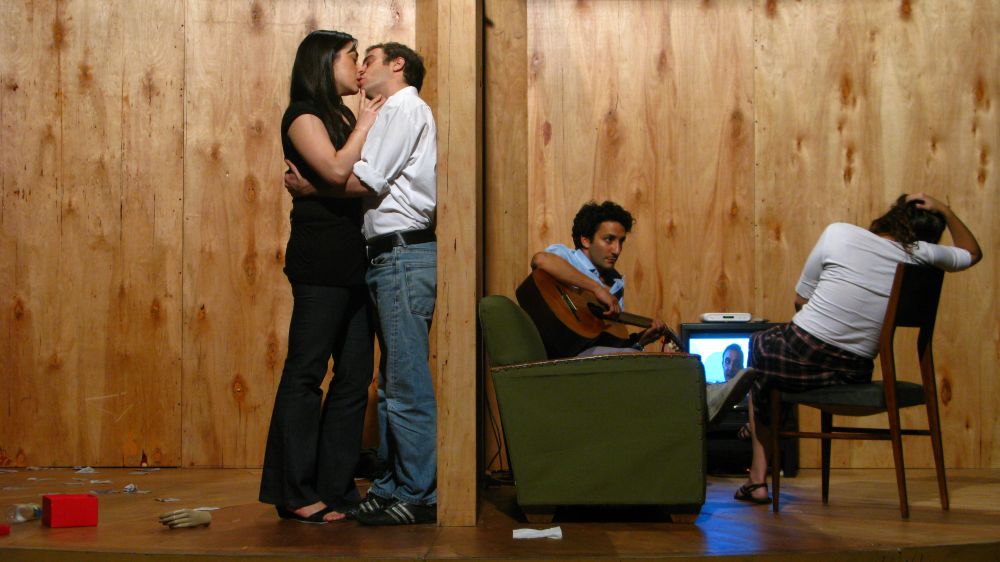
Argentine theatrical director and writer Mariano Pensotti’s ambitious performance piece evanesced in three performances in the middle of February in San Francisco, in the middle of a lengthy international tour his company is doing, and leaving behind it a long trail of disintegrating engrams like cold, vanishing sparks: the sense of a futile but unavoidable search into the meaning of the past for the present, and of the present for the future, even if all we can ever hope to keep of our present moments is a deck of damaged photographs called memories from which we devise an elaborate fiction we call our life.
The piece (it doesn’t feel quite right to call it a play) is performed on a revolving stage, made of undressed pine and divided into four pie-shaped sets; partly via dialog, partly by way of an endless, recitative-like voice-over, in Spanish, with English supertitles, by four actors playing young Argentines living out the dilemmas of growing up between the years 1999 and 2009; that is, between Argentine’s economic collapse and an uncannily similar one that hit the West at large ten years later.
As Pensotti recounts in the program notes, he got the idea for the piece from a collision of events and questions: a series of damaged photos, many of nameless Argentines, that he started collecting from a photo lab that used to stand near his home (and has since closed due to the digitalization of photography) and a series of questions about the growth of hopeful, dream-filled youth as it moves into its first years of disillusioning maturity, and another series of questions about how we build our identities on a complicated foundation made up of the illusions of aspiration, the fragments of failed dreams, and the compromises we make with an often recalcitrant and incomprehensible reality.
If this makes the play seem to court the problems of excessive ambition, it should. The play itself – performed by an extraordinarily able and energetic quartet of actors (Pilar Gamboa, Javier Lorenzo, Santiago Gobernori and Maria Ines Sancerni) who, in the two-hour performance, create dozens of characters spawning subplots and counterplots in more than 80 scenes – just manages to maintain enough coherence to keep me, as a spectator, committed, at the occasional price of psychological plausibility, and thus momentary losses of sympathy with the characters’ dilemmas. Which is a small shame, as those dilemmas are often ludicrous and tragic and all-too real: a young filmmaker and his girlfriend, love-drunk on each other, entangle and disentangle their romance between painful sorties into the disappointments of the harsher reality outside their impassioned dyad; a young woman discovers that her father has a second family, and sets out to spy on him and pull him back into her own emotional orbit by means as devious as his own have been toward her; an aspiring young business man receives a box containing a severed hand that turns his next ten years into a recurring nightmare of almost farcical paranoia that he is never able to resolve, explain or become resigned to: a MacGuffin representing the ultimately grotesque enigma of human life.
At the end of the play, as the stories of the four Argentines are left in an uneasy state of irresolution, the last, or perhaps the first, element that fed Pensotti’s restive imagination peals out, as the empty stage revolves beneath the fading light, through the sound system that throughout has been regaling us with a mixture of pop tunes, “house” and what one of the characters himself complains is too much folk music: the alt-band “of Montreal,” with the dark, knowing, disillusioned voice of Kevin Barnes singing,
“The past is a grotesque animal, and in its eyes you see …”
The themes are even more relevant today than they were 60 years ago. Patriotism, Communism, the First Amendment and the ghost of McCarthy are all re-awakened in this robust production of the 1963 courtroom-plus-politics drama, based on a real case in 1954. Courageous Second World War correspondent Denis Corcoran is outraged when a nationally syndicated columnist repeatedly accuses him of debauchery, cowardice and communist sympathies.
Instead of pistols at dawn, the two clash in court. (Corcoran got in the first barbs with a blistering attack on his journalist rival).
Director Ron Nash and producer Brenda Weidner coax a sterling effort from everyone, with the most consistent performance from Kris Neely as the opposing lawyer. Shrewd casting makes the imposing bulk of Paul Abbot as Corcoran’s lawyer dominate the scenes even when he is not speaking. And Ron Dailey as three characters (thank heavens no Equity actors are involved) comes off very well – although the Scottish burr does falter a touch.
A clever piece of stagecraft, to relate the events to the context of the times they were in, is getting the actors to read news headlines from the period (color television, jet travel, Elvis). Stirring speeches and unexpected twists in the storyline keep the attention focused.
However, the play is overlong (three Acts) and could do with judicious cutting of some of the speeches. The problem lies with politics in the last 50 years, because politicians and presidential candidates have trotted out the lines and sentiments so often that they have become hackneyed, ringing with insincerity. Especially in the closing speeches (stirringly delivered by both lead actors) one could predict, if not the actual words, the themes about to be uttered.
The courts, costs of litigation and legal processes have changed so much that in today’s climate the sequence of events seems almost quaint. But the pressing moral, social and political issues still burn as bright and productions such as this deserve their days on the stage.
Presented within the flow of the lives of fictional characters, this is a monthly column with a journalist’s perspective on brain research.
“Are you nervous at all?” Sanjay says.
“Excited,” Dana responds to her husband. “Yes, nervous, but with excitement.”
She is having her brain examined today. Well, not exactly examined, but observed by a method called Positron-Emission Tomography (PET scan) which is used to measure changes in cerebral blood flow as a result of brain activity.
“It’s not too late for you to take part in this also, you know.”
“No, no, I’d rather watch.”
Since her decision to participate in the study, they have been reading up on how the brain controls muscular movements. There is a region towards the back of the brain, appropriately called the posterior parietal cortex, which takes visual information as input and translates it into motor commands. These commands travel through a pipeline of several brain regions to the primary motor cortex, a region that sends neural impulses to the spinal cord resulting in muscle contractions.
Later that afternoon, Dana dresses as if she’s going out dancing.
“Does my primary motor cortex look ready for action?”
“I don’t know but I think my posterior parietal cortex is getting activated.” Her husband winks at her.
She is wearing a flowing jade silk skirt that comes up just above her knee, a silk shirt with just the amount of cleavage that her husband likes, and pencil heels. She has been told that she should prepare for tango dancing as if she was going out to a nightclub and not to a science lab.
Dana and Sanjay have been dancing for many years now. They won an amateur tango contest last year which is what brought them the attention that had led to her participation in this experiment.
When they arrive at the place where the study is to be conducted, she looks around for a dance floor, perhaps a live band. The place looks like an office with a few desks and computers. Through an open door, she sees some large machines. The professor, Dr. D, arrives soon and explains the procedure to her.
“So, I, uh, I’ll be lying down the whole time,” she says. How can they study tango dancing if she will be lying down the entire time? She looks over at Sanjay and he looks as skeptical as she feels.
Dr. D laughs. “I know it sounds very strange.”
“I thought someone said that I will be moving my legs, I mean, I was told to dress for dancing.”
“Yes, yes, the machine is designed so that there is a surface area for moving your legs as if you are dancing. That’s the idea, to watch what’s happening in your brain as your legs move to the music.”
Dana does not look convinced. But she has committed to this, trusts the scientist, and is curious about the outcome. She follows the professor to a room with a large intimidating machine. She has seen these machines on television. People usually lie down in them with their head placed inside the machine. The only difference is that this particular machine actually has an inclined bottom surface where here legs would rest.
“That surface is for you to move your legs,” Dr. D says. “You’ll be listening to tango music through headsets.”
As Dana moves her legs in rhythm to the tango music, sensory organs in her leg muscles will pass on data to the brain’ in terms of the location and orientation of her muscles. The brain will use this information to update the motor commands that it sends back to the muscles. Scientists understand the neural mechanisms of basic motor functions. They are curious, however, to observe how these same mechanisms scale up to handle the complexity of the motions of dance.
In a study at the University of Texas Health Science Center at San Antonio, scientists used PET scans to observe the brains of five male and five female tango dancers in an experiment that occurred as described for the fictional character Dana.
Once Dana is lying inside the scanner with her head immobilized, she is asked to execute the basic salida step of the Argentine tango as she hears the music through her headset. By restricting the legs to motions where the body could not actually move in space, the scientist were able to limit the study to the exact movement of the leg muscles without having to worry about the extra movements of the entire body moving from one location to another.
Sanjay is not allowed to be in the lab so he is unable to watch the results but the professor explains what he and his colleagues saw in the brains of Dana and the other participants.
“We were able to confirm a hypothesis about the parietal lobe,” he said. “That’s the area in the back part of your head.”
“That’s such a large area,” Dana says. “Was there a specific region that you were observing?”
“Yes, yes, the hypothesis is that the brain contains a representative image of the body in a specific area called the precuneus. This representation helps the precuneus to choreograph the movements of the muscles, with the help of other parts of the brain. Of course, we can’t exactly see the representation in the precuneus but we can see blood flow activity in the area with a PET scan.”
“So more blood flow means more activity?” Sanjay says.
“Yes. And the tango dancing created a high level of activity in this region.”
“What’s name of the region, again?” Dana asks.
“Precuneus. You can google it to see the location and the size.”
“But what’s the point of this study,” Sanjay says. “It’s just curiosity or does it provide some answers?’
“Well, possibly. This area is one of the least studied areas of the brain so the more we know about it, the better we can use the knowledge.”
“We were asked to do the steps with and without music. What was the reason for that?”
“Very good question. That was to subtract the affect of music on the brain and to confirm that the precuneus is still activated.”
As they are driving home, Dana searches for precuneus on her iPhone and reads out parts of the Wikipedia definition to her husband:
Please send feedback and suggestions for future columns to leena@fishridingabike.com. Go to WhoseBrainIsIt.com for links to past columns and to FishRidingABike.com for Leena’s writing portfolio. Leena has a journalism degree from Stanford University.
References:
Brown, Steven & Parsons, Lawrence M. “The Neuroscience of Dance.” Scientific American July 2008:78-83. Print.
Look at that 20-mins-due flash, the bad news all lit up there in little red L.C.D. blocks. See it?
I know. Shame. I’m disappointed for you miss. Really, I’m incensed. And I can’t be easy company, can I? I smell, I know. But forget what pop culture tells ya. I don’t have to be touting the Big Issue to have a friendly chat with my fellow citizen, do I?
Thanks, and yeah, exactly, I AM NOT my lack of accommodation. Thank you. I’m a street orator, actually, and it looks like you’re stuck here…
Sod’s law, Missus. Bloody busses. Bloody English weather. Believe me, there is no way you’d catch me wandering London through this spill. It’s like God himself has only just realised he’d got his Creation business perfect but then screwed it all up with Adam. And now he’s switched on his hundred and forty-four thousand mile plasma, watched five minutes of the Iraqi death toll on CNN and has lost almost complete faith in judgement. He’s weeping rivers. ‘Not had a crisis like this since the flood’, sing the angels, who’ll mop it all up. Just like last time. Look at the hail-stones pelting down so hard. I swear they’ll split pavement.
Heh, sorry. Saw the Burqa and thought I’d let rip at the enemy. Take it you’re a convert right, you being white and christened Susan or something? You kneel five times a day and all that? See, that’s where I’d fail Allah. And don’t ask me what I believe. I write fantasy fiction, I’d only make something up. A cantankerous-narcissist-god with fire for hair. Or something. So, Susan or something. I’m me and you are?
Steph. Of course you are. Lovely name, nice to meet ya… I’m… Well let’s see: I’ve answered to arsehole, Oi you, tramp, loser, Boleraam, John Clay…
I’ve got quite a few. Call me Spiderfingers.
What?
Yeah, loads. Did a lot of Babushka Doll stuff actually. Nothing publishable though. Oh well eh Steph?
You’ve NEVER heard of Babushka Doll Lit?
Wow. Really? That’s like saying you’ve never heard of Nirvana. We’d better do something about that then. Babushka Doll Literature: more of a game than a series of stories. Hope you’ve a good memory.
O.K, whilst we still agree I’m not the type of tramp that believes in monsters and chats to daffodils, I’ll tell you about an adventurous boy and his rather unenviable position. Maybe if you like it, you could tell someone else? It’s not too hard to remember. If you enjoy a story enough, all the details should be like the clothes on your body. With your eyes shut you can recall every last item clinging and hanging off of you. Hey, I know you see this crusty-bearded ball of faded Technicolor that’s trying to befriend you, and under there, you’re preparing to politely grin away through some navel-gazing ordeal. But life dealing this tramp shit for cards? Not the subject for an opening story of mine.
I call it Bradley the Boy Wonder. But that could change. He Normally Spits is a close second choice. And hey, you may’ve heard this yarn before but don’t you dare stop me if you have, ‘cos no one, I mean not even Atlas tells it the way I could.
Bradley, the Boy Wonder
There was this kid who had two ‘gifts’. The first was a rather unique offering, a rather unusual gesture by the deities of biology. Kid could fold himself in half. Now, in lesser versions of this urban myth, where filthier imaginations have filled in plot holes and whatnot, you’ve probably heard that four of his ribs hadn’t developed properly, and that his lower spine was missing two vertebrae. But that’s all complete bull-crap. Wank Boy, as some mediocre orators call him, Wank Boy was all about the yoga. Really, this high school kid, we’ll call him Bradley – American – this kid Bradley was raised by his single mum who, apart from being a filthy rich Californian, had a penchant for extreme Venksai-Yoga. She’d been teaching Bradley Lotus spreads and Frog stretches ever since age three. And yes, I spoke of two gifts and yes, you got it Steph; this lil’ urban myth (every word as close to the truth as I could possibly take you), relies on Bradley boy’s second gift. Y’see, Bradley was big. Enormous. Would have been called Vlad the Impaler had he made it to college. But Bradley dies at the end of this.
He’s 13, alone in the house one hot Californian Sunday morning. Its summer holidays again and so, my god, how Bradley let those crazy hormones run him wild. See, Bradley’s mother skips outta their tidy piece of beachfront, hops gaily into the SUV and just sits for a moment, smiling about her impending book signing. This latest highpoint of subsequent media intrusion and path of re-invention has left her giddy. And if you were Bradley’s mother, ready to pull out of the driveway, if you’d chosen to crane your neck up at the kitchen window, well. You’d see Bradley watching you. Spying the cloud of fluffy happiness, the one you woke up inside this morning. That white candy floss nesting your hippy brain as you finally pull out the drive on a full tank of unleaded. You’re blissfully unaware of your little wonder running upstairs to his room. You have no idea that he’s using his ‘gift from Venksai’ in an erotic fashion, bent double and over on the bed, jacking his head up and down. Like some kind of human oil pump. What d’ya call em? Geysers? Or is that the hot pool things in Iceland? Doesn’t matter. You get the picture.
Bradley’s found a seriously fucked up way of combining the two gifts Mother Nature’s dropped in his gene pool.
But Bradley’s shit scared of the noise, the hormonal moaning gushing from inside his throat, so full of himself. He doesn’t wanna alarm old lady Docherty next door, even though next door is a whole house away. So the kid’s playing a Best of The Doors album. He’s lighting his own fire so to speak. He’s sucking away to 60’s pop… And then… He becomes inflamed with a wild idea: he could get (as Jim’s just crooned) much higher. And when he manages to slide himself in-between the gap of old oak wardrobe and the far wall of his room, when he gets to thinking of Jim Morrison taking it from behind, getting concrete hard so that he HAS to breathe through his nose, 13 year old Bradley is in his own very private heaven.
Till he gets stuck.
———————————————————————————————————
‘John Clay, he’s a London based author who routinely submits fiction to his online writers circle. He vents his thoughts on the mythology of rock and roll monthly in ‘Spiderfingers’.
With obscene regularity, his characters negotiate the fields of sex, violence and faithlessness in a world where god exists but has deep seated emotional issues.John however and by his own admission is a well-adjusted and fully functioning member of society. He also believes the royal family are cold blooded lizards from a dead planet called Tu-Tu.’