
Poetry from J.K. Durick

Plague Poem for Day Thirty-Six

She asks me what’s up for today,

an innocent enough question

one we’ve asked each other

for so many years it’s easy to

lose count, but now it takes on

a weight of meaning, perhaps

a subtle dig, I have been doing

very little recently, yards need

tending, garage cleaning, and

the cellar organizing, or she may

be making a point about how

much more she does every day

while I read, write a bit, watch

too much TV, nap, and some days

walk around our neighborhood

the world I’ve built and live in now

and when she asks what’s up, I end

up saying I have plans, plans I leave

mysterious, a bit of pride, a vague

something to say when she asks

and I have nothing else.

   Plague Poem for Day Thirty-Seven

Sometimes I forget things, easy things

a pill at a certain hour, a person’s name,

or who I sent something to but forgot and

sent the same thing off again. I forget

so easily, why I walked from the kitchen

into the living room, what it was that I

hoped to find in the car. Forgetting has

become part of every day, I shed parts

of me this way, I trim down my life

get rid of whole sections of my past,

parts I miss and parts I’m better off

without. It’s part art, part medical, much

too methodical in its ways to be creative,

more paint by numbers than impressionist,

more fill-in-blanks than poetry. I forget

more each day, have become proficient in

my own way. Tried to write a check, but

fumbled the date, remembered the number

of the day, the month, even could have said

Wednesday with confidence, but I couldn’t

remember the year, it’s not ’97 anymore,

what happens to years, days are simple, but

years hurt – I wrote 2015, I remember that

year but for some reason have forgotten all

the rest, even today, it’s an easy thing to do.

     Plague poem for Day Thirty-Eight

Where do they go after they’re done with us?

Where do they go, the dead that is, where do

they go after they give up the ghost, the ship,

stop all this nonsense? Do they gather in the

wings, compare notes, watch to see who’s next?

Do they take time, think back about how their

ends unfolded? Do they talk about the who, what,

and when of it, the warning signs, the bad advice,

the look on the faces around them when they knew?

Do they decide which ones of us they will haunt,

tap on the glass, drag chains, pace slowly back and

forth in the attic, whisper to us on windy nights?

Now that they know that enough wasn’t enough but

all they could take; do they mark things down in

their ledgers, try to balance the book, the things

they remember and what we are saying about them?

Do they care about body bags, coffins, and makeshift 

morgues? Do they care about the numbers, the living

and then the dead, the seeming winners and their place

as losers? Do they measure remembrance – the flags

at half-staff, the mention on the evening news, vague

funerals with nothing left to say? Do they know that

they were/are keeping us from returning to normal?

Do they wonder now that they know more than we do?
Poetry from Michael Robinson

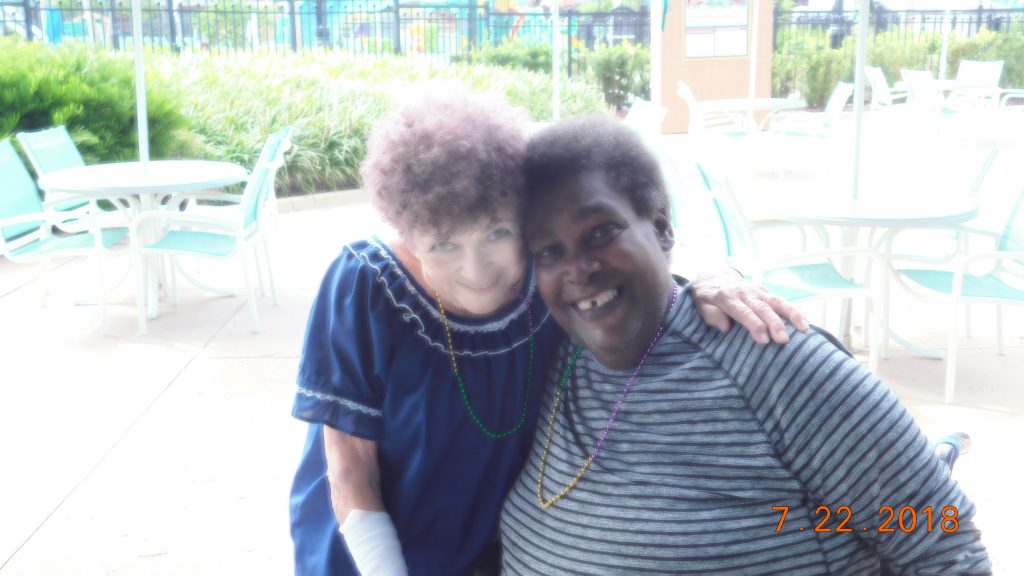
Joan Beebe and fellow contributor Michael Robinson
Michael Robinson (right) and fellow contributor Joan Beebe

Autumn Leaves II  

In the fall, I find myself playing in a hill of leaves,
Like when I was a little boy,
The world was full of adventure with the sounds of life. 
In the fall, I found myself looking at the world,
When the skies were gray with a hint of life,
Something unique about the sun being hidden. 
At that moment I find that I was alive,
Alive to see the world in a new way,
In a way that I will never forget.        
4-12-2020  

Autumn III 

There are no clouds in autumn that are white,
The sky is gray like my foster’s mother hair,
With silver streaks.  

An old washing ringer washtub,
Pressing the clothes as she feeds them,
Through the wringer.

The gray wooden porch and bending steps, 
Clothes blowing in the November wind,
It was quiet as I watched her,

A moment in which I understood,
Life was safe at that moment with gray clouds,
And hair streaking gray hair and her countenance were soft.      
4-12-2020    

Autumn Leaves IV 

The leaves fall on me as snowflakes would,
There were gray skies and I watched,
My foster mother with her silver-gray hair,
And arthritic hands hanging clothes on a clothesline.  

At that moment, I realized that life was fleeting,
In the very moment, I felt the world stop,
And she with her reddish tan face,
With a nose that had been broken. 

Her silver hair blowing in the breeze,
On that autumn day,
When I realized that my love for her,
Was true.       
4-12-2020  

Autumn Leaves V
For Donna   

In the fall of nineteen seventy-seven,
It was a blizzard of leaves fallen to the earth,
The wind was blowing as it were December,

Winter winds.  
The hospital ward was mostly empty,
Except for my foster mother and me,
She had a soft face and farmers hands, 
From a life of hard work.  

I applied lotion to her face,
As she had done so many times when,
I was a little boy getting ready for school,
“No ashy kids in my house!” her voice commanded. 

One of the few times, I heard her voice,
Now on her death bed,
Gentle warm tears flowed down her face,
It was the first and last time that I saw her. 
It was the first time that this
Seventy-year-old,
Half Negro and Cherokee woman,
Accepted a gentle touch,

It was a moment that we all long for,
To be loved and to love.  
A moment like that first time watching her,
From afar that November day seven years earlier.
We both knew that this was a moment,
We shared life and her last connection to someone,
She loved me as her son.      4-12-2020

Autumn Leaves VI 

The leaves return to the earth,
One by one in a shower of many.
Dancing in the wind,
Fallen to the fertile ground. 

In the spring of the year, they shall return,
When the sun is hot, and the moon is bright. 
When the stars light up the sky,
There a twinkle and I will see. 
I will remember the gentleness of your soul,
And the warmth of your smile. 

Spring will be the beginning,
Of love that we shared,
Never to be forgotten.       
 4-9-2020  

Poetry from Joan Beebe

Joan Beebe and fellow contributor Michael Robinson
Joan Beebe (left) and fellow contributor Michael Robinson

A rose has beauty

And sending it to someone

Has a message so caring.

A thank you for friendship,

And being always there

What more could one ask .

So I leave with a prayer.

And may blessings pour down

That we will share the roads of life

And remember the rose that will

help us through strife.

Poetry from Mark Young

paradigm a dozen

The grunge music scene is

teaching old neurons new

tricks. I now have blueberries

on my cereal while two dozen

girls learn about innovation

first hand, getting to witness

a cyborgian dancer. It’s a

scene of midmorning disarray

& excitement that has the citi-

zens of Gettysburg panicked—

Lincoln is coming on the right

day. I’m scared stiff, but why

should I be alone. I bring in my

investors & show a 40-minute

video of an avalanche bearing

down on a ski vacation in the

Alps. It exacerbates their fears.

Fill / loosley & / do not compact

With experience, this copper-alloy piece can be used to create a product that includes all the processes involved in harvesting, production, transportation, & construction. It eliminates all extremes of elaboration, but forces you to leave behind your familiar house, street, & neighbors; & prompts a defection from fixed meaning through the use of non-sequiturs — start off with Magritte & move on to the navigational abilities of the prostate, from Derrida on to the venture capital industry.

single-serve liturgies

A railway line runs im-

mediately behind the

parietal lobe. The placebo

effect could make pictures

of classical architecture

affective as stimulus mate-

rial. Split-brain syndrome

using different lags provides

empirical motivation for

some true effects to exist

at particular intervals. Our

RV got rear ended by a hit

& run driver. Unlicensed

work is non-free by default.

trajectory as far as

What we retain of the
movement is its structured
form. Any steady increase
in template performance
can be processed by the
use of microcontrollers
or some contextualized
analysis of migration &

language diversity. Else-
where, work permits are
only offered to those with
a separate income flow or
the ability to access behind-
the-counter medicines. The
intransigence of light she
found difficult to cope with.

Poetry from Amlanjyoti Goswami

Odiyan

You call me monkey man, odiyan, shapeshifter

When I stalk the still night, deserted by shadows.

Everyone is imprisoned in their homes.

You take photographs. I let you

See me in my naked wisdom, I turn

Your myths around, the camera can see me too.

Your wide angle, your narrow perspective, the side glance

Doesn’t matter. What matters is matter, and how it thinks

How it changes shape, becomes ape.

How it walks on stilts, my legs lightning.

You measure me metric, call me eight feet, electric.

You chase, I follow you, in a karmic circle

Where yesterday is today but with another name.

I count stars on lazy nights, not with fingers but with toes

Bending inward, breaking the chasms of distance.

Yes, I change shape sometimes, when I feel like it.

In the rain everything will be blurred again.

Today’s light post, tomorrow’s shadow. 

I am still alive, if that’s what you want to know.

Though living now is a different matter,

Filled with absence and uncertain wisdom.

I fly on my feet to remind you it can be done.

You are a little short of confidence, need a spring of hope

And though you are all inside, you must not forget who you are,

What you can be. As for me, I am who I am. Pure matter

That changes form. A spirit, free bird, Ariel, peeping tom,

I am not going to change, but into a bird, or who knows

The next wild thing that comes my way.   

Woman of the High Plains  

(Dorothea Lange, Woman of the High Plains, 1938)

In one photograph there is a woman

Scorched by sun.

Hand on forehead, another on neck.

She cannot resist a smile,

Where does it comes from?

Something the photographer just told her?

We won’t know. It changes things,

Turns her into an emblem,

Fortitude against the elements.

This is deep desert country. Texas, 1938.

She needs the work, has to keep at it.

Cannot give up. No not now.

Salt dripping the sack she wears.

The horizon beyond the toil. Earth and sky.

No war yet, but enough going on at home.

She stays unnamed. Perhaps the name is hidden in Lange’s notes.

Notes that say: ‘if you die, you are dead, that’s all’. Her words.

But she is alive, willing, a survivor.

There is still some time to go.

There will be work today, tomorrow.

We aren’t sure about the day after.

We don’t know what after that. Perhaps a house, in sunny country

Perhaps olives and vegetables. Perhaps the hint of a smile

Even as the day moves down west.

Twilight and then night. The photographer goes home,

Equipment packed into a box.

The photograph reaches the galleries, eighty years later.

We pause near the exit, return to her

From a million miles away

In another country, almost another world

A familiar worker down the road

A weary deserted path to nowhere. The sight of a day’s wages

The same sad hint of a smile.

Short Bio: Amlanjyoti Goswami’s poetry has been published in journals and anthologies around the world, including his recent collection River Wedding (Poetrywala) which has been widely reviewed. His poems have also appeared on street walls of Christchurch, exhibitions in Johannesburg, an e gallery in Brighton and buses in Philadelphia. He has read in various places, including in New York, Delhi and Boston. He grew up in Guwahati and lives in Delhi.