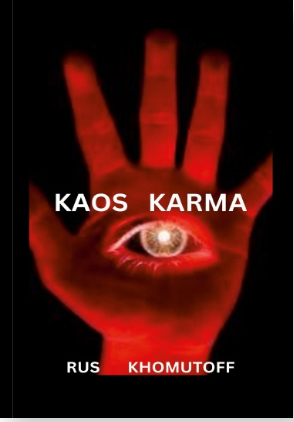
Review of Rus Khomutoff’s Poem Kaos Karma
“Essentially an artist does one thing throughout his career, but over the years he discovers its various implications and expands upon and deepens aspects of what had been present in his work. Perhaps that’s the difference between a serious artist and an entertainer. The artist is constantly deepening a single, obsessive theme, rather than decorating a succession of topical themes.”
~Richard Foreman
Rus Khomutoff’s poem Kaos Karma suggests an encounter between a body of literary writing and a body of magickal/philosophical writing, thus crossing (nonstop) various thresholds of consistency. This despite the consistent all caps no punctuation of its form that positions it on brink of resembling Jenny Holzer’s Truisms (1978–87), though she did not center the text as Khomutoff usually does.
So I read Kaos Karma as an abstract machine that consists of formed and unformed formal functions expressing the relationship of literature to a philosophy of cut-up chaos magick (and vice-versa). As such, Khomutoff offers a way of saying something about the philosophy of poetry that began with Stéphane Mallarmé’s Un coup de dés jamais n’abolira le hasard, but also of the philosophy that is claimed by and for, and sometimes of, chaos magick’s labyrinthine conception of multiplicity and singularity.
In Kaos Karma the reader is not linked by means of period, genre, nationality, style, theme or political ideology; for it has a relentless high-wire flow of exposition that exposes a conniving with transcendence. Especially when its apparently cut-up philosophical transactions (without transitions) are underway. It is with this privilege I am according to Kaos Karma the sign of art that can force thought. This, while at the same time, it is busy effectuating dispersal and fragmentation, rather than totalization.
Khomutoff, on an aesthetic plane, screams in all caps urgent questions that confronts the reader with phrases from different disciplines as the poem oscillates between manifesto and chance. Yet the jump-cuts encountered in Kaos Karma are an encounter between a poetic discipline which decrees a level of specificity and irreducibility. The poet has an immanent manner when he is considered on quite another terrain: that of literature ‘itself’. For, Kaos Karma is important for what it can do as an ABSTRACT MACHINE, rather than for what it might be said to mean.
This evaluative enterprise involves an assessment of the degree of affect produced by Khomutoff’s dramatic work as an impure intercourse between literature and manifesto. But Kaos Karma has a very particular slant deriving from two distinct (but intimately related) bodies of work, Beat literature on the one hand, and the rhizomatic philosophy of Gilles Deleuze and Félix Guattari on the other, as it gestures towards the preposition of its title.
Of course rhizomatic philosophy is itself already subjected to particular encounters with connectivity in our poetic thinking, but the liaisons found in Kaos Karma reads as if the writer is pushing the reader to be impatient and to get on to the next phrase without pause. There is a privileging of a certain speed-flow of words here that merges the possibility that some of Kaos Karma is inscribe or prescribe with a heavy dose of something irrational.
While I would not wish to stress this view, what emerged out of reading Kaos Karma a number of times, is a fact that certain words used here (more than others) gravitate comprehensively towards specific mysteries around passion through the text’s emphasis on being and judgement.
It might be objected that the encounters with passion I found in Kaos Karma are arbitrary (validated by a mere coincidence). But each poem page, to a greater or lesser extent, bears the imprint of a coincidence of this sort.
To identify a specific philosophical passion or problem in each of the pages of Kaos Karma would be reductive and subject the poet’s word-flows to the demands of rationality, instead of feeling. My point, however, is quite to the contrary, even though Kaos Karma read the third time through illuminated through these encounters with passion the philosophical tradition of Deleuze and Guattari for me. Particularly, their critique of interpretation which they together launched in The Anti-Oedipus. In that sense, Kaos Karma may assist the reader in the unlearning of romantic word-image-thoughts which have dominated the poetic discipline.
This is only in part explained by the frequent recourse which Khomutoff makes in his work to ecstatic celebration. The uniqueness of the pertinence of the colorist Dionysian non-space he creates as a form of modulation questions the relationship of poetry to passion to the extent to which the magickal chaotic philosophy of Austin Osman Spare pervades his practice.
Transfiguration forms the corpus of Khomutoff’s writing in this dramatic poetry. But the reader does not encounter a programmatic statement which might be applied by one attempting to write about literature and philosophy in the manner of, or after Kaos Karma. This singular body of work enters the bloodstream of this reader at a rate quite distinct but similar to William S. Burroughs’s Beat poetic transfusions. And yet there is a noncorrosive quality in these Kaos Karma poetic interventions which renders any attempt at a general theory of literature decadent. An intellectual-artistic enterprise doomed in advance.
For me, the reading of Kaos Karma required an exploration of my memories of the work of Antonin Artaud, James Joyce, Henry Miller, José Saramago, Maurice Blanchot, Comte de Lautréamont, Samuel Backett, Jack Kerouac, André Breton, F. Scott Fitzgerald and the stream of consciousness writing that originated with Surrealism and the works of psychologist William James; even as the poem invents unknown or unrecognized affects and brings them to light. For Kaos Karma outlines a plane of consistency which enables, activates or prolongs mental fluxes and becomings as it unfolds a possible world of declaration which secretes and promotes incommensurability, heterogeneity and multiplicity. Such an encounter with such a world entails the crossing of a threshold of becoming, a displacement which scrambles positions of psychoanalytic or karmic interpretation. It consists of a stream of semiology which is anti-psychoanalysis.
This banging bit of poetic writing is precisely an affair of becoming, but it is important to note that becoming in Deleuzeian terms does not entail the attainment of form by means of identification, imitation, or mimesis; but finding, rather, the zone of indiscernibility such that it is not possible to identify or distinguish this or that specific thing. It is a process, that is, a passage which traverses the livable and the lived inseparable from becoming.
~Joseph Nechvatal
Joseph Nechvatal is the author of Venus Voluptuous in the Loins of the Last God, available here.