1. Dear poet! Please tell us about your childhood.
I was born on July 19, 1960, in Baku, the capital of Soviet Azerbaijan, to a Turkic family of an Azerbaijani father and a Tatar mother. Russian was spoken because it was the lingua franca of the USSR. I spent part of my childhood in the Penza region with my grandparents, who had moved there from the siege of St. Petersburg during World War II. Many of my mother’s relatives died of starvation during the Nazi siege of that city. Among her relatives were renowned musicians of international renown, such as Ravil Martynov, founder and chief conductor of the St. Petersburg State Symphony Orchestra. My father’s mother, my grandmother, Mrs. Sarfinaz, was descended from a Khan clan. Her father, Khan Tagi, had several sons, but after the rise of Soviet power, they were executed. My grandmother survived only because she was married by then, bore her husband’s surname, and lived elsewhere. My father, Alikhas, was a staunch communist and a power engineer by training.
What inspired you to become a writer?
The May Day demonstration of 1968. My father took me to a large seaside square. It was spring, with a bright blue sky and an orchestra playing festive marches. This festive atmosphere inspired my first poems.
2. Who is responsible for a child’s future: parents or the environment?
The child’s parents, the environment, their personal talents, and their unique destiny. I was 15 years old when a stray shot from a neighbor’s gun nearly killed me. I survived and became a poet.
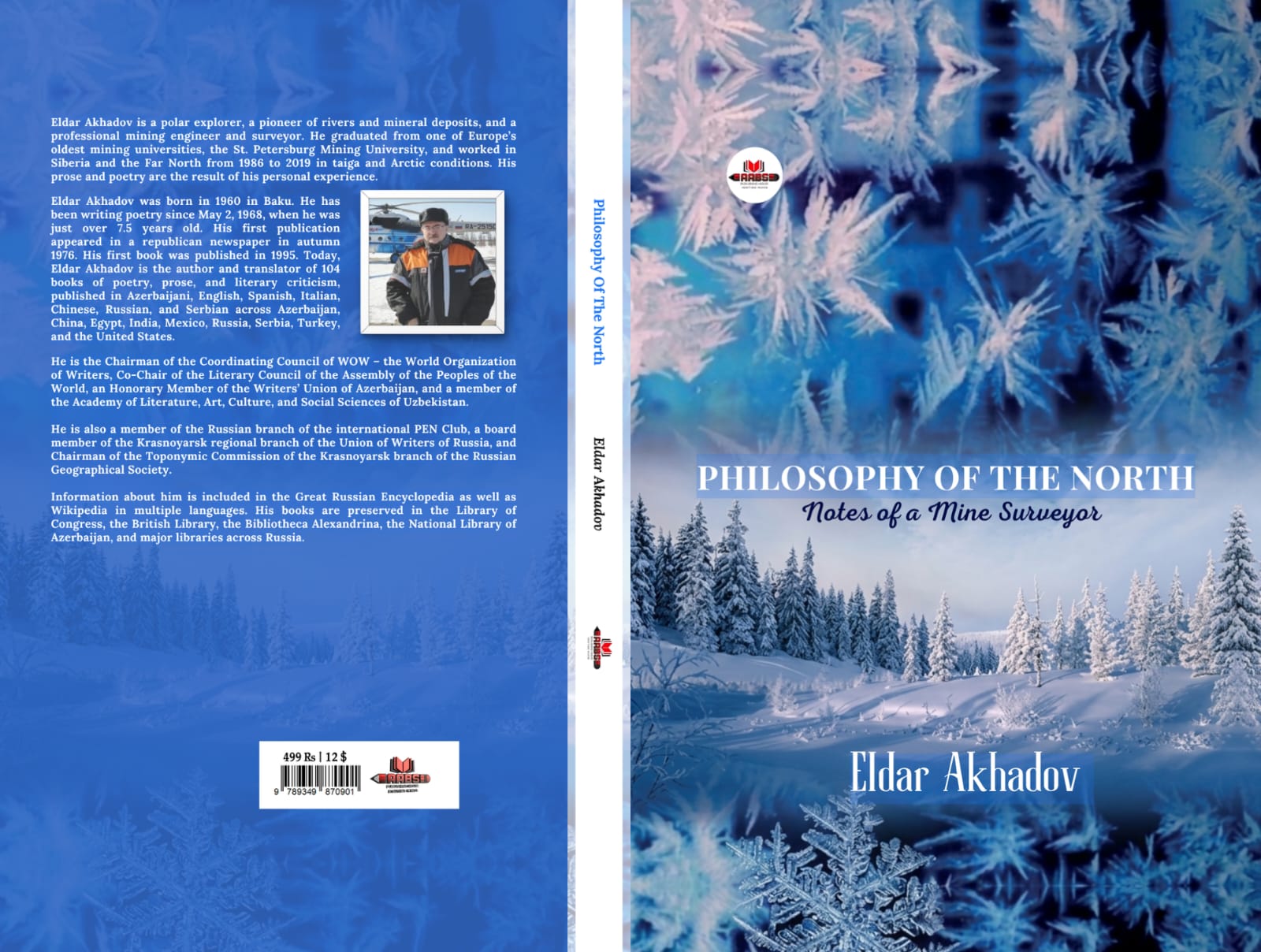
I also graduated from the oldest mining university in Europe, the Saint Petersburg Mining University (founded in 1773), and became a mining engineer and surveyor (a navigator of underground and surface geodetic work). I worked in this specialty in the Caucasus Mountains, the Siberian taiga, and the Arctic tundra of the Far North. I became an explorer, a member of the Russian National Geographical Society (founded in 1845), and the author of fiction and scientific books in seven languages, published in Azerbaijan, Canada, China, Egypt, India, Mexico, Russia, Serbia, Turkey, and the United States.
3. Wars are everywhere on our planet. Do you think we live in a favorable environment?
What should we teach future generations?
I don’t think we live in a favorable environment, but the fact that we’re still alive is a great blessing. Future generations must learn to live in mutual understanding and love; humanity has no other path.
4. Share your opinion on literature.
World literature is as diverse as the peoples inhabiting the planet.
Nevertheless, it is possible to find common ground with all competent writers, because the universal spiritual and cultural values of all peoples are the same.
About e-books.
E-books have a right to exist as a source of knowledge and cultural values alongside paper books. The main thing is that people love to read.
5. What is your opinion of the new generation?
Do we have new talents?
Of course we do. I am the father of four children: two sons and two daughters. They are all talented in various ways. I am convinced that all children are talented, and it is the job of parents and teachers to help them discover their talents.
6. Many poets and writers use AI to write poems and even books.
What is your opinion on this?
I am certain that AI was created to help people, but not to replace their creativity with electronic software. A program can simulate human emotions, but it cannot truly sense them.
7. What are your plans for the future?
I am the author of 108 books of poetry and prose for adults and children, and I plan to continue my creative work.
8. A quote from your book that would inspire a young reader to read your book.
“To fly, you need wings. If you’re a poet, you’ll definitely fly.”