
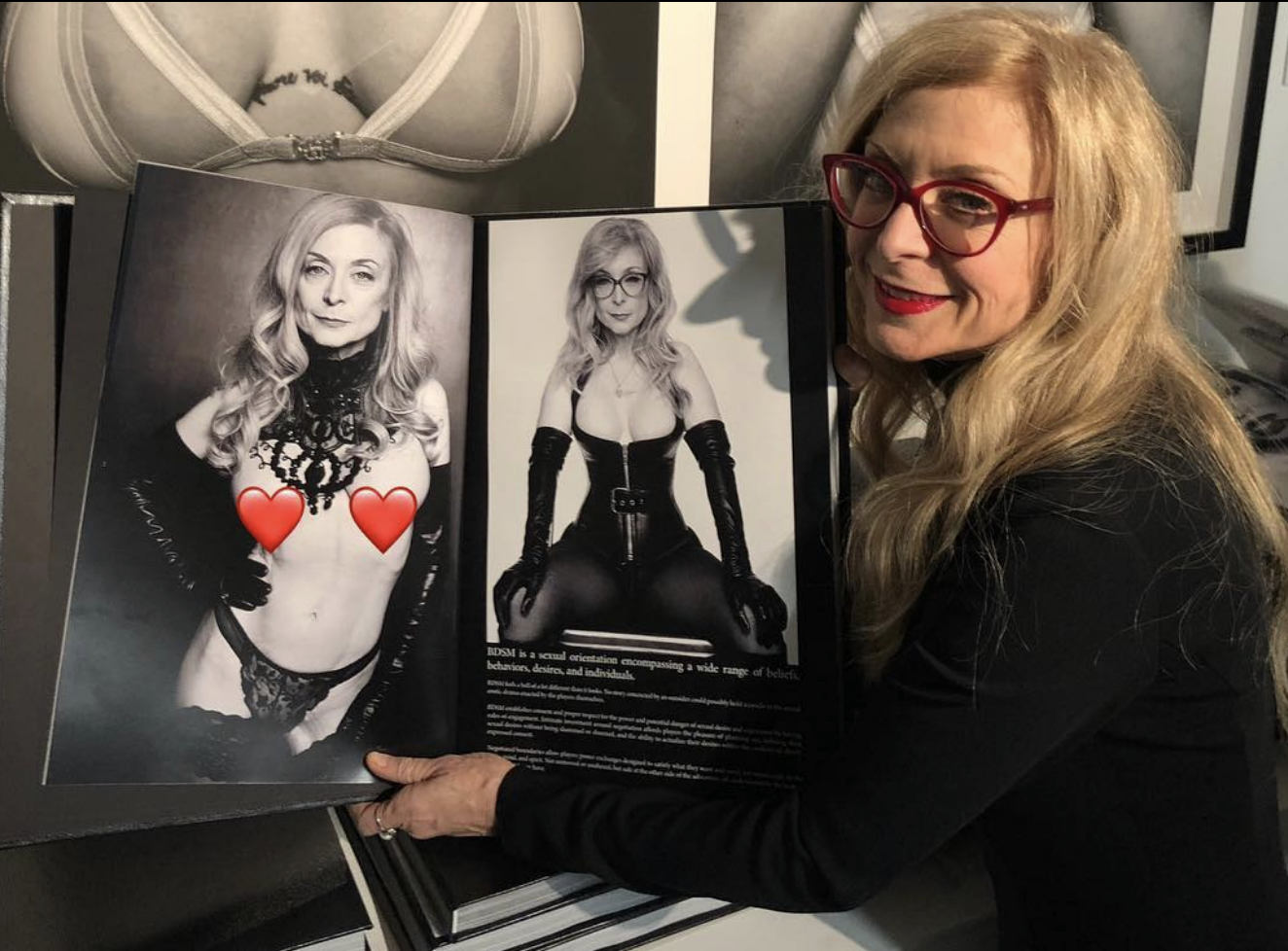
Nina Hartley’s public life spans more than four decades, but the clarity with which she speaks about autonomy, consent, and the politics of the body suggests a through‑line that began long before her first appearance on camera. Born Marie Louise Hartman in 1959 in Berkeley, California, she grew up in a household shaped by political trauma and intellectual rigor. Her father, Louis Hartman, was a popular San Francisco radio announcer whose career was destroyed during the McCarthy era. As she recounts it, he would find work, settle in for a week or two, and then “some guys show up, and he would get fired.” The blacklisting left the family economically destabilized and left her father, once a public figure with a thriving career, working as a short‑order cook and eventually becoming a stay‑at‑home parent in the 1960s, long before such a role was culturally legible for men. “I grew up in the aftermath of the destruction,” she says, describing a childhood marked by her father’s depression and her mother’s long hours as the family’s primary breadwinner.
Her mother’s side carried its own political history. Hartley’s maternal grandfather was a civil‑rights activist in 1930s Alabama, appearing in major histories of the period such as Hammer and Hoe. She notes that he was “beaten up by goons and left for dead in a field,” and that one of those goons was a young Bull Connor, years before he became the infamous segregationist police commissioner of Birmingham. The family’s politics remained firmly leftist and activist; Hartley recalls being taken to anti‑war and civil‑rights marches in a stroller. Religion, however, was absent. “I was not raised in a religious household. No church, no temple, no religious instruction at all. From age eight I realized it was all a story.” This early secularism, combined with the family’s political history, shaped her lifelong skepticism toward moral authoritarianism and her insistence on bodily autonomy as a fundamental right.
Before entering adult film, Hartley pursued nursing, earning a Bachelor of Science in Nursing from San Francisco State University and graduating magna cum laude in 1985. Her intention was to become a nurse‑midwife, influenced by the natural birth movement and by the somatic theories of Wilhelm Reich, whose concept of “body armor” resonated with her. “The birth industry in this country is deeply flawed,” she says, pointing to the United States’ comparatively high maternal and infant mortality rates among industrialized nations. Although she never practiced nursing professionally, the training shaped her understanding of the body as a site where trauma, repression, and liberation all manifest. “The body is stuck forever in the present moment. It cannot leave the present moment,” she explains. “Worry we feel in the body. Anger we feel in the body. Grief we feel in the body. Rage we feel in the body. And it can only be resolved in the body.” Her later work in adult film and sex education, far from being a departure from this somatic framework, became an extension of it. “Sex energy is just hyper‑charging the other physical modalities. When we help a person realign their relationship to pleasure… all their demons show up.”
Hartley entered adult entertainment in 1984 with Educating Nina, quickly becoming known not only for her performances but for her articulate advocacy of sexual freedom, sex‑positive feminism, and performer rights. By 2017 she had appeared in more than a thousand films, making her one of the most prolific figures in the industry. She also produced a series of instructional videos that became foundational texts for sex education outside traditional academic settings, and she lectured at universities including Dartmouth and multiple UC campuses. Her mainstream visibility increased with her role in Paul Thomas Anderson’s Boogie Nights (1997), but her influence has always been rooted in her educational work and her political clarity.
When asked to define sexual autonomy, Hartley answers without hesitation. “Autonomy is being able and supported in making decisions about what happens to your own body. Do I have the right to my own body or not?” She connects this directly to contemporary politics, noting the consequences of recent legislative rollbacks. “The rollbacks for women’s physical autonomy are quite severe and far‑reaching. We’re already seeing increased deaths, increased infant death, permanent disability through botched obstetrical emergencies.” Her critique of religious influence on policy is equally direct. “I get that your religion tells you not to do these things. But how does your religion give you the right to tell me not to do those things?” She traces the current political climate back to the alliance between the religious right and Ronald Reagan. “Up until Reagan, the religious right stayed away from politics. Falwell and Reagan realized there was a sleeping giant. Forty‑five years later, here we are with Christian nationalists really working the agenda.” Yet she also sees a counter‑movement emerging. “What we do have on our side is the under‑40 exvangelicals — young people raised in that system who realized, ‘Oh hell no. Oh hell to the fuck no.’”
Hartley’s approach to consent is grounded in ethics, not aesthetics. She articulates the distinction between consensual kink and public imposition with characteristic precision. “Do I have the right to beat your ass? Yes. Do I have the right to do it in front of people who didn’t agree to be there? No, I don’t.” She continues, “Do I have the right to lead you around on a collar and a leash? Yes. Do I have the right to do it in public? No. I cannot involve other people in my scene who did not agree to be part of the scene.” On breath play, she draws one of her few absolute boundaries. “I do not do neck compressions. It’s not ‘choking.’ External pressure applied to the throat is strangulation. Strangulation is by nature super‑duper violent.” She adds, “As a dom, I get to not do things. A sub can beg and beg — you can hold your own breath. I am not restricting your airway.” Her reasoning is grounded in legal and ethical realism. “All you need is one dead person. ‘She said yes.’ Yeah — and now you’re going downtown to the station. It’s not a thing.”
Her understanding of sexuality is informed by evolutionary biology as much as by feminism. “Female sexual response was important — we have an organ that just does that,” she notes, referring to the clitoris. “We’ve been human for a lot longer than we’ve been monogamous or treating women as property.” Pleasure, in her view, is not frivolous but a bonding mechanism, a stress‑release system, and a tool for resilience. This perspective aligns with anthropological research on early human social structures, which suggests that cooperative child‑rearing, fluid kinship networks, and non‑monogamous sexual practices were common in pre‑agricultural societies.
Across her career, Hartley has served on the board of the Woodhull Freedom Foundation, one of the leading organizations advocating for sexual freedom as a human right. She has been a consistent advocate for performer labor rights, medically accurate sex education, and the decriminalization of consensual adult sexual expression. Her public persona has remained remarkably consistent: articulate, informed, unapologetic, and grounded in the belief that bodies are not political abstractions but lived realities.
She summarizes her philosophy succinctly: “Autonomy is the right to eat what I want, fuck who I want, risk, control, terminate a pregnancy, carry a pregnancy — the basics.” And, as she adds, “Pleasure is an altered state of consciousness. Pleasure connects us.”
In a culture that remains deeply conflicted about sexuality, pleasure, and bodily autonomy, Hartley’s voice stands out not because it is provocative but because it is coherent. Her life — from a politically scarred Berkeley childhood to a pioneering career in adult film and sex education — forms a continuous argument for the centrality of bodily autonomy in any free society. She speaks not as a provocateur but as someone who has spent a lifetime thinking seriously about the body as a site of power, vulnerability, and possibility. Her work, in all its forms, returns to the same essential question: Do we have the right to our own bodies or not?
Alex S Johnson bio
Dubbed “the Baudelaire of our time” by cyberpunk godfather John Shirley, co‑screenwriter of The Crow (1994), Alex S. Johnson is an internationally published author whose work spans horror, surrealism, speculative fiction, and cross‑genre experimentation. His writing has been translated into Greek, Chinese, and Spanish, with his story “El Funeral del Mundo” (“World Funeral”) appearing in Microficciones y Cuentos, curated by Argentine editor Sergio Gaut vel Hartman. Other Microficciones-published authors include Cat Rambo (former SFWA President and Nebula Award winner), Paul Di Filippo (steampunk and slipstream pioneer), Lewis Shiner (World Fantasy Award winner, original cyberpunk figure), and Anna Taborska (multiple Bram Stoker award‑winning British horror writer and filmmaker).
Johnson’s collaborations include the New York Times bestseller Seeing Lessons with Tom Sullivan, the blind actor, author, and motivational speaker known for his appearances on WKRP in Cincinnati, Mork & Mindy, MASH*, Highway to Heaven, and in Airport ’77 with James Stewart. His work with Sullivan — and with Betty White, who supported Sullivan’s disability advocacy and collaborated with him on two other books— helped inspire the 2025 anthology Neurospicy!, featuring contributors such as Synchronized Chaos’s Cristina Deptula and acclaimed speculative fiction author Caitlín R. Kiernan, winner of the World Fantasy and Bram Stoker Awards and praised by Clive Barker as “an original.” On his Substack The Smol Bear Review, Johnson recently published exclusive essay by Kiernan, “Finding Mr. Barker,” after the piece was orphaned in an authorization boondoggle with Clive Barker’s official channels. The remainder of the work will see publication in issues of Black Diadem magazine.
Johnson’s latest major release is Dreams of Fire and Steel 2: A Sword and Sorcery Anthology, continuing his commitment to independent, cross‑genre literary ecosystems. He lives with his family in Carmichael, California.
Pingback: Synchronized Chaos’ First July 2026 Issue: Questing for Renewal | SYNCHRONIZED CHAOS