
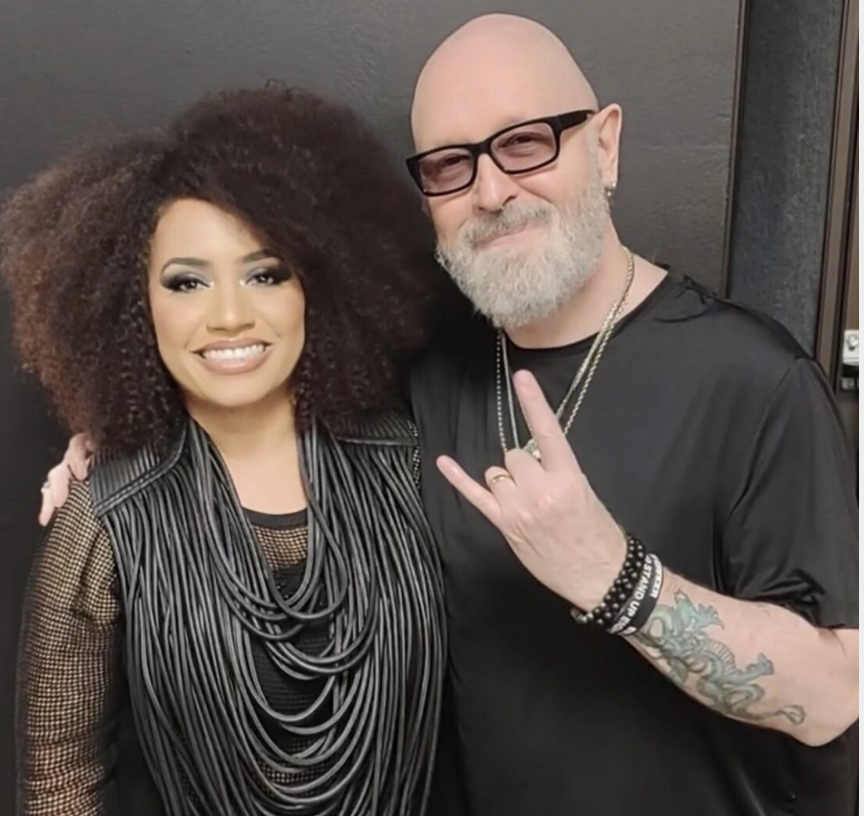
Militia Vox’s story opens with a kid staring at a piano and deciding she wants in because her best friend is doing it.
“My best friend was playing piano, and I was like, ‘Oh well, I want to play piano too,’” she says. They started together; the friend drifted away. Militia didn’t.
Very quickly, piano stopped being an activity and became a relationship. “Music became a thing that was my best friend,” she remembers. “This is something that I can carry with me forever.”
Her teacher enrolled her in competitive piano guilds without really explaining what that meant. Every year she had to take guild exams, playing for judges who measured everything: dynamics, posture, interpretation.
She accelerated fast. “Next thing I know, I’m winning regional and state competitions, and then like was considered one of the best young pianists in the country,” she says.
But the more she tried to bring herself into the music, the more the classical world pushed back. “Some of the powers that be in the classical circles would say things like, ‘She plays too loudly,’ ‘She bangs on the piano,’” she recalls.
She even got criticized for how she sat: “Sometimes I would side saddle, and they didn’t like that.”
She was already chafing against the idea that her job was to be a polite conduit for “dead composers’ music.”
“I got tired of playing dead composers’ music and not being able to create more,” she says. “When I was trying to bring more of myself to the performance, I was getting marked for it.”
By the time she reached the Boston Conservatory at Berklee, the faculty basically admitted she’d outgrown them. “They were like, we have nothing left to teach you, like your art’s already way above what we’re doing here,” she says. So she decided: if they couldn’t teach her, she’d use what she had and make something of her own.
Even before that, she was already staging rebellions. In eighth grade, she put together a performance‑art piece for a talent show, recruiting friends, painting their faces black and white, dressing them in shredded tuxedo jackets, and choreographing a routine to the industrial‑leaning song “Oh Industry” from the movie Beaches.
“I choreographed this piece to it, and I sang, and everybody was like, ‘This is so weird. It’s really good, but it’s so weird,’” she says. That was the moment she started to feel the split: the world wanted her to fit, and she couldn’t.
“I always felt like I was having to fight and rebel,” she says. “This was like my villain arc because I started a strong sense of like, I can’t fit in here, so I’m just gonna go in the other direction. If you guys are gonna make me feel like I’m doing things wrong, I’m just gonna go for it.”
Her childhood environment didn’t offer much in the way of a scene. She grew up in Maryland, “in the middle of like what was a horse farm,” with no musicians around.
Her father, an avid record collector, became her unofficial curator. “He would like send me to my room and be like, ‘You’re Potter, and you’re gonna listen to King Crimson,’” she says. She’d lie on the floor, listening, trying to decode how those songs existed at all. “I’d just try to figure out like how did these people meet each other? How did they write this stuff? How are they putting this? How do they know what sounds to choose? What notes to choose?” she says.
She watched the Grammys and saw a room full of musicians on TV, wondering, “Where are you? Like, I need to be there. How do I do this?”
Her first rock concert was Duran Duran. She was a kid, her parents had to take her, and she spent the show standing on her chair, screaming at the band. “I was screaming at them and embarrassing the hell out of my parents, just screaming at the band, ‘I’m one of you. Take me with you,’” she says.
Her parents tried to make her sit down. “I was like, ‘No, no, no! I need to be where they are,’” she remembers. It felt like the old fantasy of running away to join the circus—only her circus was rock. “Same thing,” she says. “Different circus.”
The bridge from classical to rock came through a boyfriend who was putting a band together.
He knew she was an actor and asked, “Can you cry on command?” Then he handed her a line to sing: “It’s kind of like ‘Red Water’ by Type O Negative.” She didn’t know Type O Negative yet. “What’s Type O Negative?” she asked—and then went down the rabbit hole. “I was like, ‘Oh, this is awesome,’” she says.
The band asked her to join. “They were like, ‘Oh, do you want to come be in the band?’ I was like, ‘Be in the band?’ I was like, ‘Yes, you want me to be in your band?’” It blew her mind.
That band became Disciples of Astaroth, a name steeped in occult resonance. They played Boston and sold out every night. “We used to sell out. We played in Boston, and we’d sell out every night that we played,” she says. They played New York once, at the Batcave. The sound was dark, gothic, heavy, and theatrical. It was also deeply intertwined with drag and queer performance.
Disciples of Astaroth was a co‑singer band: Militia and Britt the Other Bully. Britt did drag—specifically “dark drag,” long before the RuPaul era made that aesthetic mainstream. “He did drag. He did like dark drag,” she says. “Way before Sharon Needles and these drag queens from like the RuPaul era.” He performed to Ministry and other industrial and extreme bands. “Belinda Davenport would do her performances to like Deicide,” Militia recalls of another drag queen from Beverly, near Salem.
The beauty‑queen drag performers didn’t always appreciate it. “All the other drag queens were kind of uncomfortable because it was pretty wicked,” she says.
Militia marched in Gay Pride with Britt, did drag performances with him, and shared dressing rooms with trans performers.
“I basically was raised by drag queens when I started,” she says. They taught her the importance of aesthetic and presence. “They showed me like, you know, you have to have a look, you have to have an aesthetic, you have to have something to offer in the performance,” she says. “This is how you do your makeup, like show makeup. This is how you get your glitter to stay on. You should up your look or magnify who you are.”
For her, drag queens and trans people were part of the band ecosystem. “I was so used to incorporating drag queens and trans people into our band situation,” she says. “It was weird for me to find people that didn’t find that normal. Like I was like, why wouldn’t that be normal? They have the most to say.”
After Disciples of Astaroth, she moved to New York and joined a shock‑rock band whose singer was a performance artist.
“We were featured on Real Sex on HBO,” she says. Her mother saw the episode and called her, crying. “She’s like, ‘Oh my God, you guys are on Real Sex, and you guys are like doing all this crazy stuff on stage,’” Militia recalls. Her response was pure: “I was like, ‘Well, what are you doing watching Real Sex, Mom?’”
New York’s underground felt like an extension of the world she already knew. “Performance artists are like, they have something to say,” she says. “In New York, performance art and music is also like sister friends. There’s a lot of performance artists here that are also in bands.”
Drag performers, performance artists, musicians, and trans people overlapped constantly. “They’re like the twinsies,” she says. “A lot of drag performers are also performance artists here.”
Her original band Vulgaris eventually caught the attention of Cleopatra Records. “We made an album and then we got noticed by Cleopatra Records,” she says.
They signed a deal to contribute a song to a Dead Can Dance tribute album. “We have the last track on the Dead Can Dance tribute album,” she says. But the label cut their elaborate intro without asking.
“We had done this very elaborate, like moody intro. They cut the whole thing without asking us,” she says. “We were just like, their mind was blown, and then they like shelved our record.”
The full‑length, Embrace the Empty, was a dark, Type O Negative meets My Life with the Thrill Kill Kult‑style record. “It was very Type O meets like My Life with the Thrill Kill Kult,” she says. It never got the release it deserved.
That experience fed into a strategic shift. Militia is now widely known for her cover work—especially fronting Judas Priestess, the all‑female Judas Priest tribute band—but she’s blunt about why she started doing covers. “I only started doing cover songs because my original music wasn’t getting the attention that I wanted it to,” she says.
Her first original band, Disciples of Astaroth, did get attention and sold out shows, but it was localized. The wider industry didn’t know what to do with her. Covers became a way to get heard, to leverage the power of familiar songs while still bringing her own ferocity and theatricality to the stage.
Her range—four octaves, with a taste for drama—made her a natural fit for Judas Priestess. She’s done Bowie covers, Tina Turner, Motörhead’s “Ace of Spades,” and more, moving across genres with the same intensity she once brought to Chopin and Liszt. She’s also collaborated with figures like Dee Snider and sang a duet with Rob Halford, the metal god himself, inhabiting the lineage of metal while refusing to be confined by it.
Identity and representation are central to her story. Militia talks openly about being a Black woman in heavy metal, a genre that has long been saturated with toxic masculinity and narrow ideas of who belongs. She’s been told to change her appearance, to tone down, to fit a mold that has nothing to do with her talent.
“Everybody told me ‘I should not be doing that,” she says. “Everybody, literally, family, friends, strangers.” We duet on the Amyl and the Sniffers’ song. “People told me I shouldn’t be doing that..” She says. “I lived it too. I related to it so much.”
Her album Burn My Crosses was misread by some as anti‑Catholic, leading to bans from events and venues.
In reality, it was a response to corruption and hypocrisy she witnessed in Catholic school, where choirs were rigidly controlled and singing pop songs “for fun” was considered disrespectful.
“Anytime I tried to instill an element of fun musically, usually shot down,” she says. She’s been banned multiple times for being outspoken, for refusing to soften her critique, for refusing to pretend that institutions are benign when they’re not.
At the same time, she’s deeply rooted in dark literature and subversive art. She’s a member of the Edgar Allan Poe Society of Baltimore, a detail that fits perfectly with her aesthetic.
She loves Poe, Bowie, Nine Inch Nails, and the whole lineage of artists who turn darkness into revelation. Her upcoming work includes a collaboration with 24‑7 Spyz and a solo album titled For Those Without Shadows, a post‑apocalyptic project that promises to push her themes of identity, survival, and rebellion even further.
Threaded through all of this is a refusal to compromise authenticity. Whether she’s side‑saddling on a piano bench, painting her face black and white for an industrial performance piece, fronting Judas Priestess, marching in Pride with dark drag queens, or being featured on Real Sex, Militia Vox is not interested in shrinking herself to fit anyone’s comfort zone. “If you guys are gonna make me feel like I’m doing things wrong, I’m just gonna go for it,” she said as a teenager—and she never stopped.
Three hours of conversation with her don’t feel like a linear biography so much as a constellation: classical guild exams and King Crimson, Duran Duran and Dead Can Dance, drag queens and Deicide, Cleopatra Records and shelved albums, Catholic school choirs and banned records, Judas Priestess and Tina Turner, Poe societies and post‑apocalyptic visions. What ties it all together is the same line she screamed at Duran Duran as a kid: “I’m one of you. Take me with you.” She wasn’t asking permission. She was announcing a fact.
Militia Vox didn’t simply move from classical piano to metal. She built a life out of refusing to play dead men’s music quietly, out of insisting that drag queens, trans people, Black women, and neurodivergent misfits belong at the center of the stage. She didn’t just find her voice. She forged it, loudly, and never apologized.
About Alex S Johnson:
Dubbed “The Baudelaire of our time” by John Shirley, primary screenwriter of the cult classic horror film The Crow (1994) and songwriter for Blue Oyster Cult, Alex S Johnson is a retired university English professor, author, editor and publisher with Nocturnicorn Books. He has performed spoken word with the likes of Iris Berry (Punk Hostage Press; The Lame Flames, The Ringling Sisters with Pleasant Gehman), Ellyn Maybe (Beyond Baroque; author of The Cowardice of Amnesia as edited by Exene Cervenka of X and published by Henry Rollins of Black Flag and Rollins Band); Danielle Willis, author of the cult classic Dogs in Lingerie (Zeitgeist Press) and Lambda Literary Award-winning author and retired Yale University trained pediatrician/bi rights and disability rights activist Jan Steckel. Other interviews he has done published on Synchronized Chaos, Blue Blood Magazine, Metal Hammer and Zero Tolerance, etc. include Diamanda Galas, Jarboe, Gitane Demone, Rozz Williams, Lemmy Kilmister, Ronnie James Dio and King Diamond. He lives in Carmichael, California with his family.