
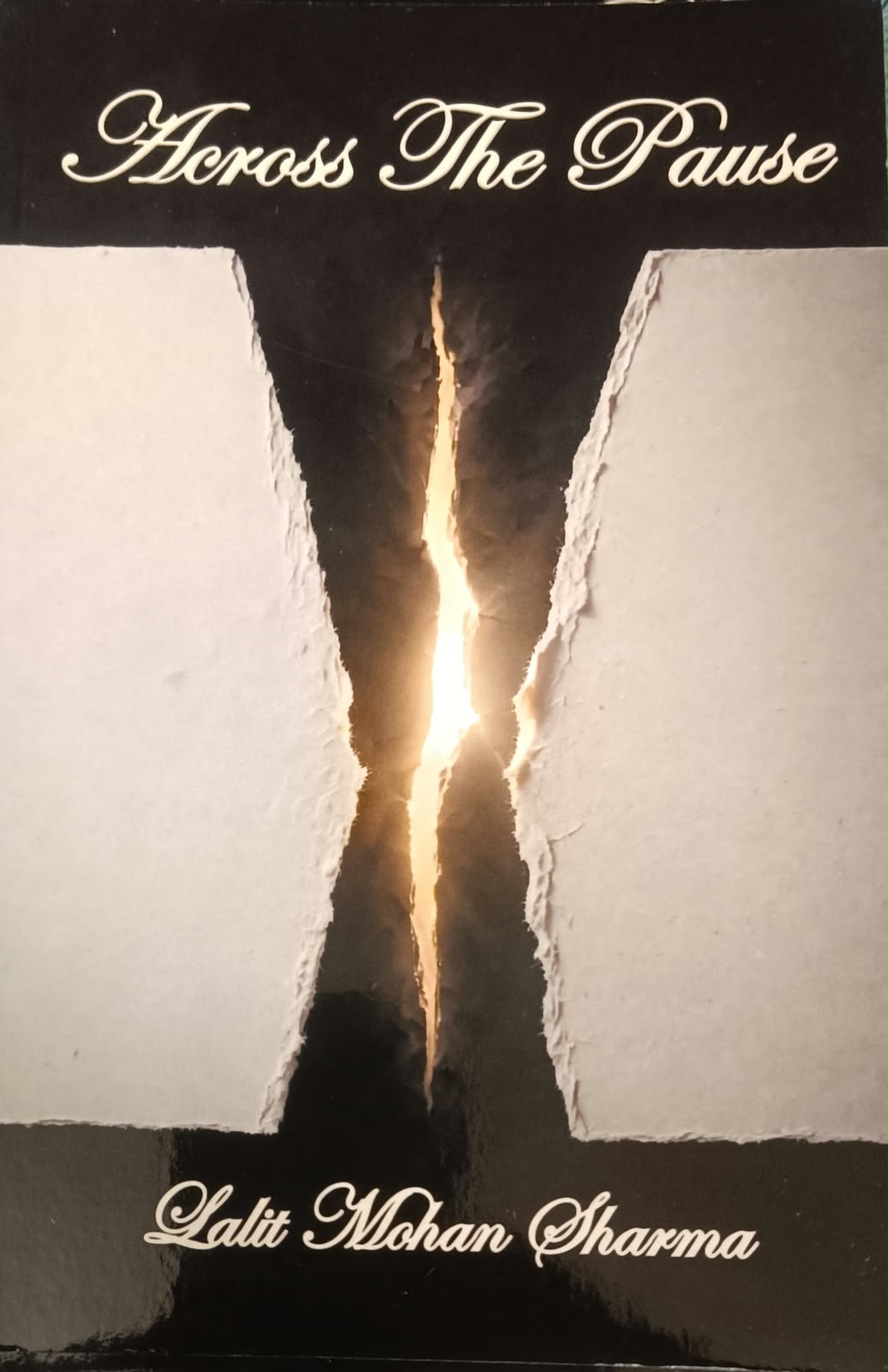
THE POETIC PASSION: ‘ACROSS THE PAUSE’ BY DR LALIT MOHAN SHARMA.
Reviewed by Dr Jernail S. Anand
The poetic passion is self-consuming but like a flame it goes down in splendour. -Anand
THE AUTHOR:
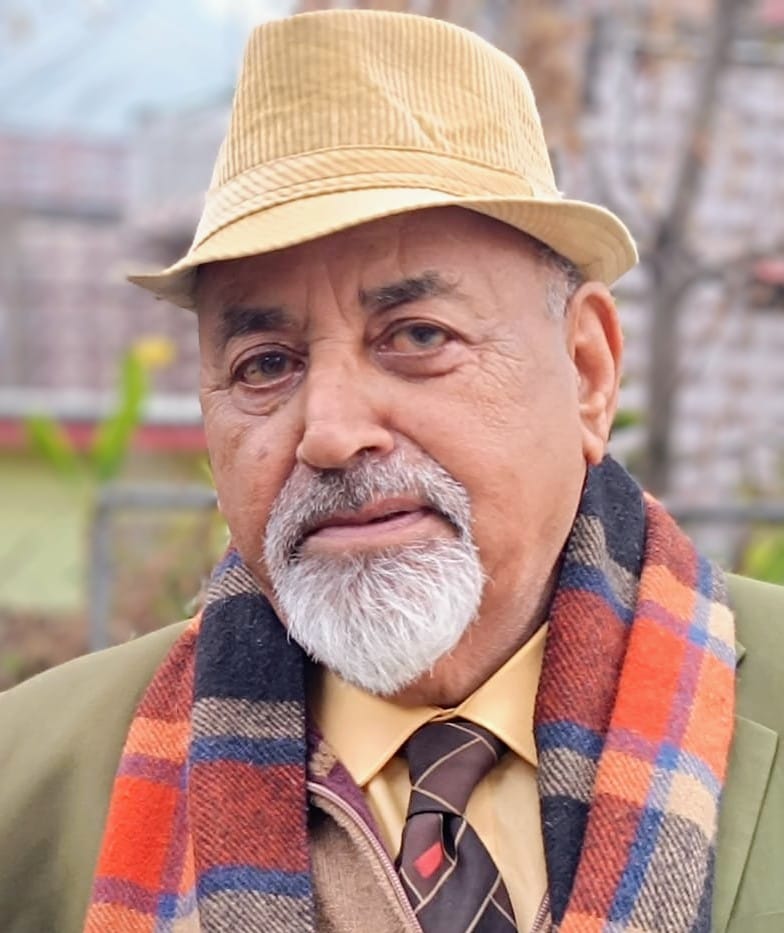
Dr. Lalit Mohan Sharma is a seasoned voice in contemporary poetry whose reflective verses beautifully weave personal introspection with universal human experiences…his work continues to enrich modern poetic discourse with depth, clarity, and quiet emotional power, ” writes Malini Joshi, editor, The Literature Times. Born 1952, a former government college Principal, Dr Sharma is a bilingual poet, translator and author. His publications include 17 books of English poetry, two anthologies of Hindi poems, Another Gandhi, a monograph on Pandit Durga Dass, a freedom fighter and A Three- Step Journey, an English verse translation of Zahid’s Urdu poems. His poetry book On the Edge has received the International Culture Award from International Academy of Rome. Included in several books of repute on poetry, stories and academic research on Modern Thought and Post-Truth Era, his poetry books, Icy Chill on Fire, Across The Pause, and ‘Blind Man’s Bluff’, his first book of short fiction, came out in 2026. International Academy of Ethics has conferred on him fellowship of the Academy.
Review
The poet’s job is to look with wonder at the phenomenon and analyze things which disturb the human flown, generate sympathy for man where he is a victim and react when he is a perpetrator, and above all, express his angst if he finds himself helpless. Whether someone agrees with you or not, does not matter if the poet is true to himself, because poetry is the result of an inner craving, and it ignites the same fire in the readers. The poetic passion is self-consuming but like a flame it goes down in splendour.
If William Wordsworth had met Lalit Mohan Sharma, he might have reconsidered his theory of emotion recollected in tranquility, and even Eliot might have given a thought to his idea of ‘escape’ from emotion, because here is the poetry which resembles a volcanic eruption. When the procession of the Muse takes off, a thousand wry calculations stand on the banks, looking in wonder at flowning waters. Poetry takes into its stride everything that looked so unpoetic – all pains, all joys – everything that lent any emotion to the poet, is woven into the spiral of poetry, which moves like waves towards the ocean.
It is more like a mining operation. The poet digs deep into his heart, and brings up pearls of emotion from the depths. Of course, this dive into the self is propelled by outside agencies. For every moment, there is a stimulus which sends him poeticising.
It is the environment outside, and the passion inside, which intersect each other at a certain degree of heat, where they melt and the imagination carves out new forms, new articulations, and new thoughts. Poetry is that novelty which even surprises the poet and he wonders if he carried an idea so sublime in his own blood and veins.
‘Across The Pause’, Dr Lalit Mohan Sharma’s 2026 collection of 75 poems, is a mature, deliberate work from a poet who has spent a lifetime with words: as a bilingual writer, translator, former college Principal, and author of 16 English poetry books. The result is a volume of rare cohesion, emotional clarity, and quiet power. It is a record of the impromptu conversations which take place when intellect and heart sit down together in the face of subtle and not so subtle challenges and exigencies of daily life.
Described as Sharma’s “most conscious and mature work”, the work “transforms “everyday life into a territory of existential interrogation”. The pause signifies the suspension, that separates loss and presence, oblivion and memory, and fulfilment and desire.
Mauro Montacchiesi thinks that it is a text that encourages contemplation, the suspension of judgment, and reflection. The language used is essential, clear. According to him, Sharma has mastered the art of subtraction: every emotion is filtered through a sensitivity that prioritizes depth and measure; every image is necessary; every line is calibrated. His poetry seeks emotional truth and resonance. It is a poetry that requires attention to be fully understood. In the Preface, the poet himself asserts: Writing a poem is an overwhelming experience, you forget the rest of the world, only remember what enters into a poem with its independent life. Writing is therapeutic, mind is acclimated to a celebratory joy, a quietness akin to mindfulness.
Time disturbs the poet in various ways. In ‘Stasis’, he finds man and his impatient moves infructuous before the wilful movement of time:
Time will not move faster if you quicken
The needles of the dial on your wrist for
No illusion can pluck and twist a reality
To suit the whims of this finite existence.
When the poet wants to hasten into tomorrown [Tomorrow’s Day], it leads to an emotional dislocation of time. Dr. Sharma excels himself in giving expression to the idea how sleep escapes the grip of a disturbed soul:
Sleep has often delayed her embrace
I wish to have tomorrown’s bath at night
And get dressed up for the next morning
“Urgency” picks on the raw needs of life, which, denied, turn into a haunting passion. The mask of the poet is off, for a moment, philosophy is taken off like clothes, and we see the clear vision of a languishing soul suffering the pangs of separation:
O for a pair of feminine lips and hands
With green glass bangles on the wrist,
Fair feet clasped in inch high sandals,
Mouth moves ever so lightly as she rolls
Up her hair into plaits to raise in a bun!
The poet wonders if death is “just disappearance”. “Ethereal”, is a superb document of pain, loss and the end where man’s wits sometimes find themselves:
Whom did I love, I do not known for
The one with whom I shared living
Just vanished as a cloud in the sky light,
In the room as when power supply fails.
Nothing has yielded more contemplation and acrobatics of thoughtful meditation than a “Mirror” in the poetic lore across ages:
Looking into a mirror makes none happy,
It’s when a human face turns into a mirror
That you discover joy deep in your heart.
“Choice options” points to the convulsions in poet’s mind where he fails to grasp “what inner conflicts seize human organs? And “what grueling battles are fought within?. “Intellectual” humanizes man half stricken by cleverness. The poet points to a great divide in man’s perceptive parts, but what restores his humanity is his susceptibility to err:
The intellectual acts by half his cleverness,
For he too is vulnerable to his emotions,
Can’t always keep intact his detachment,
Partially succumbs to error like the ordinary.
“Resolution” is a poem which reflects the true Lalit who realizes the repair work is on before the ultimate surrender. The poetry assumes a stoic tone, lending a rare sagacity to the text, missing in ordinary mortals, who suffer the pangs of life:
Let me carry on repair work and paint
Walls injured with time and look ugly
To the eye, the house resembles ruins
With time, and seem to be uninhabitable.
“Reading and Writing”, perhaps concludes this tumultuous journey in which the poet finds “Reading will become surrogate writing”. This coming together of the subject and the object is like bridging the gap between two entities of man, the attempt to understand [reading] and the final work when this understanding is dispersed in the winds [writing].
Once you identify with the author’s mask,
That’s to ask yourself to expand beyond T
The limiting concerns of your narrown life; Y
ou assume a larger canopy of existence.
The poems stand out for “emotional clarity, formal discipline, precision of imagery” with a poetics that “favours the sobriety of feeling” and qualify beyond confessional poetry to meditative lyricism. The work deals with themes of time, female presence, fragility of body, illness and solitude, the political as an extension of the personal. The language is disciplined, imagery precise. Each poem springs from “a soulful emotion that seeks to translate into words what eludes the grasp of rationality.” The foreword’s mention of “fragility of contemporary democracies” and “manipulation of consensus” hints that Sharma is not writing from an ivory towner. Yet the political never overwhelms the personal. Instead, it’s absorbed into the same meditative field.
The epigraph from Dante’s La Vita Nuova — “All ye that pass along Love’s trodden way, / Pause you awhile and say / If there be any grief like unto mine” — sets the tone perfectly. It frames the collection as an invitation to pause with the poet, to test your grief against his, and find kinship rather than competition. Finally, ‘Across The Pause’ which carries Sharma’s own sober, luminous signature, speaks most to readers who value reflection over reaction and look for the moments between moments.
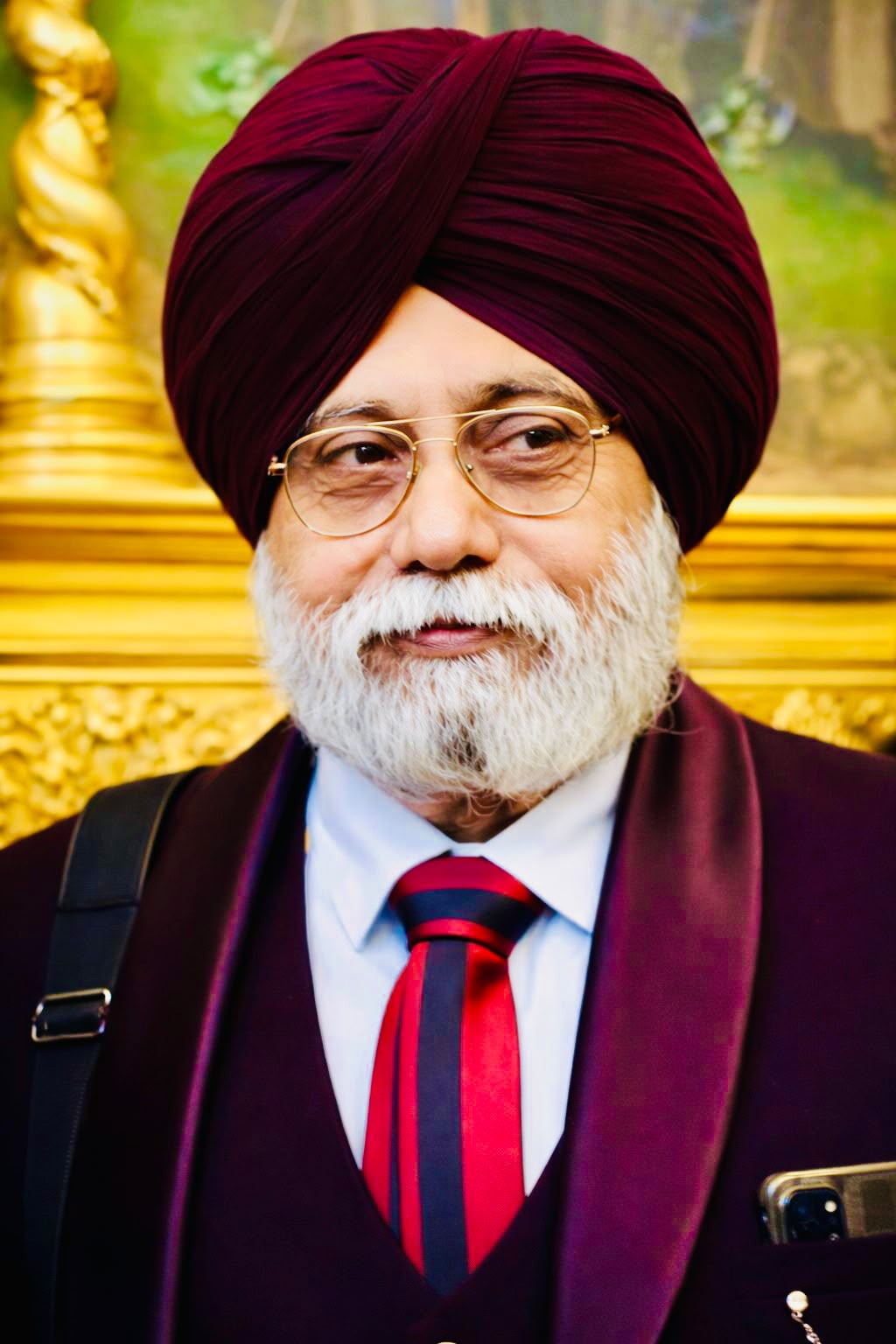
Dr Jernail Singh Anand stands as a major figure in contemporary world literature as a 21st Century Metaphysical Poet. With 210 books, including 20 epics, he has created a distinctive body of work that fuses Vedic spirituality, ethical inquiry, social critique and philosophical reflection. His seminal epic Lustus: The Prince of Darkness and the recent Equilibrium reimagine mythology for the technological age. Founding President of the International Academy of Ethics, he is a laureate of the Charter of Morava (Serbia), Seneca (Italy), Franz Kafka and Maxim Gorky awards. His name is inscribed on Serbia’s Poets’ Rock, and he holds honorary membership of the Serbian Writers Association. Anand’s writing positions poetry as an instrument of planetary consciousness and moral responsibility.