
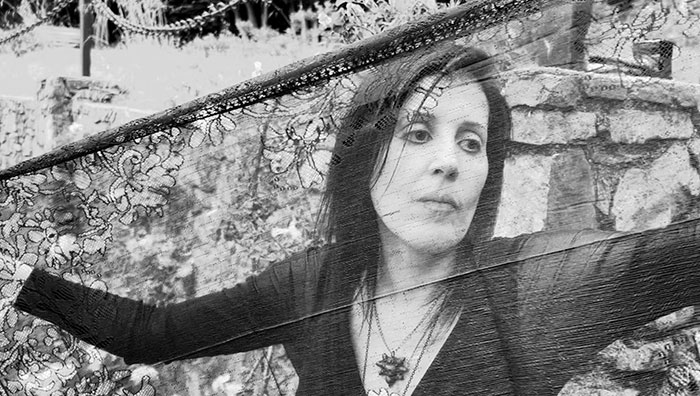
The War Inside the Voice: Leila Abdul‑Rauf Between Calls from a Seething Edge and Andros Insidium
by Alex S Johnson
Leila Abdul‑Rauf has long occupied a singular position in the experimental music landscape, moving fluently through noise, ambient, metal, thrash‑adjacent hybrids, folk‑metal permutations, and avant‑garde vocal architecture. Her recent work unfolds across two closely linked records: Calls from a Seething Edge, released on Cyclic Law in 2024, and the newer Andros Insidium, whose title she describes as a partly invented Latin construction—“andros meaning… the masculine,” while “insidium… I don’t even know if that’s real… sometimes you just got to make something up just to keep it interesting.”
Calls from a Seething Edge is the record that contains “Crimes of the Soul,” a song whose emotional and visual architecture anchors much of the conversation.
Abdul‑Rauf explains that the video was shot by her partner, Gregory Hagen, who “does make an appearance on both that record… Calls from a seating edge, which came out on cyclic law in 2024, and then… he also does a vocal appearance on Andros Insidium.”
The video’s pastoral core was filmed at “a local rose garden here in Oakland… such a hidden gem… a great place to just go and relax… watch the water fountains and all the birds… whatever’s lurking around there.”
That serenity is violently interrupted by war footage edited in by their friend Dave Brenner, who “kind of gave it the grit that… was true to the song.”
Abdul‑Rauf isn’t certain of the exact source of the footage—“you’ll have to talk to him about that”—but suspects “probably Gaza or Lebanon or a combination, Syria… all the recent bombings and things like that.”
The backdrop for Calls from a Seething Edge is explicitly geopolitical. Abdul‑Rauf describes 2024 as “sort of, like, the D‑day for all the… genocides going on,” a time when she began to feel “really… angry and vulnerable in a way that I hadn’t felt quite to that point,” especially in “this… hyper‑surveillance world that we’re living in.”
She became “really anxious… very on edge,” and war moved “to the forefront” of her thinking. Her day job at a psychoanalytic institute—“I do administration, but I’m around psychoanalysts all the time”—inflected the record’s conceptual frame.
For over a decade she has been immersed in a culture that insists, “don’t take everything at face value… really distill it… don’t make these flipped judgments… explore… the most horrible parts of ourselves.”
War, she notes, is “one of the most despicable things about humanity,” yet “going back to early humans, there’s always been war and violence of some kind.”
The record asks, without pretending to answer, whether war is something humanity can ever transcend: “Is war even something that we… can ever be above?… I like to think yes… but…”
One of the songs on Calls from a Seething Edge, “Failure to Fire,” draws on research from the Vietnam War. Abdul‑Rauf recounts studies suggesting that soldiers “weren’t… killing each other… enough,” which led to the use of gas to “incite more violence.”
She connects this to the premise of the film Jacob’s Ladder: “That was the whole premise for the movie Jacob’s Ladder, too… people don’t really want to kill each other… so they had to drug them.”
The song becomes a meditation on the gap between human reluctance and systemic coercion.
Sonically, “Crimes of the Soul” is built from deceptively simple materials. “The structure’s pretty simple,” she says. “I did very simple drum programming… some… deep growly synths… and lots of these lofty kind of vocals.” The second half introduces what sound like “high stringy synths,” but they are in fact trumpet parts “really stretched out… and playing back at different speeds.”
She took a treated horn part from “Summon,” the first track on Calls from a Seething Edge—“there’s another treated horn part at the beginning… that’s drop‑pitched”—and “put it in ‘Crimes of the Soul’ and sped it up… probably 3 or 4 different speeds.”
The result is a harmonic mesh that feels electronic but is “honestly just… acoustic horn, just trumpet… through a microphone… some reverb and some pitch shifting.”
Her approach to gear is deliberately minimal. “You’re very self‑sufficient as far as your gear,” I say.
“Not at all,” she replies. “I feel like I’m the antithesis of techie.” She insists on keeping “the gear as minimal as possible,” explaining, “I can’t wrap my head around these complicated setups with all these pedals… wires everywhere, I get nauseous when I see… I’m impressed when other people do it, but if I had to do it, I would just… freeze.”
The simplicity is in service of performance: she wants to “really get into the vocal performance, the horn performance… interact with the crowd,” especially now that there is “a lot more… challenging singing and… a lot more growling in the sets… a lot more visceral and immediate” than her earlier, more “down tempo” work.
If Calls from a Seething Edge is the war‑haunted, psychoanalytic record, Andros Insidium is the newer, parallel project where Abdul‑Rauf continues to push her voice and compositional strategies.
She notes that many listeners think she “now is going solo,” but clarifies that these projects have been running in parallel for years: “I’ve been doing my solo projects since 2012… Vastum started right before I joined Hammers… and then I started my solo project not much longer after that.”
On Andros Insidium, tracks like “Eros Anima” and “Fractured Body” carry some of her most overtly metal‑inflected and Halford‑inspired vocal lines. “There are a couple moments on… ‘Eros Anima’… where I just get my inner Halford out,” she says. “No one’s gonna say that when they listen to it, but… there’s some vocal melodies where that’s straight up the case.”
“Fractured Body” on Andros Insidium is repurposed from a Vastum song, “Corpus Fractum.” “I just… translated into English ‘Fractured Body’,” she explains. “Instead of the… guitar lead as the vocal lead… the rhythm guitars is the synth… did different drum part… shortened it… took, like, the intro of the Vastum song and made it its own song.”
The ending, built from “sound bites of glass breaking,” is a direct homage to Einstürzende Neubauten’s “Haster Luger”: “At the end of ‘Haster Luger’… there’s just, like, this endless… stream of broken glass. I was like, well, that’s… gotta… give my love to them there as well.”
Her influences form a dense, unconscious archive: “There’s… all kinds. There’s… Einsturzende Neubauten… a little Dead Can Dance, little Skinny Puppy… it’s all there back in… deep in the unconscious.”
One of her most important inspirations is Rob Halford: “I’m a huge Rob Halford fan. Anyone who knows me… knows that.” She has read “both of Rob’s memoirs” and K.K. Downing’s, calling them “all fantastic,” and still describes Judas Priest as “the best heavy metal band in the world.”
Abdul‑Rauf’s personal history adds further layers to her work. She grew up between two religious traditions: an Egyptian Muslim father, an imam, and an Irish Roman Catholic mother from New York.
She spent childhood weekends in a Sufi mosque in Soho, sitting through sermons, listening to the call to prayer, participating in dhikr: “You repeat God’s name… whirling around… almost passing out from these recitations.”
She recalls “all the call to prayer… it just kind of works its way in,” and notes that these sounds later resurfaced in her solo work.
Her band history is equally rich. Amber Asylum, Hammers of Misfortune, Vastum, Saros—each marks a different phase.
She describes joining Hammers after playing with Sigrid in Amber Asylum: “We had had a couple of years already… touring together… and then she invited me to join Hammers… I said, oh, okay, well, it’s Sigrid, I love playing with Sigrid.”
Hammers, she notes, is “John’s… basically his solo project brought to life in a band,” and her role was to “support… his ideas… guitar‑wise and vocal‑wise.”
Vastum, formed with Dan and others, continues: “At this point, it’s just me and Dan… we’ve been writing another record.” Her long partnership with Sam Foster—“the drummer of… Saros… who used to be in Weakling”—extends across projects: “He’s all over my last two solo albums… hand percussion… he’s done videos… all the photography… that’s all… he did all of that… that’s like an almost 25‑year relationship… he’s been such a big part of my life creatively.”
Touring has become increasingly strategic. Abdul‑Rauf outlines an upcoming East Coast solo tour with dungeon‑synth artist Vela Straz, describing the genre’s cosplay, masks, swords, chainmail, and 1980s keyboards: “It’s a whole thing.” The aesthetic appeals to her, and the economics make sense: “Touring with a band now is a total racket… too expensive… solo is more worth your while.”
Her sets now feature “a lot more growling… a lot more visceral and immediate” energy, even as she maintains dynamic range.
Her perspective on heavy music’s evolution is grounded in experience. She notes shifts in production—“hyper‑compressed guitar tones,” “drum triggers,” “homogenized growls”—and the explosion of global diversity in metal scenes, from blackgaze and shoegaze‑metal hybrids to internationalized extreme music.
She also gestures toward the intellectual currents behind punk and metal, mentioning Marxism, socialism, and situationism, and referencing a friend who “wrote a whole book on situationism in punk rock.”
When asked about advice for women in extreme music, Abdul‑Rauf answers with warmth and pragmatism: “Play with good people… collaborate with true friends… diversify creatively… avoid burnout.” She emphasizes the importance of long‑term artistic relationships: “If you play with good people, they’re gonna be in your life for a long time.”
Across Calls from a Seething Edge and Andros Insidium, Abdul‑Rauf’s work reveals an artist who moves fluidly between genres, cultures, histories, and emotional registers, creating music that is as intellectually rigorous as it is sonically visceral.
Her records are not simply fusions of influence; they are the lived expression of a life shaped by war, ritual, rebellion, psychoanalytic inquiry, and relentless creative curiosity.