Out of faded afterthought in its spreading yard of white flame
a line of dark that splits the light moves in several directions at once
and before long has left a skyline of hands raised for shade
to better receive the sight of land despite the only definition
being a debt none of us can afford, though our purpose is the image,
to live in it, to know its glow, know the floor of eternity as the back of the mind
which is the image’s way of ending, of achieving stillness, and further
into the image, sleeves are rendered over the bulk of bare wrists, and we,
we become aware it is us seeing it all, that our silence is always our purpose,
is always to see and refuse what is ours, unable to afford what we’re looking at.
If they are present, the warmth is theirs, so I am still agitated,
wounded even by sleep. Carts of fruit have broken in the street.
Everything cannot form neat little lines; some things must splatter to happen.
The recurring aprons have failed their pledge. The self-checkout is gathering cobwebs.
The menus are blowing away in the wind. A couch in the street is the crested horizon.
But I am still here, shoes and everything, and I am absolutely wasting all of my joke.
I find my truth in what I don’t agree with, and from my seat on the airplane
I hear the flight attendant announce the only missing passenger, and it’s me.
—The Banker
To Come
We thought we might shut the anthem up good,
so we drank, watched unspeakable joy capsize,
touched burgundy night, were outraged with ourselves
in the morning, and realized our inexpressiveness
was our only morality, the anthem. It came from
the heart of inconsequence, only to be glimpsed while forgetting.
It came from a place of purity, purity that rang like escape routes
from an implacable faith, where scouting was a shout at water
lathered in streaks of ash. The anthem came from a place
people weren’t sure really existed, yet had memories of,
memories that announced themselves like collective hallucinations
in rehearsal of childhoods to come, but in the end, the anthem
turned out to be nothing more than the stale air
shut away in a room that was locked from the outside.
All the many thin, angled bars of light
slowly floated dust down the old beer signs.
The jukebox again repeated the good song
which spoke clearly in the only voice.
The bad song does not speak in the only voice.
—The Drinker
Cop
Soon it will be dark, and in her lack of sight
her ear will supply all the courtyard birdsong
of trickling water in a cold office bathroom.
There will be an elevator shaft, and in the silent elevator,
her ear will supply the sound of a dog walking in circles.
Outside on a park bench will sit a little harmonica
and passersby will invent a child blowing into it.
When we think of the past, our efforts seem silly.
It’s often difficult to decide on a monument
when every single sleep that comes answering is bare.
A god is vice begins and ends vice
—The Thief
The One in Charge
One day the ice in his glass
did not melt properly
and he discovered he was empty.
But when no one can afford
to relax at the top, how to tell
what relaxing looks like?
We kidded ourselves; we spoke of tar and rain,
balconies and raw meat, sun on umbrellas.
But what we desired most could only suffice
if too much to receive, a place only visible
from the outside, so we looked all over
not for what we had lost, but for the moments we lost it;
we looked for the beautiful ways, the ambitious ways which
in the past, with far more people to know, we lost it all.
—The Second Gunman
Coin into Fountain
Like any precise enough metallic
put to milliseconds across a dome of daylight,
it wasn’t itself as it was happening,
as it was happening, it was something else,
it was a flickering jewel between towers
in shaky blue sky above city traffic,
then the slap of the surface, water closing fast
the circle by mimicry of shape and rushing
across the engraved profile toward itself
until a clash spiraling finger oil upward
to dissolve under the surface and its dialogue
which was then the intact hum of the buried above
while the bottom was struck and all the other coins
already installed long enough to bear small life
fell storied into their own respective borders,
and the dialogue above the surface continues;
who is there left to abandon?
They learn when they buy.
—The Billionaire
Derek Thomas Dew (he/she/they) is a neurodivergent, non-binary poet currently living and teaching in New York City. Derek’s debut poetry collection “Riddle Field” received the 2019 Test Site Poetry Prize from the Black Mountain Institute/University of Nevada. Derek’s poems have appeared in a number of anthologies, and have been published widely, including Interim, ONE ART, Allium, The Maynard, Azarão Lit Journal, Two Hawks Quarterly, Ocean State Review, and Overgrowth Press.
Naji Naaman Foundation for Gratis Culture (FGC) announced that competition for Naji Naaman literary prizes for 2026 (24th picking season) is already open. Prizes will be awarded to authors of the most emancipated literary works (in content and style) aiming to revive and develop human values.
Literary manuscripts (thoughts, poems, stories, etc.) of 40 pages at most, in all languages and dialects, typeset, with the curriculum vitae and an artistic photography of the author, should be sent to Maison Naaman pour la Culture (by e-mail: info@najinaaman.org) before the end of January 2026. Manuscripts written in languages other than English, French, Spanish or Arabic must be accompanied by a translation or résumé in one of the aforesaid languages. Prizes will be announced before the end of June 2026. Works (in full or in part) published in the free of charge prizes’ yearbook will become (only for the aforesaid publishing purpose) the property of the publishing house.
Laureates will bear the lifetime free of charge honorary title of member of Maison Naaman pour la Culture (MNAC).
PRIX LITTÉRAIRES NAJI NAAMAN
2026
(24ème cueillette)
La Fondation Naji Naaman pour la Culture Gratuite (FCG) vient d’annoncer que le concours des prix littéraires Naji Naaman pour l’année 2026 (24ème cueillette) est déjà lancé. Ces prix seront décernés aux auteurs des œuvres littéraires les plus émancipées des points de vue du contenu et du style, et qui visent à revivifier et développer les valeurs humaines.
Les manuscrits littéraires (pensées, poésies, contes, etc…) d’un maximum de 40 pages, de toutes langues et dialectes, composés, accompagnés du curriculum vitae et d’une photographie artistique de l’auteur, sont reçus par la Maison Naaman pour la Culture (par courriel: info@najinaaman.org) jusqu’à fin janvier 2026. Les manuscrits qui ne sont pas écrits en français, anglais, espagnol ou arabe, doivent être accompagnés d’une traduction ou d’un résumé dans l’une de ces langues. Les prix seront déclarés avant fin juin 2026 au plus tard. Les œuvres publiées (en partie ou intégralement) dans le recueil annuel gratuit des prix deviendront (à ce seul effet de publication) la propriété de la maison.
Les lauréats porteront le titre honoraire, à vie et gratis, de membre de la Maison Naaman pour la Culture.
PREMIOS LITERARIOS NAJI NAAMAN
2026
(24ª edición)
Creados en el 2002, los premios literarios Naji Naaman tienen la finalidad de premiar aquellas obras literarias más creativas desde el punto de vista del contenido y del estilo, y que desarrollen e impulsen los valores humanos.
Las obras podrán estar escritas en cualquier lengua o dialecto, si esta no fuera francés, inglés, español o árabe deberán ir acompañadas de una traducción o resumen en cualquiera de estas lenguas. La extensión de las obras (ensayo, poesia, relato, novela, etc.) serán de un máximo de 40 páginas. Los originales y en su caso la traducción, serán entregados o enviados junto al c.v. y una fotografia del autor a la dirección por e-mail (info@najinaaman.org). El plazo de entrega finalizará el último día de enero de cada año. El fallo del jurado se hará publico a más tardar el último día de junio de cada año (así como el de las obras cuya publicación será gratuita dentro de la serie literaria creada por el Señor Naaman en 1991). No se devolverán las obras presentadas y las premiadas pasarán a ser propiedad de la casa.
Los ganadores recibirán así mismo el título honorífico de miembros de la Maison Naaman pour la Culture.
جوائز ناجي نعمان الأدبيَّة 2026:
فتحُ باب التَّرَشُّح
أُعلنَ فتحُ باب التَّرشُّح لنَيل جوائز ناجي نعمان الأدبيَّة لعام 2026 (الموسمُ الرَّابع والعِشرون). وهذي الجوائزُ مُشَرَّعَة أمام الجميع، في مجالات الأدب كلِّها، وفي أربعة أصقاع العالَم، وبلغات هذا العالَم ولهجاته من دون استثناء. والمعروف أنَّها تهدفُ إلى تشجيع نشر الأعمال الأدبيَّة على نطاقٍ عالميّ، على أساس عَتق هذه الأعمال من قيود الشَّكل والمضمون، والارتقاء بها فكرًا وأسلوبًا، وتوجيهها لما فيه خير البشريَّة ورفع مستوى أنسنتها.
والجوائز غير محدَّدة لجهة العدد، وتتضمَّنُ نشرَ الأعمال الَّتي تلقى الاستِحسان والاستِحقاق في كتاب أنطولوجيا الجوائز السَّنويّ المجَّانيّ الصَّادر من ضمنَ سلسلة “الثقافة بالمجَّان”، علمًا بأنَّ الحقوقَ في تلك الأعمال تسقط، في الخصوص الأخير حَصرًا، لصالح المؤسَّسة النَّاشرة، مؤسَّسة ناجي نعمان للثَّقافة بالمجَّان.
تُقدَّمُ المخطوطات في نسخةٍ واحدة، منضَّدة، في مهلةٍ تمتدُّ حتَّى آخر شهر كانون الثاني (يناير) 2026، وتُرفَقُ بها سيرةُ المؤلِّف وصورةٌ عن بطاقة هُويَّته بالإضافة إلى صورةٍ فنِّيَّةٍ له. وفي حال كان المخطوطُ بلغةٍ غير العربيَّة أو الفرنسيَّة أو الإنكليزيَّة أو الإسبانيَّة، تُرفَقُ به ترجمتُه (أو ملخَّص عنه في صفحتَين على الأكثر) بإحدى تلك اللُغات.
تُستقبَلُ المخطوطاتُ بالبريد الإلكتروني على العنوان المذكور أدناه.
Every nation has its own heart. This heart is its culture, language, traditions, and values. These values have guided people through centuries, protecting them from challenges and leading them toward the future. In today’s rapidly changing world, returning to and preserving national values has become more important than ever. Those who forget their roots lose their future as well.
The Uzbek people possess a rich historical heritage, ancient traditions, diligence, and hospitality — all of which form the living heartbeat of our nation. Every custom, every ceremony, and every piece of oral folklore is not merely a memory of the past, but a vivid expression of the nation’s soul. The rebirth of nature during the Navruz festival, the fragrance of sumalak, and the blessings given to the younger generation — each of these connects us to our shared spiritual roots.
National values make a person truly human. Through them, we understand who we are and preserve our identity. Therefore, every young generation must deeply grasp the essence of national values and learn to harmonize them with the modern world. Values are not frozen relics of history — they live, develop, and renew. When generations draw inspiration from the past and apply it to the present, the spirit of the nation remains eternal.
In the modern world, some young people view national traditions as “remnants of the old days.” Yet this perception is mistaken. True modernity is not about rejecting one’s roots, but about striving for innovation while remaining grounded in identity. New technologies, the Internet, and global cultural exchange open doors to the world — but amid this openness, preserving our national “self” is crucial. There can be no progress without identity, just as a tree without roots cannot bear fruit.
National values are not limited to customs or clothing; they are reflected in one’s heart, behavior, words, and ethics. Honesty, compassion, respect for elders, and care for the young — these are the beats of our people’s heart. Each family, each educational institution, and every individual must continue to embody and pass on these values in daily life.
Thus, national values are the heartbeat of a nation — the force that keeps it alive. If this heart stops, the spirit of the nation fades. But as long as it beats, the people will remain eternal. Our greatest duty is to protect these values, to instill them in the hearts of our youth, and to present our national identity proudly to the world. National values are not just the legacy of the past — they are the strongest foundation for the future.
Yodgorova Madina Sherzod qizi was born on August 4, 2006, in Toshbuloq town, Namangan District, Namangan Region, Republic of Uzbekistan. She graduated from her local secondary school with a gold medal. She is currently a second-year student at Namangan State Pedagogical Institute.
Did you notice that there aren’t any mirrors in here?
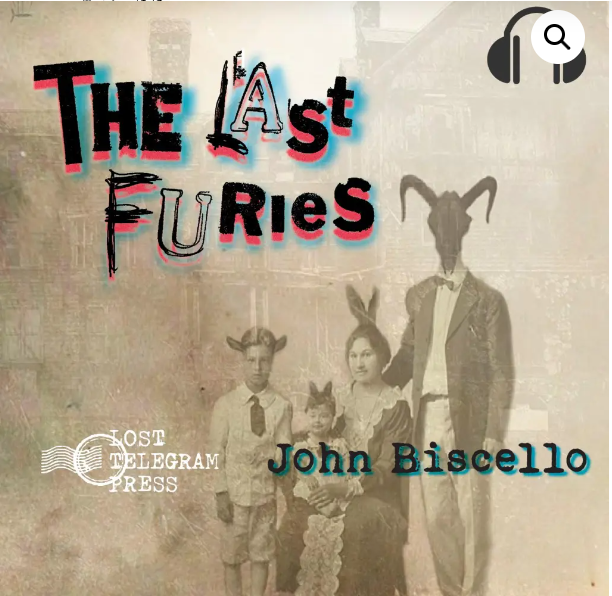
John Biscello’s 5th novel, The Last Furies, is a redolent, speculative box of matches; evoking his characters mosaiced spiritual reckonings; disjointed love triangles and haunted house of mirrors; in a taut avant-garde and hybrid-writing-form which boldly experiments with poetry and prose that is both lyric narrative and dreamscape, not unlike Elizabeth Smart’s surrealist prose poem novel By Grand Central Station I Sat Down and Wept.
With a background in screen-writing, these influences are Biscello’s nod to cinema and emphasis on art and visual components, often eschewing traditional formatting, in keeping with surrealist writer Mikhail Bulgakov’s style, to explore emotion and spiritual quests, without typical rule-book. The publishers, Lost Telegram Press, have created an artbook with interior postcard, to complement this fragmentary style, where cinematic-scene-play, sits with a lush dream-style, reminiscent of French New Wave in its refusal to explain itself. A screen-play within a novel, permitting entry from our own ubiquitous world, to this discomfiting navarre.
Biscello utilizes elaborate world-building images; icons, tarot and psychological-affliction, to represent erasure by the passing and haunting of nonsequential time. His philosophical introspection engages readers to question abstractions of identity, with narratives taking inner journeys. Those phantasmagoric elements are not simply beguiling to consume, but serve as totems to explore more multiplex themes concerning society. A blurring of reality into dream state, permits Biscello to draw on less prosaic narratives and convention, to explore camouflaged-themes of reality and perception, not unlike Aldous Huxley’s eponymous book. This results in an unsettling atmosphere exemplifying humanities primal fear of chaos and instability, where we mislay our ability to comprehend truth; seeing instead, the fragility of reality through surrealism.
Viola felt as if she were watching a scene from a film that had never been made, in a time and a place that had never existed.
Surrealism in film attempted the same; film-makers endeavored to tap into the unconscious mind, harnessing the seeming illogic of dream state, to reject norms of rationalism and conventional storytelling. Biscello employs kindred jarring, symbolic imagery; borrowing film-techniques of non-linear editing in how he writes, to disorientate and provoke deeper consideration. His writing mirrors surrealists attempts to revolutionize cinema from passive diversion, into a tool exploring hidden desires, fears, and different layers of reality, beyond usual consciousness, much as writer/artist Leonora Carrington did. Biscello invites us to suspend time and merge histories, with less scene-breaks and; “intimately swapped semblances of reality.”
The Furies is part memory and nostalgia, part journey toward grasping identity and a powerful social commentary on the absurdity of the crushing weight of tradition, in a similar vein to Jorge Luis Borges and Gabriel García Márquez. “Why so much fear of masks? Because the tears we cry burns acid through em which devours our skin.” All writers consider ‘the unreliable selfhood’ whereby phantasmagoric storytelling skews perceptions of reality, based on mis-en-scene’s instability. These fantastical disparate elements and gathering of icons, mirror a deeper psychological break; considering trauma and madness as part in any stories tapestry.
Biscello’s startling evocation of spectral vaudeville alongside theater, draws these influences to break free of the mortal actors’ stage, weighing his character’s inner-lives beyond performance. Questions of where we go when we exceed our fictional-lives, can be applied to the reader as much as fictional-character, because as a universal question, in an increasing artificial reality, we’re already experiencing this disassociation. With a mystical radio that can defy time and space, through main protagonists, Viola, Evie and Arturo; an actress, playwright, and poet, Biscello engages phantasmagorical means to transcend history and ask germane questions. Considerations of whether technology is dreamed into existence, or means of entering a private esthetic, creating an immersive atmospheric dreamworld and interfacing like radio-waves do? What was once disparate, permits us to see differently; against an allegorical shamanistic universe, seeking the unknown, in a collectivized unconsciousness.
Biscello possesses no literary canon or convention; his surrealist annotations stir in evocative desertscapes, whose inhabitants exist as characters from Tarot, poetry, Joan-of-Arc inspired suicide cults, mystics and artistic-outsiders. Carl Theodore Dreyer’s 1928 silent film The Passion of Joan of Arc, is one of the fundamental components in The Furies; intersecting narrative, whereby Artaud, claimed his ouvre; “was intended to reveal Joan as the victim of one of the most terrible of all perversions: the perversion of a divine principle in its passage through the minds of men, whether they be Church, Government, or what you will.” These metamorphic tours through the mutable wilds of persona, are backdrops for profound undertone, alongside an erudite exploration of unreality, mirroring the character’s inner-world. The novel’s atmosphere itself, becomes a character, with its own influence.
Phantasmagorical novels operate on the impossible and illogical, rarely explaining anomalous events within their narrative. Releasing the need for a clear set of rules for their magical system; magical realism can feature fantastical events, in the real-world, utilizing ghosts and prophecy in a philosophical, puzzle-like introspection They explore vertiginous intellectual conceits, not least; parallel realities, which permit the fantastical to be plausible. The bizarre metamorphosis of protagonists, slipping into a phantasmagorical realm, allow obscure magical elements like a radio, to be key tools in exploring more psychological themes of isolation and belonging.
Biscello’s reality is a threshold hallucination, considering individual perceived reality, against a shared universe outside the laws of time, ultimately begging us to imagine, what would we find? Both in ourselves and without.
Phaedra, Phaedra, was it all a dream?
I’m now sealed in and withering
Having lost the golden key.
Candice Louisa Daquin is the author of several poetry collections, and her debut novel, The Cruelty, will be released on November 25th, 2025 (FlowerSong Press).
It is rough around the edges but that will eventually work out- the water will make everything smooth and flat and standard like an envelope.
I will let you in on something: when I was a boy my parents were octopuses. Do not task me
with explanations. I just knew. Okay. It was a certitude.
When I went to sleep my father had to lie in bed with me. I had recurring nightmares. Each night the room was filled with ghosts who wore red fezzes. I know it has Freudian overtones, but who knew then. Not even my father, who was a human. I think my mother sometimes kept him company, which settled nothing.
Anyway, I grew up, you might say. And I am acceptable, at least on the surface and that takes up most everything.
Where I Live
I am not Chinese. But I am married to a Chinese woman. And I have observed over years that if a Chinese person comes upon a patch of earth, they will fetch a pail and shovel, bring some seeds and plant a garden. It is all those years of agrarian living.
In my building there is an OC who had allergies. Instead of going to a doctor, he chopped down all the trees and bushes and every living green thing outside his window and then sat back pleasurably.
Mao Zedong took care of the sparrows in China. It was called The Great Leap Forward. Sparrows ate grain so the Chinese destroyed their nests and killed them off by noise and terror and exhaustion. Of course, sparrows ate locusts and when the sparrows were gone the locusts consumed all the crops. This was The Great Chinese Famine.
I am very partial to sparrows. When I approach and they hop off I find it very gratifying. In Montparnasse on the steps of Sacre Coeur Basilica I once fed sparrows from my hand and it was secretive.
Talking To The Tree
Looking up at the tree its heart hanging there aimlessly still I could see its filigree leaves and catkins
planning something: perhaps to pay a debt or fill an old order. There was an idea doubtless germinating in that bound body. I stopped my aimless wandering, my body stiff with age, my hands in my pockets, empty but for small change. What would I say to the tree? If we were in the same world it was only because of our bodies. The mind of the tree and its body were close together. My mind had flown from my body, a bluejay screeching in the uppermost branches.
We are the immortal goodbyes the gods said to each other
Aeons ago at the gloaming hours of broken covenants
Every word is now a forging of newfound courage, or hope
Behind gray clouds that quiver on the breast of crestfallen dew
Do not bind us now to the oaths of our failed bloodlines
We may fail yet again with tired maxims, axioms hiding
In the palimpsest of hardworking mediocre metaphors
—————–
At a bullet train station in Fujian
Ten years ago around this time of year
The weather was biting like a lover gone bitter
The fellow Chinese teacher said something about winter wind in China
Which can typically lick human faces off with frost bite
That there’s no way to know pain from shame
Because the cold is an anaesthesia
So we could be walking around like zombies
With nice-smelling coiffed hair
Empty eye sockets staring back at people
I didn’t know if he was only trying to shock or humor
A newcomer with excess baggage to boot.
When the train arrived, the wind howled harder
Stepping inside I caught myself in the glass door
Not a zombie yet, whatsoever, thank God
Just a Bukowskian traveler with frozen lake eyes
Emeniano Acain Somoza, Jr., is a native of Siquijor Island in Central Visayas, Philippines. He was last based in Fujian, China as a second-language teacher after over a decade stint as a Corporate Communications Officer in the Middle East. Some forthcoming online and in print, most of his poems and stories have been published by literary magazines and journals, including The Philippines Graphic, The Philippine Free Press, The Philippine Star, and the Philippine Studies: Historical and Ethnographic Viewpoints Vol. 53 , among others. He has published three poetry books since 2010. and currently Editor-At-Large for The Syzygy Poetry Journal.