Eshmatova Charos is one of the most inquisitive students, deeply studying linguistic theory, and a holder of international certificates. She was born on August 18, 2007 in Uzbekistan. She is studying at Denau Institute of Entrepreneurship and Pedagogy Fields of activity: in depth of study the Uzbek language, gaining detailed knowledge of Turkish languages, and Early Achievements and Educational Path. She has obtained a national certificate in Uzbek language and literature (B level) and holds several international certificates. She graduated from secondary school with excellent grades and achieved notable positions in several academic subject Olympics.
But, there are some who do not believe in Beleever
And some are waiting, hoping it will fail forever
From a company in Japan,
From Shisiyado Siyako’s hand.
From Marjon Calcium’s harmony,
It opens the door to healthy destiny.
Beleever, Beleever, oh Beleever,
We truly love you forever.
Beleever, Beleever, oh Beleever,
With you our lives are healthier.
Some have already been cured,
Some have risen, their strength secured.
Many found joy and a brand-new start,
Some are eager to drink with heart.
Some cannot reach the product’s way,
But those who drink are healed each day.
Some expected death in despair,
But found new life and fresh air.
Some passed with honor, that is true,
But many still love Beleever too.
Beleever, Beleever, oh Beleever,
We truly love you forever.
Beleever, Beleever, oh Beleever,
With you our lives are healthier.
Dilafro‘z Sultanova, daughter of Azimboy, was born in 1996 in the To‘rtko‘l district of the Republic of Karakalpakstan. She stepped into the world of literature in 2025 and has since emerged as a prolific and dedicated creative writer. To date, she is the author of thousands of literary works and the holder of several international certificates.
Her creative portfolio is diverse, encompassing quotes, monologues, life-based stories, poems, and traditional ghazals. Through her writing, she reflects deep emotional insight and a strong connection to real-life experiences. Several of her poems are currently being adapted into songs, marking a new stage in her artistic journey and highlighting the growing recognition of her work.
The Last Your heart tiptoed down the hall out the door across the street as far as the other side of town until the rubber band snapped and took the rest of you leaving a chasm in mine.
I filled it with words first as entreaties cried out ever so calmly then etched onto endless pages until the torrent ebbed and shifted form.
One day I realized I had written a poem that wasn’t about us.
So this is my final for you. One word broken in two.
Good bye.
Periodic Table of Emotions
There’s a science to this chemistry of avoiding combining catalytic connections between the heart and the head. Like all good experiments, something has to blow up, spill over, or make me choke to figure out what doesn’t work. Unfortunately, while actual scientists record the results to know what to avoid, as an artist, I tend to use a less clinical approach; the process has always been what interests me most. Even with the dances I choreograph, once they are done, it’s being in rehearsal I remember, not the finished work.
So in the lab of my life, I need to go back and redo again, and again, not remembering that it isn’t the amount of each element, but the fact that they don’t work together at all. Reminding me once again that this combination still produces a destabilizing outcome.
Longing and anticipation, anxiety and memory, anger and regret, self-medication and sorrow, these opposing components do not play nicely together in any setting, controlled or otherwise.
With compounding and identifying which interactions work well together, the balancing act is more nuanced, but I have found that these groupings are always from the same side of the spectrum. Calm and compassion, forgiveness and gratitude, awareness and curiosity, these always interplay quite nicely. Mixed with the right physical response, they can produce an alchemical conversion into a state of being that is calm, settled, almost at peace. With more subtle adjustments: a little more breathing, a little less fear, the sweet spot of spiritual sanity is attained. Not in the past or future but finally, gloriously, successfully in the present.
Exhale.
Now, where did I leave that glass of wine?
– Janaea Rose Lyn
5
4
I love this rhythm. Generally subdivided as 123, 12, or 12, 123, it’s my favorite to choreograph and drum. Dum dum dum, Tek tek. Dum dum, Tek tek tek. Or to jumpstart the clutch of my heart when it’s faltering. Boom boom boom, Bap bap. Boom boom, Bap bap bap.
Five is the number of wounded themes I have identified, where the best and worst of my impulses reside. It is the count of the primary pillars that inform my life. And let’s not forget the senses. Each has a primary pattern that is daily re-interpreted with subdivisions, changing accents, and syncopation, as I phrase the structured improvisation that is my life:
Belonging attention care, Trust guidance
Love service, Art beauty abundance
Sight sound smell, Taste touch
The first are my recent areas of intense scrutiny. What I didn’t get, what I long for, what I gave to a fault, what informed my behaviors, and where I attached the conviction that no longer serves me. Protective armor has its place, for a time. Defenseless, I have no choice but to give these to myself. The necessary cliché of healing my inner child so the adult me is integrated, interacting with intention and no longer in reaction. The work at hand.
Following are what nourish me, and each other. Soul food.
The last are trickier. Blinders finally off, the view is expansive, but the glare of seeing what is actually in front of me often requires a hat, something I never wore before. The volume of the voices in my head is louder, too. I lost my olfactory sense for a time, which has always been dominant for me, so it was disorienting to say the least. The day of the shock, it came back full force. It turns out I also needed some pharmaceutical assistance, so it’s now safely restored to the pantheon of pleasures. The final two can leave me aching, so I try not to focus on them as much since you’ve gone. I can enjoy eating and drinking again, but that’s not the flavor I miss. When we do see each other, I look forward to our parting hug, brief kiss of care, and the sensation of your scent landing lightly on my skin.
– Janaea Rose Lyn
Room to Move
Gravity, physics, and physical abilities notwithstanding, the primary partner in my dancing life was space. Moving in and through it, changing levels and planes, staying in place or inverting perspective, all of this expanded my expressiveness. Space is tangible. It has weight and viscosity. It’s more obvious when it duets with water or temperature and can be felt as humidity or an icy chill, but it shimmers all the time. Pay attention, and you’ll see.
Now I am navigating a whole other relationship to spaciousness, interiority. My head and heart growing to make room for a different kind of locomotion. I have always worked on my inner self, but as with training my outer self, neither produced outcomes as quickly as hoped. With time, the results were evident in both areas. I have many decades of practice under my belt.
Unencumbered by the grueling demands of the life I once lived, I find I am working harder than I ever have. My daily spiritual practice takes as long as a New York City technique class once did. Once completed, I am not sweating on the outside but equally as exhilarated within. Filled with insights, understanding, and shifting perceptions, I may look the same to others, but invisibly, I am more gracious and accepting. I am less encumbered by my psychology, and am learning how to get, and stay, out of my old ways. I no longer get as easily ensnared in the drama of others.
I have blood memory and bone density, even if my flesh is a little more wrinkled. I often get compliments on my long, salt and pepper mermaid hair. You have to earn that, and I can live underwater now. I can breathe in both worlds. The vastness of emptiness is not terrifying anymore because I have found that when I fall, I can also grow wings. I have met divine mentors and apprenticed myself. I was always a serious student, though to my chagrin, not always a quick learner.
Like the air that surrounded me onstage, unseen by the audience but charged nonetheless, I am a lone but no longer alone.
I’m in good company.
– Janaea Rose Lyn
See Through
Where stone and pillar held firm and formidable, diagonal canyons of air and light form transient shadow and shape.
Strange how echoes become visible when belonging to either side.
Confessions and fervent prayers drift past in full view, no longer needing to seep through cracks to escape.
Bored eyerolls and questionable gestures intended for childhood crushes across a pew look lost, eternally seeking a response no longer forthcoming.
The curious daughter of the tree out back
climbed as the perfect perch
to hold hands, steal a kiss,
has entered as a congregant of trunk and branch.
Deeply exquisite is this state of exposure.
Nothing ruined, only revealed.
Centuries of lives that cobbled these stones with their stories, only to find their place with one. At their head.
Sun replacing stained glass becomes the window witness.
Annotasiya: Ushbu ilmiy maqolda oʻzbek tili geografik hududlar onomastikasi Boysun tumanidagi ayrim hududlarining nomlari misolida oʻrganiladi. Mavzu dolzarb boʻlib, oʻzbek tili onomastikasining rivojlanishada toponimika, oronimika, mikronomikaning farqlari va ahamiyati yoritiladi. Maqolaning maqsadi — oʻzbek tili toponimik onomastikasini kengaytirish hamda bir nechta hududlarning nomini ommaga keng mulohaza orqali yoritib berish. Tadqiqotda tahlil va solishtirma metodlaridan foydalanilgan. Natijalar shuni ko’rsatadiki, onomastikada shu vaqtgacha oʻrganilgan joy nomlari bilan birgalikda fan uchun yangi boʻlgan hudud nomlari ham keng jamoatchilikda oʻrganilmoqda.
Kalit soʻzlar: Onomastika, Boysun tumaning kichik hududlari toponimi, toponimika, oronimika, mikronimika.
Annotation: This scientific article examines the onomastics of geographical areas in the Uzbek language through the example of the names of certain territories in the Boysun district. The topic is relevant, and the differences and significance of toponymy, oronymy, and microtoponymy in the development of Uzbek onomastics are highlighted. The purpose of the article is to expand Uzbek toponymic onomastics and to present the names of several regions to the public through broad discussion. Analytical and comparative methods were used in the research. The results show that, along with place names previously studied in onomastics, new territorial names that are novel for the field are also being actively explored by the wider public.
Keywords: Onomastics, toponyms of small territories of the Boysun district, toponymy, oronymy, microtoponymy.
Аннотация: В данной научной статье ономастика географических территорий узбекского языка рассматривается на примере названий отдельных местностей Бойсунского района. Тема является актуальной, в статье освещаются различия и значение топонимики, оронимики и микротопонимики в развитии узбекской ономастики. Целью статьи является расширение топонимической ономастики узбекского языка, а также всестороннее представление названий нескольких территорий широкой общественности. В исследовании использованы аналитический и сравнительный методы. Результаты показывают, что наряду с ранее изученными в ономастике названиями местностей, активно исследуются и новые для науки территориальные названия.
Ключевые слова: Ономастика, топонимы малых территорий Бойсунского района, топонимика, оронимика, микротопонимика.
Introduction
Everything surrounding us in the environment—objects, events, and phenomena—has its own name according to its function, characteristics, movement, and state. Through naming, humanity preserves countless pieces of information in its collective memory. The field of linguistics that deals with the naming of objects and phenomena is known as onomastics. The term onomastics (from Greek onoma — name) is an independent branch of linguistics that studies proper names.
Proper names include personal names, place names, names of rivers, lakes, mountains, deserts and other natural objects, celestial bodies (stars, planets, galaxies), various socio-cultural objects (schools, enterprises, street names), as well as names given to animals. Onomastics embodies valuable information about humanity’s historical memory, national and cultural values, and linguistic thinking.
Within onomastics, several subfields are distinguished:
Toponymy — the study of geographical names (cities, villages, streets);
Oronymy — the study of names of mountains, mountain ranges, and hills;
Micronymy — the study of names of small geographical objects (wells, canals, small hills).
The Origin of Selected Place Names
The toponym “Boysun” is derived from the ancient Turkic words boy and sin, meaning “great mountain” or “large mountain”. In ancient Turkic beliefs, alongside the worship of various natural objects, mountains were also venerated, and Boysun was considered one of such sacred mountains. According to local legends, wealthy representatives of ancient Turkic tribes lived in this area, and the term “Biysin” was interpreted as “the village of the rich”. Among the local population, this latter explanation is considered more acceptable.
Besherkak is a village located in the Boysun district of Surkhandarya region. The toponym originates from the names of five individuals who once lived in this area. According to the conclusions drawn by Sadriddin Ayni in his work “Tuhfai Khaniy”, written based on eyewitness accounts by Qazi Muhammad Vafo (Shuhrat) of Karmana by order of the Bukhara ruler Rahimkhan, Rahimkhan undertook his second campaign to Kohistan in 1170 AH (1756/1757 AD). Near the Kohistan fortress (present-day Kallamozor), clashes occurred between the Hisar people and other free inhabitants of Kohistan.
In this battle, Rahimkhan emerged victorious, executed the captured men, constructed a tower of skulls, and distributed women among his soldiers. When the population around the fortress was massacred, five shepherds who were grazing livestock survived. As a result, the pasture was later named Besherkak, reflecting the number of surviving shepherds.
Approximately nine kilometers from Besherkak village lies Uzunquduq village. This name is associated with the formerly nomadic population of the area. Due to the absence of surface water, residents dug wells to access water; however, because the water level was deep, the wells had to be dug very deep. As a result, the place was named Uzunquduq (“long well”), although semantically the term chuqurquduq (“deep well”) would have been more accurate, since uzun refers to horizontal length, whereas chuqur refers to vertical depth.
The area also contains several oronyms such as Qirqtaram, Qiziljar, Xolmurod Hoji O‘ri, and Galaqo‘ton. The name Qirqtaram is believed to have originated from the appearance of consecutively aligned hills resembling strands of hair. Qiziljar is associated with the soil type of the area, which is fine-textured and red in color.
In Uzbek, the word o‘r has two meanings: (1) ravine or depression, and (2) elevation or hill. In Xolmurod Hoji O‘ri, the word o‘r is used in the sense of elevation, referring to a hill where the house of a person named Xolmurod Hoji was located. The name emerged from local expressions indicating proximity to his house.
The name Galaqo‘ton is linked to livestock breeding. Qo‘ton refers to an enclosure or structure used to pen sheep herds, while gala denotes a gathering or large group. Thus, Galaqo‘ton signifies a place where many herds were gathered. Micronyms in the area include Kelitosh, Ko‘rquduq, Qaloqlisoy, and Qamishlov.
Research Methodology
This study was conducted using an anonymous online survey with the aim of expanding research in Uzbek onomastics, introducing new data, and examining the accessibility of this information for the general public. More than seventy-five participants residing in the studied areas took part in the survey. No age restrictions were imposed, and personal data were not disclosed to ensure participant safety.
Review of the Literature
Toponyms constitute a significant part of the linguistic layer of a language. Professor E. Begmatov notes that nearly 50,000 toponyms from the regions of Kashkadarya, Surkhandarya, Khorezm, and Fergana have been identified and collected by Uzbek linguists. In the article “Oronyms Formed from Mongolian Lexical Units” by O. Begimov and Z. Aminova, it is stated that Southern Uzbek oronyms contain words and affixes characteristic of the Altaic period shared by Turkic and Mongolian languages. In later stages of the Uzbek language’s development, these elements underwent various phonetic, semantic, and grammatical changes, giving rise to new names through Uzbek-specific morphemes.
Additionally, S. Qorayev’s book “The Meaning of Geographical Names” provides explanations of key concepts related to place names in the sections “An Introduction to Toponymy” and “Terminology of Toponymy”. Such studies demonstrate that toponymy has been extensively researched.
Research Results
The results of the survey indicate that the majority of participants were young people (53%). Their knowledge of the etymology of local toponyms, oronyms, and micronyms, as well as their understanding of lexical-semantic and phonetic features of these names, was assessed. The findings confirm that the naming of geographical objects is closely connected with the natural-geographical conditions, functional characteristics, and worldview of the local population.
Discussion
During the research process, it was revealed that some place names are semantically inconsistent. Therefore, the issue of assigning new, more appropriate names was also considered. Scientific works in onomastics—including monographs, dissertations, and articles—were analyzed to identify their strengths and weaknesses, and recommendations were made for incorporating additional data.
Conclusion
The geographical names (toponyms) of Boysun district are closely linked to the region’s natural and geographical conditions, historical development, ethnic composition, and the worldview shaped by the local population over centuries. Place names in the area have emerged based on mountain relief, water sources, flora and fauna, historical figures, tribal names, and legends.
The study demonstrates that alongside toponymy, oronymy and micronymy are also actively used in Boysun district, and their significant role in the development of Uzbek onomastics has been substantiated. These names serve as important sources for preserving national and cultural heritage, traditional lifestyles, and historical memory. Therefore, the study of geographical names in Boysun district is of great importance not only for linguistics, but also for history, ethnography, and geography. The results of this research are considered to have significant scientific and practical value in enriching Uzbek onomastics and transmitting place-name heritage to future generations.
References
1. Турсунов С. Сурхондарё вилояти топонимлари. – Тошкент: Алишер Навоий номидаги Ўзбекистон Миллий кутубхонаси нашриёти, 2008. – Б. 33.
2. https://uz.wikipedia.org/wiki/Boysun 3. Ayniy Sadriddin. Asarlar, 4-jild, Toshkent, 1965 yil,
4. Umarov I. va boshqalar. Surxon vohasida…, 2014 5. Tursunov S. “Surxondaryo viloyati toponimlari”. T. 2008-y 6. S.N.Tursunov, Q.Rashidov. “Boysun”. Boysun. 2011-y.
7. Бегматов Э. Жой номлари – маьнавият кўзгyси. – Тошкент: Маьнавият, 1998. – Б. 66.
8. Бегимов О.Т. Аминова З.П. Оронимы, образованные из монгольских словарных эдиниц // Молодой учёный. Я международный научный журнал. №.11(115)/2016/. – C. 1660.
9. Qoraеv S. Ko‘rsatilgan asar. –B. 6-23; 190-197.
Blended Learning vs Traditional Learning: Which is more effective for ESL Students?
Qobiljonova Hurixon2nd year student of English philology faculty Uzbekistan State University of World Languages
Scientific adviser: R. Murodova, Teacher of English philology faculty, Uzbekistan State University of World Languages
Abstract: This article investigates the effectiveness of blended learning compared to traditional learning methods for English as a Second Language (ESL) students. Blended learning combines online digital resources with face-to-face instruction, potentially offering a more engaging and personalized educational experience. In contrast, traditional learning focuses on direct classroom interaction and structured teaching methods. By reviewing existing literature and analyzing case studies, the study explores key aspects such as language acquisition, student engagement, and overall educational outcomes. The findings suggest that while both approaches have their advantages, blended learning often provides greater flexibility and adaptability to individual learning needs, making it a more effective option for ESL education. This article aims to guide educators and policymakers in understanding the implications of these findings for curriculum design and teaching strategies in ESL settings.
Keywords: Blended Learning, traditional learning, ESL (English as a second language), language acquisition, student engagement, educational outcomes, teaching strategies
Смешанное обучение против традиционного обучения: что более эффективно для студентов, изучающих английский как второй язык?
Кабилжанова Хурихон2 курса факультета английской филологии Узбекского государственного университета мировых языков.
Научный руководитель: Р.Муродова, преподаватель факультета английской
филологии Узбекского государственного университета
Аннотация: В этой статье исследуется эффективность смешанного обучения по сравнению с традиционными методами обучения для студентов, изучающих английский как второй язык (ESL). Смешанное обучение сочетает онлайн-ресурсы с лицом к лицу, что может предложить более увлекательный и персонализированный образовательный опыт. В отличие от этого, традиционное обучение акцентирует внимание на непосредственном взаимодействии в классе и структурированных методах преподавания. Путем обзора существующей литературы и анализа кейс-стадий исследование изучает ключевые аспекты, такие как овладение языком, вовлеченность студентов и общие образовательные результаты. Результаты показывают, что, хотя у обоих подходов есть свои преимущества, смешанное обучение часто обеспечивает большую гибкость и адаптивность к индивидуальным потребностям обучения, что делает его более эффективным вариантом для ESL-образования. Эта статья нацелена на то, чтобы помочь педагогам и политикам понять последствия этих результатов для разработки учебных планов и стратегий преподавания в контексте ESL.
Ключевые слова: Смешанное обучение, традиционное обучение, ESL (английский как второй язык), овладение языком, вовлеченность студентов, образовательные результаты, стратегии преподавания
Aralash o‘qitish va an’anaviy o‘qitish: ESL talabalari uchun qaysi biri samaraliroq?
Qobiljonova Hurixon: Ingliz filologiyasi fakultetining 2- kurs talabasi,
O’zbekiston Davlat Jahon Tillari Universiteti.
Ilmiy rahbari: R.Murodova, Ingliz filologiyasi fakulteti o’qituvchisi,
O’zbekiston Davlat Jahon Tilleri Universiteti.
Annotatsiya: Ushbu maqola ingliz tilini ikkinchi til sifatida o‘qitish (ESL) talabalar uchun aralash o‘qitish va an’anaviy o‘qitish usullari samaradorligini o‘rganadi. Aralash o‘qitish onlayn raqamli resurslarni to‘g‘ridan-to‘g‘ri dars o‘tish bilan birlashtiradi, bu esa yanada qiziqarli va shaxsiylashtirilgan ta’lim tajribasini taqdim etadi. An’anaviy o‘qitish esa dars davomida to‘g‘ridan-to‘g‘ri muloqot va tizimli o‘qitish usullariga e’tibor qaratadi. Mavjud adabiyotlarni ko‘rib chiqish va tadqiqotlardan olingan ma’lumotlarni tahlil qilish orqali ushbu tadqiqot til egallash, talabani jalb etish va umumiy ta’lim natijalari kabi asosiy jihatlarni o‘rganadi. Topilmalar shuni ko‘rsatadiki, har ikki usulning o‘z afzalliklari bo‘lsa-da, aralash o‘qitish moslashuvchanlik va mustaqil o’rganishdagi qulayliklarni taqdim etadi va bu uni Ingliz tilini ikkinchi til sifatida o’rganish uchun samaraliroq variantga aylantiradi.
Kalit so`zlar: Aralash o‘qitish, an’anaviy o‘qitish, ESL (ingliz tilini ikkinchi til sifatida o‘qitish), til egallash, talaba jalb etish, ta’lim natijalari, o‘qitish strategiyalari.
Introduction. In the rapidly evolving landscape of education, the effectiveness of teaching methodologies is a critical area of research, particularly for English as a Second Language (ESL) students. Traditional learning, characterized by face-to-face instruction and structured classroom environments, has long been the standard approach in language education. However, the advent of digital technology has paved the way for blended learning, which combines online resources with in-person teaching. This hybrid model aims to enhance student engagement and provide a more personalized learning experience. Blended learning offers unique advantages, such as flexibility in learning pace and accessibility to diverse educational materials, which can be particularly beneficial for ESL students who often face varying levels of language proficiency. Conversely, traditional learning emphasizes direct interaction between students and instructors, fostering a sense of community and immediate feedback that can be essential for language acquisition.
This article seeks to explore the comparative effectiveness of blended learning and traditional learning for ESL students. By examining existing research and analyzing key factors such as language acquisition, student engagement, and educational outcomes, we aim to provide insights that can inform educators and policymakers. Ultimately, understanding which method proves more effective can lead to improved teaching strategies and enhanced learning experiences for ESL learners.
What is Traditional Learning?
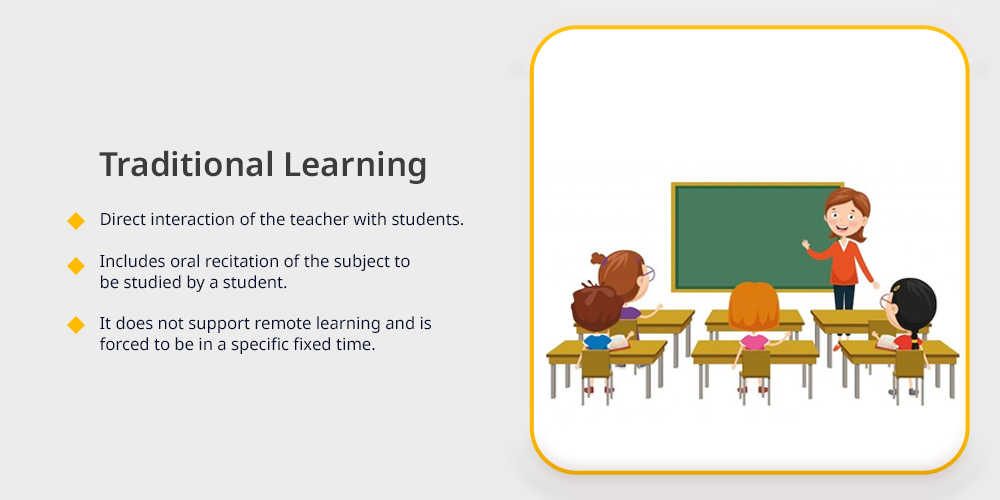
Traditional learning involves the direct interaction of the teacher with students. It includes oral recitation of the subject to be studied by a student while the other students sit there quietly and listen. This tactic is still used widely in schools and is also known as conventional education. Traditional learning does not support remote learning and is forced to be in a specific fixed time. It elaborates learning and opting for new skills while sharing space with different students with different interests and passions.
Traditional learning in ESL education offers several benefits that can significantly enhance language acquisition. One of the primary advantages is the direct interaction between students and instructors. This face-to-face communication fosters an environment where learners can engage in real-time discussions, ask questions, and receive immediate feedback. Such interaction is crucial for developing speaking and listening skills, as students can practice pronunciation and conversational techniques with their peers and teachers.
Another benefit of traditional learning is the structured classroom environment. This setting provides a routine and discipline that can help ESL students focus on their studies. The physical presence of a teacher can motivate students to participate actively and commit to their learning. Furthermore, traditional classrooms often foster a sense of community, allowing students to build relationships with their peers, which can enhance their language skills through collaborative learning.
In terms of teaching strategies, traditional learning can incorporate various methods to cater to different learning styles. For instance, teachers can use group activities, role-playing, and interactive discussions to engage students and encourage participation. Additionally, the use of visual aids, such as charts and flashcards, can help reinforce vocabulary and grammar concepts.
Assessment in traditional settings also allows for comprehensive evaluation of student progress. Instructors can conduct regular quizzes, oral presentations, and group projects to gauge understanding and provide personalized feedback. This direct assessment can lead to more tailored instructional approaches, addressing the specific needs of each student.
Overall, traditional learning in ESL education emphasizes interaction, structure, and personalized feedback, making it a valuable approach for language acquisition. By employing diverse teaching strategies and fostering a sense of community, educators can create an effective learning environment that supports ESL students in their journey to language proficiency.
Effectiveness of Blended Learning for ESL students
The rapid development of technology has transformed the field of education, providing new opportunities to improve teaching and learning processes. Blended learning, which integrates online and offline instructional methods, has gained prominence in ESL education. This approach allows learners to develop language skills in a more flexible, interactive, and personalized environment. The purpose of this paper is to analyze the impact of blended learning in ESL instruction and suggest best practices for its implementation.
Different Models of Blended Learning
Blended learning is not a one-size-fits-all approach; it encompasses various models that can be adapted to different educational contexts. Key models include:
The Flipped Classroom: In this model, traditional learning structures are inverted. Students engage with new content online at home, typically through video lectures or readings, and use classroom time for interactive activities, discussions, and applied learning exercises (Horn & Staker, 2015).
Rotation Model: This approach involves students rotating through different learning stations or activities, including online learning stations, traditional classroom activities, and group work. The rotation can be fixed (pre-scheduled) or flexible (adjusted based on students’ needs) (Bonk & Graham, 2012).
Flex Model: Predominantly online, the flex model provides students with a personalized pathway through a curriculum. While most content delivery and practice happen online, teachers offer on-site support and tutoring as needed (Garrison & Vaughan, 2008).
A La Carte Model: Students take one or more courses entirely online while continuing to attend traditional classes. This model allows for greater flexibility and customization of the learning experience (Horn & Staker, 2015).
Enriched Virtual Model: Combining elements of the fully online and traditional classroom environments, this model offers students the option to complete coursework online while attending occasional in-person sessions for hands-on activities and face-to-face interactions (Graham, 2013).
Benefits of Blended Learning in ESL
1. Increased Engagement and Motivation: Interactive digital tools, such as language learning apps, multimedia content, and gamification, enhance student motivation and participation.
2. Personalized Learning Experience: Blended learning allows students to learn at their own pace, revisiting online materials and practicing language skills as needed.
3. Flexibility and Accessibility: Online resources make learning accessible anytime and anywhere, accommodating different learning styles and schedules.
4. Immediate Feedback and Assessment: Digital platforms provide instant feedback, enabling learners to monitor their progress and identify areas for improvement.
5. Collaborative Learning: Virtual discussion forums, video conferencing, and group projects foster communication skills and peer interaction.
Challenges of Blended Learning in ESL Despite its advantages, blended learning presents certain challenges:
•Technological Barriers: Limited access to technology or internet connectivity may hinder some students from fully participating.
•Teacher Training and Adaptation: Educators need professional development to effectively integrate digital tools into their teaching methodologies.
•Student Self-Discipline: Online learning requires students to be self-motivated and disciplined, which can be challenging for some learners.
•Quality of Online Content: Ensuring that digital materials are pedagogically sound and aligned with learning objectives is essential for effective blended learning.
Effective Strategies for Implementing Blended Learning in ESL
1. Selecting Appropriate Digital Tools: Educators should choose interactive platforms, such as Duolingo, Kahoot, or Google Classroom, to support language learning.
2. Balancing Online and Offline Activities: A well-structured curriculum should integrate classroom instruction with digital assignments and activities.
3. Providing Guidance and Support: Teachers should offer clear instructions, monitor progress, and provide personalized feedback to help students succeed.
4. Encouraging Student Interaction: Online discussion forums, collaborative tasks, and virtual speaking exercises can enhance communication skills.
5. Continuous Assessment and Improvement: Regularly evaluating the effectiveness of blended learning strategies and making necessary adjustments is crucial for success.
The future of blended learning in ESL education looks promising, with emerging technologies and methodologies paving the way for more personalized, interactive, and effective learning experiences. These advancements will not only enhance the quality of language education but also make it more inclusive and accessible for learners worldwide.
Conclusion
In summary, blended learning represents a powerful approach to EFL/ESL education, combining the strengths of traditional classroom instruction with the flexibility and interactivity of digital tools. By enhancing student engagement, providing personalized learning experiences, and offering greater flexibility and accessibility, blended learning has shown its potential to significantly improve learning outcomes and retention rates. Various models, such as the flipped classroom, rotation model, and enriched virtual model, demonstrate the versatility of blended learning in catering to different educational contexts and learner needs.
The benefits of blended learning are evident in successful case studies from institutions around the world, where programs have reported improved language proficiency, higher student satisfaction, and increased motivation. The integration of emerging technologies like AI, VR, and mobile learning further enhances the potential of blended learning to create more personalized, immersive, and effective educational experiences.
As we look to the future, it is clear that blended learning will continue to play a critical role in ESL education. Its ability to adapt to individual learners’ needs and integrate seamlessly with evolving technological advancements makes it a vital component of modern education.
Educators and institutions are encouraged to embrace and invest in blended learning strategies. By doing so, they can provide more engaging, flexible, and effective learning environments that cater to the diverse needs of their students. Professional development for teachers, equitable access to technology, and continuous support for both educators and students are essential to the successful implementation of blended learning. Together, these efforts can help unlock the full potential of blended learning, transforming language education and empowering learners to achieve their goals.
REFERENCES:
Bonk, C. J., & Graham, C. R. (2012). The Handbook of Blended Learning: Global Perspectives, Local Designs. Wiley.
Garrison, D. R., & Vaughan, N. D. (2008). Blended Learning in Higher Education: Framework, Principles, and Guidelines. Jossey-Bass. Thorne, K. (2003).
(Horn & Staker, 2015).
(Graham, 2013).
Blended Learning: How to Integrate Online and Traditional Learning. Kogan Page.
BLENDED LEARNING IN TEACHING ENGLISH AS A SECOND LANGUAGE https://doi.org/10.5281/zenodo.15001959
Qobiljonova Hurixon Jahongir qizi is a second-year undergraduate student of English Philology at Uzbekistan State World Languages University. Her academic interests include English language studies and linguistics. She has participated in international academic conferences and is a recipient of the Kelajak Bunyodkorlari commemorative badge.
Common Mistakes in Learning a Foreign Language and Effective Ways to Overcome Them
Sultonova Shahlo Baxtiyor qizi
UzSWLU, Student
Abstract
This article explores the most common mistakes learners make when studying a foreign language and analyzes their causes and consequences. Despite the growing importance of foreign language proficiency in education and professional life, many learners fail to achieve fluency due to ineffective learning strategies, lack of consistency, and psychological barriers. The article highlights key issues such as fear of making mistakes, overreliance on grammar, memorization without context, and unhealthy comparison with others. It also offers practical recommendations to overcome these challenges and emphasizes the importance of persistence, learner autonomy, and communicative practice. The findings of this article can be useful for students, teachers, and independent language learners seeking more effective approaches to language acquisition.
In the modern world, foreign language competence has become an essential skill rather than an optional advantage. Globalization, international education, migration, and digital communication have significantly increased the demand for multilingual individuals. English, in particular, plays a dominant role as a global language, while other languages such as Korean, Chinese, and German are also gaining importance in specific fields. Despite the availability of numerous learning resources, applications, and courses, many learners struggle to reach a satisfactory level of proficiency.
This paradox raises an important question: Why do so many people invest time and effort in learning a language but still fail to communicate fluently? The answer often lies not in intellectual ability, but in common learning mistakes and misconceptions. Understanding these mistakes is a crucial step toward improving language acquisition outcomes.
Fear of Making Mistakes
One of the most significant barriers in language learning is the fear of making mistakes. Many learners believe that errors indicate a lack of intelligence or competence. As a result, they avoid speaking until they feel completely confident, which may never happen. This perfectionist mindset prevents learners from practicing the language actively.
From a linguistic perspective, mistakes are a natural and necessary part of learning. Children acquire their first language through constant trial and error. Similarly, adult learners must accept errors as learning opportunities. Research shows that learners who actively use the language, despite making mistakes, progress faster than those who remain silent.
Overemphasis on Grammar
Grammar is often considered the foundation of language learning, and while it is important, excessive focus on grammatical rules can be counterproductive. Many learners can explain complex grammatical structures but struggle to form simple sentences in real-life situations.
Language is primarily a tool for communication. Without practical application, grammar knowledge remains passive. Learners should aim to balance grammar study with speaking, listening, and reading activities. Functional use of grammar in meaningful contexts leads to better retention and fluency.
Lack of Consistency and Discipline
Another common mistake is irregular study habits. Many learners study intensively for short periods and then abandon the language for weeks or months. This inconsistency disrupts memory retention and slows progress.
Language learning requires continuous exposure. Even short daily practice sessions can significantly improve comprehension and fluency. Consistency helps build habits, reinforces vocabulary, and strengthens neural connections associated with language processing.
Ineffective Learning Methods
Learners often follow popular or advertised learning methods without considering their personal learning styles. Some people are visual learners, others auditory or kinesthetic. Using an unsuitable method can lead to frustration and loss of motivation.
Effective language learning requires self-awareness. Identifying strengths and preferences allows learners to choose appropriate resources and strategies. Personalized learning increases engagement and efficiency.
Memorizing Vocabulary Without Context
Memorizing isolated vocabulary lists is another widespread mistake. Words learned without context are easily forgotten and difficult to use correctly. Language is not a collection of separate words but a system of patterns and meanings.
Learning vocabulary through sentences, dialogues, and real-life examples improves understanding and long-term memory. Contextual learning also helps learners grasp collocations, idiomatic expressions, and cultural nuances.
Negative Comparison and Loss of Motivation
Comparing oneself to other learners can negatively impact motivation. Some individuals learn languages faster due to prior exposure, learning environment, or personal circumstances. Constant comparison leads to self-doubt and discouragement.
Language learning is a personal journey. Progress should be measured against one’s own past performance rather than others’ achievements. Maintaining a positive mindset and celebrating small improvements are essential for long-term success.
In conclusion, many difficulties in language learning stem from common but avoidable mistakes. Fear of mistakes, excessive focus on grammar, lack of consistency, ineffective methods, context-free memorization, and negative comparison all hinder progress. By recognizing and addressing these issues, learners can adopt more effective strategies and develop confidence in using the language.
Language learning is a gradual process that requires patience, discipline, and resilience. With the right mindset and approach, achieving fluency becomes an attainable goal rather than a distant dream.
References:
1. Brown, H. D. (2007). Principles of Language Learning and Teaching (5th ed.). Pearson Education.
2. Ellis, R. (1997). Second Language Acquisition. Oxford University Press.
3. Harmer, J. (2001). How to Teach English. Longman.
4. Krashen, S. D. (1982). Principles and Practice in Second Language Acquisition. Pergamon Press.
5. Nation, I. S. P. (2001). Learning Vocabulary in Another Language. Cambridge University Press.
6. Richards, J. C., & Rodgers, T. S. (2014). Approaches and Methods in Language Teaching (3rd ed.). Cambridge University Press.
7. Lightbown, P. M., & Spada, N. (2013). How Languages Are Learned (4th ed.). Oxford University Press.
Shahlo Sultonova was born on August 3, 2005, in the Khorezm region of Uzbekistan. She is currently a second-year student at the Uzbekistan State World Languages University (UzSWLU).
As a university student, Shahlo is known for her responsibility, dedication, and strong interest in learning. She actively works on improving her academic knowledge and developing professional skills related to her field of study. Shahlo values self-development and strives to combine theoretical knowledge with practical experience.
Her main goal is to become a highly qualified specialist in the future and to contribute positively to the development of society through her profession.