The festival, one of the main events of the international art market, presents works of modern and contemporary art in over 280 leading galleries proven in the world.
The summer sun illuminates the beautiful landscapes of Switzerland.
While I was walking through these landscapes with pleasure, I was thinking about how long our journey to Basel would take us.
What passages, from beauty to beauty, from Lugano to Luzerno.
Indeed, it seems to me, as they say, a beautiful dream with open eyes.
How beautifully the hand of man has worked together with the generosity of nature and in this way, in this place, they have built a true paradise.
My thought goes far.
Being amazed by these beauties, which impress me and that with my words I cannot describe them properly.
And what an opportunity and art exists, for every person and every nation, if this valuable experience in the transformation of the environment which resembles heaven on earth, here in Switzerland. That they can use it, and that everyone can practice it in their own place, in the care and protection of nature and at the same time for the benefit of their health.
Arrival in Basel
After a five-hour journey,
we arrive in Basel.
And here is the Rhine River, not only offering us amazing beauty but a memory and journey with the old European history.
In the beautiful and ancient Basel.
An indescribable pleasure for this place,.
And not only for its beauties, but also for the fact that Basel welcomes us with open arms and envelops us with the warmth of the most beautiful and important activities not only for Switzerland but also for the whole of Europe.
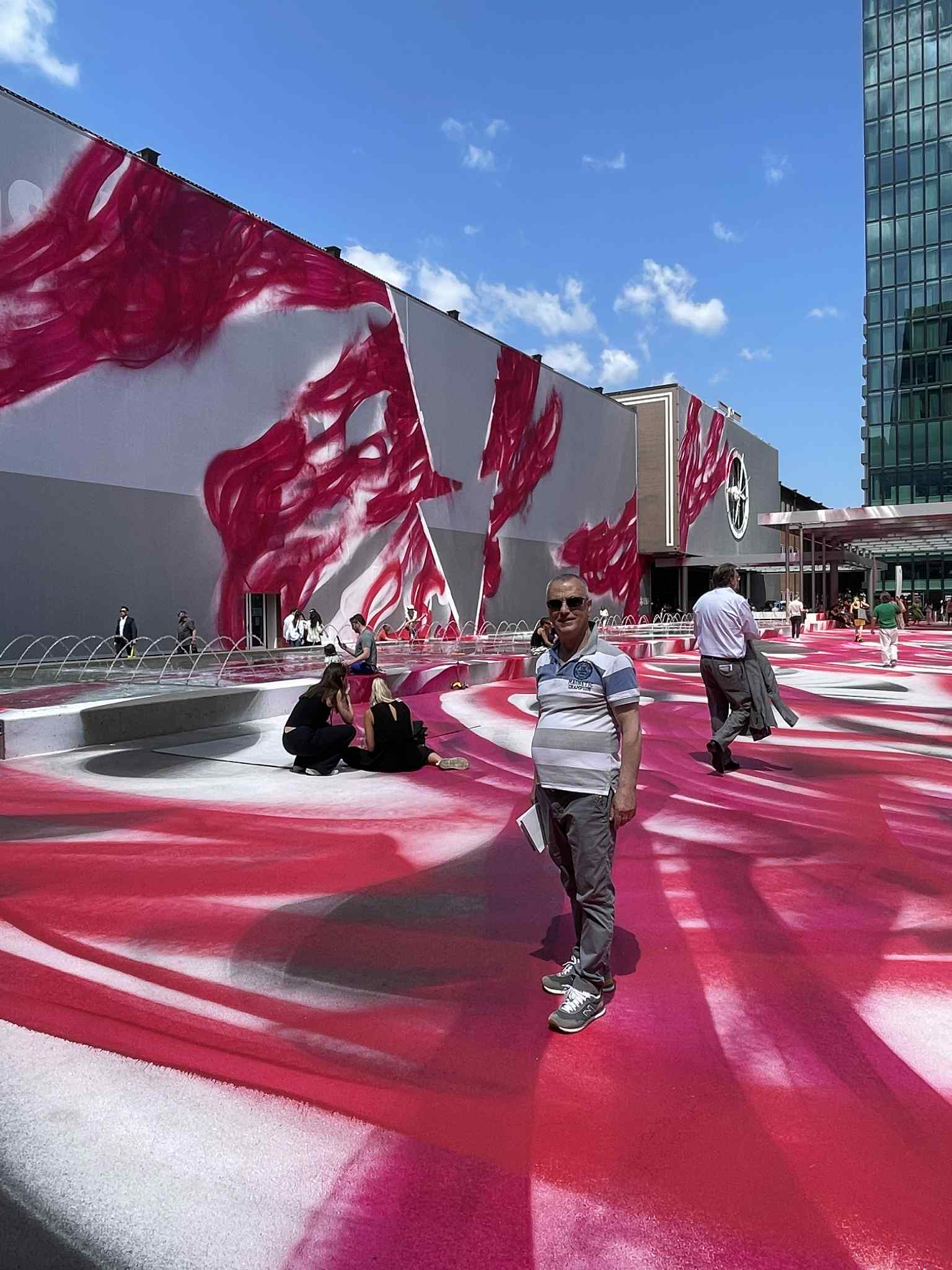
Before us lies majestic and all dressed in red, the square in front of the building, where the song festival – Eurovision 2025 took place
The square in front of the Basel fair is in fact the most magnificent platform that can be offered to art at Art Basel.
And who can use it better than the internationally renowned painter, who has repeatedly freed herself from the limitations of the classical canvas to claim entire spaces as a canvas for her colorful excesses?
Now Katharina Grosse has transformed the fairground into a large painting.
In doing so, she included the entire square, including the fountain and the surrounding architecture, in her work.
The German painter has long been considered a star.
And she is practically destined for this great commission, which is given to an artist every year for the days of the Art Basel fair.
The Swiss press writes about her and her fame has already spread throughout Europe and the whole world.
Switzerland is ahead in all arts.
It constantly organizes exhibitions to help talents, in supporting and encouraging them as well as displaying the products of the hands of the youngest, the oldest and the most famous artists.
Truly a model to be taken as an example by all European countries and why not the world.
An excellent job in giving the right value to those works that really have value.
The first day
Crowds of people flowed like a river in front of the festival building.
Others climbed the stairs to the palace of culture, where the exhibition titled Arte-Basel had opened.
An exhibition service employee greeted us in Italian and with her warmth and talented hospitality, offered us all the necessary information about ARTE-BASEL 2025.
Second day in Basel
Already amazed by the exhibited works.
We move from one pavilion to another. We take photos.
Thousands of square meters have been made available for the exhibition of works by great artists, as well as ample space for the many visitors.
A special commitment and interest from the employees of the municipality of Basel.
They follow every activity, every detail of this exhibition, in help and support of the exhibition employees as well as the artists themselves.
Everything in order and with correctness.
“We like this,” said one of the employees, because with the same dedication these beautiful works of art were created, which are exhibited in all the exhibition pavilions.
Values should be protected only with values.
Works that amaze with their beauty and the messages they carry for the culture and life of people everywhere in the world.
We will see and hear each other in the other visits made by our side, in the following days, in these artistic activities, developed in Switzerland and their importance and values for Europe and the World.
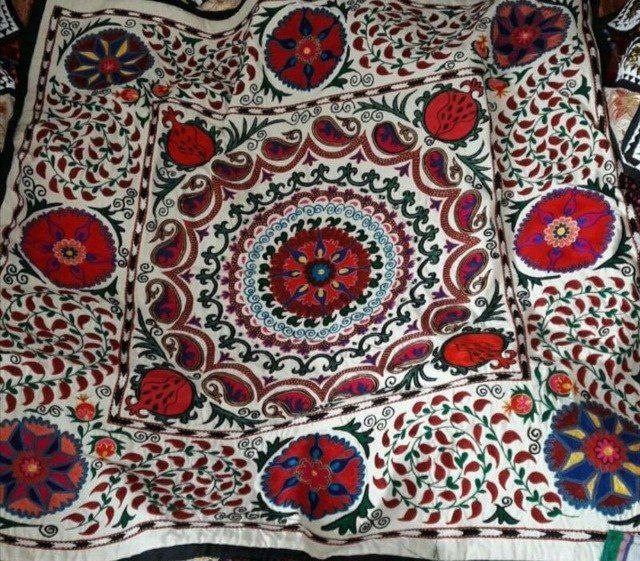
Embroidery is one of the oldest and most traditional crafts in Uzbekistan. For centuries, the people of Nurota, Shahrisabz, Fergana, Tashkent, Samarkand, and Bukhara have practiced this art. When stitching techniques, threads, fabrics, and patterns are harmonized, they create a beautiful result. Embroidery features a wide variety of stitches, colors, patterns, and fabrics. Bright colors are often used to make the designs more attractive.
Silk thread – the most delicate and glossy (often used for suzani). Wool thread – warmer, used for robes (chopon) and pillows. Cotton thread – cheaper and available in many colors. Silk is preferred because its shine lasts long and gives elegance to the design.
Fabrics for embroidery Mainly strong and smooth fabrics are chosen: adras, coarse cotton, silk, and others.
Meanings of patterns Pomegranate – blessing, abundance Almond – happiness, fertility Pepper – protection from the evil eye
Meanings of colors Red – life, love Green – nature Blue – sky, loyalty White – purity
Embroidery is 100% handmade (stitched with a needle or a hooked tool).
According to ancient traditions, Uzbek girls – future brides – prepared various embroidered items for their dowry: handkerchiefs, curtains, belts, bags, vests (nimcha), bedsheets, suzani, clothing decorations, headwear, and other gifts. At the wedding, the bride presented the items she had made to the groom’s relatives. Before the wedding, the dowry was displayed as an exhibition to demonstrate the bride’s skill and diligence. The finer and more beautiful the embroidery, the more highly it was valued. Girls were taught embroidery from a very young age and, after three to four years, began embroidering independently.
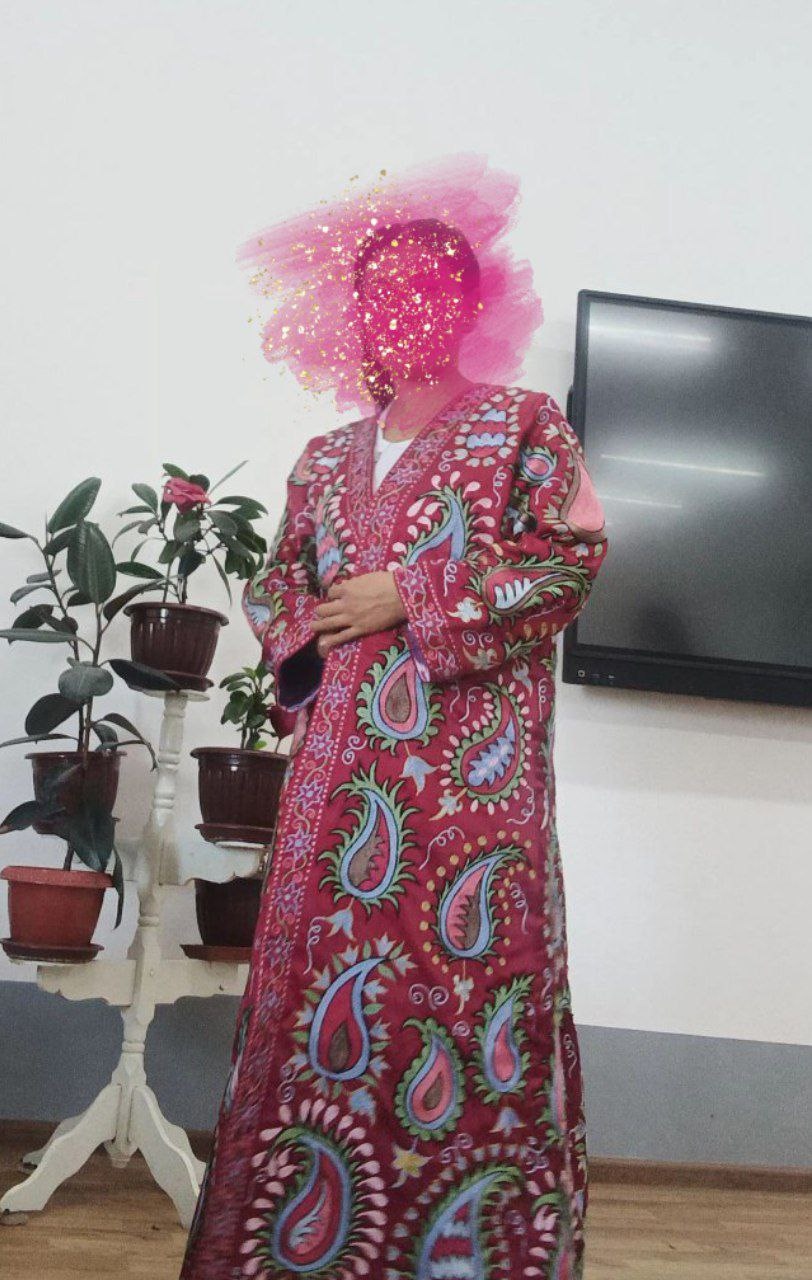
Today, one of the most popular garments is the suzani robe (chopon), which combines tradition and modernity and appeals to everyone. Iroqi stitching is mainly found on girls’ skullcaps (doʻppi). On Uzbekistan’s national holiday Navruz, people wear iroqi skullcaps, khan-atlas, adras, and suzani robes.
Globalization and National Identity: The Choice of the New Generation
In the modern world, the word globalization is no longer an abstract concept. It is the reality in which we live, study, and dream about our future. Borders between nations are gradually becoming symbolic, communication technologies connect people from different continents in a matter of seconds, and cultures are interacting faster than ever before. For today’s youth, globalization offers a wide field of opportunities: access to education abroad, cooperation in science and business, cultural exchange, and broader horizons for personal development.
Yet, behind these opportunities lies a serious question: what will happen to our national identity? When global trends dominate social life, there is a danger that unique traditions, languages, and customs may lose their value in the eyes of the younger generation. A young person may easily adopt international fashion, foreign languages, and global lifestyles, while sometimes forgetting the songs, proverbs, or traditions that shaped their own nation’s spirit for centuries. This creates a paradox of the 21st century: while the world is becoming closer, it risks becoming more uniform and less diverse.
However, globalization does not have to be the enemy of national identity. Instead, it can be an opportunity to present one’s culture on the international stage. Youth who learn to speak foreign languages, master modern technologies, and travel the world can also become ambassadors of their traditions. They can introduce their national literature, music, and art to foreign audiences. In this way, globalization becomes not the loss, but the expansion of national identity.
The new generation has the ability to integrate into the global society while keeping the roots of their homeland strong and alive. The choice, therefore, lies in the hands of young people. Do they want to become passive consumers of foreign culture, or active protectors and promoters of their own? Will they let globalization wash away their uniqueness, or will they use it as a bridge to tell the world who they are? This is not just a personal choice; it is a historical responsibility.
In conclusion, globalization is not a force to resist, but a process to manage wisely. The new generation must build a balance: to accept global values like cooperation, innovation, and tolerance, while at the same time preserving the priceless wealth of national identity. Only then can they ensure that the future world is not a monotonous place, but a colorful mosaic of cultures, where every nation’s voice is heard and respected.
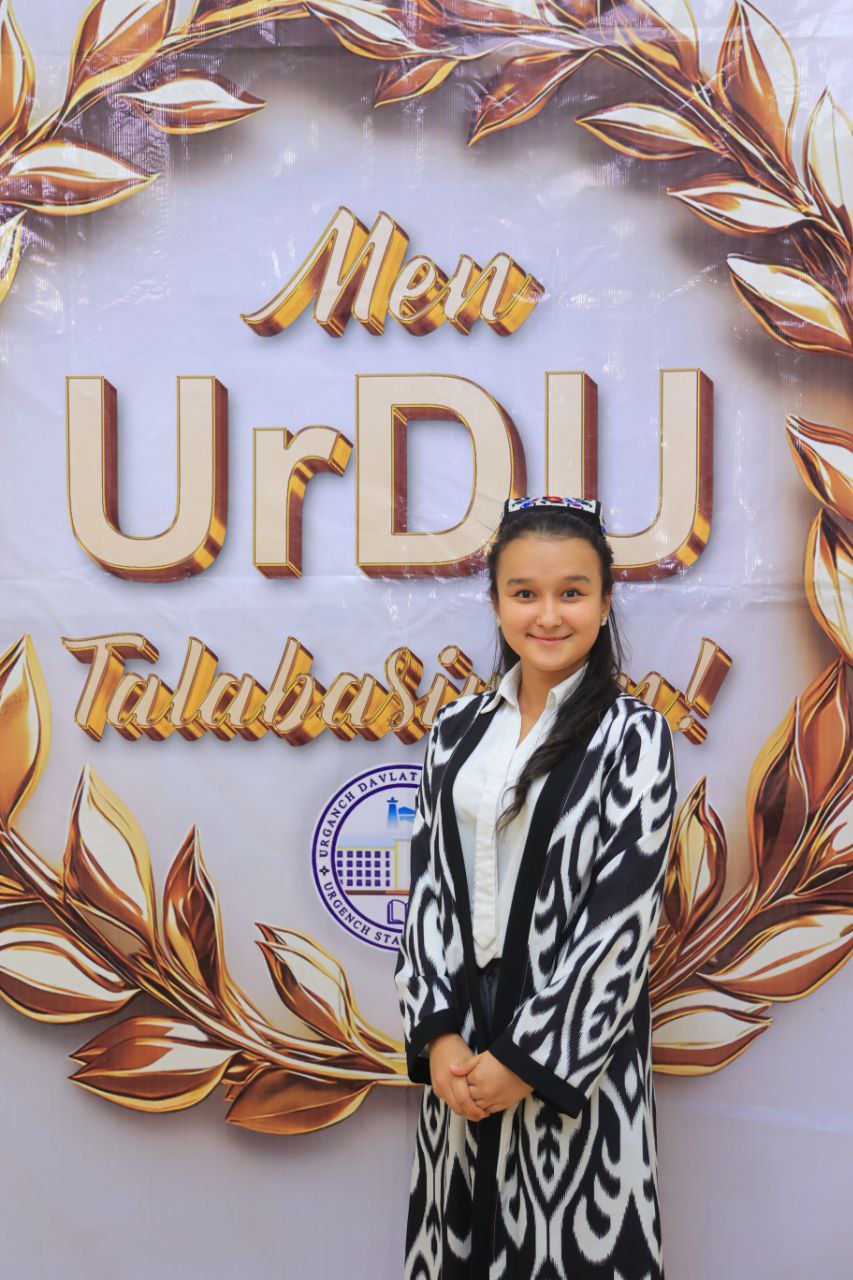
Dildora Khujyazova (born in 2005) is from Khorezm region, Uzbekistan. She is currently studying Geography at Urgench State University. Dildora is passionate about writing, journalism, and research, and she has authored several scientific articles. She actively promotes honesty, cultural dialogue, and youth engagement in her community. Her aspiration is to study abroad and represent her country through both academic and creative achievements on the international stage.
I am now 77 years old… this is a strange time of life, but then, I guess every stage of life has its strangeness… anyway… I lived my first 11 years on a failing dairy farm near Baldwin, Wisconsin… I have lived most of my life since then in the East Metro suburbs of St. Paul, Minnesota… about 45 miles from where I was born… as a kid, the trip to “the cities” was a huge adventure… but today, it is just minutes away on the freeway… while the farm was going broke, my dad worked on the I-94 freeway which was cutting through the countryside about a mile from our farm… his job was sharpening pilings with a chain saw… this was a terrible job… the construction companies would hire local farmers to do these miserable jobs while most of the work crew was tradesmen who lived elsewhere and moved around to follow the work…
the pilings were like telephone poles that were driven into the ground in wet areas as supports for the concrete columns that held up bridges… the telephone poles were treated with creosote as a preservative for when they were driven into the ground… the creosote was a black, tar like substance that would cover dad’s hands and face and permeate his clothing when he came home from work… the farm did not have running water and we only had hot water from heating it on the kitchen stove, so getting cleaned up from all this creosote was pretty much impossible… not to mention that it was summer, so a person got hot and sweaty working on the construction sites… and then coming home, there was field work to do by the dim single light of an old John Deere tractor… no wonder he often went to the bar after work with the construction workers…
my dad had one sister who was a few years younger than him… she was married to a guy from Thorpe, Wisconsin about an hour east of Baldwin where my grandparents lived at that time… the sister and her husband lived between Withee and Owen, Wisconsin… they had one child, a son, who was two years older than my older brother, so four years older than me… he was named “Bill” after his dad… for my brother and I, it was a real thrill to see Bill whenever his parents came to visit us and the grandparents in Baldwin… we thought that Bill and his family were tremendously rich although, in reality, they were simply middle class while we were poor… we got “hand me down” clothes from Bill… some of which were crazy fancy to us… I remember that I got a brown suit that somehow bypassed my brother… I was about ten years old and really had no use for a suit… I don’t think I ever wore the suit outside the old farm house, but I thought it made me look like a billionaire…
so, at some point in maybe 1958, my brother and I got to spend a couple weeks with our aunt and uncle and Bill at their house near Withee… one of our dad’s drinking buddies from the construction site was a guy named Cliff, who lived in Wausau and who offered to drop us off at Bill’s house on his way for a visit at his home… so, we got in the car with Cliff and off we went to Withee… Cliff proved to be a perfectly decent guy and dropped us off with no problem… strange to think of in 2025… sending 10 and 12 year old kids with a stranger, no less, a drinking buddy from the construction site… but although the usa was in some ways very harsh in those days, it was in some ways less distrustful and worried than today…
anyway, Bill was maybe 14 and so, it was so exciting for us to be away from our crazy home, with all the drinking and fighting… and Bill’s house seemed an island of tranquility, although, it was maybe not so tranquil when we were not there… but I don’t really know about that… so, the house seemed a virtual palace compared to the threadbare old farmhouse… it had running water, hot and cold! indoor plumbing, central heat and it was clean and neat with polished furniture, tasteful end tables with lamps and knick-knacks… there was a curved stairway that my aunt had designed herself and had built going upstairs leading to the bedrooms and the attic… over the front door was a long shelf with a collection of beer steins, ranged by size from tiny cups to the huge two foot stein in the center… the kitchen was modern with a range instead of a woodstove and their were folksy rugs on the polished wood floors…
then Bill took us up to his room which we had never seen before… Bill’s dad was an auctioneer, and at that time the auction business was booming as the small farms were going bankrupt and being bought by the more successful farmers to make much larger farms… this consolidation was made possible by increasing mechanization… combines and hay balers, bigger tractors and machinery of all kinds was making it possible for one farmer to vastly increase his productivity and handle lots more acres and milk cows… our farm had 16 milk cows and today, farms in that area have hundreds of milk cows… so the industry was really changing and all these big changes were just getting going in 1958… whenever my uncle had an auction, he would look around first and pick out anything that seemed interesting or unusual and buy it for himself… lots of those old farmhouses had military stuff in the attic that soldiers had brought home from the two world wars and even from the civil war, and my uncle liked collecting guns and old military stuff… Bill got his pick of this stuff, so, Bill had in his room all kinds of items that we found fascinating…
he had several civil war swords and a civil war pistol… he had muskets and a real German Luger… he had a big red nazi flag with a white circle and a swastika in the middle as well as a German army helmet and a confederate flag… he had a horse pistol which was a pistol that fired a 410 shotgun shell and a complete civil war uniform… all of this stuff was in Bill’s room… across the hall in the attic, his dad kept the rest of the gun collection with all kinds of old and odd guns… our dad came home from World War II with a strong dislike for guns and shooting, but our uncle was an avid hunter and fisherman… so, this whole thing was a new world for us…
our aunt was into “antiquing” furniture, taking newer furniture and treating it to make it look old and beat up… this astonished me because the furniture I was used to did not need any treatment to make it look old and beat up… in sheds behind the house our uncle kept his collection of odd old cars that he had picked up at the auctions including a Model T, a Model A, and several others… Bill let us climb in these old cars and look them over… then even though he was too young to actually drive, Bill showed us an old car that his dad let him drive around on their property… they had even built a dirt track oval in a pasture next to the house where Bill and his friends, who also had old beater cars, would race their cars… and, I think the most amazing thing of all, was when Bill got his 22 rifle out and was shooting out the back door of his house at fence posts across the back yard… at one point our aunt took us and some friends, loaded into a big fancy station wagon to go swimming in a local creek… I think it was called Rock Creek… anyway, it was a hot summer evening and the water at the swimming hole was cool and crystal clear… I was terrified of the water as I could not swim… but, I found the whole scene just fantastic, like something that would be in a movie or on television… the sound of the stream rippling over the rocks, the dark trees, the kids splashing around… the moms sitting on the side smoking and talking… the whole scene lit by the headlights of the cars… it was like a fairy tale in the middle of an enchanted forest…
well, shortly after that time, my grandparents moved from Baldwin to Withee to be near their daughter… but then in 1961, their daughter, Bill’s mom, died in a car accident… Bill had been a wild child as a teen and so had finished high school at a private military school his parents sent him to to get straightened out… my last real memory of Bill in those days was from 1963 when he got married… he had joined the Air Force right out of high school so, in the years after his mom died, while we regularly saw our Grandparents in Withee, and our uncle, we did not see Bill…
I vividly remember Bill’s wedding… he wore a fancy Air Force uniform and he and his bride walked down the steps of the church with uniformed Air Force guys on either side holding sabers up crossed over the heads of the bride and groom…
so, many years passed… my dad died in 1984… after a suitable period of mourning, my mom started dating my dad’s cousin, who was a widower… when dad’s cousin died, after he and my mom had dated for several years, she got into contact with my uncle, Bill’s dad… Bill’s dad had always been a colorful character… he always had a bright red Ranchero car/truck and I remember him tooling around Withee back in our early days of going there to visit Grandma and Grandpa… he was kind of a wheeler/dealer who always had business deals going, fishing trips, hunting trips, etc… he owned a small airplane back in the years after the war and there was a story that he had tried to take my Grandpa for a ride in it but couldn’t get off the ground because my Grandpa was a pretty big guy… this airplane was a framework covered with fabric… it was apparently very small and could land and take off from the farm fields… by the time I knew Bill, the plane was gone… our uncle was a nervous guy and a slick talker… he was always kind to my brother and I and showed us his rock tumbler and how he would make jewelry out of agates he found here and there… he would cut and polish the agates and glue them into clasps for pins, earings, etc… I remember an old person in Withee who knew our uncle all his life, saying that he had been much calmer and more relaxed before he went away to the war…
so, anyway, after our uncle’s wife, my dad’s sister had died, our uncle had remarried and moved to a different town… I remember hearing sometime down through the years that he had gotten divorced… and then, he and my mom started dating… so at some point, maybe around 2000, I had driven with my mom, one of my sisters and my wife to visit my uncle who I had not seen for all these years…
my uncle was living in his parent’s house in Thorpe and it was fun to see him… he had not really changed at all… he showed us his gun collection which he still had and which was stored in a locked room in the basement of the house he lived in… then he offered us some homemade blackberry wine which my wife said was very tasty… I do not drink alcohol, so did not try it… then, he showed us a small triumph sports car which he said he had found in a barn and had restored… it was a really cool little car…
anyway, he said that my cousin Bill was just across the street if I wanted to see him… of course I did… it was so exciting to see my cousin again after all these years… he actually looked so much like my dad that it was really cool… he had the same curl in his hair that my dad had except that like his mother, his hair had gone entirely white at a very young age… his dad mentioned that we had partaken of his homemade blackberry wine and Bill looked at me and said, “would you like a Diet Coke?” so, yes, we were both middle aged boomers… and I was much more excited about the soda than the homemade wine…
he was still with his wife and we had a great afternoon of conversation about how our lives had gone… only too soon, the day was getting late and we had to leave for home… I never saw my uncle or my cousin Bill after that… the uncle died in 2004 and my mom died in 2017… in the intervening years, I made some half hearted efforts to get in touch with Bill, but never got any reply… last summer, my wife and I were driving to Wausau, Wisconsin to visit our daughter’s in-laws… driving out I-94, within a mile of the old farm, and then on Wisconsin 29 past Thorpe and Withee, I got to thinking about the days of my childhood and so, later that day, I made one more attempt to find my cousin Bill… when I did a google search for his name, I immediately found him, but unfortunately, it was his obituary… he had died of Parkinson’s disease four years ago… he had been very ill with this disease for many years, which explained why I had never heard back in my attempts to contact him… he had acquired the disease as a result of exposure to agent orange in Vietnam… this was a hazard of our generation… I well knew the horrors of Vietnam because my own older brother had been killed in action in Vietnam in 1968…
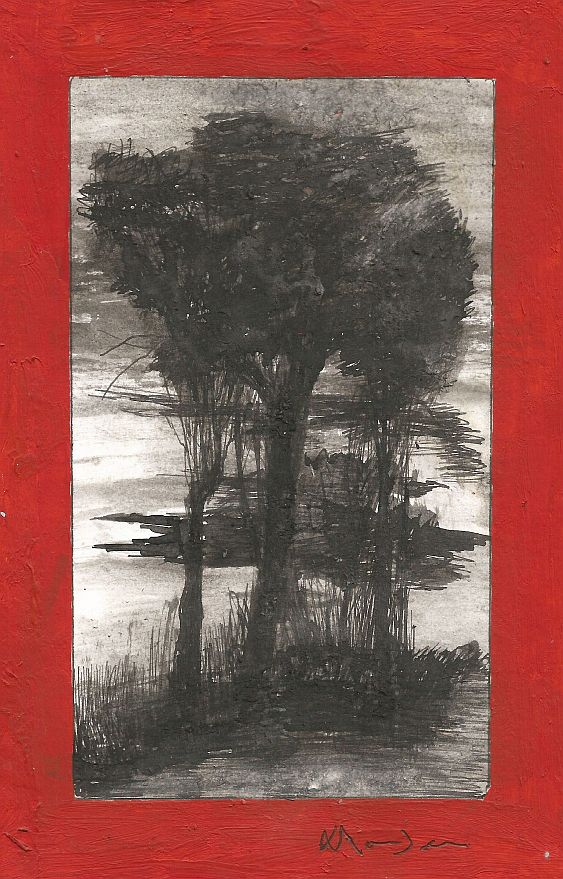
so, I missed one final visit with my cousin… Bill was the only cousin on my dad’s side… on my mom’s side, I had and still have dozens of cousins but on dad’s side, there was only Bill… well, I felt bad that I had not made more of an effort to stay in touch and so I decided that I would send Bill’s widow a small drawing as a memorial to Bill… so, I made a drawing of some trees in black ink with an orange border… I then went on line to see if I could find an address for Bill’s wife to send her the drawing… well, when I typed her name into the google search, her obituary popped up… she had died last spring… so, I still have the drawing…
I am still breathing the sweet midwestern air and walking around in this glorious world of trees and sky, houses and people, friends, relatives and strangers… every day is a blessing and every day is a reminder of the beauty and fragility of life… I have been very lucky and blessed in this life with a happy marriage, beautiful children and grandchildren and love and kindness in abundance… I have lived the life that my brother never got to live and have enjoyed the health that deserted my cousin Bill… and I have definitely learned that, if you want to reconnect with someone or reach out to your past, you have to do it now because the future is not promised to any of us…
Future Office – Opportunities for Youth Development
In today’s world, where science and technology are rapidly advancing, it is natural that young people strive to achieve success.
But an important question arises: how can we develop? Where should we begin?
Nowadays, artificial intelligence, technology, and social media have become an inseparable part of our lives. At the same time, many young people fall into laziness, lack of discipline, and become distracted by endless streams of information and videos. As a result, questions such as “How do we succeed? Where do we start?” concern not only me but also many younger people.
While searching for answers to these questions, a project called “Future Office” opened a new door in my life. When I learned about the project, I felt it was exactly the opportunity I needed, and I was accepted into its second season.
The Project and First Impressions
The project began online via a Telegram channel. On the very first day, 140 participants were accepted, divided into groups, and each was assigned a curator. I found myself on the 5th group’s list and eagerly joined the group chat. Without waiting for opportunities to come to me, I was one of the first to introduce myself and connect with everyone. To my delight, my teammates were active and open-hearted — we quickly bonded and built a strong network.
Our group was tasked with choosing a name, logo, and slogan. Everyone contributed ideas, and most importantly, we respected one another’s opinions. In the end, we named our group “Renaissance” and came up with a slogan together. These tasks helped us adapt quickly to new people and new environments.
Another task of the day was reading Camus’ “The Stranger.” Albert In the evening, we attended an online training by Shohjahon Urinov, a recipient of the Zahiriddin Muhammad Bobur State Scholarship, on “Conducting Scientific Research and Applying for Prestigious Scholarships.”
We young people often don’t know where to start, what the right path is, or what documents we need. What are the stages of selection? What common mistakes do candidates make? These questions are very important. But who do we ask if we have no acquaintances or access to specialists, especially for youth like me living far from big cities?
This project gave us answers to all these questions and more. Since the project was online, everyone could participate from their region. The group chat allowed free communication and networking. Now, I have friends from different regions, and that is amazing. Being surrounded by like-minded peers helps us compete, learn from each other, and push one another toward our goals.
The best part was the online training from experts. First, they shared their knowledge with us, then answered all our questions. Now we know what to do and how to do it — we have taken one more step closer to our dreams.
Day Two – The Battle of Ideas
This day took place in the “ThinkLab” workshop. We were given a poem by a famous writer and debated it in the literary arena, defending our perspectives. The “ThinkLab 2” and “Quick Battle” sessions truly tested our intellect and wit — just as the saying goes, “The brave are tested in the arena.”
I’ve always loved critical thinking. I have a habit of analyzing things from different angles, giving reasoned judgments, and making thoughtful decisions. The ThinkLab was made for people like me! Fortunately, my teammates were also well-read, sharp-minded people. I learned so much from them, and they learned from me — like paying attention to details and seeing things from different perspectives. It was amazing to share knowledge with each other.
I’ve always had many friends, but exchanging deep ideas with them wasn’t easy — we often didn’t listen to one another. But with an audience united by one goal, everything became easier and full of new insights.
Day Three – Movie Time
“Movie Time” wasn’t just about sitting on a couch with popcorn. It was about living the story with the characters and learning life lessons. The film was deeply emotional, showing how someone with physical challenges still achieved their dreams. It made us realize how many healthy people live in fear instead of pursuing their goals.
I had actually seen this film before. At first, I wondered, “Do I really need to watch it again?Won’t it be boring?” But then I remembered a phrase that often comes up in my life: “Repetition is the mother of true learning.” Surely, the organizers had chosen this film for a reason. Watching it again, I noticed details I hadn’t paid attention to before. Instead of just following the characters’ stories, I imagined what I would do if I were in their place.
After the film, we discussed it as a group. 140 people shared 140 different ideas and experiences — it felt magical, like unlocking another secret on my path toward my goals.
Later that evening, we had a seminar with Davron Ergashev, a multiple grant-winner, on “Create Your Own Opportunities: Winning Grants, Writing Motivation Letters and Preparing a CV.”
This training taught us essential skills like writing CVs, crafting motivation letters, and applying for grants — real keys to achieving our dreams. Everyone actively participated, asking questions without hesitation. By the end, we understood that everything is truly in our own hands.
Day Four – Quiz and Reading Time
The day began with the “Quiz for the Smart” — a movie quiz. Three rounds, fifteen questions, and 140 delegates competing in teams. Intellectual games always attract young people; they reveal the talents not only of bookworms and researchers but also of movie lovers.
After the quiz, we returned to “Reading Time” and analyzed “The Stranger” in a voice chat. Each participant shared their golden thoughts. This wasn’t just reading a book; it was about self-discovery and understanding life’s true purpose. Personally, I always empathize with the characters when I read — I cry and laugh with them. That’s why I actively participated and shared my experiences with the group, knowing it brought me closer to my goals.
Day Five – Plastic-Free Day
As part of the “Plastic-Free Day” campaign, each participant collected 20 pieces of plastic waste in their area. It may seem small, but it’s a crucial step toward protecting our planet.
At the end of the day, we attended an eco-training by Husan Tursunboev, the founder of “EkoNur.”
I’ve always enjoyed participating in eco-campaigns. I know my efforts alone can’t influence everyone, but when my younger siblings see me cleaning up, they do the same with their friends, who then influence their families — like a chain reaction. It feels amazing to contribute, even in a small way, to spreading ecological awareness. After all, how can we stand by and watch our beautiful planet be destroyed?
Conclusion
-During the “Future Office” project, I learned many valuable lessons:
-Don’t wait for opportunities — create them yourself.
-Personal development requires books, films, intellectual games, and practical actions.
-Most importantly, teamwork and exchanging ideas help you discover yourself.
If every young person made good use of such opportunities, they would not only develop themselves but also uplift their communities.
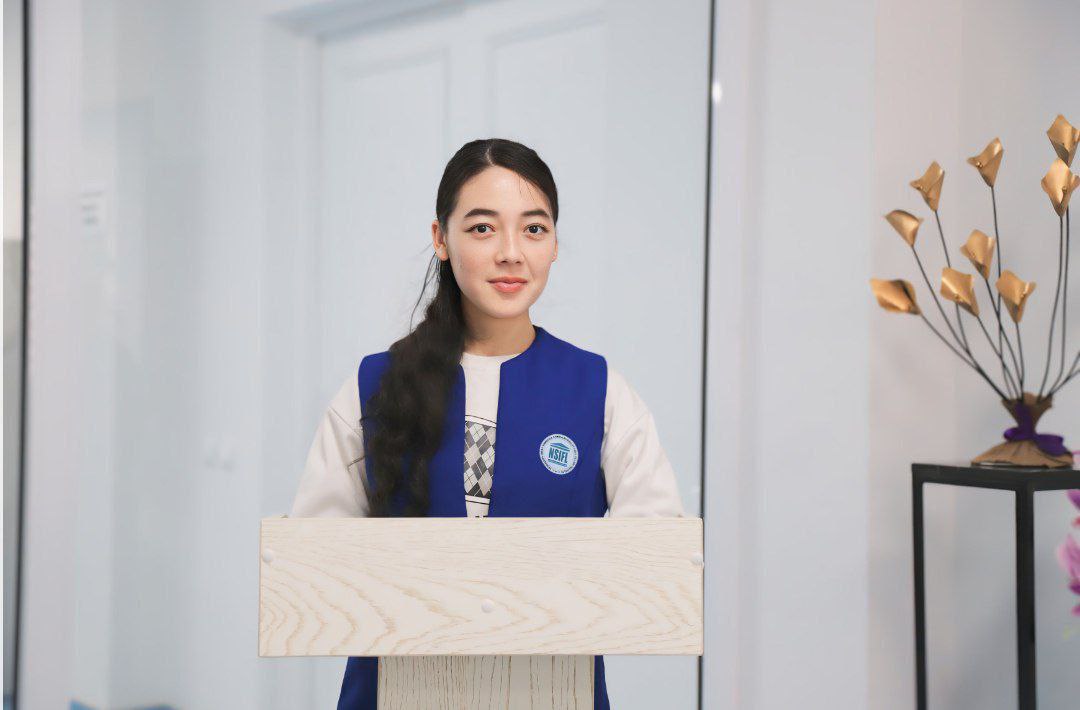
Mushtariybonu Abdurakhimova, 3rd-year undergraduate student at Namangan State Institute of Foreign Languages
Active Volunteer | Recipient of the Uzbekistan Volunteers Association Badge of Honor | Creative Writer | Avid Reader | Public Speaker | Social, Environmental & Cultural Activist | Founder of the “Ibrat” Volunteer Group | Leader | Amateur Artist | Presenter
Born on March 26, 2006, in Dangʻara district of Fergana region, Uzbekistan, Mushtariybonu Abdurakhimova is an inspiring young leader actively engaged in education, creative initiatives, cultural and formal communication, public speaking, as well as social and environmental projects. She not only participates in various training sessions and video programs but also organizes and leads them herself.
Mushtariybonu completed her secondary education at School No. 2 in Dangʻara, where she developed a keen interest in literature, foreign languages, culture, critical thinking, and public speaking. Driven by these passions, she was admitted on a merit-based scholarship to the Faculty of Philology at Namangan State Institute of Foreign Languages, where she is currently a third-year student.
From the moment she entered university, she became an active member of volunteer movements, contributing energetically to social and ecological projects. She successfully completed the DXM Volunteers program and earned the Badge of Honor from the Uzbekistan Volunteers Association. Earlier, her university team won first place in the collective reading competition, earning the title of “Most Well-Read Team.” She also served as the coordinator for the female students’ division within the Youth Union, organized numerous projects and competitions, spoke as a guest and trainer in various video programs, and successfully published her first scientific article.
In her spare time, Mushtariy enjoys reading, critical thinking, analyzing podcasts, intellectual videos, and films. She is an amateur artist, a skilled home cook, and has a knack for handicrafts. Her volunteer roles include guide volunteer, eco-volunteer, UNDP volunteer, “Istiqlolli Avlod” volunteer (working on human rights, children’s rights, and anti-violence programs for women), U-Report volunteer, participant of the “EcoAvlod” Season 2 project, and participant of the 4th season of the International Ecology and Tourism Congress.
She actively supports the elderly, provides assistance to lonely seniors and people with disabilities, and is known for her adaptability, sociability, and strong communication skills. Mushtariybonu loves engaging with people and is a quick learner, always striving to make a positive impact through social, environmental, and cultural initiatives.
Despite her young age, Mushtariybonu Abdurakhimova stands out as a talented, proactive, and socially responsible leader, contributing to meaningful change in her community and beyond.