
Poetry from Shangguan Changfeng, for poet Lan Xin’s birthday

Lan Xin

September 

Happy birthday Lan Xin 

Blossoms of Phalaenopsis

— Dedicated to Lan Xin , In the Name of Purity

Poem by Shangguan Changfeng

Translated by Lan‑Xin Samei

Phalaenopsis are in bloom,

Beneath the morning glow of Wenbi Lake.

Blossom after blossom,

Like letters from the snow‑capped mountains,

Sent down unto the mortal world.

Pure and immaculate.

Nothing but whiteness,

Nothing more, nothing less.

Nothing but wholeness,

Nothing wanting, nothing excess.

That pristine heart,

Grown from this very land.

The Dongba paper knows it,

That bamboo brush knows it.

Every first stroke upon the page,

Is a seed,

Slowly awakening through the night.

You plant these seeds into poetry,

Into the crevices between two languages,

Upon the invisible road stretching from Hunan to Lijiang.

Thirty years long,

You have walked yourself into a river,

Carrying those ancient characters,

Flowing toward souls who scarcely believe in the moon.

White butterflies rest upon your shoulders,

Their wingtips trembling gently —

Blessings taking flight from the Dongba scriptures.

They utter no word,

Simply abide in whiteness, simply exist.

With their pure radiance,

they bring soft closure to a love that has traveled far.

This pristine heart is no garden‑plucked flower.

It grows of itself from this land steeped in healing.

Every petal

is a thought of love and compassion,

resting lightly in your hands.

Today the wind breathes soft.

Sweet osmanthus shall bloom in a few days,

yet phalaenopsis are already in full flower,

blooming just right.

Like your well‑tendered gentleness,

your unyielding resolve,

and the perfect way

you have graced this world

through all these years.

— By Shangguan Changfeng 

For Lan Xin’s birthday

At Dongba Culture Academy, when osmanthus is soon to bloom, September 5, 2026
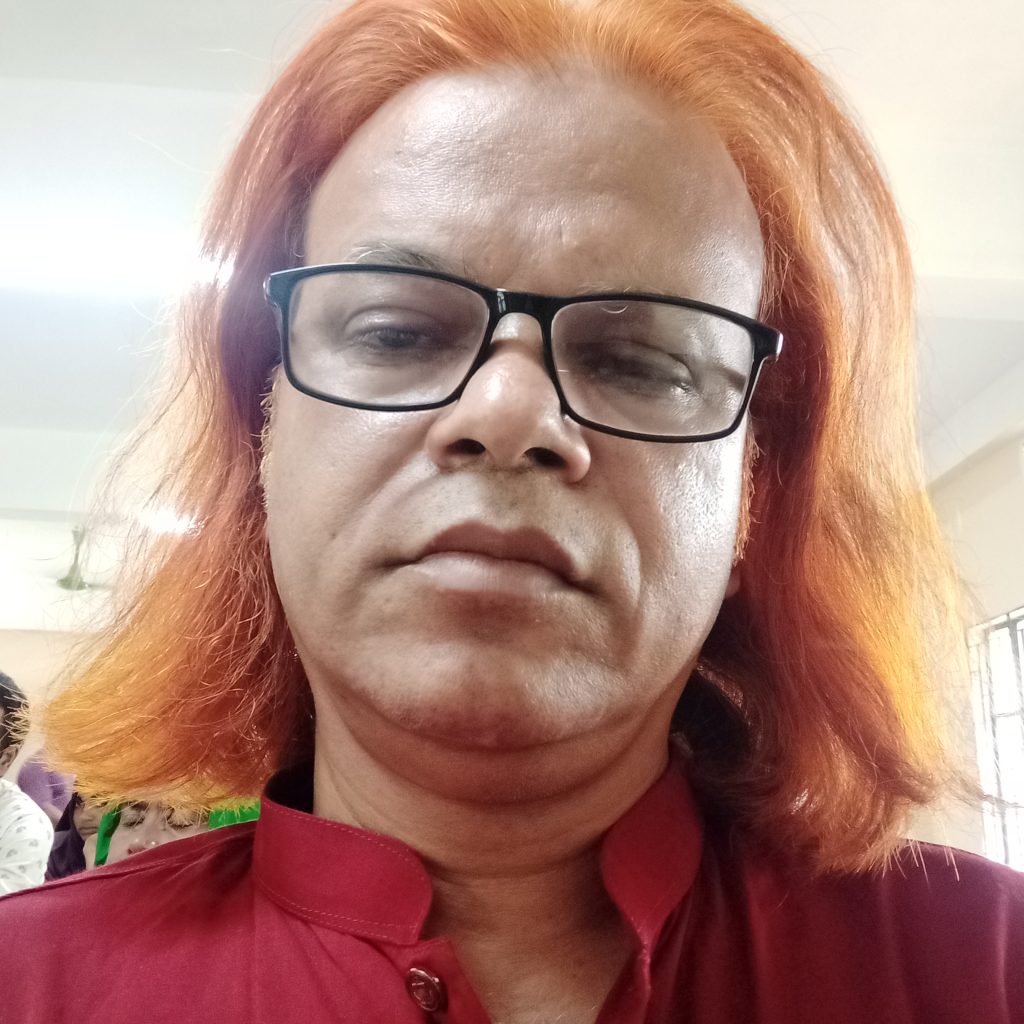
Poetry from Mesfakus Salahin

South Asian man with reading glasses and red shoulder length hair. He's got a red collared shirt on.
Mesfakus Salahin

The Endless Path

Mesfakus Salahin

Chapainawabganj, Bangladesh 

 As evening deepens, the birds return to their nests; 

Where shall I return? 

You have let go of my hand—

The hand that bears the passage of five seasons.

I stand waiting on an endless path, 

Alone in this desolate, traveler-less land.

You walk on, ever further away, 

Hand in hand with the stars,

To a place from which no one returns—

 From which no one can return.

 I know you will never come back; 

Your place of pilgrimage has changed.

Ice will melt into water, and water will turn to ice;

The lamp at the head of the night-bed will flicker out for lack of fuel;

The imprint of love will be washed away by the waters of time; 

The wounds of the path will heal; 

Wild grass will sprout upon the skin; 

Villages will transform into cities, 

And cities will turn into cremation grounds; War will erupt amidst a dance of light;

New rivers will flow, fed by the spray of blood; Hearts will be shattered;

The garments of the denizens of darkness will wear the deceptive guise of light;

The stairway to the seven heavens will crumble to dust; 

‘Yesterday’ will drink dry the waters of humanity; 

Statues of dead stone will lean against the sun; 

And love itself will be manufactured in famous factories.

The wayfarer’s wounds will remain just that—wounds; 

Yet, I shall stand at your doorstep, 

Waiting, with dreams in my hands.

Short story from Bill Tope

The Prodigal Returns 

The telephone rang at my house, which was located out in the country, in a rustic suburb of St. Louis. It was Mom.

“Joey’s home,” she said breathlessly. She waited a beat. I said nothing.

“Jeff,” she said. “Are you there?”

“I’m here.”

“Are you going to come and see your brother, visit for a while?” she asked hopefully. I thought back to how Joey hadn’t touched base with any member of his family for seven long years. That was a lot of unanswered letters, a lot of unreturned phone calls, a never-ending questioning of Joey’s many friends.

“No, Mom, I’ll pass. I’m sort of busy, you know.”

After a pause, Mom said, “I understand.”

“How long will Joey be there?” I asked.

“He’s going back to California in a week,” she replied.

“See you in eight days, then, Mom.”

“Bye, honey,” she said sadly.

“Bye, Mom.”

Eight Days Later       

Seated at the dinner table, I looked up from the hamburger casserole and asked, “How was the visit with Joey?” 

Mom lowered her head, appeared ready to cry. I glanced at Dad, who as usual was stoic and unreadable.

“You don’t seem very happy about seeing him again,” I said. Mom was forever conjecturing about Joey’s whereabouts, talking about how she was dying to see him again. Nobody said anything. It wasn’t until months later that the true story of Joey’s visit was revealed. It was worse than I had imagined. Moreover, it helped explain the dark, brooding stain on Dad’s recliner, the only decent piece of furniture in the  home.

. . . . . . .

Three Days Before

It was well past midnight when Dad padded from his bedroom out to the living room of the small frame house in Southern Illinois. He had been awakened by a din emanating from the stereo and the voices of a score of persons unknown to him, who were packed into the living room and kitchen. The air was thick with cigarette smoke as well as the sweet effluvium of marijuana. A high-pitched soprano voice soared above the rumble of other voices and shrilled the length of the house. A flutter of laughter followed. Dad frowned. As he stepped into the room, no one seemed to pay him any mind. Finding his son, he gestured to him. Joey staggered up to Dad, grinning stupidly.

“What the hell is going on, Joey?” asked Dad.

Joey shook his head as if to clear it, then proffered a lighted joint. He had a shit-eating, stoner grin on his face.

“Take a hit, Dad,” he urged in a sing-song voice. “It’ll get you high, man!” 

Dad waved the offer away and his face, if possible, grew even darker. Now he knew where the five hundred dollars he had gifted his son for a new start in California had gone. The room was rife with drugs and alcohol. A girl with long blonde hair, who couldn’t have been more than fifteen, floated by, as if in a daze. Dad shook his head disapprovingly.

“I opened up my home to you,” he rumbled angrily. “And you bring all this shit into it.”

Joey blinked. He was having trouble following his father’s words. 

Dad continued, “Now, take your friends and your drugs, and get the hell out. This isn’t your home anymore. Get out,” he  repeated. “And,” he added meaningfully, “don’t come back.”

Instantly sobered by this harsh rejection, Joey frowned, quickly gathered the partiers, and steered everyone to the door. “Let’s go over to Mike’s house,” he said, referencing his best friend, a skinny blond man in a biker vest. And, leaving an unmerciful mess behind them, the entourage quitted the Walker house. As they left, Mom crept from the bed and joined her husband in the living room. The door slammed shut. A thick blue fog of pot smoke hovered near the ceiling and overflowing ashtrays and spilled bottles of beer littered the residence. Sitting on the arm of a recliner was a hypodermic syringe.

“I’m sorry, Pete,” Mom said, as though it were her fault.

“It’s alright ‘hon. We’ve still got one son.”

Poetry from Duane Vorhees

ISMS’ END: THE PROMISE OF PROGENY

We are all here, nerves and graves,

we, the todays and yesterdays.

The path of song runs through everyone. 

The Olympic pool doubles the sun

while the winter moon halves it.

Humanity lives in its huts

with its gods and with its isms

(and every belief system is an ism–

but why are there no isms of innocence?).

Humanity divides its world with walls and fences.

How permanent! yet how delicate!

are these stews in our kettles’ bellies!

Today’s chefs, prepare your tools and kitchens,

lay out your dynastic friction.

Those urns, those ferns, those burns

— those tomorrows—those blurs–

they still await their turn.

And they hope to mature.

And they hope to endure.

But we hope they can sing us to better futures.

Lacking the doneness of death,

living has a possibility yet.

ST. GEORGE’S DILEMMA

I am a knight,

a man in tin

upon a mission.

I have a dragon

Inside,

and there’s a maiden

Within,

and I must decide

which I should save

and which must slay.

SHEET MUSIC

When we concerto alone

you hum pianissimo

until my baton is down.

ANGELS’ ALLIES

Chicago exorcists of the curse of Hue,

the children’s choice seemed so simple and so clear: 

To purge and burn the stench of their parents’ sins

as voyeurs in Johnson/Nixon’s daisy chain.

Even as torrents of TV blood and horror

entombed the country’s slumbering shame and guilt

beneath accumulations of mud and silt,

they nurtured the nations’ worst hotel murders.

“So, whose side are you on?” A binary pick —

The side of the assassins or the martyrs.

And which will you be, the muck or the water?

Heedless moral passion or cowardly check?

Dump the Hump! Make Love Not War! Get Clean For Gene!

 Tune In, Drop Out! Trust No One Over 30!

New! Improved! Eliminate Parental Dirt!

Alas. We knew not the problem’s in our genes.

I ASK US

At which When did we become our parents,

self-convinced once more of our own invincibility’s

blood, bones, and blues?

There’s a border, we thought, between those anxious 

actions of the bulls on the street

and the bulls of the freight;

so at what Then did the line get crossed?

On some cryptic boiling point

our former arrogant innocence transmuted to ignorant inerrancy.

And, unappalled, we applaud our Light’s sad

transformation into Lightning Bolts.

So to Fate’s position we default.

But, in our prescient prehistoric youth, were’nt we

Already angels’ allies? 

Essay from Amonboyeva Shahnoza

A Government Trying to Rebuild a Reading Habit, One Grant at a Time

I keep thinking about a small detail buried in a government decree from January of this year: Uzbekistan is now requiring workplaces to set up a physical “book corner” and run a monthly “reading hour” for employees. Not schools — workplaces. Offices, factories, ministries. There’s even an internal ranking system tracking who reads the most, with a cash prize equal to a month’s salary for the top reader.

There’s something almost touching about the specificity of it, and also something a little sad. You don’t legislate a “reading hour” into existence unless the habit has genuinely eroded and someone in government noticed and decided it mattered enough to write into law.

Uzbekistan has spent the better part of a decade trying to rebuild its publishing ecosystem and its reading culture more or less from the ground up, and the newest round of measures, formalized this January, gives a pretty clear picture of where the pressure points are.

The most direct intervention is aimed at people who actually write books. Young writers can now apply for competitive grants that cover, for up to a year, a monthly stipend worth fifty times the base calculation unit — enough, in local terms, to let someone write without a second job eating all their hours. On the translation side, the government will cover half the production costs and eighty percent of the copyright costs for translating major foreign literature into Uzbek, and for translating Uzbek literature outward into other languages. That second half matters more than it might look at first glance. A national literature that only gets read domestically stays provincial almost by definition; a translation subsidy is, in a quiet way, an attempt to put Uzbek writers into conversation with the rest of the world’s readers rather than leaving them talking only to each other.

There’s also a slower, more structural piece: every year, at least three professional and technical books from abroad are supposed to get translated into Uzbek by local publishers, annotated with glossaries and explanatory notes by qualified specialists. It’s an unglamorous kind of literary infrastructure — nobody’s writing poems about a translated engineering textbook — but it’s the sort of thing that determines whether a country’s professionals can actually work from up-to-date knowledge in their own language, or whether they’re permanently a few years behind because the good material only exists in English.

None of this happens in a vacuum. It builds on a longer push that started with something more physical: getting book-selling spaces into towns and cities that didn’t have any. Regional governments were told, back in earlier rounds of this policy, to hand over unused state-owned buildings, rent-free, to anyone willing to open a specialized bookstore. Shops that did more than seventy percent of their business in books got a tax exemption. That’s the kind of policy that doesn’t generate headlines but quietly changes whether a teenager in a smaller regional town has anywhere at all to buy a novel.

The most recent presidential address added a number that stuck with me: ten million books a year are meant to be distributed to school libraries, framed explicitly as an effort to get young people in local neighborhoods reading again. There’s also a longer-range plan running through 2030 to digitize library collections entirely, so that physical distance from a major city library stops being the reason someone can’t get access to a book.

I don’t think any of this guarantees a reading renaissance. You can subsidize book prices and still lose to a phone screen; you can build a library and still find it empty. Reading habits are shaped by a hundred things a ministry can’t legislate — what your parents read to you, whether your friends talk about books, whether you’re too exhausted after work to open one. A mandated “reading hour” at the office might produce a genuine habit in some people and pure performance in others, and there’s no easy way from the outside to tell which is happening.

But I find myself less cynical about this than I expected to be, mostly because of where the money is actually going. It’s not vanity publishing for state-approved narratives — it’s stipends for young writers to have time to write, and subsidies specifically for bringing outside literature in and sending local literature out. That’s a bet on literature as exchange rather than literature as propaganda, which is a distinction worth noticing, especially from a government that could have chosen the easier, more self-serving version of a “reading culture” campaign.

Whether it works is a ten-year question, not a one-year one. But it’s rare to see a state put actual line items — fifty times the base unit here, eighty percent of copyright costs there — behind something as soft-sounding as “getting people to read more.” I’ll take that as a more honest starting point than most cultural policy manages.

Amonboyeva Shahnoza, student of Urgench State University, working towards a bachelor’s in computer engineering

Poetry from Alan Catlin

Surfing with Salvador Dali on the Anthropomorphic Beach:

an experiment in automatic writing

Sunbathing on the anthropomorphic 

beach, the severed finger of God is

a lifeboat for drowning sailors

shipwrecked on a Dali seascape,

capsized by morphological echoes

that agitate the waves, creating

white caps out of desert psalms.

Vendors at Tiki bars sell nothing

but bogus cocktails like espresso

martinis with a double shot of my

baby’s love. After the lifeguards

have left, beach combers arrive

with their extension ladders, Geiger 

counters, and metal detector devices.

What they find may not be fungible

on the open market but could 

become the stuff of Art.

Surrealistic Silver Surfers

The beach chairs are electrified making

shark week watches more difficult

when your pants are on fire though

the drones are sending up-to-date accurate 

information of where the great whites are

in relation to the sleeping bodies on rubber

rafts and monster truck tires floating on

late summer tidal flows, the rip currents

that propel Olympic swimmers elsewhere

for cheap thrills. At night, the hot wired

life guard stands are a beacon for deep sea 

fishers, ancient mariners, more viable than

lighthouse lenses illuminating the deep blue sea.

Film studies

Muybridge in motion, sideral as

sunsets, planets in alignment.

Holst compositions, not as transcendental

as Mahler, but not aethereal either.

Solar winds are devastating, knocking

out power stations: damn the torpedoes

full speed ahead! The space probe

leaving the galaxy, a time capsule of

what it was like before the technocrats

took over. Comforting to know: somewhere

in space Glenn Gould is playing Bach.

Film strip club

Like Warhol’s Factory covered in

aluminum foil. Everyone exposed,

onstage and off, shot as subjects,

features a young woman who cries

from one eye, tears rolling the way

pins do down tin pan alleys, the way

Lou Reed holds Coke in a bottle,

suggestive as all hell. David Bowie,

Guy Pearce, Crispin Glover, all

the actors who played him know what

he hides inside. Every instance is

Memento: no one remembers anything

especially the super stars, all of them

dead now that Mary Woronov is gone

to a wake for the angels.

Film set

Dark as the grave whereon my friend

is lain where the creature from the black

lagoon hangs his rubber suit when there

are no foreign bodies to terrorize.

Lunar caustic pools of dry ice fog makes

the back stage set almost credible, homey

for a hound like Baskervilles’. Conan Doyle

believed that Juliet of the Spirits was

a biographical statement, life study for 

a Capulet after the Montagues. Once upon

a time in Hollywood, anything seemed 

possible like a christ in concrete or

handprints of the stars.

Inner movies

The kind that only show in morning

rooms on locked-in wards where all

the inmates are prisoners of another

life. Style is important when the institute

is out of orange jump suits but Hazmat

ones are here. Clear the visor before

viewing the blue screen of death. 

The images inside are the real ones, 

everything else is imagined., fake as

charlatan who has the keys that locks

everyone in.

Poetry from MD. Shinha Sarder

The Engineer


Between the lines of numbers,
where silent equations grow,
an engineer dreams of tomorrow
and builds what others cannot know.


With a mind full of questions,
and a heart that dares to try,
they turn ideas into structures
that reach toward the sky.


They measure, design, and calculate,
they test what seems unknown,
and when the first attempt breaks apart,
they build again on their own.


A bridge may rise from their vision,
a machine may move by their hand,
a network may connect distant hearts,
across every sea and land.


They speak the language of science,
but their purpose is deeply human:
to make life a little easier,
to solve problems, to keep moving.


Behind every circuit and system,
behind every carefully drawn line,
there is patience, hope, and courage,
and a dream that refuses to decline.


An engineer does not simply build
with steel, code, or stone;
they build possibilities
where possibilities were unknown.


And when the world moves forward,
faster than yesterday,
the engineer stands quietly,
creating a brighter way.


For every problem has an answer,
every failure has a lesson,
and every dream can become real
when knowledge meets determination.


So let the engineer keep dreaming,
let curiosity light the way,
for the future is waiting to be built

by the minds of today.