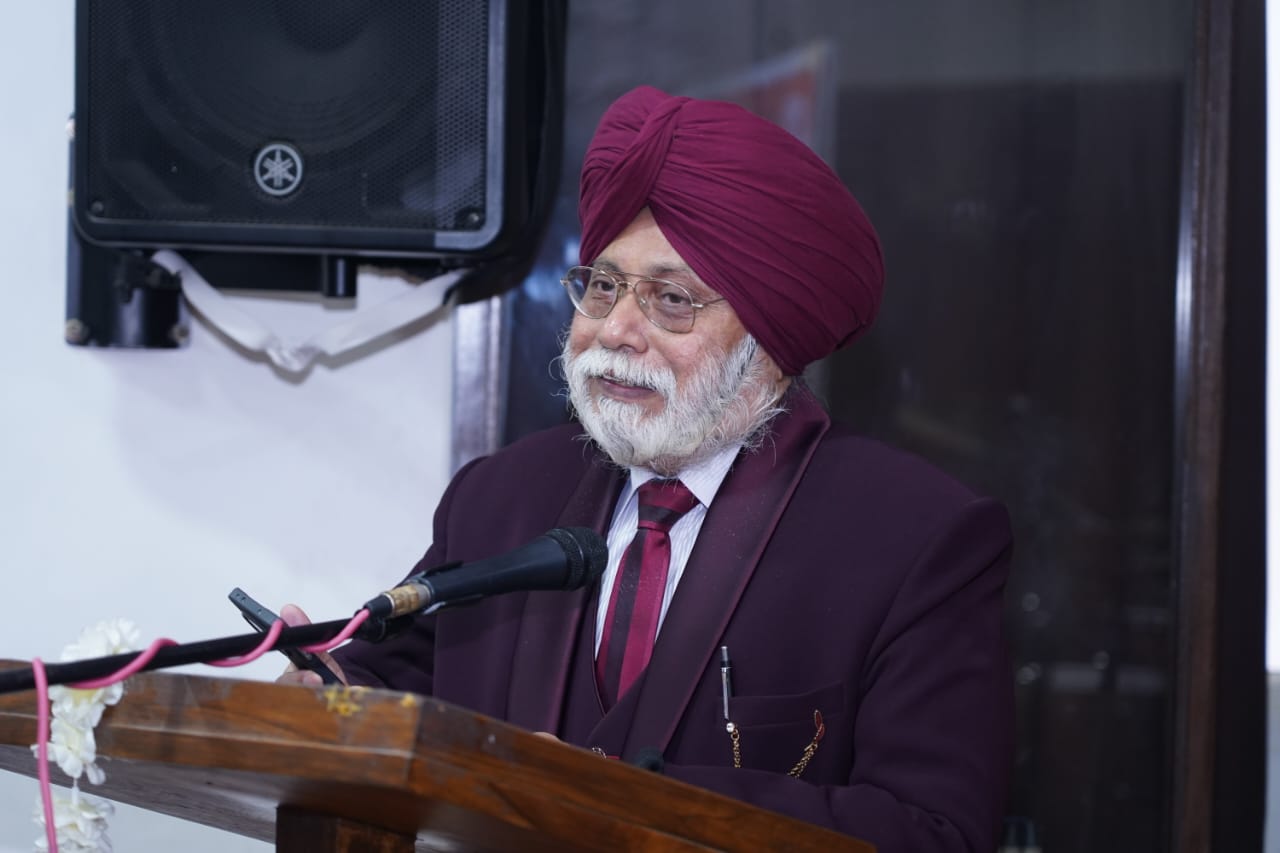
At a recent Poetry Conference organized by Sanskar Bharti, Chandigarh, [4th Jan 2026], Dr. Jernail S. Anand, who chaired the Poetry Conference, in his presidential address made a reference to the raging issues of our times.
Knowledge versus Wisdom
The highlight of his speech was his distinction between Knowledge and Wisdom. He pointed out that Knowledge is the domain of Satan, because it was Satan who had tempted Eve to eat the fruit of Knowledge. The Empire of Knowledge that we have created with science and technology is a great achievement of human mind. But it has a tragic flaw.
After getting knowledge, men should become wise. Where is wisdom? Where is innocence? Guile thy name is man. This is what our knowledge has done to man. He has become a gangster. He is not in his senses today. Success has gone to his head.
Is it not a fall down the abyss? Knowledge has made man proud and arrogant, whereas wisdom makes him humble. This is the line which can be drawn between the two.
The Chaos in Modern Life
Referring to the chaos in the life of the modern man, Dr. Anand observed that we have spent more time on studying history, leaving no space for study of the Present and we have shown absolutely no concern with the Future. He pointed out that Universities which dispense knowledge have Departments of History but where is Dept of the Present and Dept of Future?
The think tanks are discussing history, which is now a fixture and cannot be edited. And what we have missed sorely is planning for today and tomorrow. As an example, he pointed out that our marriages have problems. Is there any new philosophy in place to keep men and women in a state of balance? Can peace be brought to family life? Our girls and women who work in night shifts, when going home in autos, are they safe from gangsters? If not, how can we leave our society fall down the abyss?
Don’t we need to ensure that women are safe in this society? Such things need our attention, not who attacked whom in history and on which date.
Poetry as a Part-time Affair
Dr Anand made a startling disclosure that almost all the poets are part time because Poetry affords no career for anybody on which he could live. Poetry is good as a passion. It is not the cup of tea for the society, for the simple reason that poets are most self-obsessed. If they talk of society, it is in high-flown fantasies. Poets are called unacknowledged legislators, but he thinks that they are para-prophets also.
They feel the pain of the society and present it in their poems. Poetry that is immortal, is the poetry that talks of the immortal, he observed.
Dr Jernail Singh Anand is an Indian poet, with an oeuvre of 200 books, out of which 18 are epics. Laureate of Seneca, Charter of Morava, Franz Kafka, Maxim Gorky Awards, he was recently crowned Best Author of the Year 2025 by a Vietnam Poetry Organization, Rhythm. He is President of the International Academy of Ethics. His name adorns the Poets’ Rock in Serbia. Anand is a towering literary figure whose work embodies a rare fusion of creativity, intellect, and moral vision.
By M. and B. Skelt (publishers) – Folger Shakespeare Library Digital Image Collection http://luna.folger.edu/luna/servlet/s/r8t2ob, CC BY-SA 4.0, https://commons.wikimedia.org/w/index.php?curid=40908149
According to Shakespeare's Macbeth,
Life "is a tale
Told by an idiot, full of sound and fury,
Signifying nothing."
First, some announcements: In February, on Saturday the 28th at 2pm, Synchronized Chaos Magazine partners with the Hayward Lit Hop to co-host the Hayward Coffee Hop.
Join with us to hear poems and sample the wares of four different local coffee shops in downtown Hayward, California (Zocalo’s, Snappy’s, Concha Dreams, and the Old City Roastery). Advance tickets required, reserve your spot here.
In March we will have a presence at the Association of Writing Programs conference in Baltimore which will include a free public offsite reading at Urban Reads on Friday, March 6th at 6 pm. All are welcome to attend!
So far the lineup for our reading, the Audible Browsing Experience, includes Elwin Cotman, Katrina Byrd, Terry Tierney, Terena Bell, Shakespeare Okuni, and our editor, Cristina Deptula. If there’s time, an open mic will follow.
Poet Marin Angel, of Finland and Bulgaria, is forming a new, vast, international poetry society, the Poetic Political Party for Transparency, that will publish books and which seeks editors and writers.
Published poet and contributor Tao Yucheng is still hosting a poetry contest, open to all readers of Synchronized Chaos Magazine.
Synchronized Chaos Poetry Contest: We seek short, powerful, imaginative, and strange poetry. While we welcome all forms of free verse and subject matter, we prefer concise work that makes an impact.
Guidelines: Submit up to five poems per person to taoyucheng921129@proton.me. Each poem should not exceed one page (ideally half a page or less). All styles and themes welcome. Deadline for submissions will be in early March.
Prizes: First Place: $50 Second Place: $10, payable via online transfer. One Honorable Mention. Selected finalists will be published in Synchronized Chaos Magazine.
From Brian: These prose poems and photos are a journey that celebrate memory and colour and the near and far. Please travel along and explore both the written word and the visual narrative. The content will include but not be limited to, forest trails, meadows and skies, grasshoppers and wild clovers, electric light, and various seasons. And at times we will dream, reminisce, and wonder about the world, its form, content, and continual movement.
Now, for February’s second issue! This issue, Sound and Fury, Signifying Everything, as opposed to Macbeth’s feelings of meaninglessness, points to the importance of individual people and relationships, to ordinary settings and personal life stories.
Dmitriy Kogan asserts the value of ordinary words from understandable poets. Mykyta Ryzhykh’s micropoems hit on different nerves: money, guilt, tradition, speech, silence. Christopher Bernard’s first installment of Senor Despair explores the search for hope and meaning in a complex world.
Terry Trowbridge’s speakers inhabit and listen to time, rather than shouting their existences into the world. Mahbub Alam’s speaker slowly awakens from a deep sleep. On the other hand, Aurelia Preskill’s speaker desires to fully inhabit her universe and her own body. Michael Todd Steffen’s pieces concern observation: seeing our world, and the instability of what we see. Janaea Rose Lyn takes us on a poetic journey from grief to cognition to embodiment and, finally, to translucence. Taro Aizu finds gentle peace in everyday blessings and beauty. Jumanazarova Mohlaroyim Islombek qizi explicates the deep and stormy inner world behind Said Ahmad’s ironically titled novel Silence. Timothee Bordenave explores the emotional territory of pleasure, escape, rebirth, and devotion.
J.J. Campbell depicts the debris of soul damage from a long and weary life, but continues living, as he has little choice. Mahbub Alam evokes the solemn weariness of insomnia in an elegant poem. Taylor Dibbert reflects on turning points in a relationship that went south. John Edward Culp’s work quietly dares without becoming showy, as a person eases into the risk of loving and being loved. Kalipada Ghosh celebrates a gentle and inspiring love. Dr. Fernando Martinez Alderete presents the comfort and care of a steady, long-term love. Lan Xin’s love poetry carries a spiritual bent, drawing on metaphors of angels and ancient Chinese temples. Cai Zhenyuan ties love into universal compassion and making moral choices.
Alexa Grospe speaks to the visceral pain of someone struggling to be seen and loved in their ordinary humanness. Jacques Fleury advises readers to become comfortable and at home in their own identities and bodies. Eva Lianou Petropoulou reminds humans not to lose sight of our hearts and creativity in the age of artificial intelligence.
Bill Tope and Doug Hawley contribute a co-written bleak, funny, and tender short story that highlights the humanity not only of disabled people, but all those who age and change with time. Noah Berlatsky comments with humor on physical aging. Dilafro’z Sultanova aspires to health and wellness in her advertising jingle to the Central Asian health drink Beleever. Diyora Abduolimova and Jurayeva Aziza Rakhmatovna discusses the importance of and methods for inclusive education for children with disabilities.
Shoshana Vegh speaks to a mythical love that endures through time. Mesfakus Salahin promises his commitment to his loved one throughout his life journey. Jamal Garougar affirms a quiet, humble love. Mandy Pistikou’s poetry outlines a romantic relationship that grows and deepens with time. Sabo Jurayeva urges people to marry for the right reasons, building strong families on love and commitment rather than infatuation.
Jerrice J. Baptiste’s colorful artwork celebrates the joy of female friendship and sisterhood. Graciela Noemi Villaverde highlights the transformative power of both friendship and love. Sayani Mukherjee explores interpersonal love through the lenses of memory, religion, myth, and culture. Hanaan Abdelkader Ashour honors the love she shared with those who are departed and feels their continued presence.
Halilova Rukshona Abdufattohovna honors the scientific and philosophical legacy of ancient scholar Abu Nasr al-Farabi. Sevara Jo’raqulova highlights the love for Uzbek heritage, nature, and culture in Alexander Faynberg’s poetry.
Duane Vorhees also addresses nature as a theme, speaking to spring’s regrowth in a natural, unsentimental way. Aziza Xazamova shares fun and colorful winter memories. Christina Chin celebrates the clear, pure beauty of winter. Ananya S. Guha’s poetry speaks to natural cycles and resilience, places that keep a hold on people even after they leave. Yongbo Ma constructs an interior landscape built through a variety of objects, places and natural creatures: rocks, tadpoles, frogs, a person’s hometown.
Brian Michael Barbeito’s nature-based prose is quietly luminous, reflective, and tender, reminding us to see the grace in the everyday. Soumen Roy compares the ebbs and flows of relationships to waves at sea. Dr. Jernail S. Anand’s essay highlights the cosmic and natural power balances of the universe.
G’afforova Hadichaxon Abduhamid qizi also writes from a wide perspective, addressing the importance of addressing air pollution on systemic as well as individual levels. Jalolova Charos weighs various sustainable design models for our world’s growing cities. Mamatraimova Khadicha Eshali qizi discusses toponymy, the science of naming places and landforms, in a certain area of Uzbekistan. Dildora Xo’jyozova appreciates Uzbekistan’s rich and multilayered history and culture. Shahnoza Ochildiyeva celebrates the literary legacy of Uzbek writer and social theorist Chol’pon.
Razzokova Feruza’s essay discusses how language and culture influence emotional expression. Mahmudjonova Rushonabonu outlines the global importance of the English language. Qobiljonova Hurixon compares advantages of blended and traditional education for those learning English as a second language. Sultonova Shahlo Baxtiyor qizi discusses ways to overcome cognitive and psychological barriers to language learning. Axramonova Laylo O’ktam qizi discusses the impact of bilingualism on personality.
Sultonmurodova Aqida identifies and offers solutions to problems students face with learning foreign languages. Shodiqulova Dilorom Niymatulla qizi highlights the value of teachers’ classroom preparation and evaluation tasks in helping students learn languages and other subjects. Mahamqulova Ruhshona Rustam qizi discusses the cultural and psychological benefits of joint educational programs, where a student may receive academic credit from institutions in different countries. Mominova Nozimakhon highlights the many ways education benefits society at large.
Xolmurotova Gulzoda outlines roles of digital platforms in language learning. Jumanazarova Nafisa discusses roles for artificial intelligence in learning English. Mamatova Mahbuba Abdulboqi qizi addresses the proper pedagogical conditions for using project-based technology in teaching literature. To’g’ilova Dinora shows how mobile apps can help students learn the Korean language. Abduhamidova Nihola shares methodological foundations for multimedia tools in language lessons. Madinaxon Tu’ychiyeva explores the efficacy of digitally based learning. Olimova Marjona Ubaydullayevna discusses how artificial intelligence can help with language learning.
Saida Turdiboyeva reflects on how artificial intelligence is changing our lives. Azimov Mirsaid Salimovich highlights the growing importance of computer code in global infrastructure. Nematova Zarina Ochilboyevna points to the emerging trend of digitization in the labor market. Toshbekova Nozima offers suggestions to address youth unemployment. Abdiyeva Mahbuba Rahmiddinova advocates for increased attention to women’s entrepreneurship as a pathway to economic development and empowerment. Zarina Yorboboyeva discusses ways to improve strategic management in business enterprises in Central Asia. Shonazarov Shohjaxon outlines advantages and disadvantages of modern consumer credit.
J.K. Durick’s pieces speak to automation and modern life, the slow erasure of the self. Bozorboyeva Nasiba Ergashboy qizi urges wisdom and foresight in the development and rollout of artificial intelligence technology. Mo’minova Rukhshona highlights how science should not be separated from ethics.
Gaurav Ojha encourages revolutionaries and activists to keep up their spirit and idealism. Norman J. Olson’s drawing conveys the current atmosphere of Minneapolis. Patricia Doyne highlights inconsistencies in American public policy regarding firearms and cultural violence. Kujtim Hajdari laments the destruction and sorrow war causes.
Mauro Montacchiesi highlights themes of moral and psychological choices in the here and now in Dr. Jernail Singh’s book Beyond Heaven, Beyond Hell. James Tian excoriates religion enforced through fear and moral blackmail. Mohammad Sedigh Haghighi reminds us that meaning cannot be outsourced, we are all tasked with a long and personal quest to find what matters.
Ruziyeva Nigina Sanat kizi delves into the moral and spiritual aspects of O’tkir Hoshimov’s work. Jakhongir Nomozov interviews Azerbaijani poet, translator, and journalist Aysel Khanlargizi Safarli on beauty, meaning, and spiritual understanding in her work.
Sevinch Botirjonova explicates the power of words in an increasingly connected world. Stephen Jarrell Williams speaks to memory, faith, and history. Nozima Gofurova highlights the thoughtful literary criticism of Ozod Sharafiddinov and how he examined literature as a force to mold and inspire society as well as elegant entertainment. Jumayev Sanjar Ilyos ogli celebrates the many roles of Uzbekistan’s young people in shaping the country’s future.
This article explores the impact of social media on various aspects of human life, including communication, mental health, education, and social behaviour. While social media has created new opportunities for global connectivity, self-expression, and information sharing, it has also contributed to psychological issues such as anxiety, addiction, and reduced face-to-face interactions. By analysing both positive and negative effects, the study provides a balanced understanding of how social media shapes modern society.
Keywords: Social media, human life, communication, mental health, digital behaviour, online interaction, technology
ANNOTATSIYA
Ushbu maqolada ijtimoiy tarmoqlarning inson hayotiga ta’siri, xususan muloqot, ruhiy salomatlik, ta’lim jarayoni va ijtimoiy xulq-atvorga ko‘rsatadigan ta’siri tahlil qilinadi. Ijtimoiy tarmoqlar global muloqot, o‘zini ifoda etish va axborot almashinuvi uchun yangi imkoniyatlar yaratgan bo‘lsa-da, ular tashvish, qaramlik va yuzma-yuz muloqotning kamayishi kabi salbiy holatlarga ham sabab bo‘lmoqda. Tadqiqot ijobiy va salbiy ta’sirlarni solishtirgan holda ijtimoiy tarmoqlarning zamonaviy jamiyatdagi o‘rnini keng yoritadi.
Kalit so‘zlar: Ijtimoiy tarmoqlar, inson hayoti, muloqot, ruhiy salomatlik, raqamli xulq, onlayn muloqot, texnologiya
АННОТАЦИЯ
В данной статье рассматривается влияние социальных сетей на жизнь человека, включая общение, психическое здоровье, образование и социальное поведение. Социальные сети создают новые возможности для глобального общения, самовыражения и обмена информацией. Однако они также способствуют возникновению тревожности, зависимости и снижению очного общения. Анализируя как положительные, так и отрицательные стороны, исследование раскрывает роль социальных сетей в современной жизни общества.
Ключевые слова: Социальные сети, человеческая жизнь, коммуникация, психическое здоровье, цифровое поведение, онлайн-взаимодействие, технологии
INTRODUCTION
Bugungi kunda ijtimoiy tarmoqlar inson hayotining ajralmas qismiga aylangan bo‘lib, odamlarning qanday muloqot qilishi, bilim olishi, ishlashi va munosabatlar o‘rnatishiga katta ta’sir ko‘rsatmoqda. Facebook, Instagram, TikTok va X (Twitter) kabi platformalar odamlar o‘rtasida tezkor axborot almashinuvi va uzoq masofalardagi aloqalarni saqlashni osonlashtiradi. Shu bilan birga, ijtimoiy tarmoqlardan keng foydalanish maxfiylik, psixologik holat va ijtimoiy munosabatlar borasida xavotirlarni ham keltirib chiqarmoqda. Ushbu maqola ijtimoiy tarmoqlarning ikki tomonlama — foydali jihatlari va salbiy oqibatlarini o‘rganib, masalaning mohiyatiga chuqur yondashadi. Bunday tahlil sog‘lom raqamli odatlarni shakllantirish va ijtimoiy tarmoqlardan mas’uliyatli foydalanishni targ‘ib etishda muhim ahamiyatga ega.
Artificial Intelligence (AI) has emerged as a pivotal component of contemporary society, exerting a profound influence on diverse facets of human existence. The pervasive influence of AI extends across a multitude of fields, encompassing healthcare, education, entertainment, and everyday activities, thereby restructuring our societal dynamics and technological interactions. An in-depth examination illuminates the extensive impact of AI on human existence.
Artificial Intelligence has played a transformative role in the healthcare sector through its enhancements in diagnostic precision, customization of treatment strategies, and optimization of administrative operations. The utilization of machine learning algorithms enables the examination of medical information for the anticipation of disease epidemics, recognition of patient susceptibility factors, and facilitation of early disease detection. AI-driven instruments, such as image interpretation systems and automated surgical platforms, amplify the accuracy and effectiveness of medical interventions, consequently resulting in improved patient prognoses. Artificial intelligence will definitely cause our workforce to evolve. The alarmist headlines emphasise the loss of jobs to machines, but the real challenge is for humans to find their passion with new responsibilities that require their uniquely human abilities. According to PwC, 7 million existing jobs will be replaced by AI in the UK from 2017-2037, but 7.2 million existing jobs. This uncertainty and the changes to how some will make a living could be challenging.
The transformative impact of artificial intelligence on our society will have far-reaching economic, legal, political and regulatory implications that we need to be discussing and preparing for. Determining who is at fault if an autonomous vehicle hurts a pedestrian or how to manage a global autonomous arms race are just a couple of examples of the challenges to be faced. Will machines become super-intelligent and will humans eventually lose control? While there is debate around how likely this scenario will be we do know that there are always unforeseen consequences when new technology is introduced. Those unintended outcomes of artificial intelligence will likely challenge us all.
Another issue is ensuring that AI doesn’t become so proficient at doing the job it was designed to do that it crosses over ethical or legal boundaries. While the original intent and goal of the AI is to benefit humanity, if it chooses to go about achieving the desired goal in a destructive (yet efficient way) it would negatively impact society. The AI algorithms must be built to align with the overarching goals of humans.
Artificial intelligence algorithms are powered by data. As more and more data is collected about every single minute of every person’s day, our privacy gets compromised. If businesses and governments decide to make decisions based on the intelligence they gather about you like China is doing with its social credit system, it could devolve into social oppression.
CONCLUSION
In conclusion, social media has a significant impact on human life, influencing the way people communicate, learn, and interact with the world. It provides many advantages, such as easy access to information, stronger global connections, and new opportunities for education and self-expression. However, social media also creates challenges, including addiction, mental health issues, misinformation, and a decrease in real-life communication. The overall effect depends on how responsibly individuals use these platforms. Therefore, promoting digital literacy, healthy online habits, and critical thinking is essential. By finding a balance, society can benefit from social media while reducing its negative consequences.
REFERENCE
1. Boyd, D. M., & Ellison, N. B. (2007). Social network sites: Definition, history, and scholarship. Journal of Computer-Mediated Communication, 13(1), 210–230.
2. Kuss, D. J., & Griffiths, M. D. (2017). Social networking sites and addiction: Ten lessons learned. International Journal of Environmental Research and Public Health, 14(3), 311.
3. Andreassen, C. S. (2015). Online social network site addiction: A comprehensive review. Current Addiction Reports, 2(2), 175–184.
4. Valkenburg, P. M., & Peter, J. (2011). Online communication and adolescent well-being: Testing moderating effects of personality and ICQ-use. Computers in Human Behavior, 27(1), 275–284.
5. Hawi, N. S., & Samaha, M. (2017). The relations among social media addiction, self-esteem, and life satisfaction in university students. Social Science Computer Review, 35(5), 576–586.
6. Nurmanova, C. M. K., & Komiljonova, M. A. (2024). WAYS AND SECRETS TO IMPROVE STUDENTS’IELTS WRITING. Academic research in educational sciences, 5(CSPU Conference 1 Part 2), 209-213.
7.Nurmanova, C. M. K., & Komiljonova, M. A. (2024). THE CRUCIAL ROLE OF VOCABULARY IN ENGLISH LANGUAGE PROFICIENCY. Academic research in educational sciences, 5(CSPU Conference 1 Part 2), 205-208.
This article explores the pivotal role of youth in Uzbekistan’s evolving political and social landscape under President Shavkat Mirziyoyev’s “New Uzbekistan” reform agenda. Since assuming office in 2016, Mirziyoyev has prioritized youth engagement, emphasizing their potential as catalysts for democratic progress, economic innovation, and social cohesion. The article examines how policies targeting education, employment, and civic participation have empowered young Uzbekistanis to contribute to nation-building. By analyzing recent initiatives, such as the Youth Parliament and digital governance platforms, alongside Mirziyoyev’s vision of modernization, the study highlights the opportunities and challenges faced by young people in shaping Uzbekistan’s future. Drawing on recent developments, including Uzbekistan’s growing global partnerships and domestic reforms, the article argues that youth involvement is central to sustaining the country’s transformation. It concludes by assessing the long-term impact of youth-driven political engagement in fostering a more open and dynamic society.
Keywords: Youth, Uzbekistan, Shavkat Mirziyoyev, New Uzbekistan, political transformation, social transformation, Youth Parliament, digital governance, education reform, civic participation, international partnerships, economic development, environmental challenges, democratic progress, global integration
Introduction
Uzbekistan, a Central Asian nation with a rich historical legacy, is undergoing a transformative phase under President Shavkat Mirziyoyev’s leadership. Since taking office in 2016, Mirziyoyev has championed the “New Uzbekistan” vision, a multifaceted reform program aimed at modernizing the country’s political, economic, and social systems. Central to this vision is the empowerment of youth, who constitute over 60% of Uzbekistan’s population of approximately 36 million. As Mirziyoyev has stated, “We have created conditions for our youth, they are making effective use of them and conquering great heights”. This quote encapsulates the government’s commitment to harnessing the energy, creativity, and ambition of young Uzbekistanis to drive national progress.
The political landscape in Uzbekistan has historically been centralized, with limited avenues for civic participation. However, Mirziyoyev’s reforms have introduced significant changes, including greater transparency in elections, economic liberalization, and enhanced opportunities for youth engagement. Initiatives such as the Youth Parliament, educational reforms, and digital governance platforms have created new spaces for young people to influence policy and contribute to societal development. This article investigates how these reforms have shaped youth participation in Uzbekistan’s political and social spheres, the challenges they face, and the potential long-term impacts of their involvement. By analyzing recent developments and Uzbekistan’s growing international partnerships, the study underscores the critical role of youth in realizing the “New Uzbekistan” vision.
Materials and Methods
This study adopts a qualitative approach, drawing on secondary data from recent news articles, official government statements, and academic sources to analyze youth engagement in Uzbekistan’s political and social transformation. The research focuses on developments from 2024 to July 2025, ensuring relevance to current trends. Key sources include reports from Daryo News, Global Voices, and Zamin.uz, which provide insights into recent policy initiatives and youth-focused programs. Additionally, President Mirziyoyev’s public statements and policy announcements are examined to understand the government’s strategic priorities.
The analysis follows the IMRAD structure, with a focus on thematic content analysis to identify recurring themes in youth engagement, such as education, civic participation, and economic opportunities. The study also incorporates Uzbekistan’s international collaborations, particularly with Azerbaijan and Hungary, to contextualize its global integration efforts. Limitations include the reliance on secondary sources and the potential for bias in state-affiliated media, which is mitigated by cross-referencing with independent outlets and international reports.
Results
Youth-Centric Policy Initiatives
Mirziyoyev’s administration has implemented several initiatives to empower youth, aligning with the “New Uzbekistan” vision of an “open and fair society that cares about every citizen”. One flagship program is the establishment of the Youth Parliament under the Oliy Majlis (Uzbekistan’s legislature), which provides a platform for young people to engage in legislative processes and advocate for policy changes. The Youth Parliament fosters political awareness and leadership skills, enabling young Uzbekistanis to influence national development.
Educational reforms have also been a cornerstone of youth empowerment. The renovation of institutions like the Benkov Art School and the expansion of higher education access reflect a commitment to nurturing talent. Additionally, policies targeting sports development, such as the Concept for the Development of Football until 2030 and preparations for the 2028 Olympic and Paralympic Games, have created opportunities for young athletes to excel globally, boosting national pride and youth confidence.
Digital Governance and Civic Engagement
The introduction of digital governance platforms has revolutionized youth participation in Uzbekistan. Online portals and mobile applications allow young citizens to interact with government services, provide feedback, and participate in decision-making processes. These platforms align with Mirziyoyev’s emphasis on digital transformation, as seen in discussions at the Uzbekistan-Azerbaijan inter-parliamentary forum, which highlighted digital reforms as a priority for youth inclusion.
International Partnerships and Youth Opportunities
Uzbekistan’s growing international engagement, particularly with countries like Azerbaijan, Hungary, and Slovakia, has created new avenues for youth. The inter-parliamentary forum in Khiva, attended by youth parliament representatives from Uzbekistan and Azerbaijan, emphasized the role of young people in fostering bilateral cooperation in education, culture, and digital innovation. Similarly, strategic partnerships with EU nations have facilitated educational exchanges and training programs, enhancing the skills of young Uzbekistan.
Challenges to Youth Engagement
Despite these advancements, challenges persist. Political participation remains limited by bureaucratic hurdles and a historically centralized system, which can discourage youth activism. Economic disparities, particularly in rural areas, hinder equal access to opportunities. Moreover, while digital platforms have increased engagement, digital literacy gaps among some youth populations limit their effectiveness. These challenges highlight the need for sustained investment in infrastructure and education to ensure inclusive participation.
Discussion
The results demonstrate that Mirziyoyev’s “New Uzbekistan” vision has significantly reshaped the role of youth in the country’s political and social fabric. The Youth Parliament and digital governance initiatives have created unprecedented opportunities for young people to engage in governance, reflecting a shift toward a more inclusive political system. The emphasis on education and sports, as evidenced by reforms in the arts and athletics, underscores the government’s recognition of youth as drivers of cultural and economic progress.
However, the vagueness of the “New Uzbekistan” concept, as noted by some analysts, poses a challenge in translating reforms into tangible outcomes. While Mirziyoyev’s government has made strides in opening up the political system, the legacy of centralized governance means that youth participation is still developing. The success of football reforms, for instance, serves as a metaphor for broader systemic changes, but questions remain about their depth and sustainability.
Internationally, Uzbekistan’s partnerships with Azerbaijan and EU countries signal a commitment to integrating youth into global networks. The inter-parliamentary forum in Khiva and agreements on education and digital transformation highlight the potential for cross-border youth collaboration. Yet, economic and digital divides within Uzbekistan must be addressed to ensure that all young people, regardless of region or background, can benefit from these opportunities.
The long-term impact of youth engagement depends on the government’s ability to sustain these reforms. Mirziyoyev’s quote, “We guarantee the interests of every incoming investor”, reflects a broader commitment to creating an enabling environment for growth, which includes empowering youth as stakeholders in development. By fostering a generation of educated, politically active, and globally connected young people, Uzbekistan is laying the foundation for a modern, democratic state.
Conclusion
Under Shavkat Mirziyoyev’s leadership, Uzbekistan is witnessing a transformative era where youth are at the forefront of political and social change. The “New Uzbekistan” vision has catalyzed reforms that empower young people through education, civic participation, and international collaboration. While challenges such as bureaucratic barriers and economic disparities remain, the establishment of platforms like the Youth Parliament and digital governance systems marks significant progress. The sustained engagement of youth will be critical to realizing Mirziyoyev’s vision of an open and fair society. Future research should explore the measurable impacts of these initiatives on youth empowerment and their role in shaping Uzbekistan’s democratic future.
References
1. Daryo News. (2025, July 2). Uzbekistan to expand fine and applied arts with major reforms and youth initiatives. Retrieved from daryo.uz
5. Daily News Hungary. (2025, June 12). Shavkat Mirziyoyev’s “New Uzbekistan” vision leads the country toward a modern and democratic State. Retrieved from dailynewshungary.com
7. Azernews. (2025, July 2). Azerbaijan, Uzbekistan chart course for enduring cooperation – ahead of President Mirziyoyev’s visit to Baku. Retrieved from en.trend.az
THE CONSTITUTION AS A GUARANTEE OF FREEDOM AND PROSPERITY
Jumayev Sanjar Ilyos ogli is a 3rd-year student of the Faculty of Law at the Karakalpak State University named after Berdaq E-mail:sanjar2005j@outlook.com | Phone: +998 88 656 6005
Academic supervisor:Gulimov Amanlik Bazarbayevich, Doctor of Law, Professor at the Karakalpak State University named after Berdaq
Abstract
This article examines the Constitution of the Republic of Uzbekistan as the supreme legal instrument guaranteeing individual freedom, human dignity, and long-term national prosperity. Relying on the 2023 constitutional reforms and contemporary theories of constitutionalism, the study analyzes how the principles of sovereignty, the rule of law, separation of powers, and political pluralism form a stable foundation for democratic governance. Special attention is given to the Constitution’s human-rights architecture, including the recognition of human dignity as the highest value, the direct applicability of constitutional norms, and the mechanisms ensuring judicial protection. Furthermore, the article explores the Constitution’s role in shaping a modern social state, safeguarding economic rights, reinforcing legal predictability, and promoting peaceful international engagement. The research concludes that the renewed Constitution of Uzbekistan functions not only as a legal framework but also as a strategic blueprint for ensuring freedom, justice, sustainable development, and the well-being of present and future generations.
Keywords: Constitution; constitutionalism; rule of law; human dignity; fundamental rights; sovereignty; separation of powers; democratic governance; social state; legal certainty; economic rights; Uzbekistan Constitution; international law; national prosperity.
Introduction
A constitution represents the supreme legal and political framework through which a state defines its fundamental principles, delineates the structure of public authority, and secures the rights and freedoms of its citizens. In modern constitutional theory, it operates as both a normative instrument of governance and a social contract reflecting the collective will of the people. As the embodiment of constitutionalism, a constitution limits state power, ensures the rule of law, and establishes mechanisms that safeguard individual autonomy against arbitrary interference.
Within this theoretical context, the Constitution of the Republic of Uzbekistan occupies a central place in shaping the country’s democratic transformation. The 2023 constitutional reforms introduced a substantially modernized legal and institutional architecture designed to strengthen the protection of human rights, enhance governmental accountability, and promote the principles of social justice and sustainable development. By reaffirming human dignity as the highest constitutional value, expanding the catalogue of fundamental rights, and reinforcing guarantees of legality and judicial independence, the renewed Constitution reflects global constitutional standards while preserving the nation’s historical identity and statehood traditions.
The significance of the Constitution extends beyond its legal dimensions: it serves as a strategic blueprint for building an open, just, and prosperous society. As the foundational legal act with direct effect throughout the state’s territory, it establishes the principles of sovereignty, political pluralism, separation of powers, and civic participation—all of which contribute to long-term social stability and economic growth.
Accordingly, this article examines the Constitution of Uzbekistan as the primary guarantor of freedom and prosperity. It explores the theoretical foundations of constitutionalism, analyzes the constitutional mechanisms that protect fundamental rights, and assesses how the renewed Constitution provides an institutional environment conducive to human well-being, democratic governance, and national progress. The central argument advanced herein is that the modernized Constitution functions not merely as a legal document but as a comprehensive framework that secures liberty, justice, and sustainable prosperity for present and future generations.
Methods
This study employs a multidisciplinary legal research methodology that integrates doctrinal analysis, comparative constitutional review, and normative evaluation to examine the Constitution of the Republic of Uzbekistan as a guarantor of freedom and prosperity. The methodological approach is structured around four primary components.
First, a doctrinal (black-letter law) analysis is conducted to interpret the constitutional provisions directly relevant to sovereignty (Article 1), popular legitimacy (Article 7), fundamental rights (Articles 13–35), the rule of law and supremacy of the Constitution (Article 15), separation of powers (Article 11), and political pluralism (Article 12). This analysis allows for a precise understanding of the normative functions, internal coherence, and legal effects of constitutional norms within the national legal system. The text of the Constitution (2023 edition), as published on the official legal portal Lex.uz, serves as the primary source.
Second, the research applies a comparative constitutional methodology to situate Uzbekistan’s constitutional reforms within the broader global context. This includes examining relevant standards contained in the Universal Declaration of Human Rights (1948), the International Covenant on Civil and Political Rights (1966), the International Covenant on Economic, Social and Cultural Rights (1966), and selected comparative models from civil law and post-Soviet constitutional systems. This method enables the identification of structural similarities, divergences, and harmonization trends between Uzbekistan’s constitutional framework and internationally recognized norms of constitutionalism.
Third, the study uses a normative-evaluative method to assess the extent to which constitutional principles contribute to the realization of freedom, justice, and socio-economic well-being. Particular attention is given to the Constitution’s provisions on the protection of human dignity (Article 13), guarantees of judicial protection (Articles 26–28), and recognition of international law supremacy in relevant contexts (Article 15). These elements are evaluated in light of established theories of constitutionalism, rule of law, and the social state.
Fourth, a systemic-structural analysis is applied to examine how constitutional institutions operate as interdependent components of democratic governance. This includes an assessment of the legislative, executive, and judicial branches, mechanisms of constitutional review, and instruments ensuring civic participation such as referenda (Article 9). The systemic approach also considers the preamble’s emphasis on intergenerational responsibility and sustainable development as a structural objective of constitutional governance.
By synthesizing these methodologies, the research provides a comprehensive assessment of the Constitution as both a supreme legal act and an instrument for ensuring long-term national development. This methodological framework allows for an integrated and scientifically grounded understanding of how constitutional norms operate in practice and how they contribute to the establishment of an open, just, and prosperous society in Uzbekistan.
Results
The research demonstrates that the renewed Constitution of the Republic of Uzbekistan provides a comprehensive legal framework that effectively secures fundamental freedoms, reinforces institutional accountability, and promotes long-term national prosperity. The results are reflected across four major constitutional dimensions.
1. Strengthening Sovereignty and Popular Legitimacy. The findings show that the Constitution firmly establishes Uzbekistan as a sovereign, democratic, social, and secular state (Article 1), thereby consolidating the state’s legal and political independence. Popular sovereignty is articulated through the principle that “the people are the sole source of state power” (Article 7), which aligns with international democratic standards, including Article 21 of the Universal Declaration of Human Rights (UDHR). The prohibition of unauthorized assumption of state power—declared unconstitutional in Article 7—further strengthens political stability and institutional legitimacy.
2. Expansion and Constitutionalization of Fundamental Rights. The analysis confirms a significant expansion of human rights protections, consistent with global human rights instruments such as the ICCPR and ICESCR. Human dignity, declared the “highest constitutional value” (Article 13), serves as the normative foundation for all rights and freedoms. Key protections include:
the right to life and inviolability of the person (Articles 24–25);
guarantees of fair trial, presumption of innocence, and protection from arbitrary detention (Article 26), consistent with Articles 9 and 14 of the ICCPR;
inviolability of private life, personal data, and home (Articles 27–28);
strengthened social, economic, and environmental rights, including labor protections, property guarantees, and environmental safety (Articles 40–50).
Moreover, the Constitution’s direct effect clause (Article 15) ensures that these rights are judicially enforceable without the need for implementing legislation, significantly enhancing access to justice.
3. Reinforcement of the Rule of Law and Institutional Checks and Balances. The results highlight the entrenchment of the rule of law as a constitutional cornerstone. Article 15 establishes constitutional supremacy, while Article 16 prohibits any interpretation or regulation that undermines fundamental constitutional principles. The tripartite separation of powers (Article 11) is further reinforced by:
increased parliamentary oversight over the executive;
enhanced guarantees of judicial independence;
the introduction of more explicit mechanisms for constitutional review.
These developments correspond to Venice Commission standards on constitutional justice and strengthen legal predictability, transparency, and governmental accountability.
4. The Constitution as a Framework for Socio-Economic Prosperity. The renewed Constitution embeds the characteristics of a modern social state by codifying guarantees related to social welfare, entrepreneurship, private property, and sustainable development. The preamble articulates the responsibility to preserve natural resources for “present and future generations,” while environmental protection is constitutionally mandated in Article 50. Economic rights—including the freedom of enterprise, protection of private property, and state obligations to foster a favorable investment environment—align with global economic-governance principles reflected in OECD and UN development frameworks.
Furthermore, the integration of international law into the domestic legal order (Article 15) enhances Uzbekistan’s global economic engagement and strengthens investor confidence, contributing to long-term national prosperity.
Discussion
The findings of this research demonstrate that the renewed Constitution of the Republic of Uzbekistan represents a substantial advancement in the normative foundations of constitutionalism, aligning the country with contemporary global standards of democracy, human rights protection, and sustainable governance. The constitutional reforms are not merely formal amendments; rather, they embody a structural transformation of the legal and institutional order, strengthening both individual freedoms and the state’s capacity to ensure long-term socio-economic development.
1. The Constitution as a Modern Social Contract. The entrenchment of popular sovereignty in Article 7 positions the Constitution as a genuine social contract reflecting the will of the people—an element that resonates with classical constitutional theory from Rousseau to modern democratic governance models. Unlike earlier constitutional frameworks in the region, Uzbekistan’s renewed Constitution provides stronger safeguards to prevent the usurpation of state power, ensuring political legitimacy and stability. This contributes to a governance environment where the rule of law prevails over administrative discretion.
2. Human Dignity and Rights Protection in a Global Context. The explicit recognition of human dignity as “the highest constitutional value” (Article 13) marks a doctrinal shift that brings Uzbekistan in line with the constitutional traditions of Germany, Italy, South Africa, and other states where dignity serves as an interpretive cornerstone. This approach not only strengthens domestic rights protections but also harmonizes with international human rights instruments, particularly the UDHR and ICCPR.
By constitutionalizing a broad spectrum of civil, political, economic, social, and environmental rights, Uzbekistan moves toward a holistic model of constitutional welfare. The direct effect of constitutional norms (Article 15) is particularly significant, as it transforms rights from declarative provisions into enforceable legal entitlements. This positions Uzbekistan alongside jurisdictions such as Spain and Brazil, where constitutional rights enjoy immediate judicial enforceability.
3. Strengthening the Rule of Law and Institutional Accountability. The consolidation of the separation of powers (Article 11) and constitutional supremacy (Article 15) demonstrates a commitment to a stable, predictable legal order. These elements are essential for preventing executive overreach and ensuring the accountability of all branches of government. From a comparative perspective, these developments mirror recommendations of the Venice Commission and the best practices of consolidated democracies. Enhanced judicial independence and expanded possibilities for constitutional review further deepen the rule of law environment, which remains foundational for both human rights protection and socio-economic progress.
4. The Constitution as an Engine of National Prosperity. The renewed Constitution embraces the concept of the social state through provisions guaranteeing social welfare, environmental stewardship, and economic freedom. This multidimensional approach reflects global constitutional trends, where prosperity is understood not solely in economic terms but also in relation to sustainable development, social equity, and intergenerational justice. The explicit constitutional commitment to preserving natural resources for “present and future generations” reflects principles found in the constitutions of Norway, Ecuador, and other environmentally conscious states.
Moreover, the recognition of international treaties as having precedence over conflicting legislation (Article 15) strengthens Uzbekistan’s integration into the global legal system. This fosters legal certainty for investors, facilitates international cooperation, and aligns national legislation with global standards—factors that are crucial for economic modernization and long-term prosperity.
5. Implications for Constitutional Development. The results indicate that Uzbekistan’s constitutional model is evolving toward a hybrid system combining elements of classical liberal constitutionalism, social-state principles, and international legal integration. This positions Uzbekistan uniquely within the post-Soviet legal landscape, signaling a deliberate shift toward global democratic norms while preserving national identity and sovereignty.
Conclusion
The Constitution of the Republic of Uzbekistan stands as the central legal and moral pillar safeguarding human dignity, political freedom, and sustainable national development. The findings of this research confirm that the renewed constitutional text—strengthened through the 2023 reforms—establishes a comprehensive framework aligned with both classical constitutional doctrines and contemporary international standards, including those articulated in the Universal Declaration of Human Rights and the International Covenant on Civil and Political Rights.
By elevating human dignity to the status of the highest constitutional value, guaranteeing the direct effect of constitutional norms (Article 15), and reinforcing the separation of powers (Articles 11–13), the Constitution ensures legal predictability, transparency, and accountability as fundamental governing principles. Moreover, the consolidation of socio-economic rights, the affirmation of the social state model, and the deepening of commitments to lawful international cooperation collectively demonstrate that constitutionalism in Uzbekistan functions not merely as a system of restraints, but as a proactive architecture for societal progress.
Ultimately, the Constitution operates as both a legal guarantor and a long-term strategic blueprint for an open, just, and prosperous society. Its normative strength, institutional coherence, and rights-based philosophy render it a durable foundation for national development and a vital safeguard for the freedoms and well-being of present and future generations.
EDUCATION AS THE KEY TO SUCCESS: ITS ROLE, IMPORTANCE, AND SOCIAL IMPACT IN MODERN SOCIETY
Author: Mominova Nozimakhon
Email: nozimaxonmominova7@gmail.com
Institution: 2nd-year student of the Faculty of Pedagogy and Psychology, Department of Special Pedagogy (Speech Therapy), Kokand State University
Abstract
This article examines education as the main foundation of personal achievement and social development in the modern world. It analyzes the role of education in shaping intellectual abilities, professional skills, moral values, and innovative thinking. The study highlights the connection between education and economic growth, social stability, and national progress. Special attention is given to current challenges in education and possible solutions for improving its quality and accessibility.
Keywords: education, success, personal development, social progress, knowledge, skills, innovation, values, leadership, lifelong learning.
In the twenty-first century, education has become one of the most powerful instruments for achieving success and improving the quality of life. In the past, physical strength and natural talent were considered the main factors of success. However, in today’s knowledge-based society, intellectual abilities, creativity, and continuous learning play a decisive role. Globalization and technological advancement have transformed the labor market and social structure. New professions appear every year, while traditional jobs are replaced by automation and artificial intelligence. In such conditions, education helps individuals adapt to changes, develop new competencies, and remain competitive. Therefore, education is not only a personal right but also a social responsibility.
Moreover, education contributes to the formation of democratic values, critical thinking, and civic awareness. It prepares young people to become active participants in social, economic, and political life. For these reasons, education is widely recognized as the key to sustainable success.
Education is a lifelong process that involves acquiring knowledge, developing skills, and forming ethical principles. It begins in early childhood and continues throughout adulthood. Formal education in schools and universities is supported by informal learning through experience, communication, and self-study. The main purpose of education is not only to transfer information but also to teach individuals how to think, analyze, and evaluate different perspectives. Critical thinking enables people to distinguish between reliable and unreliable information, which is especially important in the digital age. Furthermore, education promotes emotional intelligence and social skills. Through group activities, discussions, and projects, students learn cooperation, leadership, and conflict resolution. These abilities are essential for building successful personal and professional relationships.
Intellectual development is one of the most important outcomes of education. Through systematic learning, individuals improve their memory, attention, logical reasoning, and problem-solving abilities. These skills help them understand complex concepts and apply knowledge in real-life situations. Reading, writing, research, and experimentation stimulate curiosity and creativity. Educated people are more likely to generate new ideas, invent technologies, and contribute to scientific progress. Innovation, in turn, plays a crucial role in economic and social advancement. In addition, education develops digital literacy, which is essential in the modern world. The ability to use computers, analyze data, and communicate online increases professional efficiency and global connectivity.
One of the most visible impacts of education is its influence on career development. In the modern labor market, employers prefer workers who possess specialized knowledge, technical skills, and adaptability. Higher education often provides access to better job opportunities, leadership positions, and financial stability. Professions such as medicine, engineering, law, economics, and information technology require extensive academic preparation. Without proper education, it is difficult to achieve excellence in these fields. Continuous professional training and lifelong learning further enhance career growth. Moreover, education encourages entrepreneurship. Educated individuals are more capable of starting businesses, managing resources, and implementing innovative strategies. As a result, they contribute to job creation and economic development.
Education plays a vital role in shaping moral character and ethical behavior. Schools and universities promote honesty, responsibility, discipline, and respect for others. These values are essential for maintaining social harmony and trust. Through literature, history, and social sciences, students learn about human rights, justice, and cultural diversity. This knowledge helps them develop tolerance and empathy. Educated individuals are more likely to oppose discrimination, violence, and corruption.
Furthermore, moral education strengthens self-control and self-respect. People who possess strong ethical principles can resist negative influences and make responsible life choices. Education is a driving force of social progress and economic growth. Countries with high levels of education usually demonstrate better living standards, technological development, and political stability. An educated population increases productivity and innovation. Education also reduces poverty and social inequality. By providing equal learning opportunities, societies enable individuals from different backgrounds to improve their social status. Scholarships, online learning platforms, and inclusive policies play an important role in this process.
In addition, education improves public health, environmental awareness, and civic participation. Educated citizens are more likely to follow healthy lifestyles, protect natural resources, and engage in community activities. its importance, modern education faces numerous challenges. These include insufficient funding, outdated curricula, lack of qualified teachers, and unequal access to resources. In some regions, poverty and social problems prevent children from attending school regularly. Rapid technological changes require constant updating of teaching methods and materials. Traditional lecture-based approaches are often ineffective in developing practical skills and creativity. Therefore, innovative teaching strategies are necessary. Another challenge is student motivation. Excessive academic pressure, lack of guidance, and limited career awareness can reduce learning interest. Psychological support and career counseling should be integrated into educational systems.
To enhance educational quality, governments and institutions must invest in infrastructure, teacher training, and digital technologies. Modern classrooms should be equipped with computers, internet access, and interactive tools. Teacher professionalism is a key factor in educational success. Continuous training programs help educators adopt new pedagogical approaches and improve communication with students. Collaboration between schools, universities, and industries can also increase practical relevance. Furthermore, personalized learning and inclusive education should be promoted. Students have different abilities and learning styles, so flexible curricula and supportive environments are essential.
In the contemporary world, education does not end with graduation. Lifelong learning enables individuals to update their knowledge and adapt to changing professional requirements. Online courses, workshops, and self-study resources provide opportunities for continuous development. Lifelong learning enhances self-confidence and career resilience. People who regularly improve their skills are more capable of overcoming economic and technological challenges. It also contributes to personal fulfillment and social engagement. In conclusion, education is truly the key to success in personal, professional, and social life. It develops intellectual abilities, builds moral character, expands career opportunities, and promotes economic growth.
Through education, individuals gain confidence, independence, and innovative thinking. To achieve sustainable development, societies must prioritize quality education and lifelong learning. Governments, institutions, families, and individuals should cooperate to create supportive learning environments. Only through continuous education and self-improvement can people achieve lasting success and contribute to the prosperity of humanity.
References
1. UNESCO. (2022). Education for Sustainable Development.