Ekphrastic Prose from Sandra Rogers-Hare

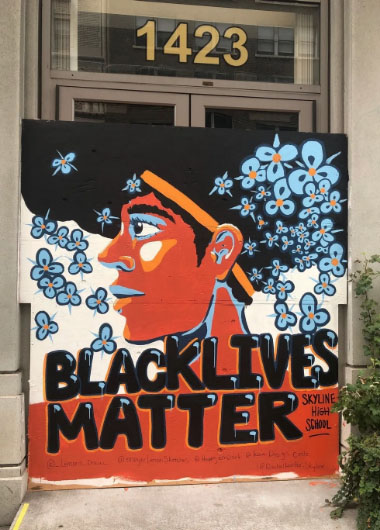
BLM

JACOB BLAKE

Count them on one hand

times we witnessed an event as a nation

      Apollo moon landing in collective awe

      Washington Mall, swearing in Barack Obama

      Paris. Replays of Princess Diana’s deadly car crash—

George Floyd died under the knee of a policeman

throngs of people and three officers looked on

Americans wrenched in pain, my hand flew to my lips

      He took his dying breath,

      “Mama!”

Americans moaned, Ahhh nooo

      That happened?

People all over the world witnessed Floyd’s death

It changed the dimensions of America

That day George Floyd died,

      so did the brittle transparent bubble

      that separated me from society.  Snap! 

      American consciousness changed.

Now, we say we need to learn about African Americans. 

We don’t know who they are.

Black  conjures slavery, church-going folks, poverty, drugs, urban crime.  

Dialogue flies across the airways

      the words pile up between us

      we’re not really closer,

      not as close as that intimate moment          

      George Floyd drew his last breath.

So, we’re all dealing with this

taking the measure of all things in our lives

What?  Jacob Blake?!  Police shot him in the back.

      Seven times.

      Plucked his shirt, stretched as Jacob bent to get in his car

      his three young sons in the back seat

      Why?

African Americans:  Images of Mammy, plantations, cotton picking

People don’t know the amazing things Africans did. 

Mansa Musa, the tenth ruler of the Mali Empire

      Was richer than Jeff Bezos

      Mansa Musa went to Cairo and spread so much gold around

      He broke the economy

      Amazon smiles

Jacob Blake’s family knew their history.

His parents were educated, enlightened people,

Helped people in Evanston, where Jacob grew up. 

Americans didn’t know that or about

      All those years of slavery, abuse

      Forced labor even after slavery was abolished         

      All those years

      Shackled to a stone blocking the American dream

After all those years, all that education, all that enlightenment

Jacob Blake is in a coma in a hospital in Kenosha, Wisconsin

handcuffed to his bed.

      After all those years,

      and all that history,

      Jacob Blake, the black man,

      is still in chains.

August 23, 2020
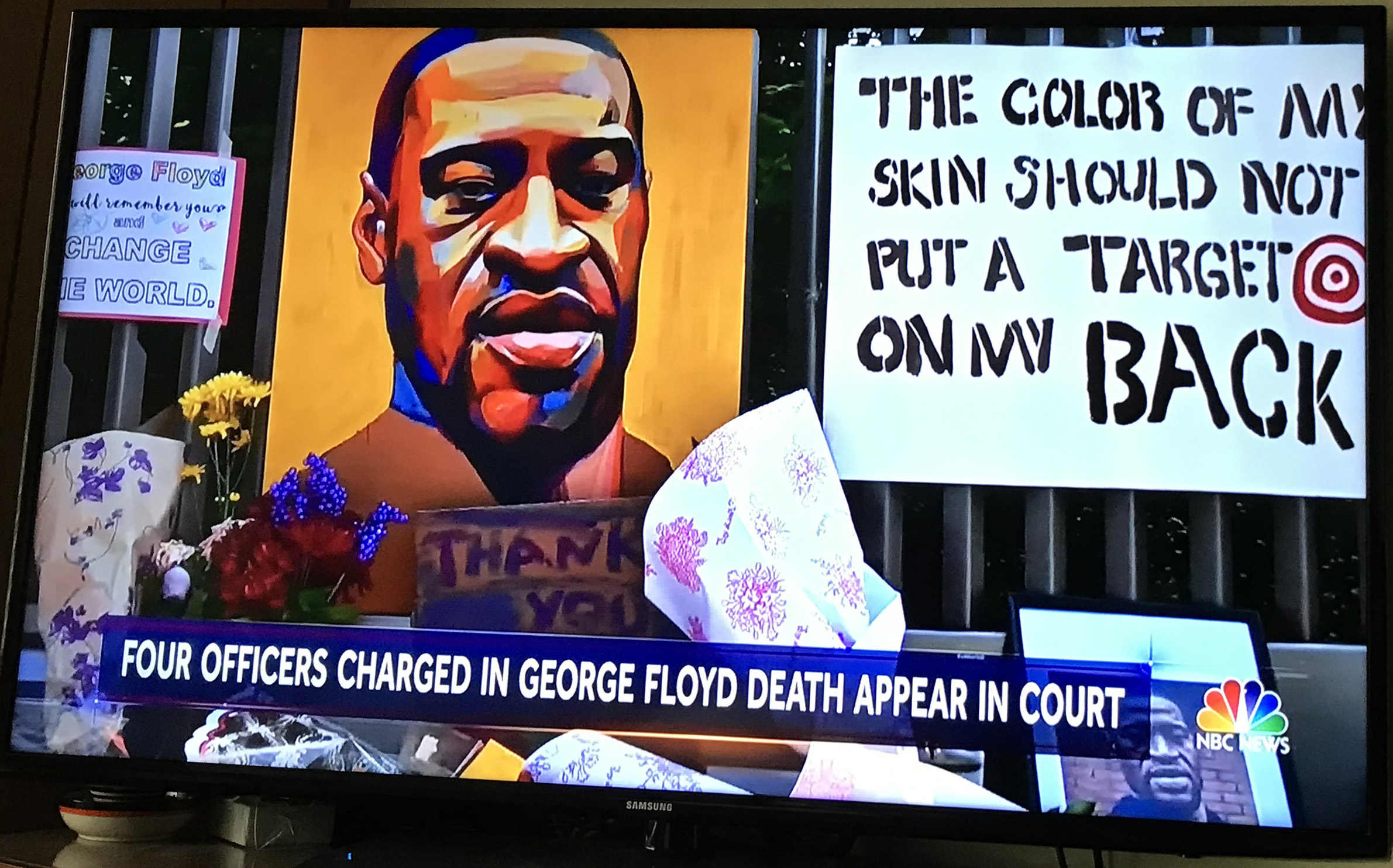
GEORGE FLOYD

On May 25, the day George Floyd died

at the hands of the Minneapolis police, both CNN and MSNBC

stopped posting the daily coronavirus count. On that day, everything changed.

What does COVID-19 have to do with the anguished cries of a dying man pinned under the knee of a veteran police officer, hands in his pockets, leaning in with determination?

What does 400 years of institutionalized, cultural and systemic racism have to do with a pandemic?

The police stopped and harassed Mama and my father

driving around St. Paul, Minnesota in the ’40s—

a white woman with a black man.

I can see them now, her blonde hair lilting

she snaps her head around, tense,

and my father, cool, a cigarette dangling from his mouth,

asks languidly, what’s the problem, officer?

He was better educated, more articulate than the police,

probably nattily dressed in slacks and sport coat for his lady.

It wasn’t his first time being stopped.

He attended communist party meetings where they discussed

racial prejudice and revolution.

Police abuse is common knowledge in the Twin Cities,

common as wallpaper, 

racial tensions have been simmering at a steady burn since forever. 

Floyd George was not the only one. There are countless others.

His killing catalyzed demonstrations across the country,

indeed, around the world,

Floyd George was actually the fifth death

at the hands of Minneapolis police since 2018.

A plague and a pestilence. 


Sandra is a renegade artist and writer, and the founder of the Genghis Khan Urban Guerrilla Research Society.

Ekphrastic Poetry from Mark Young

Representation II

The orchestra under the cypress

tree kicks into life. A few bars;

& then the scene we’re watching

on the small screen is replicated

on a larger canvas that still permits

the original viewing platform to

be included in the corner, picture-

within-picture style, framed by

the only thing that might be a

goal were it not for the pawn on

top. Or maybe it was the other

way around & downsizing has

occurred. No spectators to see

the “world game” shrunk to three

a-side. The château now a simple

manor house. A lone pianola.

Rene Magritte, Representation II, 1962

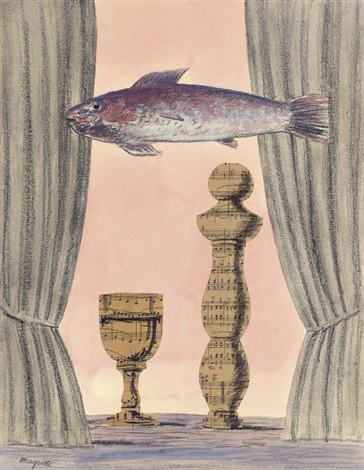
L’esprit et la forme (1928)

There is much to

sing about here.

The glass of water.

The fish out of it

but still swimming

happily around. The

pawn, token of a

game she has just

learnt but is much

taken by. Which she

has natural advant-

ages in since she can

float above it & read

the play as easily as

she can read the myst-

eries of the sea floor.

René Magritte, L’esprit et la forme , 1961

Tous Les Jours

Up here in the mountains

it is an everyday thing

to come across vestiges of

earlier climbers &/or the oc-

casional earlier painting.

They may present as tracks

in the earth or discarded

equipment. Sometimes as

ghosts or holograms. Stare

at the latter for long enough

& they sometimes become

embarrassed, begin to speak.

In a thin voice that still 

sparks echoes, this one says:

“I was once the star of The

Age of Enlightenment. Now

the world has forgotten

me. Am I not still beautiful?”

René Magritte, Tous les jours, 1966

La Marchande de Sable

Legerdemain & sympathetic

magic are not confined only

to my paintings. Sometimes

I moonlight as the sandman,

tell stories that throw sand

into the listeners’ eyes to

foster dreams that render the

invisible visible. Georgette is

happy just to watch me work;

but on occasion, when I wish

to explain more fully what is

beneath, behind, the current

painting, I sprinkle sand into

her eyes to make her sleep. She

smiles at my explanations; &

at the pipe I leave beside her to

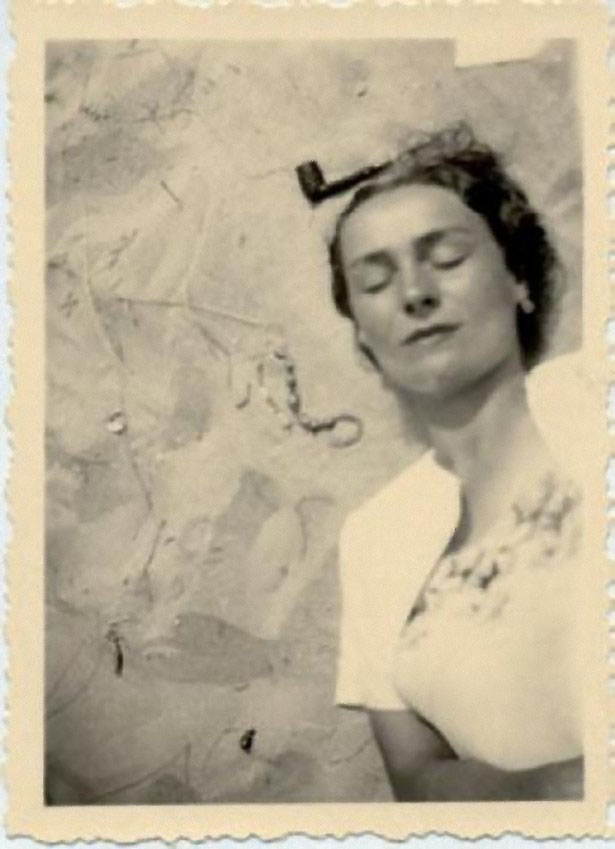
remind her where we’ve been.

René Magritte, la marchande de sable , 1936

Poetry from Jon Bennett

Soles 

There’s a new oddball in town 

I see him on 6th, 

the Tenderloin, the Marina, all over 

This man has made enormous shoes  

out of garbage: 

inner tubes, rags, 

plastic bags, pieces of foam and bark 

These foot rafts 

are up to a yard long 

causing him to walk with visible strain 

sweat on his brow 

But sometimes the shoes shrink 

and he flies along  

at a near sprint 

Down at Chrissy Field 

I finally asked him, 

“What’s the deal with the shoes?” 

He paused, smiled at me, and said, 

“The greater the surface area 

attaching me to your planet 

the less likely I am 

to float  

away.” 

Someone Likes You 

I deleted the dating profile 

then rewrote it  

added some links  

and deleted it again 

Now that it’s blank 

I get these messages, 

“Someone Likes You!” 

and a picture of a ballerina 

or a pole vaulter 

a picture of Farrah Fawcett 

a picture of an alien vampire goddess 

or an irresistible succubus 

selling me  

false hope 

false hope 

false hope 

until I take to the streets

I am Igor,

hunched, hungry 

begging the dealers 

the aqua lung-ed bung squatters 

the remains of pigeons, dogs and televisions 

on my beloved San Francisco sidewalks 

“Do you like me?  

Does anyone?  

Could anyone? 

And, if so, how much 

would it cost?”

The Echo Chamber of My Heart 

“You say you don’t 

have a girlfriend because you’re fat 

but that 

is not the reason! 

Women like 

someone sweet.” 

She’s right, and in this pandemic 

I’ve come to realize 

nothing much has changed for me 

The same longing  

rattles around 

in the echo chamber of my heart 

I could say the heart hardened 

but no, the longing 

is what changed 

only a low buzz now, 

like tinnitus, 

an annoyance rather 

than a plague. 

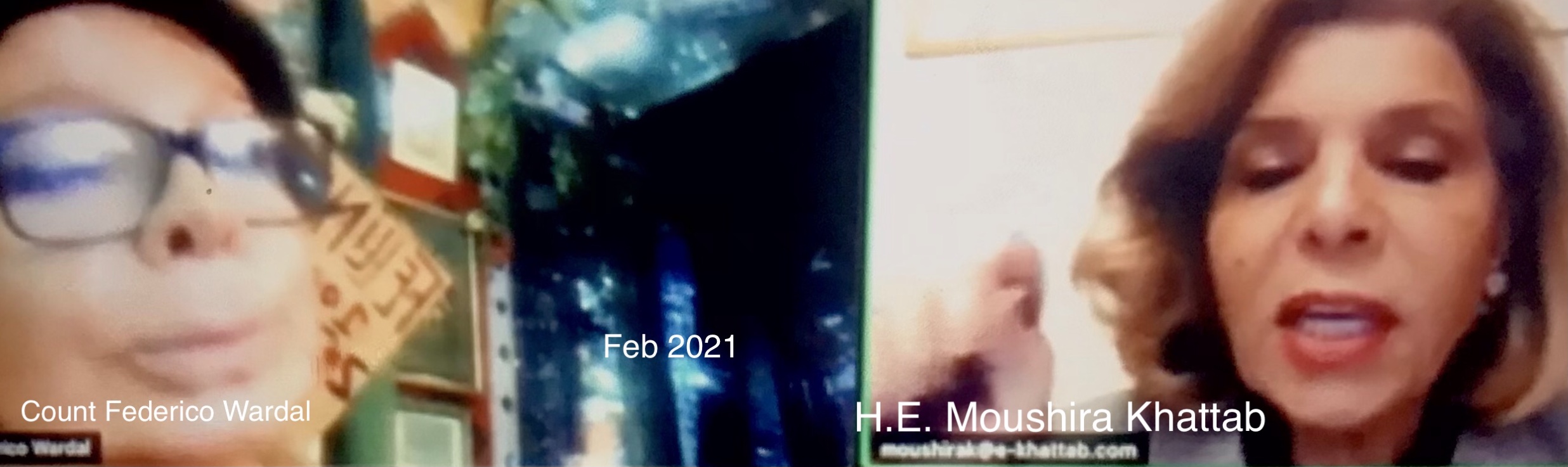
Humanitarian activist and actor Federico Wardal interviews Egyptian human rights leader Moushira Khattab

Young Italian man with glasses next to a darkened theater stage next to a light-skinned woman with lipstick and shoulder-length light brown hair. She appears to be speaking.
Count Federico Wardal, Italian actor and human rights activist, Her Excellency Moushira Khattab

Her Excellency Moushira Khattab, an Egyptian and global human rights leader, gets the attention of more than one million watchers worldwide through “What’s your Right?” a San Francisco TV program. What she does to defend human rights is educate people to be aware what their rights are, first of all.

H.E. Moushira Khattab was honored in San Francisco at the War Memorial Veterans Building, (the site of the 1965 signing of the U.N. Charter), for “The Universal Children’s Day”, an event in San Francisco organized by Hon. Mary Steiner, focused on ending female genital mutilation and child marriage.

Khattab is the first leader in the world to have written a law against FGM (Female Genital Mutilation). This law took effect in Egypt and Khattab supports extending it to rest of the African continent. But this horrible practice, rooted in tradition rather than religion, is still practiced in other continents and even in the USA!

One of Khattab’s mottos is: “give people the educational means so that they are aware of and defend their rights.”

Here is my interview with Her Excellency Moushira Khattab:

Wardal: Your Excellency Moushira Khattab, what are the best strategies that each country should take to raise awareness of human rights?
Khattab: Thank you, Count, for asking me about human rights. Educating the people is the priority in raising awareness of human rights.

To educate all the people, with special care towards the most vulnerable and the poor, is the duty of each state which is legally committed to protect human rights without any discrimination. This includes educating people about the right to equally dignified treatment without any discrimination among rich and poor, males and females, Christians, Jews, Muslims, believers in any other religion, atheists, able-bodied, able-minded or disabled people, different races or sexual or gender orientations. In order to make people aware of their rights, empowering people is not a favor but a duty, a legal obligation for nations.

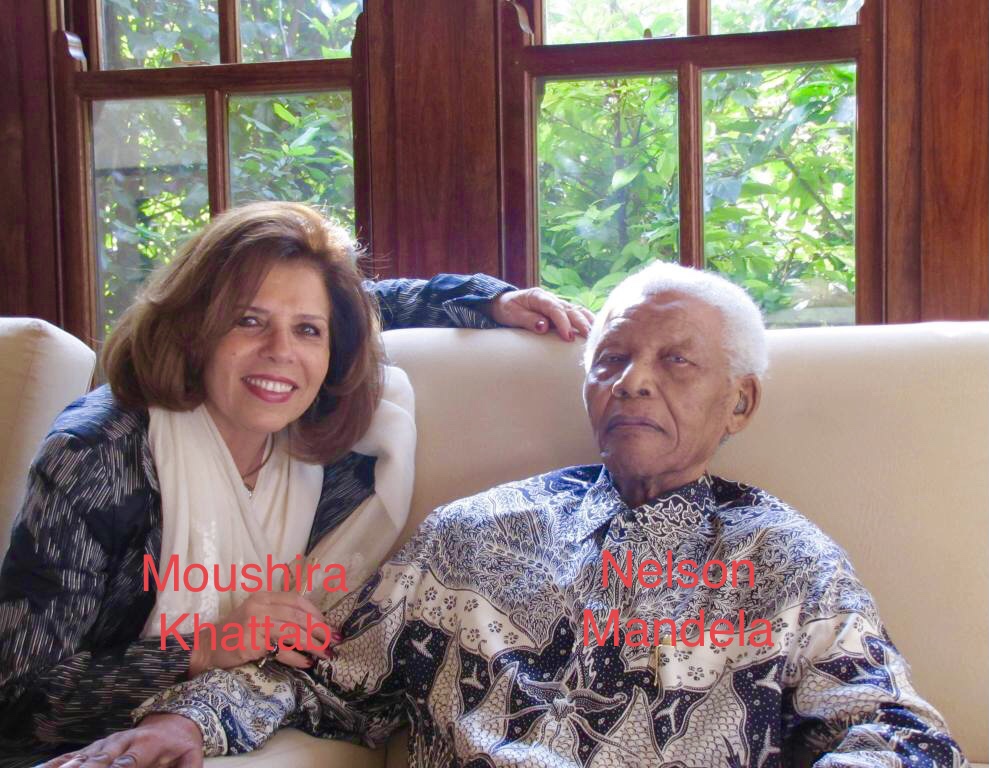
Light-skinned middle aged woman with brown shoulder-length hair sits on a white couch in a living room with windows and green plants outside. She's wearing a white scarf and patterned blue and white top. Nelson Mandela, a white haired Black man, sits next to her and is in a blue and black and white patterned collared shirt.
Her Excellency Moushira Khattab and Nelson Mandela

Wardal: Many planned human rights initiatives and institutions remain inactive and often disband when there is a change of head of state.  How can we avoid such tragic suspension or even cancellation of such activities?  How to make action to promote human rights independent of the changing winds of politics?
Khattab: Thank you very much for this further important question. I repeat, the people are the strongest pillar of any state.  When the people are educated about the rights, they will fight for their rights. When people know their rights they do not fall into oppression by the rich and powerful.

The civil society organizations are very close to the people in Egypt. I am so proud to have coordinated, initiated and led many movements to defend  women and children against FGM, child marriages, human trafficking, and all forms of violence against children. We have seen two revolutions in Egypt: the 2011 Arab Spring and the more recent June 30 revolution. And thank God, the law that I have engineered about Female Genital Mutilation (FGM) is still intact. It is the pride of Egyptian society because it was drafted by the people . 

I spent five years educating the people, parliamentarians, the judiciary, and legislators about FGM and the rights of our children, and I talked about that issue globally as well.  One of the first actions that the Muslim Brotherhood took in 2012 was to try to revoke the FGM law, but the people defended it and the civil society organizations defended it. They said, ‘This is our law, we made this law’ and now this law is intact and thank God, children have more rights,  women have more rights, because people know about the their rights. Political leaders – the head of the state, the judiciary, legislators, executive branch leaders, must be committed to the rights of the people, but the strongest link of this chain is the people themselves.


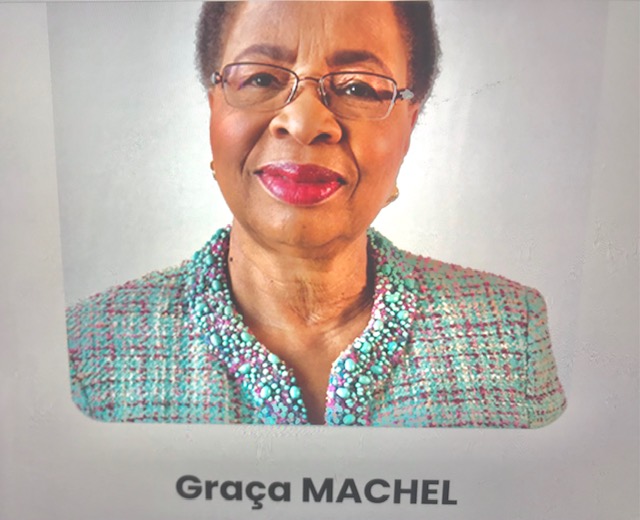
Wardal: Your Excellency is the first vice chairman of the African Committee of Experts on the Rights and Welfare of the Child and you are a member of the International Board of Trustees of the African Child Policy Forum. The president is H.E. Graça Machel, widow of Nelson Mandela. She is an icon. What are the national and international programs led by these organizations?

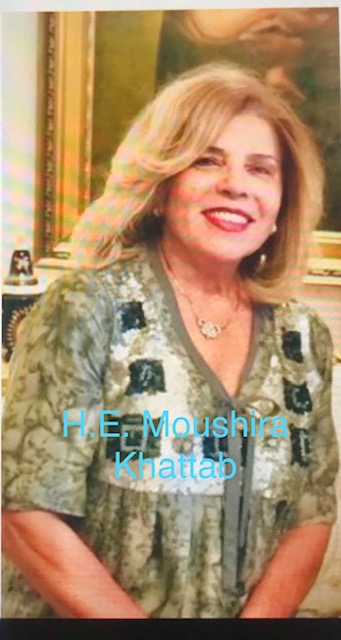
Light skinned, brown haired woman standing in front of a large painting in a gold frame. She's wearing a necklace and a green and white top that looks like tie-dye.
Her Excellency Moushira Khattab

Khattab: I am happy to be part of these organizations. The Rights of African Children is a committee established by the African Charter of the Rights and Welfare of the Child, which is composed of experts with the purpose of assisting member states to fulfill their commitments to the rights of their children. States present periodical reports to the committee and the committee reviews the reports and makes recommendations to delegations of states and to civil society in order to help them advance the rights of children.

The committee looks to see if the states have solid laws that guarantee the rights of children, if the states have a national plan of action, if the states have allocated sufficient financial funds and human resources towards the implementation of plans enhancing children’s rights. They check to see if the government is working in partnership with civil society groups to make people aware of the rights of the child and if children themselves are aware of their rights.

The committee makes recommendations to the delegation of states and civil society representatives on how to improve the conditions of children and enforce their rights in cooperation with the African Union and the United Nations. The committee of experts is selected by the nation’s representatives to the African Union. The African Child Policy Forum is a very solid civil society organization that works for the rights of African children through providing knowledge and dialogue and advocacy for improvement. 

The African Policy Forum works to make sure that African governments are continually fulfilling their child rights obligations and legal responsibilities and putting in place policies and legal protection for the wellbeing of all children. These include vulnerable children, poor children, children separated from their families, refugee children, internally displaced children due to armed conflicts. Issues of concern to us include child and human trafficking, child soldiers, child marriage, and child labor.

Flyer announcing Her Excellency Moushira Khattab's appearance at San Francisco's Universal Children's Day event.
Announcement for the event in San Francisco where Her Excellency Moushira Khattab spoke

Wardal: Excellency, climate change is making it increasingly harder to sustain life on our planet. We are all weaker and it is more difficult to control the proliferation of viruses and epidemics.  

Khattab: Thank you for this connection you made between climate change and Covid!

The economies and societies of most countries, rich or poor, are set up to function under normal conditions. So when special and emergency conditions such as Covid occur, these systems collapse into chaos, resulting in health and economic catastrophes. Climate change, demographic explosions and wide-ranging damage from conflicts are not taken into account. Political will is insufficient to address this crisis, where peace and security need to be strongly promoted. We need the political will to enable the UN to deal with such a crisis. The UN’ s member states need to review its charter to enable the security counsel to meet its responsibilities. When COVID 19 erupted, Secretary General Antonio Guterres spoke up on March 23, 2020 and invited world leaders to put their guns down and fight Covid-19. A strong food program was successfully implemented to face the COVID emergency during the state of chaos in which humanity had fallen.

Middle aged Black woman with glasses, short curly cropped black hair, lipstick and an aqua, white and purple sweater.
Graca Machel

Wardal: The Nobel Prize-winning genius Marconi, inventor of the radio and telegraph, said, ‘My inventions are for the benefit of humanity and not to be used for its destruction.” On the other hand, there is no such control on the scientific research on viruses.

Khattab: We need international transparency and information sharing in the age of Covid. No nation should hold onto medical information, but should share it instead to protect human beings from falling sick.

This should also apply to the Covid vaccines. Poor people have the right to be protected from the virus as well. The UN has to deal with the distribution of the vaccine and is making decisions right now on who gets the vaccines first and how to make them available to those who cannot pay.

International transparency on this aspect is absolutely necessary in order not to lose further human lives.

Wardal: Excellency, you are always welcome as a guest on my San Francisco television show! I also encourage you to write a book about your immense knowledge of civil and human rights. I know you are busy with vital political activity, but maybe, step by step, you could start to write a book, chapter by chapter. I would be especially happy helping you.

Khattab: Thanks. My children and my friends constantly encourage me to write a book about my long and continuing work to improve living conditions and to guarantee respect, equality, and dignity. I will see. At the moment my life doesn’t leave me this possibility.

Poetry from Eva Petropoulou Lianou

CONTACT

I forgot what a kiss is – the taste of an afternoon coffee. So as the waves pulled from the land, I feel like a desert ship.

Contact, I forgot what that word means, Shipwreck for months In books.

I look for a meaning to embrace me, to tell me everything will be fine .. To go and leave those roses in my father’s memory, To light a candle to the Virgin Mary.

Contact, To be in your dream hug. Let me see your eyes, To smell your perfume. I’m looking for that word in that old dictionary.


Eva was born in Xylokastro where she completed her basics studies. She loved journalism by small and attended journalism lesson at the ANT1 School. In 1994 she worked as a journalist in French newspaper “Le LIBRE JOURNAL,” but her love for Greece won and returned to her sunny home. Since 2002, she lives and works in Athens. She works as a web radio producer reading fairy tales at Radio Logotexniko Vima every Sunday. Recently she became responsible for the children’s literary section of Vivlio Anazitiseis Publications in Cyprus.

She published books and ebooks: ” I and my other avenger, my Skia publications Saita.” “Zeraldin and The elf of the lake” in Italian and in French as well as “The daughter of the Moon” in 2 languages ​​English and Greek. The Moon Daughter published by Ocelotos 4 times, received best reviews for author’s writing and writing style.

She is a member of the UNESCO Logos and Art Group, Writers of Corinth, and Panhellenic Writers Association. Also, her work is mentioned in the Known Greek awarded encyclopedia for Poets and authors, Harry Patsi, page 300.

Her books have been cleared by the Ministry of Education of Cyprus.

Eva’s recent work includes: “The water Amazon fairy called Myrtia”, illustrated by Vivi Markatos, dedicated to a girl that become handicapped after a sexual assault, the translation of stories by Lafcadio Hearn, “Fairy travel with stories from Far East” – an idea that she worked on for more than 6 months – illustrated by Ms. Ntina Anastasiado, a very well-known sculptor and sumi e painter in Greece. 

Blog: http://evalianou.blogspot.gr

E-mail: eviepara@yahoo.fr

Middle aged white woman's headshot, she has a multicolored patterned scarf on her head and dark hair.

Essay from Michael Robinson

The Mob    

April 4, 1968   

Elderly white woman in a blue dress next to an older middle aged Black man in a striped tee shirt, hugging in a pool lounge area.
Michael Robinson, right, with fellow contributor Joan Beebe

Emmett Till, a 14-year-old young black male was beaten, mutilated, and lynched, and shot in the head. He was tied down to a cotton gin-fan and thrown in the Tallahassee River near Money, Mississippi. His crime was that he was accused of flirting with a white woman in a family grocery store. He was abducted four days later. Emmett Till was murdered on August 28, 1955. The lynching of black people (men and women) by the Ku Klux Klan is a great part of America’s history. The lynching of Emmett Till brought lynching to the forefront in America’s national conscience. What has provoked such resentment towards nonwhite races? Issues of injustice, racism, and violence have always been directed towards black Americans. Yet, many black Americans, fought, suffered, and died, for the honor to be an American citizen.  The country learning of Emmett’s fate was outraged. If one is lynched, then no American is safe. Over the years people forgot about the difficulty of the Black Americans.

I was ten years old at the time. The fear and the tightness in my stomach caused me to vomit violently. The mob prowled the city with taunts of “Burn this motherfucker down, burn baby burn!” was the rallying cry, in addition, they repeated “if you don’t have “soul brother” on your door, we’ll burn your house down.” It was April 14, 1968, Martin Luther King had been assassinated. Days later blacks looted and set fire throughout neighborhoods in the nation’s capital. The police and national guards watched the mob devastate the community. The mob set out to destroy and threaten to kill other blacks. My foster father frantically used one sheet of my notebook paper and wrote the words with black shoe polish. “Soul brother” taping it to the front door. Like in the capital riots the mob menaced everyone in the capital that day. 

The Mob    

January 6th, 2021   

“Hang Mike Pence!” they hollered repeatedly. A mob of white supremacists and white nationalists. All of them sent to the nation’s capital by former president Donald J. Trump. The violence and racism have grown in America under the presidency of Donald Trump. Now not only nonwhite races but our government leaders are targets of aggression.   

The white mob erected a gallows on the capitol grounds, while they continued to search the capital looking for Vice president Pence and Speaker Nancy Pelosi to murder them both. Lawmakers were also sought by the intruders in the capital that dreadful day. No one was safe from certain death. This coup led by Donald Trump to maintain power as he was voted out of the presidency in the November elections of 2020. The white mob attacked law enforcement officers on the capitol grounds leaving one officer killed and many severely injured all in the name of white nationalism.   

Adolf Hitler told the German people the lie that it was the Jewish people who were responsible for the predicament of the German nation. Six-million Jews died in concentration camps known as death camps. Adolf Hitler used this hate of the Jewish people to be a dictator. Donald Trump uses the dogma that other races are the enemy. Fear and hate are used by Trump to usurp our democracy. Trump uses deception, hatred, and dread to be a clone of Adolf Hitler.    

 I remember hiding from the black mob in 1968 was a horrific experience. Hearing the story of those lawmakers and staff and others in the capital on January 6th and their recounting the “booming” sounds of glass breaking and banging on the doors by a rabid mob of the crazed white supremacists. Many said that they called their love one to say a final goodbye.

The trauma of facing death as a mob searched for them while destroying everything in their path. It is this violence that never resends in one’s memories. It is sadness and anger that I feel for all those that had to endure such an event in their lives. I walked through the rubble of the riots in a state of shock for years to come. Life seemed surreal to me and death was intimate at that time.  My world had been ravaged by the mob like those in the capital on January 6th.    

The white supremacist destroyed many irreplaceable artworks in the house of the people. Leaving urine and feces on the walls and floors and artwork as reported. Reminding me of the night that the black mob ravaged my neighborhood. Recalling the shouts “Burn this motherfucker down!” Those words echoed in my thoughts for many decades. The insurrectionist shouted for what seemed like an eternity to hang Mike Pence. Hunting our elected officials to hang or execute them is the action of barbarians to commit atrocities against Americans. Led by a psychopathic and sociopathic, and egomaniac racist Donald J. Trump. It does not take courage to be a racist it takes valor to uphold the virtues of being a patriotic American.    

It was revealed that a black capital police officer broke down and wept after the melee said, “Is this America?” Men and women of the capitol police and metropolitan police braved the onslaught of a “murderous” mob of violent white extremists.  Three officers ended up dead from that day. Many survived because of the heroism of those officers protecting them and our capital and democracy.  This “Is America.” An America where courage and dedication to protecting our democratic way of life. The insurrection on January 6th, 2021 will remain one of America’s harrowing moments.   

      Note: Black Americans have lived through the nightmare of being murdered for decades. Black Americans’ pleas have gone unheard. Martin Niemöller wrote, “First they came for the Socialist, and I did not speak out….”     Black Americans have been speaking out for decades and now that the violence has come to the capital of the nation. People now realize that white supremacist are a menace to our nation. Martin Niemöller continued, ‘…when they came for me there was no one left to speak out.”      

Yiddish Theater Ensemble Presents: Sholem Asch’s God of Vengeance, 1906 play directed by Bruce Bierman

Synchronized Chaos is sharing a notice about this upcoming virtual theater show and will review it after opening night.

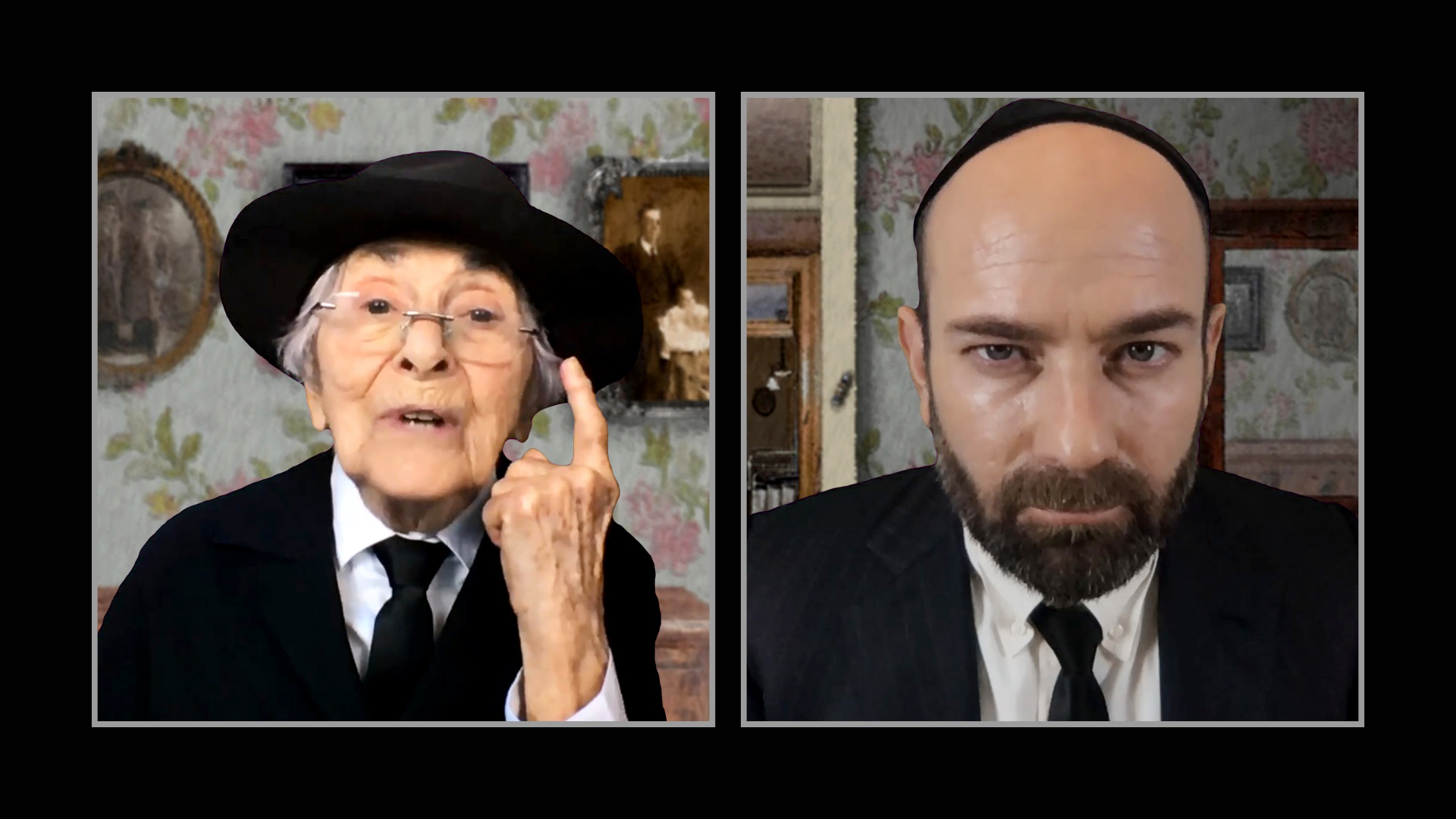
Naomi Newman, Reb Eli and Roni Alperin

Yiddish Theatre EnsemblePresents… God of Vengeance (Got Fun Nekome)

An artful online video adaptation of Sholem Asch’s groundbreaking 1906 Yiddish play

Directed by Bruce Bierman / English translation by Caraid O’Brien

Streaming Saturday, March 20 thru Tuesday, March 23, 2021

Tickets ($18 – $54): klezcalifornia.org/yiddish-theatre-ensemblewww.Eventbrite.com

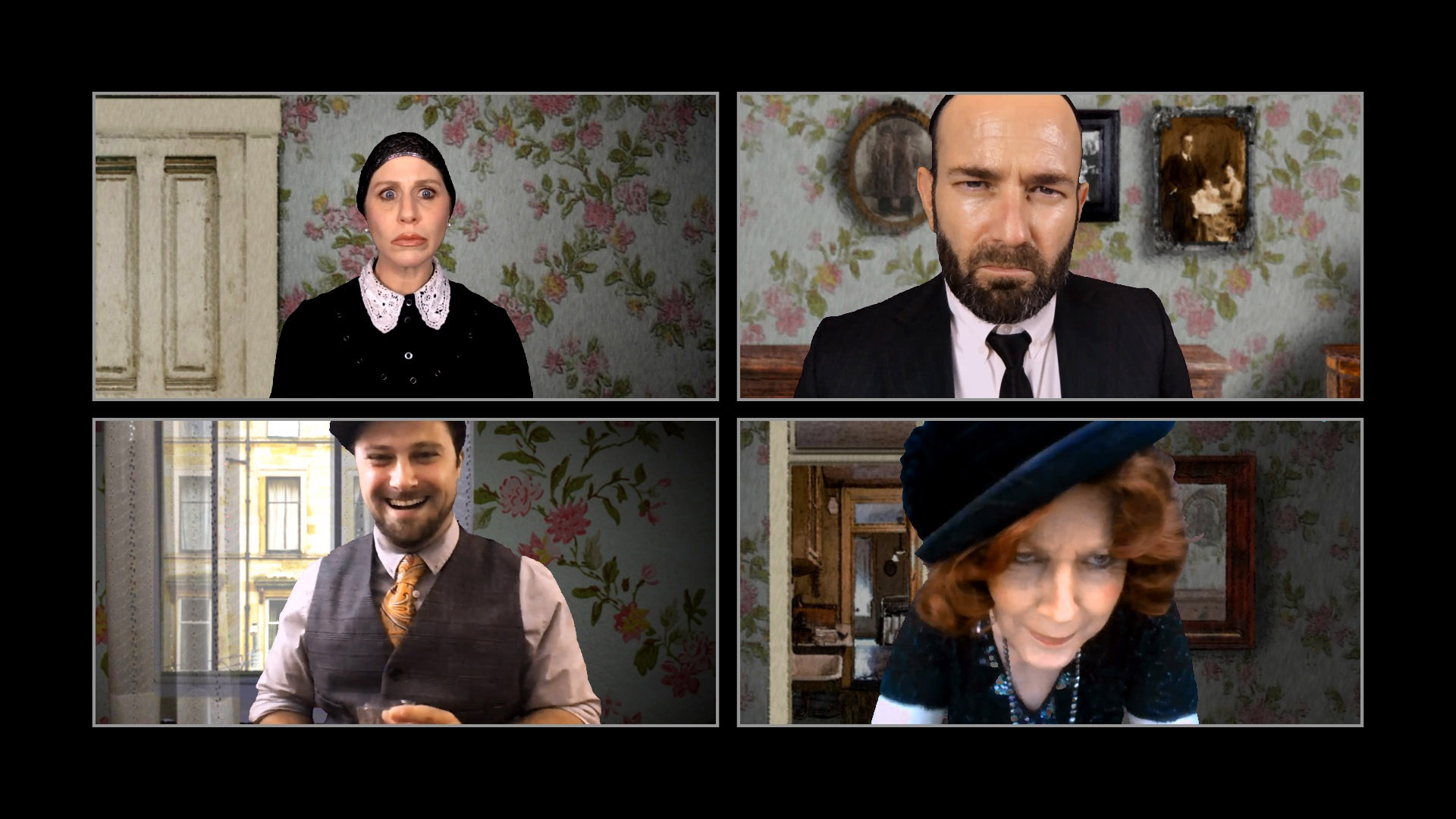
Berkeley, CA… The Yiddish Theatre Ensemble (YTE) planned on presenting the English language translation of the 1906 controversial Yiddish play God of Vengeance (Got Fun Nekome) by Sholem Asch in September 2020 at a theater in Berkeley, California but had to halt production due to the pandemic. Dedicated to this endeavor, YTE devised an innovative approach to presenting theater during this unprecedented time. The play will now be mounted on Vimeo on March 20-23, 2021 as an artful video adaptation with actors from around the country. Due to COVID restrictions, the actors were rehearsed and filmed on Zoom in full character and costume from their respective locations.  (The cast was never actually in the same room together).

The multi-cultural, multi-generational and diverse LGBTQ cast of 17 actors, many of whom had never spoken a word of Yiddish before, comes from the San Francisco Bay Area and beyond (New York and Las Vegas) and includes nonagenarian veteran of stage, Naomi Newman, co-founder of The Traveling Jewish Theater. Local Treasure Naomi Newman: 90 Years Old and Still Acting

As the play has been re-set in New York’s Lower East Side during the Depression, digital set designs (or backdrops) were added creating the 1930’s atmosphere with a distinct graphic novel style. The sets, designed by Production Designer, Jeremy Knight, of West Edge Opera, are inspired by photographs courtesy of the Tenement Museum collection with period costumes coordinated by Wardrobe Consultant, Suzanne Stassevich, formerly of San Francisco Opera. The play will be enhanced by an original score, by San Francisco Bay Area Klezmer musician, David Rosenfeld, anchoring the emotional voice of this evocative family drama. 

This adaptation based on the English translation (but including some Yiddish language and idioms) by Caraid O’Brien stays close to the script with new interpretations of character portrayals and plot development. Themes explored include: issues of domestic violence, dignity and portrayal of sex workers, freedom of expression and acceptance of LGBTQ relationships. As with many of Asch’s plays, powerful female characters give voice and agency to women. The themes speak directly to the inequities of human and civil rights still being fought for today. The play is peppered with humor.

Jill Eickmann-Soreh, Roni Alperin-Yankel, Simon Winheld-Shlomo, Esther Mulligan-Hindl

ABOUT THE PLAY:

God of Vengeance tells the story of a seemingly observant Jewish couple and their daughter Rivkeleh who live upstairs in their Lower East Side apartment during the Great Depression. Yankl and Soreh do their best to protect their only child from mixing with their bustling livelihood—a thriving ‘brothel’ business downstairs in the basement. Rivkeleh is at a marriageable age and plans for a future husband are being made.  She is ensured an attractive dowry when her father commissions a Torah scroll, worth thousands, to be written just for her.  Supposedly, the hand-written scroll is believed to protect her and keep her kosher. Meanwhile young Rivkeleh has fallen in love with Mankeh, one of his prostitutes and a tender relationship blossoms. Tensions mount and soon life upstairs and downstairs begin to entangle. As Yankl’s plans are threatened, he begins to unravel.

The themes of this play are deep and resonate today: can money buy salvation, happiness, holiness? All are explored in this family drama story that has extraordinary tenderness, elements of Greek drama —and a bisl (little) Yiddish. — Laura Sheppard, Producer

Audiences should know this is not, God forbid, a moralistic play! Sholem Asch himself said he didn’t care if he wrote a moral or immoral play. He only cared about writing a good play that had an impact and spoke to people. — Bruce Bierman, Director

Elena Faverio-Rivkel, Zissel Piazza-Mankeh

HISTORY:

After the play’s opening in Berlin, God of Vengeance had tremendous success throughout Europe and was translated into many languages. Upon arriving in New York, it was first seen in Yiddish at the Provincetown Playhouse in the West Village. The 1923 production in English at the Apollo Theatre in New York was the first to portray a lesbian relationship in a sympathetic light and included the first lesbian kiss on Broadway. That production was assailed by members of the religious and cultural establishment and was charged with obscenity and shut down. The producer and company members were arrested and found guilty.

The history of Asch and this play was inspiration for the 2015-2017 Tony award-winning Broadway production Indecent which was also seen at the Oregon Shakespeare Festival for which Director Bruce Bierman served as Yiddish Dance Dramaturge. This production only scratched the surface of the original play. Yiddish Theatre Ensemble would like audiences to experience the power of the characters and immediacy today. Yiddish Theatre Ensemble is particularly interested in Sholem Asch because he was the first playwright to incorporate modernity into his plays, mirroring 20th century life in cities and towns rather than focusing on Biblical stories or folk tales of the past.

ABOUT THE PLAYWRIGHT:

Sholem Asch (1880–1957). Although he penned several of his 18 plays, shorts stories and novels in the US on New York City’s Lower East Side and at his home in Staten Island, Asch wrote only in Yiddish. Asch is often mentioned in the same breath as other modern Yiddish fiction writers like Sholem Aleichem and I.L. Peretz. The Polish-born author and playwright is the first Yiddish writer to be widely translated into English and to gain worldwide renown, and to have a bestseller in English (The Nazarene). The star literary contributor of the Yiddish newspaper, The Forward (Forverts) from 1915-1940 was the most widely reported and caricatured writer in the Yiddish press from 1915-1950.

ABOUT YIDDISH THEATRE ENSEMBLE:

Laura Sheppard, Producerand Bruce Bierman, Director, have collaborated for twelve years to create community-based productions in affiliation with fiscal sponsor KlezCalifornia. Their collaborations include the popular Yiddish musical Di Megileh of Itzik Manger, produced as part of the Jewish Music Festival (2014, 2015), as well as KlezCalifornia’s Cabaret by the Bay. Yiddish Theatre Ensemble is dedicated to producing the rich, rarely performed repertory of the Yiddish theater as well as new works by living artists.

This production is part of the 40th Anniversary of the Yiddish Book Center (Amherst, MA), the nation’s acclaimed center for the preservation of Yiddish literature and culture and their Year of Translation. This production is fiscally sponsored by KlezCalifornia and supported in part by a Civic Arts Grant from the City of Berkeley.

CAST/LEAD ACTORS (See attached bios): Roni Alperin –Yankl | Jill Eickmann – Soreh | Elena Faverio – Rivkeleh | Zissel Piazza – Mankeh | Simon Winheld – Shlomo | Esther Mulligan – Hindl | Naomi Newman – Reb Eli | Josiah Prosser – A Scribe | Rebekah Kouy-Ghadosh – Basha | Frances Sedayao – Rayzel