Poetry from Hongri Yuan, translated from Mandarin to English by Manu Mangattu

A BRIEF INTRODUCTION TO PLATINUM CITY
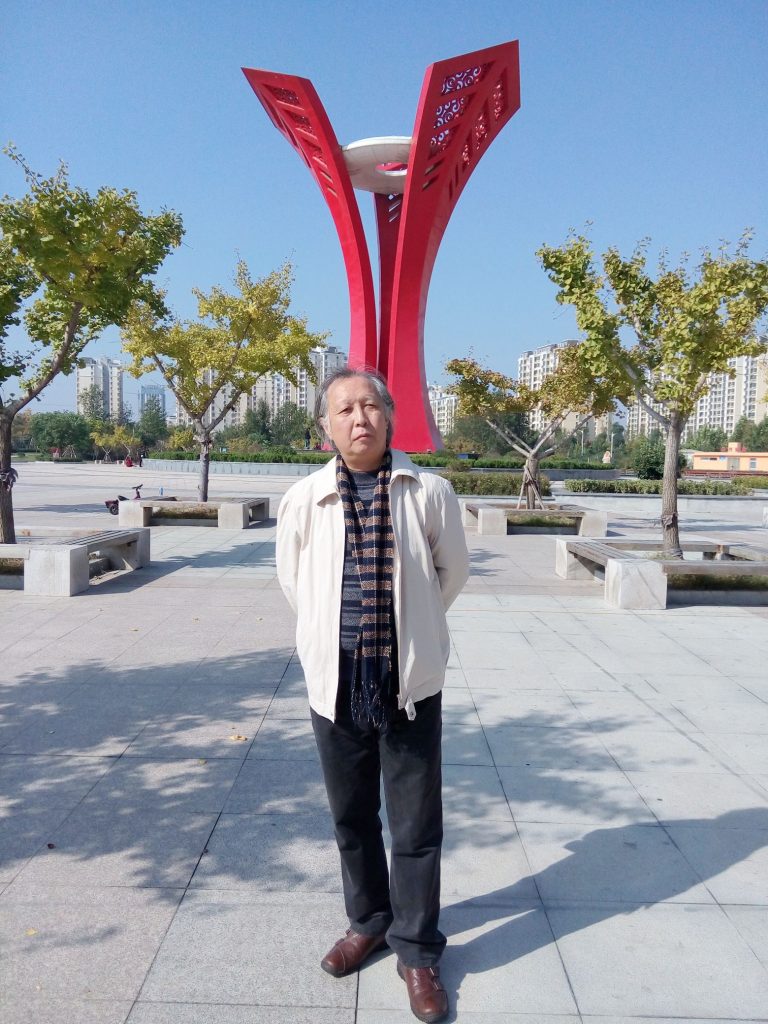
Middle aged Chinese man dressed in  slacks, brown shoes, a white coat and a scarf and striped shirt standing  in a city plaza, concrete with trees in planters.
Author Hongri Yuan

      An Editor’s Notation, following conversation with the translator…

This brief reader’s introduction to Chinese poet-philosopher Hongri Yuan’s Platinum City poem which is his vision (while meditating in 1991 and written in 1998).  It is his view of a civilization from the ancient past, its connection with prior human life and the projection that with more awareness humans could become a more universal future civilization and people. From his consideration of ancient times wherein humans were giant-like and more idealized and gods idealized beings, he suggests that this view offers us a glimpse of what mankind may become with elimination of boundaries of nation, race and religion, for instance.  

Yuan believes that concepts of good vs. evil and beauty vs. ugliness will dissipate and humans can achieve a more universal civilization and homeland in the universe.  Further, Yuan notes that prior times don’t disappear but remain locked within Space, and discovery of more such civilizations can only provide humans with keys to our advancement in the future.

Platinum City 
 
 By Chinese Poet Hongri Yuan
 Translated by Manu Mangattu
 Assistant Professor, Department of English
 St George College Aruvithura, India
 manumangattu@gmail.com
 www.mutemelodist.com
  
  
 Ah! Of iridescent gems of time
 The heavenly road you paved light!
 In a kingdom of stars,
 I found my home.
 In the golden cities,
 I opened the gates of the city to the sun,
 To behold the godly giants.
 At the royal palace of the jewel
 I read of prehistoric wonderful poems
 The enormous, gorgeous ancient books.
 Carved with the golden words 
 The wondrous strange mystery tales,
 Made my eyes drunken.
 I walked into the full new universes,
 And saw the holy kingdoms:
 Even before the earth was born
 The erstwhile home of human history.
  
 Across Time and Space in crystalline glitter
 Stands this moment a platinum city –
 The spaceships drifting leisurely,
 Like the birds, resplendent in variegated hues.
  
 In the crystal garden I saw
 A crowd of youthful giants,
 Their eyes were bright and glittering
 In the aura of the body sparkle..  
 
 They sang happy songs
 They danced a wonderful dance
 Lanky boys and girls in pairs
 As if to celebrate the splendid carnival.
  
 I saw a circular edifice
 High above the city.
 Giving out white-bright lightnings.
 Raised ground to fly into the quiet space.
  
 A frame of platinum edifice
 Creating a beautiful pattern.
 The whole city is a circle
 Arranged into a fine structure.​
  
 Into a bright hall I went.
 A strange instrument there I saw.
 A huge screen hanging on the wall,
 Displaying a golden space​.
  
 Like bits of colourful crystal gemstones!
 Resplendent with variegated colours of the city!
 Those strange and beautiful high-rise buildings
 A sight better than the myth of the world.
  
 I saw lines of strange letters.
 On one side of the screen flashed swiftly
 Numerous young and strong giants
 An effort to concentrate on the changing images.
  
 Their look is quiet and peaceful.
 The learned flame flashes in their eyes.
 In a flash of clothes
 The next is a whole.
  
 Their stature, unusually tall.
 Each one is well-nigh seven meters high.
 Both men and women look dignified
 Almost no age difference apparent.
  
 Their skin is white as snow
 With a faint flashy shine
 Bright eyes are as naive as an infant’s
 Also kindled with a strange flame.
  
 They manipulate the magic of the instrument.
 The pictures of the changing space.
 Their language is artless and plane.
 As the bell is generally pleasant.
  
 As I survey the length and breadth of the bright hall
 I feel a powerful energy
 Body and mind suffused with bliss and delight.
 As if I too am a giant.​
  
 I seem to understand their language.
 They are exploring the mysteries of the universe.
 The cities on a lot of planets
 Peopled with their countless partners.
  
 Their mind they use to manipulate the instrument
 Also can to transfer data be used
 Even thousands of miles apart
 Also to talk free to the heart.
  
 Many lines of text on the screen
 Is but a message from afar.
 The whole universe is their home.
 They build cities in space.
  
 They use the spaceships 
 To transport you to far-distant other spaces.
 Into a lightning, a moment, and you
 Vanish into thin air, without a trace.
  
 I feel a new civilization.
 They have magical eyes.
 They seem to be able to see the future
 And can enter diverse time-spaces.
  
 Men and women are holy and loving
 Superior to our world's so-called love
 They don't seem to understand ageing
 Neither do they know about war.
  
 Time seems not to exist
 Science is jut a wonderful art
 Their happiness comes from the creation of
 A universe full of divine love.
  
 I saw a young giant
 Opening the door of a platinum 
 A round, magnificent hall
 Packed with rows of giant s of men and women.​
  
 I saw a crystal stage.
 Gyrating at the center of the hall.
 Where a dignified and beautiful girl
 Was playing a huge musical instrument.
  
 A bunch of golden rays,
 Shifting with all kinds of brilliant graphics
 A mysterious and beautiful music
 Like the Dragon leisurely crowing.
  
 Thence I saw an enormous giant
 Jump out of the remarkable dance onto the stage.
 His hands held a huge ball
 Which flashed with many colourful drawing .
  
 I saw a group of young girls
 Wearing a kind of white dresses
 They seemed to fly lightly
 Like the giant cranes.
  
 The huge circular hall was resplendent
 With clear, transparent decoration.
 Like a bizarre gem of a full set,
 Scintillating brilliantly in the light.
  
 I saw a young singer
 About the golden flame
 The sound was strange and striking
 Like singing , like chanting too.
  
 Their music is at once mysterious and blissful
 That shift randomly like the lightning
 As if many planets of the universe
 Shining bright and light​ in space.
  
 The crystal city, aloft in space
 Looks resplendent, magnificent
 Countless wonderful golden flowers
 Bloom and blush in that flawless space.
  
 I saw an image of a transparent smiling face,
 As if it were a colourful garden
 The sky shed the golden light 
 And turned it into a city of gold​.
  
 I strode out of the circular hall
 Came to a wide street with a smooth
 Pavement covered with precious stones
 And in line with the platinum edifice.
  
 There are no terrestrial trees here,
 But they are in full bloom with a lot of exotic flowers.
 Sparkling with rich incense,
 Shaping a garden at the center of the street.
  
 Some strange flowers were there.
 The branches as transparent crystal
 Flashing all kinds of brilliant colours;
 And bunches of round golden fruit​.
  
 I saw a huge statue.
 It was like a spaceship.
 Clustered around by shining stars,
 High above the centre of the street.
  
 I saw the column of a dazzling fountain
 In a huge circle in the square;
 The elegantly modelled statues
 Portraying the holy giants​.
  
 The soaring magnificent edifices
 Ran round the circle square.
 There were some garden villas
 There was a platinum steeple.
  
 I saw a wide river
 Girdling this huge city
 The bottom flashed with transparent gold dust,
 Amidst which were scattered brilliant gems.
  
 The planning of tall trees on shore
 And a long crystal corridor
 A big multi-coloured bird
 Three five one group floated on the surface of the water.
  
 I saw a vast forest
 The swaying tree, a tree of gold
 The trees with towering spires
 And as some platinum Pavilion​.
  
 I saw some giants along the walk,
 Some male and female bodybuilders.
 At the water's brink or in the forest
 Like birds carefree and relaxed.
  
 The wonderful space was as bright as crystal
 Embraced this platinum city;
 A giant, white and bright ball
 Flashing boundless light into the air​.
  
 It resembled the huge suns
 And like the man-made planets
 The whole city was shining too,
 Weaving a rare breed of magic​.
  
 A strange speeding train circled
 About the city back and forth;
 There seemed to be a kind of track in the sky
 Like a shiny silver curve​.
  
 They seated body white buildings 
 As if it was a dreamlike maze
 This huge city was unusually quiet,
 Could not even hear the sound of the wind​.
  
 I bade goodbye to the platinum city.
 Near a golden space
 Stands another city here
 A huge city of gold​.
  
 The building here is also huge.
 But it's another beautiful shape.
 The whole city is glittering
 Golden edifice as beautiful as sculpture.
  
 Here there live some other giants.
 As if from another nation
 They have boundless wisdom.
 Like a golden, holy civilization.
 3.3. 1998
  
  
Bio: Hongri Yuan, born in China in 1962, is a poet and philosopher interested particularly in creation. Representative works include Platinum City, The City of Gold, Golden Paradise, Gold Sun and Golden Giant. His poetry has been published in the UK, USA, India, New Zealand, Canada and
Nigeria. The theme of his work is the exploration about human prehistoric civilization and future civilization.


 《白金城市》
 远红日
  
 时间的五彩宝石啊
 你铺成了光芒的天路
 在一座星辰的王国
 我找到了自己的家园
 我打开一座座太阳的城门
 在一座座黄金的城市
 见到了一个个神圣的巨人
 在那宝石镶嵌的皇宫
 阅读了史前奇妙的诗篇
 一部部古奥华丽的巨书
 镌雕着黄金的词语
 一篇篇玄奇美妙的故事
 迷醉了我的双眼
 我走进了一个个崭新的宇宙
 看到了一座座圣洁的王国
 在地球还没有诞生之前
 曾经是人类的史前的家园
  
 时空的水晶啊光芒闪耀
 一座白金的城市矗立眼前
 一只只飞船悠悠飘过
 像一只只巨鸟五光十色
  
 我看到一个个年轻的巨人
 身体闪耀七彩的光环
 他们的眼睛欢喜明亮
 聚会在一座水晶的花园
  
 他们唱着欢快的歌曲
 跳着一种奇妙的舞蹈
 一对对高大的少男少女
 仿佛在庆贺盛大的节日
  
 我看到一座圆形的巨厦
 高高耸立在城市的上空
 发出一道道白亮的闪电
 高高地飞入宁静的太空
  
 一座座通体白金的巨厦
 构成了一个美妙的图案
 整个城市是一个圆形
 排列成一个精致的结构
  
 我走进一座明亮的大厅
 看到一排奇特的仪器
 墙上悬挂巨大的屏幕
 显映出一片金色的太空
  
 一座座五光十色的城市
 像一块块五彩晶莹的宝石
 那些奇丽的高楼巨厦
 胜过了人间幻想的神话
  
 我看到一行行陌生的字母
 在一面屏幕上匆匆闪过
 几位年轻健壮的巨人
 专注地观看变幻的图像
  
 他们的神情宁静安然
 两眼闪映智慧的光芒
 穿着一种闪光的衣装
 通体上下是一个整体
  
 他们的身材异常高大
 个个足有七米多高
 男男女女容貌端庄
 几乎没有年龄的区别
  
 他们的皮肤洁白如雪
 隐隐闪出亮丽的光泽
 明亮的眼睛单纯如婴儿
 又含着一种奇异的火焰
  
 他们操纵神奇的仪器
 变幻太空一幅幅图景
 他们的语言简洁流畅
 像钟磬一般悦耳动听
  
 我端详这座明亮的大厅
 感受到一种强大的能量
 身心充满了幸福欢喜
 自己也仿佛变成了巨人
  
 我似乎听懂了他们的语言
 他们在探索宇宙的奥秘
 那一颗颗星球上的城市
 住着他们无数个伙伴
  
 他们用意念操纵仪器
 也可以用意念传递信息
 即使相距千里万里
 也可以自由地用心交谈
  
 那屏幕上的一行行文字
 即是远方传来的信息
 整个宇宙是他们的家园
 他们在太空建造城市
  
 他们乘坐的太空飞船
 可以到达另外的空间
 一瞬间化成一道闪电 
 在空中变得无影无踪
  
 我感受到一种新的文明
 他们长着神奇的眼睛
 他们似乎能看到未来
 也能进入不同的时空
  
 男男女女都圣洁慈爱
 胜过人间所谓的爱情
 他们仿佛不懂得衰老
 也不知道什么叫战争
  
 时间仿佛并不存在
 科学就是奇妙的艺术
 他们的快乐来自创造
 对宇宙充满神圣的感情
  
 我看到一位年轻的巨人
 打开了一座白金的大门
 一座圆形的华丽的大厅
 坐满了一排排男女巨人
  
 我看到一座水晶的舞台
 旋转在这座大厅的中央
 一位端庄美丽的少女
 演奏着一种巨型的乐器
  
 一束一束金色的光芒
 变幻出各种奇妙的图形
 一种玄妙动人的音乐
 仿佛是龙凤悠然的啼鸣
  
 我看到一位健美的巨人
 在台上跳出奇异的舞蹈
 他手中托起巨大的圆球
 球内闪耀着彩色的画图
  
 我看到一队妙龄的女郎
 穿着一种雪白的裙裳
 他们仿佛在翩翩飞翔
 像是一只只巨大的仙鹤
  
 巨大的圆厅金碧辉煌
 像水晶一般清澈透明
 又像是嵌满奇异的宝石
 闪耀出一种绚丽的光芒
  
 我看到一位年轻的歌手
 全身缭绕着金色的火焰
 那声音奇特而又优美
 像是歌唱又像是吟诵
  
 他们的音乐欢喜玄妙
 像一道道闪电变幻莫测
 仿佛是宇宙的一颗颗星球
 在太空中闪烁亮丽的光芒
  
 又仿佛一座座水晶的城市
 在空中矗立宏伟辉煌
 无数奇妙的金色的花朵
 开满了清澈晶莹的太空
  
 我看到一张张透明的笑脸
 仿佛是一座缤纷的花园
 金色的光芒从天空洒下
 化成了一座座黄金之城
  
 我走出了这座圆形大厅
 来到一条宽阔的街道
 光洁的路面嵌满宝石
 两旁林立白金的巨厦
  
 在这儿没有人间的树木
 却盛开各种奇异的花朵
 浓郁芳香又闪闪发光
 形成了一座座街心花园
  
 这是一些奇特的花木
 枝干透明仿佛水晶
 闪烁各种奇妙的颜色 
 还有一串串金色的圆果
  
 我看到一座巨大的塑像
 仿佛一个太空飞船
 高高地耸立在街头中心     
 周围闪耀一颗颗星球
  
 我看到一柱柱晶莹的喷泉
 在一座巨大的圆形广场
 一座座造型优美的雕像
 刻画出一个个圣洁的巨人
  
 一座座巍峨壮丽的巨厦
 环绕着这座圆形的广场
 巨厦的上面是一些花园
 还有一座座白金的尖塔
  
 我看到一条宽广的河流
 怀抱着这座巨大的城市
 水底闪映出透明的金沙
 还有一颗颗七彩的宝石
  
 岸边排列高大的花木
 和一条条水晶的长廊
 一种色彩亮丽的大鸟
 三五一群在水面飞翔
  
 我看到一座广阔的树林
 摇曳着一树树黄金的树叶
 树林中耸立一座座尖塔
 又仿佛一些白金的楼阁
  
 我看到一些漫步的巨人
 男男女女健美潇洒
 或在水边或在林中
 像鸟儿一般逍遥自在
  
 奇妙的太空亮如水晶  
 怀抱着这座白金城市
 一只一只白亮的巨球
 在空中闪放无际的光明
  
 仿佛是一颗颗巨大的太阳
 又像是一颗颗人造的星球
 整座城市也闪放光芒
 形成一种神奇的景象
  
 一种奇特的飞驰的列车
 在城市上空回环往复
 天空中仿佛有一种轨道
 像一条银白闪亮的曲线
  
 那一座座通体白亮的巨厦
 仿佛是一座座神奇的迷宫
 巨大的城市异常宁静
 甚至听不到风儿的声音  
  
 我告别了这座白金城市
 奔向了一片金色的太空
 在这儿矗立另一座城市
 一座巨大的黄金之城
  
 这儿的建筑同样巨大
 却是另一种美丽的造型
 整座城市金光灿烂
 黄金的巨厦美如雕塑
  
 这儿生活着另一些巨人
 仿佛来自另一个民族
 他们拥有伟大的智慧
 像黄金一般圣洁的文明 
Essay from Michael Robinson

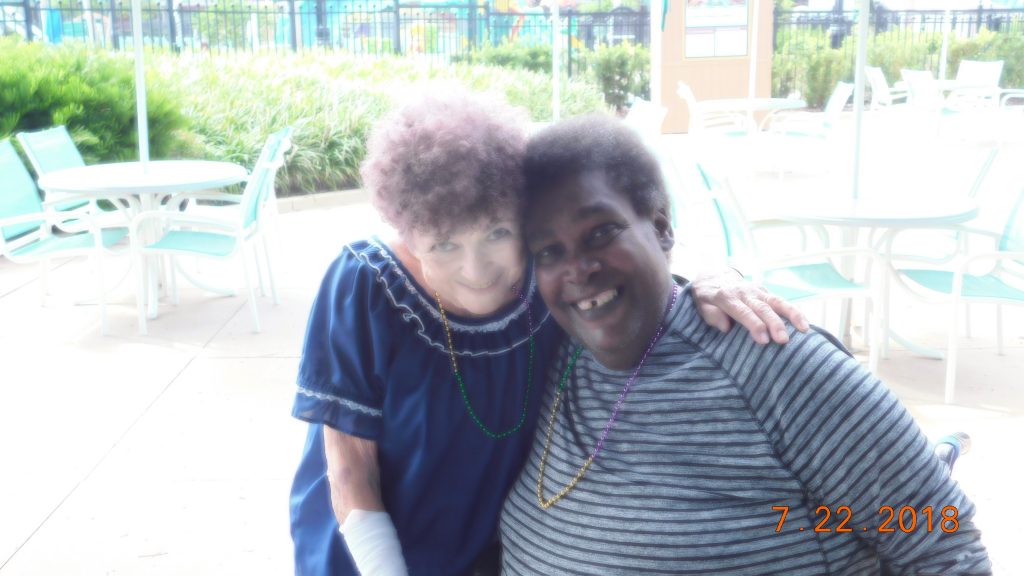
Middle aged Black man wearing a tee shirt hugging an older White woman, fellow contributor Joan Beebe, to his left. They're standing on concrete in front of some bushes and chairs near a swimming pool and both have necklaces of Mardi Gras beads.
Michael Robinson (right) and fellow contributor Joan Beebe.

It seemed to be hot the night Dr. King was assassinated. In April of 1968, I was eleven years old and I watched on the television that he had been shot. My foster father’s apartment was across the alley from my foster mother’s apartment. The alley was cool, not hot this time of the year. As I walked through the alley, someone said, “King is dead!” I yelled back something to the effect “yea!” I did not know that what was to follow that night would change not only the world, but my corner of the world. “Niggers not going to stand for this!” my foster mother cried out. She was a lady in her late sixties maybe early seventies at the time. A chill ran down my body. I was frozen in time. It was as if the world were going to end.

Living in the nation’s capital for eleven years, I had witnessed so much violence: shootings, people who had their throats cut and survived. My foster sister’s husband Richard was one of those who had survived having his throat cut. I could see the scar around his neck. I had no idea as to the reason, but it was clear to my young eyes the mark that the straight razor left. These weren’t the only memories I had of living in the streets of Chocolate City, as the black inhabitants called it. The only white faces in my neighborhood were owners of the corner stores and the priest at Holy Redeemer Catholic Church. The blacks had no need for whites except for those who owned the stores and hired neighborhood residents. The majority of the neighborhood shopping was on Seventh Street in Washington: the day-old dollar bread store, the farmer’s market, and clothing stores along a mile radius of Rhode Island Avenue, extending down towards P street and beyond.

My life was going to JFK Playground on P street across from Seventh Street, Northwest Washington. A giant slide curled around and down from the top of the hill to the dirt bottom, there was a tank we could climb on, and the biggest toy for me was a gutted fighter-jet plane which I would climb into and pretend I was a fighter pilot. My foster father loved to watch television shows such as Combat and Twelve O’clock High along with Rifleman and a variety of other shows. It was the war shows that I enjoyed watching and loved acting out on the tank and fighter jet. Across the street from the playground would be the book-mobile on Mondays, where I would go get books with pictures in them. Unable to read, I would lay them out on the floor and look at the pictures in my foster father’s apartment.

It all seemed so innocent before that night that Dr. King was murdered. I mean, I had been robbed and had my money taken by older kids by age ten. I had worked around prostitutes and walked in the alley with broken glass bottles and rocks we threw at one another for fun. I had witnessed car accidents leaving blood on the streets and then there was that kid they found in the abandoned apartment across the alley from my foster father’s apartment the summer before the riots of 68. But the following weeks were a blazing inferno that raged without mercy.

It started, as I recall, with a mob of people chanting in the streets “Burn, baby, burn!” I hid in my foster father’s apartment and I don’t recall if he were home. It all seemed so unreal that first night of the riots. The crowd was chanting words out of fear that I don’t remember. I didn’t want to remember. I had been afraid of black people ever since I could remember. The beatings at home and the beatings in the streets and the violence always there in the neighborhood on the weekends. However, this was different because everyone seemed enraged. The crowd moved within the neighborhood, setting cars on fire and shouting “Burn, motherfucker burn!” They set cars on fire and shouted, “If you don’t want your house burned down, you’d better put “Soul-brother” on your door!” My foster father used shoe-polish on a sheet of notebook paper and wrote “Soul-brother,” and posted it on the green door of the apartment. This is the only time I remember him being in the apartment with me.

After a day or two, I’m not clear about the sequence of events, but I remember the burning down of my neighborhood and the Seventh Street corridor. I was out there with the looters, police, National Guard while the helicopters circled overhead. The mobs had come together after burning down the neighborhood stores. As I walked through the rubble and the broken glass, I smelled smoke; it filled my lungs and burned my eyes. I was so afraid of life, of people, of dying in the fires. I don’t remember any firetrucks coming as my neighborhood burned to the ground.

The walk to Seventh Street was long as the smoke circled around and up. The rubble smoked, and the smell of plastic and wood lasted for months and months afterwards. Cookie and some of us kids went to Seventh Street during the riots. As we approached there were people carrying TVs and stereo equipment, arms full of clothes, any and all things that one could want. “Go get you some; it’s free!” I heard. Walking around as bricks flew into windows and the glass shattered and the ground shook as guards stood with their gear prepared for war. The police were there as well as so many military vehicles.

Everything smelled of smoke. It wasn’t just the smell. It was the sight that my neighborhood was destroyed. Nothing existed that I knew; was all gone. Nothing was of use or value after the fire storm in my world. The canister landed and exploded, and the crowd yelled. “Tear gas, tear gas!” Cookie said, “Hold your breath.” Trying to run holding your breath is difficult as my eyes were burning, and the tear gas soaked my clothes. I remember turning the corner and running.

The water was cold as my foster mother washed me. My clothes were useless, and it all added to the experience that I was in a war-zone. The world seemed to have stopped. There wasn’t any school, nor was there anything to eat but canned goods, and the water was cold to bathe in. It all began to just fade. Each visit outside was a reminder that my world was destroyed. There was a curfew and the military-jeeps with the radio antennas with mounted guns raced through the streets. It was extremely dark since there was no power. Nothing seemed to be real; nothing felt alive, and I was just stuck in a place and time that had been destroyed. This feeling of those images came to me in the night as I slept and peed the bed. I don’t remember the following months in my life. The world had a glaze to it. JFK playground melted in the storm of fire. There had been fires in the neighborhood prior to the riots, which always frightened me, but this was different. I was numb.

The pews in church were a caramel color; the statue of Mary, the Mother of Jesus, stood guard, and the stations of the cross had a different meaning for me. The candles burned and there was no smell of smoke in the air. It smelled fresh with the smoke from the burning frankincense. It was different from riot smoke. I stared at the murals above the altar of angels with their wings opened as if they wanted to hold me. I would sit there for what seemed like forever. It was the only place that made sense to me and even then, I knew what was beyond the doors. Nothing mattered. No signs of life; it was if everyone were a shell. The neighborhood was a shell and the destroyed buildings were a reminder of what had happened that April of ‘68. I was so empty inside waiting for something, for someone, to make it all go away; however, that was not the case. The killing of Dr. King brought so much destruction. There were 13 people killed, according to one source and 900 businesses destroyed. I find it hard to believe that only 13 people died in D.C. During that period, more blacks died in the city on the regular weekends full of drinking and violence.

The memory of the riots did not fade as I sat in the church alone. It was all a bad dream that never went away for me. No one talked about what had happened that week, those months, and years later. No one said, “These people have been through a war and they are suffering from Post Traumatic Stress.” No! there was no talk about all that was lost. It wasn’t just the riots. It was a generation of young people that had been affected by having the military standing there with those rifles, with machine guns mounted on jeeps, helicopters roaming in the airspace. I often wondered what had happened, and like all the other difficulties that has been presented to my race (blacks), I wonder what we could have done if the city had not been destroyed.

I think of what my life would have been if I had not been through the war of ‘68. As the Vietnam War raged, we back here in the cities were fighting for our freedom. It was a collective voicing that we had been denied a chance for life. I often remember not only the riots of “68, but the city and the harshness of inner-city life. The riots were just a result of injustice, and a plea for fairness, dignity, and a chance for a meaningful life. While white America watched my city and many other cities burning, no one came to help rebuild a country that had been torn apart by racial injustice.

It was a long night on April 4, 1968. It was the night that a part of me died when my city died. My city, my neighborhood, and my home. It was what I knew; It was my place even with all the prior violence and threats to my life. It was a place where I had learned to be safe, until the riots. Forty-nine years ago, this week, a part of me died when the army marched through my neighborhood with machine-guns mounted on jeeps. This wasn’t the TV show Combat, this was my home.

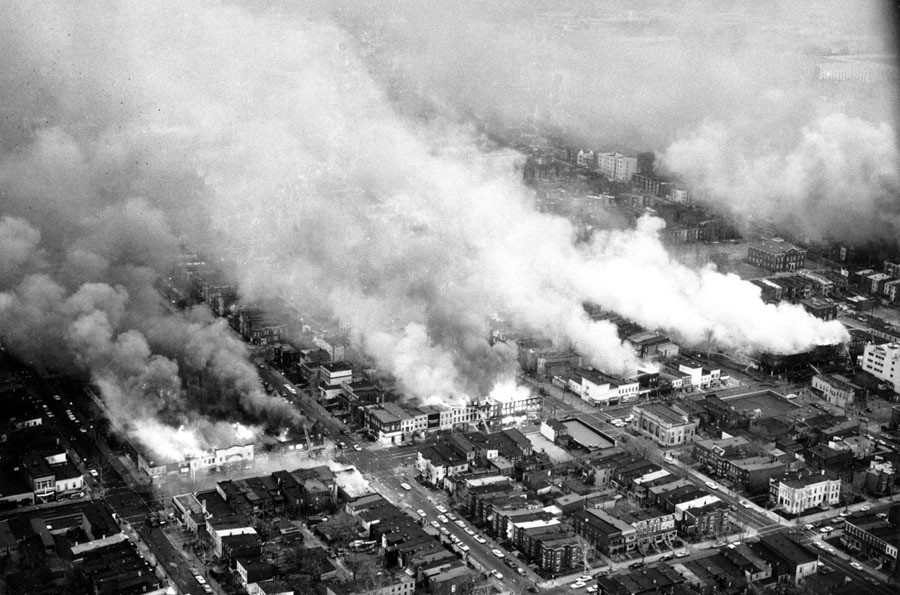
An aerial view showing clouds of smoke rising from burning buildings in northeast Washington, D.C., on April 5, 1968. The fires resulted from rioting and demonstrations after the assassination of Martin Luther King Jr. 

Black and white photo of smoke rising from burning buildings in Washington D.C. Aerial view over several city blocks.

https://www.theatlantic.com/photo/2018/04/the-riots-that-followed-the-assassination-of-martin-luther-king-jr/557159/

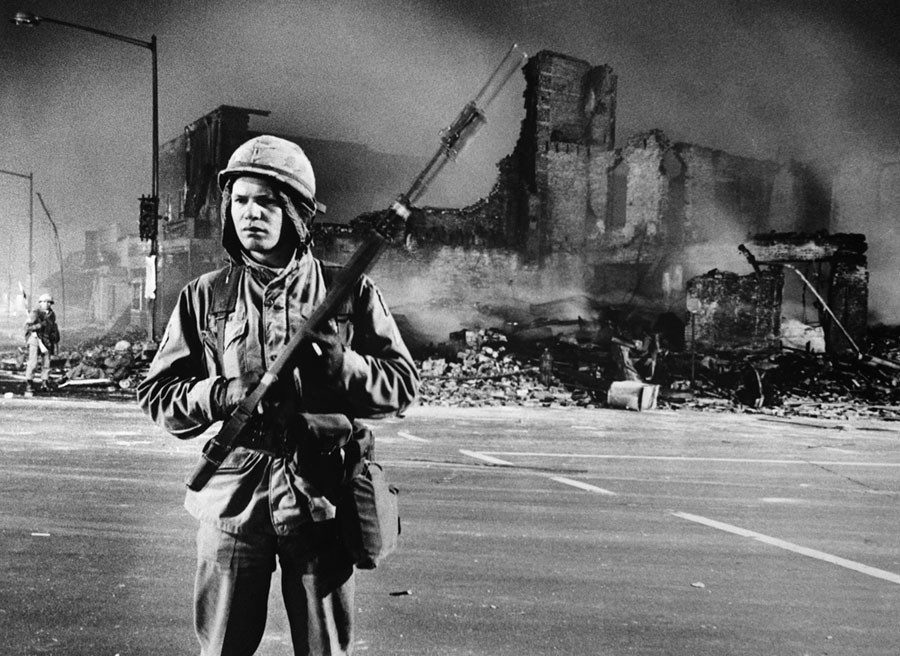
President Johnson called federal troops into the nation’s capital to restore peace after a day of arson, looting, and violence on April 5, 1968. Here, a trooper stands guard in the street as another (left) patrols a completely demolished building. 

Here, a trooper stands guard in the street as another (left) patrols a completely demolished building. White man with a large gun and a helmet stands on a street corner in front of a pile of rubble.

https://www.theatlantic.com/photo/2018/04/the-riots-that-followed-the-assassination-of-martin-luther-king-jr/557159/

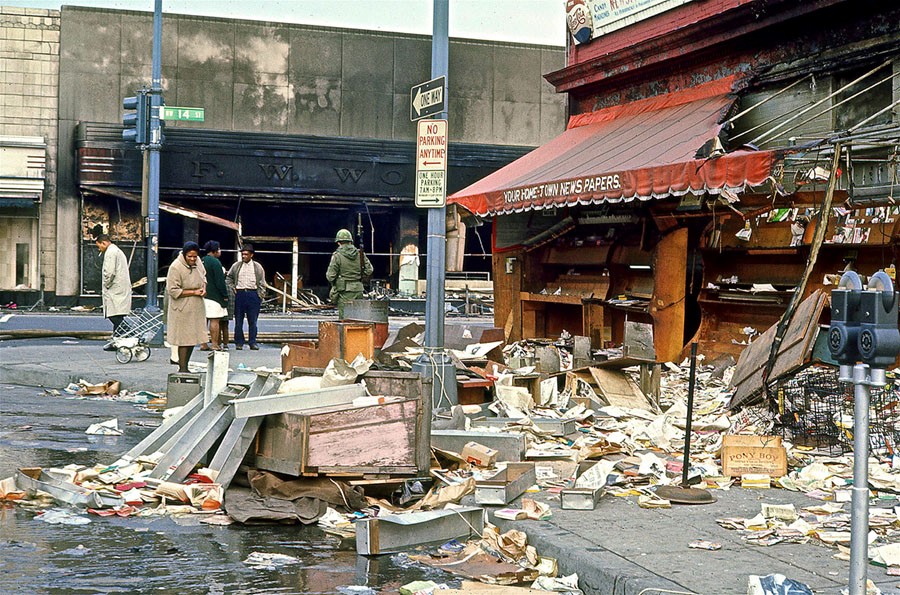
A soldier and civilians walk near a destroyed newsstand at 14th and Kenyon Streets in northwest Washington, D.C., on April 6, 1968, following rioting after the assassination of Martin Luther King Jr. 

A few Black people with coats peruse a destroyed newsstand. Paper and wooden crates are strewn everywhere on the sidewalk and street in front of the storefront. Water pools in the street.

https://www.theatlantic.com/photo/2018/04/the-riots-that-followed-the-assassination-of-martin-luther-king-jr/557159/

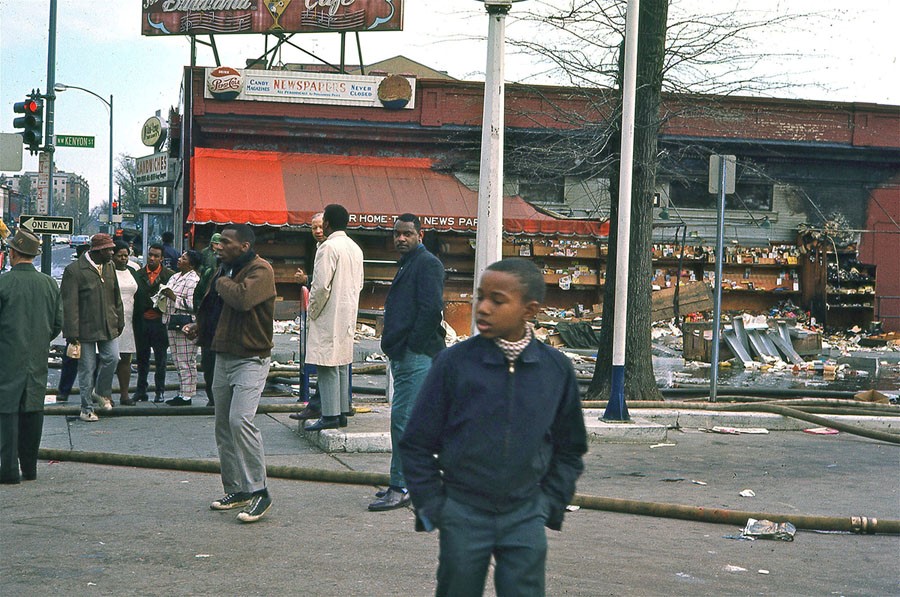
People stand near a destroyed and burned-out building on 14th Street and Kenyon Street in northwest Washington on April 6, 1968. 

Young Black boy with a coat and jeans looks off to the side in another shot of the destroyed newsstand. More people are present, Black adults in coats and jeans.

https://www.theatlantic.com/photo/2018/04/the-riots-that-followed-the-assassination-of-martin-luther-king-jr/557159/

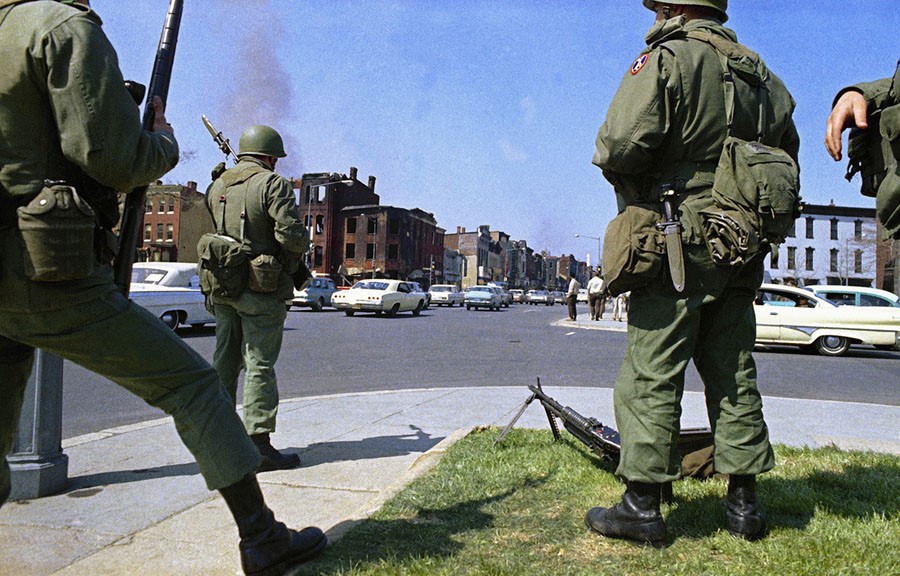
National guard troops stand at the intersection of 7th and K Streets in northwest Washington, D.C., on April 6, 1968. 

Green-uniformed National Guard troops stand guard with long guns on a street corner, facing some burned-out buildings.

https://www.theatlantic.com/photo/2018/04/the-riots-that-followed-the-assassination-of-martin-luther-king-jr/557159/

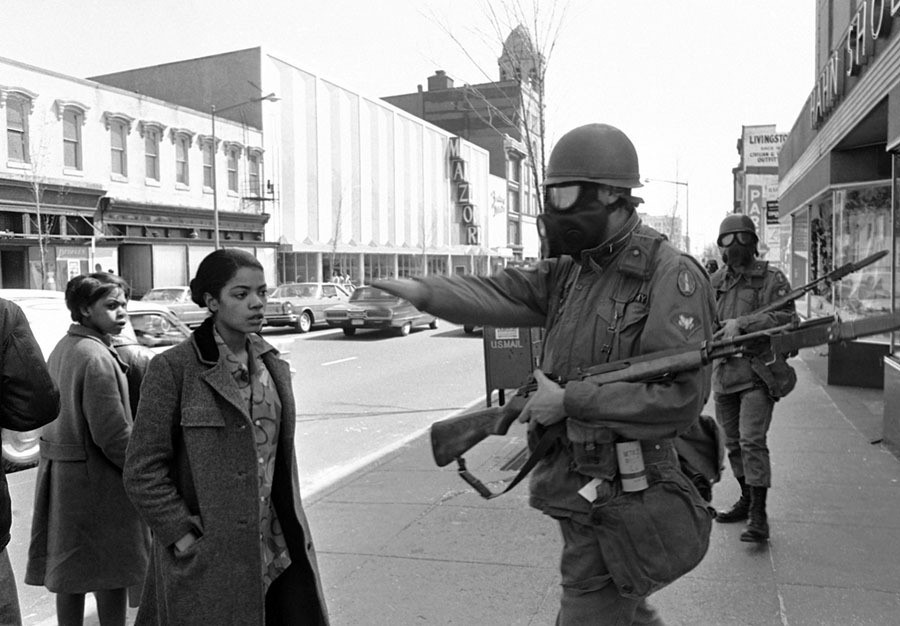
A pedestrian is waved away from an area by a gas-masked national guard soldier guarding an area near 7th and K Streets in northwest Washington, D.C., as rioting continued in the city on April 6, 1968. 

An armed, helmeted, uniformed National Guard officer waves away a young Black woman in a long coat as she looks back towards an area she's not permitted to enter.
https://www.theatlantic.com/photo/2018/04/the-riots-that-followed-the-assassination-of-martin-luther-king-jr/557159/
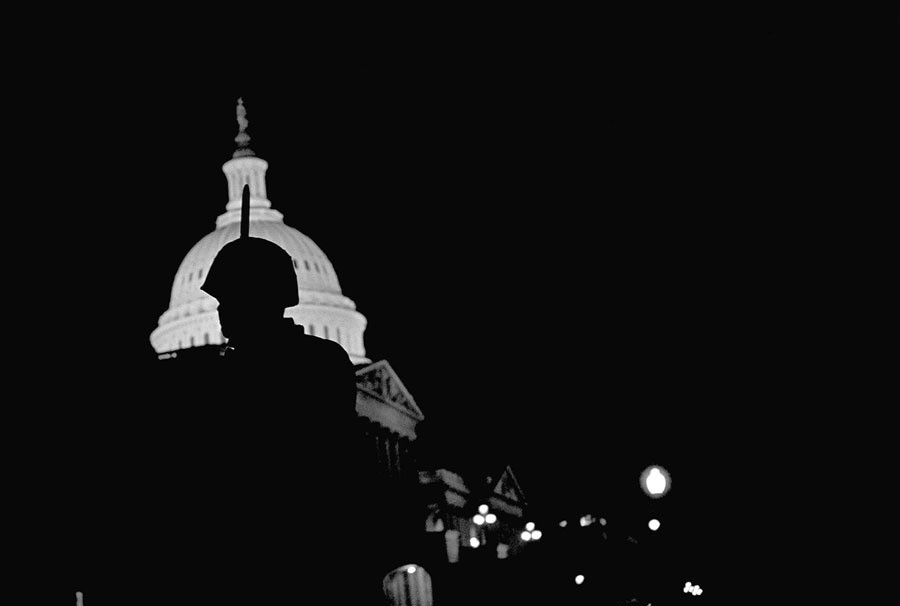
Silhouette of a National Guard officer standing up with his gun in his hands in front of the white lit-up Capitol building at night.
https://www.theatlantic.com/photo/2018/04/the-riots-that-followed-the-assassination-of-martin-luther-king-jr/557159/

Remember that time Uncle Sam gave D.C. kids a tank and jet airplanes to play on?

Taylor, Alan. “The Riots That Followed the Assassination of Martin Luther King Jr.” The Atlantic, 12 Apr. 2018, www.theatlantic.com/photo/2018/04/t+e-riots-that-followed-the-assassination-of-martin-luther-king-jr/557159/.

Poetry from Ahmad Al-Khatat

Depression

Ahmad Al-Khatat

My eyes are numb from crying, 
my hand hurts from writing, 
my head is slowly attaching 
my neck to the cords of death, 
-due to the sorrows, I have 
adopted by myself.

Drop the Curtain

Drop the

curtain, please?

The slam poetry

is finally over

The ones with

the sad faces

Will finally

pull the trigger.

The Limits of the Sun

Take me to the limits of the sun
Away from the miserable nest
-of skeletons, simply because
they remind me of my thirty-five years

Take me back in your warm dream
Where life’s bitterness appears more
like a blooming rose in the direction
of the cemetery, in which we can smile

Take me to the sorrows of our home
To learn how to love without weeping
To learn how to raise you to the rainbow
And learn about each other as we are one heart

Take me somewhere far away so
You and I we are one route to the darkness
Nobody can get in our way, nor damage us
The ones who are in, they will win and the

-ones who escape will die for being lonely
If you cannot take me anywhere near you
Then allow me to sip on some of the best
-poison, since I am weak to go on my own

to the limits of the sun…

My New Bio

Ahmad Al-Khatat was born in Baghdad, Iraq. His work has appeared in print and online journals globally and has poems translated into several languages. He has been nominated for Best of the Net 2018. He is the author of The Bleeding Heart Poet, Love On The War’s Frontline, Gas Chamber, Wounds from Iraq, Roofs of Dreams, The Grey Revolution, and Noemi & Lips of Sweetness. He lives in Montreal, Canada.

Poetry from Susie Gharib

 Thrills
  
 Let me introduce beauty in a non-physiognomical form:
  
 A ripple lapping reclusive toes
 that have shunned the elements for a century or so,
 that never graced the ground with silken soles
 for barefootedness is only common among the low
 in this sad part of the globe.
  
 A tremor running through my bones
 Upon meeting the eyes of a life-sworn foe,
 having repented his gall,
 replenishing his ocular liquid with sheets of gold,
 intricately woven by a contrite soul.
  
 A shadow that was banished decades ago
 before I could utter my very first words,
 before I could even walk,
 conjured up from the other world,
 gliding into my dreams to illumine their void.
 
 Downfall
  
 Of all his traits, furtiveness repelled me most,
 a secretive nature that coveted moss,
 that concealed the truth,
 and cloaked every action with a surreptitious look.
 I could never digest his oxymorons,
 his classy puns and tinsel tropes.
 I was straightforward. I always spoke
 not from the depth of my heart
 but from the bottom of my stomach.
 Un-arrayed, the words came naked,
 unchaperoned by punctuation modes,
 with un-softened tones,
 unfiltered by social codes
 or decorum protocols,
 unabashed and bold.
 This capacity to divulge my innermost thoughts 
 brought about my downfall.
 
 Domestic Eloquence
  
 He wants her utterly silent around the house.
 She wonders whether her utterances are full of discordant sounds,
 for his persistent repudiation of her voice
 has begun to aggravate knots of nerves.
 He says she is always very loud,
 but when she softens her tone, 
 her words produce the same impact:
 a face full of repugnance and some articulate spite.
 She recalls being once told by the only man 
 with whom she fell in love
 that he would be contented with listening to her voice 
 for the rest of his life,
 a relationship of the verbal type
 if it should come to nothing else.
 Others had intimated that she possessed mellifluence
 suited to some public broadcast,
 or perhaps singing if she had the gift!
 Such remarks make his revulsion even worse.
  
 She examines their daily interchange 
 to see what stimulates his undisguised disgust.
 She usually speaks of long-needed repairs 
 that derail the orbit of their life,
 of grease-stained plates that he loves to pile 
 for his favorite germs,
 of expenditure that taxes her every hard-earned pence.
 Now she realizes after years of domestic eloquence
 that what unsettles the parasitic in him is not her voice:
 It is finance.
  
 
 What About
  
 We tend to dwell on the sorrowful
 what renders us lachrymose,
 what piques and wounds our pride,
 what robs us of cheerful discourse,
 but what about the precious moments
 that we snatched despite all vigilant foes,
 the bouts of hearty laughter
 the cordial episodes,
 the communions we held with surroundings,
 the ripply warmth,
 the feelings that no matter how fleeting
 can buoy us up until our final repose.


 Burdens
  
 I wonder how the Swiss can cope
 with their surplus of annual gold.
 It must be a burden on one’s thoughts
 to have much more than one can hold.
  
 I wonder how the glib dispense
 with their surplus of sugared words.
 It must be a burden on one’s tongue
 to feel the trickle that audiences shun.
  
 I wonder what Arabia would do
 to its surplus of petroleum fuel.
 It must be a burden on one’s secretion
 to pump such liquid to warring nations.
  
 I wonder what new world orders can do
 to combat their surplus of nuclear feuds.
 It must be a burden on one’s mind
 to save the planet from spurious wile.
 
   
 When there’s so much
  
 When there’s so much ugliness in our daily norm
 where can we purchase beauty in an undiluted form,
 neither canned, modified, nor cloned?
  
 When there’s so much hate in our daily debates,
 where can we excavate love that’s not outdated,
 neither a relic nor reincarnated?
  
 When there are so many fumes in our modern rooms,
 where can we distil pure air into our tubes,
 with no filters sticking out of our throats?
  
 When there are so many creeds scattered like seeds, 
 where can we worship without excludees,
 a temple for all, at home and overseas?


Synchronized Chaos June 2020: Hermetic Thoughts

Hermetic thoughts. These words, taken from Henry Bladon’s imagistic poem, reflect the state of many of us, sealed up in quarantine.

Whether we have gained longer hours to spend in reflection, or just changed up our schedules and daily rhythms, we’re likely living and thinking in different ways.

Each contributor’s creative works in this issue are highly distinctive and personal.

Some writers meander into nostalgia. Ian Copestick remembers vibrant young love while reflecting on mental and physical aging. J.D. DeHart depicts the loosely shifting sense of space and time on a road trip.

Others look within themselves and to their pasts for a sense of self-understanding. Norman J. Olson recollects his favorite styles of painting and the development of his personal aesthetic, while Robert Ragan’s protagonist wonders whether he could have done more to prevent an old friend’s suicide.

Some of the ruminations turn sorrowful. J.J. Campbell contributes subdued pieces on aging, weakness, melancholy and death, Abigail George writes of heartbreak, abandonment, and the vertigo of hospitalization.

Sometimes the same pieces, or collections of work, vacillate between hope and despair. Chimezie Ihekuna’s personal essay describes how he developed the inner self-worth to withstand social exclusion due to a facial disfigurement, and how practicing the craft of writing gave him strength and a different focus and source of identity.

Mahbub’s poems speak of a fanciful romance out in nature, yet also criminal and ethnic violence and dangerous weather within his homeland of Bangladesh. Ahmad Al-Khatat brings us the death and grief of the refugee experience, yet the potential for rest and healing for humans and the rest of the natural world while sheltering in place.

Steven Croft conveys the tension of war and other disasters by illustrating the small visual details that can loom large when strong emotions distort our perception of time and space. A glimpse of a woman’s hair under her headscarf, the sight of church windows overlooking an empty baseball diamond, and a rescuer replacing his shoes after saving a swimmer in distress draw and keep us within Croft’s scenes.

Another piece harnesses details and objects to illustrate larger themes: Daniel DeCulla turns a single high-heeled shoe into a meditation on the power and grace within traditional femininity.

Tidbits of ordinary life take on artistic meaning within the films of independent director and university professor Dina Abd Elsalam, profiled by Jaylan Salah. Elsalam’s movies often portray regular people, sometimes elderly people, enjoying and making the most of their lives, and celebrate friendship and neighborliness.

Joan Beebe reaches out to all of our readers in a spirit of caring, with a gentle poem about roses, an expression of sympathy for our neighborhoods with empty streets, and a prayer to the Virgin Mary for an end to the pandemic.

Ike Boat offers up a radiant celebration of life, reciting a spoken word piece that’s an ode to the beach where he stands on a brilliant summer day in his native Ghana. A man of faith, Boat gives thanks to God for his existence.

Other contributors are also spiritual, or at least philosophical. Ken Rutkowski ruminates through drawings on his time abroad in Vietnam, where the people he met lived with equanimity and optimism. Hongri Yuan lets his imagination penetrate the heavens with a lengthy bilingual English/Mandarin vision of a golden city and supernatural statues, flowers and trees.

Christopher Bernard comments through poetry that the pandemic-emptied streets have reduced our urban crowds to a more human and manageable size, where we can actually see each other – and the return of nature and wildness.

Other pieces from J.D. DeHart describe how isolation affects our creative minds. Uniquely, he reviews a book through poetry, shifting among artistic forms just as our lives are shifting with the pandemic.

Mark Young’s artwork also shifts our expectations, combining the abstract and the concrete, lines and curves, defined and implied shapes and spaces. He incorporates text that’s meant to be aesthetic rather than literal and readable into his fanciful and at times humorous images.

We hope that readers resonate with the aesthetics of this issue, whether in the abstract visual art or poetry or in the concrete images or emotions or the narrative storytelling.

Everyone has different ‘hermetic thoughts,’ we all experience this season of isolation in our own ways and follow our own trains of thought. This issue points towards making space for all our varied mental states and different pathways towards co-creating a healthier future.

Poem from Connor Orrico

song & self-compassion
a weight on my chest and a still in my limbs,
a spill from my heart of a will within,
I wait on my best and just instill my grin
to wash up the mess of self-listening

Poetry from Christopher Bernard

Two Poems

by Christopher Bernard

 Urbi et orbi
 
Myself, I prefer a city with no one in it,
or, if not exactly no one, only a few.
 
It’s like being in an enormous sculpture garden,
immense minimalist slabs
of glass and concrete throwing shadows
dark as poetry across streets grown modest
with stillness and opening trustingly as a child’s hand.
The few people there look less grotesque
when teased out of the crowd –
the way a solitary farmer turning his field,
a pair of friends or lovers, a daydreaming
hiker, seen in a summer countryscape
between bays of woods and folds
of pastureland and field, under
an ingenuously immense sky
make the dignity of humankind,
its vulnerable nobility,
palpable, and not the poorly spun joke
it seems so often
in a city hysterical, delirious, and crammed.
 
No: our monuments, our things,
the traces of care in the woodwork,
the shadow of a mind molded from a sun –
tools and toys and trinkets, engines and edifices,
the shape of a hand on a prehistoric cave wall,
a flute played shyly on a Sunday morning –
make me less ashamed of being human.
 
I wander the empty city like a hunter
in a wilderness, except that I have found
the object of my hunt, and hold it close
inside my coat, where I can feel its heart
beating, and its warmth, and its wings.


*****
 
The Coyotes of North Beach
 
Sunset, spring: a strange wailing
rises from the gorge under our house
cautiously balanced on a cliff edge
as on a knife
above a valley where coyotes are gathering.
Strange indeed for a city
(our neighborhood, part declivity, part escarpment,
is strange enough for any city).
But maybe not strange for a city
largely emptied from a malady
emptying much of the world –
and giving meaning to the "pan" 
in panache, panama, pancake, panjandrum,
Panglossion, Pandragon, pandemic –
and so giving way to wilderness
seeping back into the streets,
crows appraising the roof tops,
mountain sheep strolling about in Wales,
curious spiders measuring bus shelters
with their delicate silks,
coyotes gathering at cross streets
and dancing in the glimmering streetlights
as they flicker on in the dusk
and making their coyote-like noisings,
as sweet as they are uncanny,
in the city's deepening twilight.
 
Why are they wailing so?
Is it from fear, or loneliness, or need for love?
 
How did the coyotes know
that they are speaking for us?

*

Christopher Bernard is co-editor and poetry editor of the webzine Caveat Lector. His new novel, Meditations on Love and Catastrophe at The Liars’ Café, appeared in January 2020.