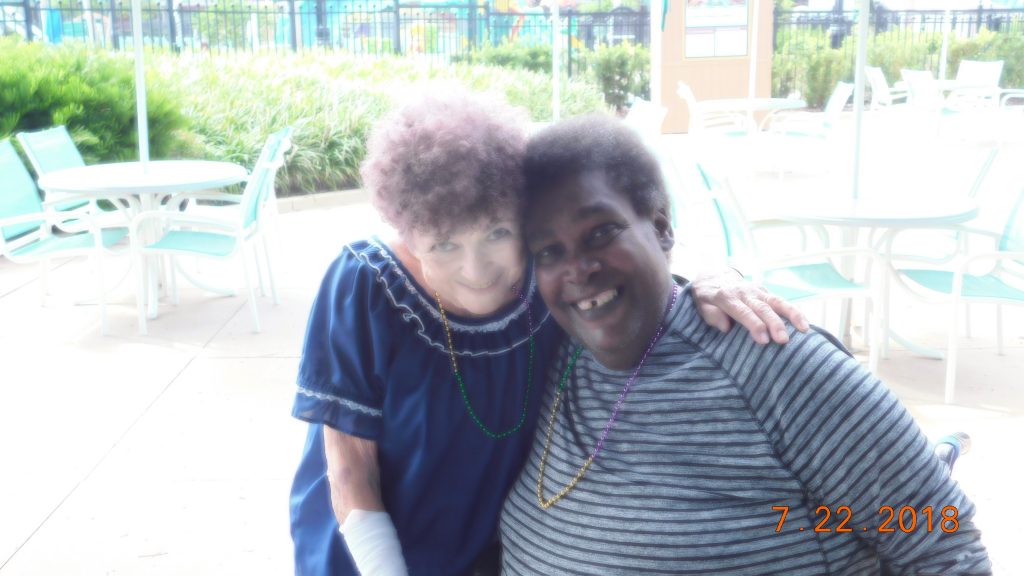
Michael Robinson (right) and fellow contributor Joan Beebe
Weep
In the middle of the night, when the moon is dark, and the clouds black.
In the middle of the night, when all the souls of America stare into the ceiling, the warm tears slowly crawl down their cheeks.
In the middle of their life, it is uncertain if there will be a tomorrow, because a sociopath stands before the cameras and rant.
We weep as a nation when our loved ones are taken away in the hearse without fanfare because there are so many that are dying.
I weep alone in my apartment because there is no one able to mourn the death of so many at one time in our history.
I weep because the war is in our midst, and the Doctors and Nurses are the first casualties in this war.
I weep because my tears cannot save lives.
My tears can not save those who die on a hospital bed in the corridor, with many besides them enclosed in plastic bags.
I weep because there are too many graves filled with someone’s loved one, and the count continues.
In the middle of the night, I weep alone because there are only memories of a time that my tears were joyful as the sound of the National Anthem was a song sung by all the nations.
Body Bags
There are body bags flowing; out of the back door of Brooklyn hospital in New York.
Body bags with someone loved ones And I have no words as the count continues.
Do you know that the bodies will be taken away? To be placed on a slab?
In America, there are thousands of body bags, Bodies in the corridor of the hospitals.
It’s a war without the guns and bombs, It’s a war on our fellow Americans.
It’s a war! When will the body bags stop?
I’m not ready to be taken away in a Boddy bag, And put in a refrigerated truck and carried away.
Are you?
In a war, there are always body bags, In a war, people die alone.
I don’t want to die alone, In a hospital corridor.
What
is greatness – moral, intellectual, artistic? It has a musty, old-fashioned
sound, and is not exactly a fashionable idea just now, with our cultural
hysterias against “elitism” of any kind, or perhaps ever was in a democratic
culture with its sweet, egalitarian shibboleths. Nevertheless, the idea of
greatness, saintliness, genius – of a superiority one cannot ignore but only
acknowledge with humility and gratitude and admiration, even, in supreme cases,
awe – periodically returns, because, like “truth” or “goodness,” it is a value
that, however we may pretend we can do without it, at a certain point we discover
that we can’t without collapsing into moral incoherence: nihilism,
demoralization and despair.
In
my own experience, artistic greatness, in particular, is partly discernible by
the fact that the subject is more powerful, more beautiful, more astonishing or
impressive than I remember it: that painting, this poem, this dance company,
that book is more than I assimilated or knew; in some sense is permanently
beyond me. It reminds me of what is often meant by “transcendent experience” – “artistic
greatness” seems to mean a direct, sensuous experience of transcendence,
piercing through the fog of distracted daily living in concentrated brilliance
– and thus is an absolute value and not a category of relative merit.
I
was provoked to these thoughts partly by the arrival in Berkeley over a recent
weekend (and thanks to Cal Performances) of one of the country’s pre-eminent
dance companies, a company that has, in the past, shown itself capable of
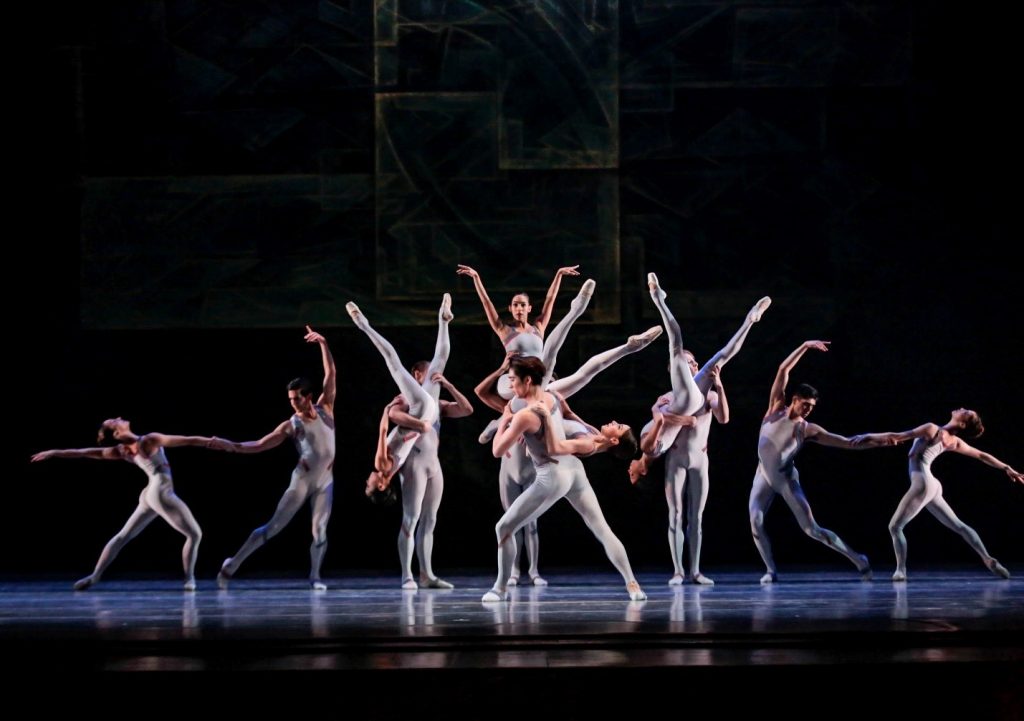
reaching such heights with sometimes intimidating ease – the Joffrey Ballet,
based in Chicago and not nearly a regular enough a visitor to the Bay Area and
the finely tuned dance audiences we have here. And the company was indeed
better than I remembered.
The
Joffrey, originally under Robert Joffrey, then Gerald Arpino, and now Ashley
Wheater, has mastered a lithe and muscular style of dancing that was on full
display throughout a cast in which all of its member are presented as principals.
Stephanie
Martinez’s “Bliss!”, which followed, set to Dumbarton Oaks, a richer and
more complex piece of Stravinsky’s, was a good deal of a looser, less
self-conscious affair, spinning between beefcake machismo and winsome
femininity, with strong contributions, again, by Iwai and Kawazawa and by Jonathan
Dole, and with an almost hilarious riff on muscularity by a stunning Derrick
Agnoletti.
If
the performance had ended, or peaked, there, at the first intermission, I would
have had an interesting afternoon, with some moments to savor and much to have
enjoyed. But I wouldn’t have been prepared for what followed.
What
followed? “Beyond the Shore” followed. But wait: this is a work, choreographed
by Nicholas Blanc (long a staple at the San Francisco Ballet) and
co-commissioned by Cal Performances, and so having a special relationship with
the Bay Area. The dance is set to a thundering, highly theatrical score by
Mason Bates (perhaps best known here for his work, a few years back, with the
San Francisco Symphony), “The B-Sides,” originally commissioned by the
Symphony. Blanc describes his dance as about “exploration as a metaphor for
human nature,” which is certainly a good thought to hang on to as we are thrust
into a series of dance adventures, one for each section of the music, as
thrilling, compelling and complex as I hope to find in this or any other dance season,
climaxing in a profoundly astonishing and deeply moving pas de deux by Victoria Jaiani and Dylan
Guttierez that took me to places dance has not taken me in a very long time
indeed, in a section called “Gemini in the Solar Wind.” This was inspired by
(and for once, the word is just, for this was in the deepest sense an
inspiration) the famous 1960s Gemini spacewalk, recordings of the NASA
communications from the walk being cleverly, and oddly movingly, incorporated
into the music. The dance was a haunting and vivifying experience, demanding
much of the entire company, which met the challenge with limber and dramatic
success.
After
being vaulted into outer space by “Beyond the Shore,” we put on the razz and came
back to earth in the concluding, dance, “The Times Are Racing,” by Justin Peck,
a choreographer I have had mixed feelings about till now but this time was completely
won over. A sneaker dance if there ever was one, this work starts in a
throbbing mob cluster of bodies exploding into a swirling disco-thon to a jammy
score from Dan Deacon (moving from ironic, to joyous, to hopeful, to joyous, to
ironic, from his hit album America) with an array of young dancers who
seemed like they’d jettisoned ten years from the assertive maturity of the
Blanc, and dressed up, or down, in sports punk togs from Humberto Leon of
Opening Ceremony, splashed with defiance – “Fight,” “Rebel,” “Change,” “Obey,”
and of course “Defy” – and knocking them flat with a trip-hop stew of dance
styles I soon gave up counting. Starting at a race, it only got faster, wilder,
crazier, though whittled down at moments to knock-’em-out solos, especially
from Edson Barbosa, that knocked out the audience too, till, speeding by like
it would never stop, the dance spun out to succeeding heights of crazy, then
spun back in on itself, whooshing back into its cluster like a deblossoming
flower before collapsing in total exhaustion.
What
a dance. What a performance. What a company.
____
Christopher Bernard is co-editor and poetry
editor of the webzine Caveat Lector.
His new novel, Meditations on Love and
Catastrophe at The Liars’ Café, appeared in January 2020.
Michael Robinson (right) and fellow contributor Joan Beebe
Quiet Reflections
She always slept in the chair,
Between the boxes that were full of clothes:
Children’s clothes that she passed down.
Her with her silver-hair and arthritic fingers,
With the scar on her nose that had been broken,
“I was a Helen,” she declared.
It was hard to imagine this old half negro and Cherokee woman,
Being anything other than a gentle and sensitive redeemer,
Of abandoned children in the inner-city.
3.20.2018
Never Mind
Why should we forget the bodies lying in,
Streets, in the classroom, in the hall.
Blood dripping into the cement.
We should not mind those body-bags lying in the corner
Collecting dust year after year.
Should we mind it after all,
This is Vietnam.
No flags are placed over the bodies,
Eventually, they too will be forgotten.
3.20.2018
Remember Me
Long after my body turns to dust,
After the last spring flower bloom over my grave,
And the peacock returns to the mountains.
The words, my words will still live on someone’s bookshelf.
Words are long forgotten in the world.
Sweet Love
The moon is fading my love,
Ending our moments of joy,
It is the daisy that we hate seeing come to life.
Still, we remember our tender bodies engulfed in ecstasy,
Long before the moon faded over the eastern skies,
Among a host of stars reflecting over the pond.
We too still fade into the sunrise.
3.20.2018
Forget Me Not
Do not forget my love for you,
Those roses made of cardboard,
While the sun turned into dust.
And the moon fell into the ocean,
Forget me not my tender heart.
Remember that blanket that held us together,
And those glasses of wine spilling onto the sheets,
Our lips touching as if they were silk.
Forget me not my tender soul.
3.20.2018
Curse
My black skin with my Cherokee mother’s eyes,
Reflects the sadness of generations of crossing the desert.
Living in contempt of life,
We hold onto the strength of our very souls.
3.20.2018
After the Winter Snow
For Larry and Donna
Bliss surrounds a black boy after the snow has fallen
A sign of the human heart has survived
An understanding of life and suffering
Hunger and thirst and desire and hopes
No longer does regret linger within his soul
It was a winter of solitude setting on the pew
Praying for salvation
While the flakes of snow surrounded the outside
Harsh was the winds and still was the life he had
There’s no need to be afraid he thought:
In time there would be a flower that would bloom inside of him
Today was that day.
3/5/2018
Touch Me
Touch me with your soul,
Like the haze of the mountain air,
That surrounds me,
Touch me when I’m young before the pain of life,
Surrounds me,
Wipe away my tears with your calm fingers,
Hold me close to your center,
Place the flowers in my garden.
8/27/2012 11:10 AM
9/6/2012 9:43 AM
The Return
The ride back to the inner-city was not the same,
It was the peacock’s feathers that allowed me to fly,
Flying above the winter winds,
High enough to reach the heavens in the summer breeze
It was never enough to ride the tide of hope with the winter snows,
With it flakes of violence.
8/27/2012 10:57 AM
A Drop of Love
A drop of love
In the shadows
A sip of warmth
No sexual fantasies
Reality a sip
Of kindness
And shadows turn into woodchucks.
9/6/2012 9:45 AM
Yesterday Hopes
Dreaming of the mountains,
In the middle of the night,
Two empty wooden chairs set in the open air,
Amber winds engulf my wonting spirit,
Peacocks coo,
In the middle of the night.
9/6/2012 9:12 AM
Awaking to it All
The freshness of it all:
Mountain air and flowers in the garden,
Blossoming souls arrive from the city,
Chickens, ducks, peacocks, turkeys, and geese,
Gaze around the coop,
I see life open before my tearful eyes.
9/6/2012 9:27 AM
Never the Same
Never the same after visiting the mountains,
Eating moms farm fresh eggs over easy,
Dad feeding the birds,
And it’s my time to renew the essence of my soul.
9/6/2012 9:36 AM
Play It Cool
When the sun climbs between the mountain’s breast,
Just play it cool,
Like jazz bouncing off the rooftops,
Just play it cool,
Smells of fried chicken and collard greens
Pork chops covered with gravy,
Just simple words and simple actions,
The cool breeze settles on the top of the ocean waves,
So just play it so cool.
9/6/2012 12:00 PM
Roof Tops
It was never easy climbing to the top of the building,
Like crabs pulling each other down,
As they reached the top of the pot,
Clawing their way to the top,
Climbing the stairs each rung brings me closer
To the top of the mountain in the inner-city,
Rooftops close to heavens gates
9/6/2012 12:11 PM
Life is Gentle
For Pat
Life is gentle at night with the wind blowing calmly. When you walk the dogs and rest from a long day’s work. Life is so peaceful knowing you are rested and wait for me to come to you. We hold one another. The years have been so precious to us both. It’s always the calming rains that last forever in our relationship. Life is kind and so is our love for one another. Life continues as does my love for you. Life is gentle as is my love for the life we have built together. You are the heart that I found in the time of my sadness. Life is so gentle now that you have found peace.
I want to Write
I want to write about the stars and the moon. To put down on paper what has never been writing before about love and the destiny of the heart. To write words that climb out of the catacomb of the darkness into the wondering light of the stars.
This is the last of an eleven-segment relationship advice column from Nigerian author and Christian motivational speaker Chimezie Ihekuna, where he identifies and debunks certain beliefs he disagrees with on the topics of relationships, marriage and sexuality.
Deception 11
Things will change for the better if only I’m married
If you are an advocate of this statement, what makes you think
so? What makes you think your present
challenges can only be tackled if you identify yourself as being married? What makes you think or gives you the hope
that marriage will make things better without your handling them now? Do you know marriage has its challenges? In the first place, what is your view point
about marriage? Can you withstand the
difficulties associated with marriage?
It can be inferred that people (especially women) who believe in
the efficacy of this marriage come from dysfunctional homes. Due to the nature of upbringing, they console
or assure themselves the improvement of their situation for good (and possibly,
better) by getting married. They hope
their situation will greatly improve if they get married.
Sadly, they fail to really come to terms with the fact that
marriage takes preparation and possess immense challenges. Their inability to seriously tackle or
truncate certain imbalance associated with their upbringing and relationships
may cost them irrevocable setbacks in their approach to pressing marital
issues. Simply put, their viewpoints are myopic because the presence of
prevailing situations encountered has overwhelmed them to believing that
marriage is the only way out.
Marriage can be compared to institution of higher learning for an
individual to gain admission into citadel of higher learning, it is compulsory
to tender the basic qualifications obtained in the high/secondary schools she
attended including the institution’s entry (certificate) result, Also, it Is
anticipated, her maturity. At
high/secondary school level, certain actions can be tolerated owing to naivety
of students. On the other hand, it is a
different ball game at tertiary level as the crux; maturity will be a criterion
or yardstick for a student’s action. In
other words, it is believed that the tertiary institution is a citadel of higher
learning where students ought to ‘give up’ their childish tendencies and fully
embrace maturity (responsibility). This
analogy reflects itself as the institution marriage. Relationships individual involve (themselves
in) ought to be a preparatory ground for marriage, just as the high school is a
step or preparatory academic phase for a higher citadel of learning. Precisely, it is an institution which ought
to be prepared for; in terms of knowing its basics, handling pertinent issues
which are not associated with it just like where high or secondary school
leavers must have obtained their High school or secondary school certificate
and maturity in the light of empowerment towards handling issue that have do
with marriage (akin to ability to meet up with pressing demands of higher
learning institutes)
It is disheartening, most people whose belief is centered on this
mirage do not realistically see to certain asserted facts. Consequently, they
become unfit to take care of general home affairs after getting married-unfit
wives and husbands. You can imagine a
family raised by incomplete parents (unfit husband and wife) and no eventual
home.
This story depicts the reality of taking into “Things will change
for the better only if I’m married” assertion.
Stacy was born into a family of a well –to-do background. Being
the first in a family of four (Later, her younger sister died some years later
after she was born), special treatments were given to her especially by her
father. She had two younger brothers. Things seemed rosy until her parents
started living a cat and dog lifestyle due to impending challenges the family
faced at that time. Subsequently, Stacy’s mother decided what she saw as normal
–leaving her husband with the children. Although her father played a dual
responsibility; generally seeing to the finances of his household and physical
and mental wellbeing of his children, he was faced with an uphill task of
balancing home affairs and his busy working schedule. As a result, he felt the
need of having mistress (who later became his second wife). She bore him only a
child but was busy maltreating Stacy and her younger siblings. Personally, you
can imagine a girl not growing under the “watchful eyes “of her mother. Stacy
had to endure the storms of life and painstaking to cater for the needs of her
younger ones. Her predicament was so unbearable that she decided to take on
menial jobs to make ends meet.
As Stacy grew up under inauspicious conditions to an adult, though
very beautiful and one most sought after ladies in her locality, she, without
the proper guidance of a good counselor and her mother, felt that marriage
would be the way out of her pathetic state. Fortunately for her, she agreed to
a marriage proposal made by a dashing you gentleman, Anthony, on the condition
that he must take care of her younger ones. What a naivety- influenced
decision! She eventually got married to him without proper mastery of what it
means to stay married and of what the true foundation of marriage is. Now, she
is married for nearly thirty years but living under the shadow of regrets.
Conclusion
To experience an enduring a blissful and beneficial relationship
with your spouse, whether married or not, don’t you think you can safeguard
yourself from the servitude of the identified blindfolds known as deceptions?
Now, you’ve read them, the rest is up to you!