didn’t it used to be cheaper?
I swear, there’s new stuff at Wal-Mart for sale for less than this
donated shoes for fifty dollars?
security closely watching the floor?
imagine a huge free pile
where people throw all their giveaways
open to the sky & free for the taking:
a mound of unspoiled human generosity
“the money we make helps us fund all the programs we offer,”
says the clerk in a perky voice
yeah…
& it helps pay your CEO that million-dollar salary he enjoys
what programs does Goodwill offer?
job search assistance, that’s right
the one time I tried to make use of that, they told me,
“the only position we have right now
is a receptionist for the church of scientology”
I decided to pass on that
GIVE says the sign
yes, I agree
but not to Willamette Week
not to Goodwill, International INC. (emphasis mine)
not to nonprofit wolves in sheep’s clothing
directly to the people who need it
_____________________________________
white yuppie privilege
at Peet’s, sipping coffee purchased with a christmas-present gift card
only place I have to warm up on this holiday
(christmas was a lot nicer indoors)
small cafe, seats filled
white arrogant yuppie couple comes in
complains about no place to sit
long-term portland resident gets up wordlessly
to yield his seat to these crocodiles
who promptly sit down & begin talking with their fellows at the next table
about what part of california they come from,
& how nice the real estate is here
and the tourists wonder
why I’m so rude
when I almost knock them down at Powell’s books
and the new gentry wonders
why there are so many houseless people sprouting up everywhere
look in the mirror, creepazoids
you’ll find at least part of the answer
to your oh so pressing vexations
they could make a movie about you
“Invasion of the Property Snatchers”
_________________________________
frozen fingers
slept outside again last night
in the leeway of a foursquare church
that was kind enough to leave its searchlights on
so I could read myself to sleep
except it was too cold to read
didn’t sleep well
took a sleeping pill at 330 am
thinking I’d sleep in a bit
woke up at 730 am to a large black man shouting
fight-or-flight surge: norepinephrine reflex
but he’s “nice” I suppose
“GOOD MORNING!
I hope you’re warm enough
You’re welcome to sleep here
but please don’t leave any garbage when you leave!
Here’s a receptacle to throw it in”
He stresses the garbage thing several times
If I’d just throw myself in the bin it’d be more convenient I suppose
I’m not warm enough, actually, but… thanks for the hope
I walk away rubbing sleep out of my eyes
with frozen fingers & toes
trying to contain my falling-apart sleeping bag
thinking, “I’m supposed to be grateful for this, I guess”
stash my stuff in a hopefully safe spot
go to the yuppie grocery pavilion
buy coffee I could have made free if I had a house
go to pour almond milk on my granola for breakfast
the milk that spend the night outside with me
it’s frozen: doesn’t pour
but none more marvelous, and more terrifying, than man.”
—Sophocles, from his tragedy Antigone
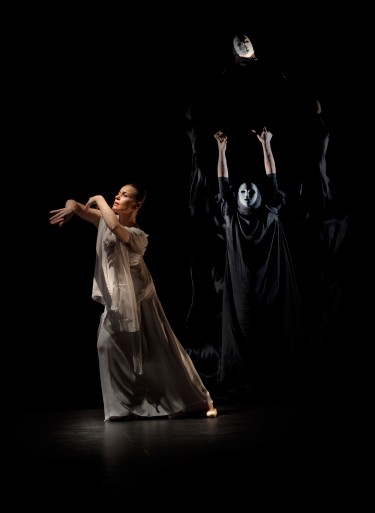
Noche Flamenca brought its dance version of Sophocles’ famous tragedy to Z Space in San Francisco for an unfortunately short run this February. (Short because, as the result of an injury, the first week of performances had to be cancelled.)
However, the rest of the run remains, and there is still time to see one of the most intense evenings in dance you are likely to see this season.
Sophocles’ searing play touches on some of the profoundest issue of human life: family versus the state, love versus politics, the gods versus man, feminine versus masculine values.
Last week I enjoyed a production of A Thousand Splendid Suns, a stage adaptation of Khaled Hosseini’s novel by Ursula Rani Sarma and directed by Carey Perloff, at San Francisco’s American Conservatory Theater.
The title, from a 17th century poem written bySaib-e-Tabrizi as he passed through Afghanistan on his way from Persia to India, celebrates Kabul’s landscape and people.
Taking place over the past forty years of Kabul’s history, the play reveals more of the Afghan nationals’ raw fortitude than the place’s evocative beauty. Yet, the strength and determination of main characters Laila and Mariam becomes its own kind of splendor.
This month’s submissions represent literal or metaphorical conversations: snippets of overheard or spoken dialogue, responses to cultural ideas or to others’ writing, or poetic tension among various ideas or emotional states.
Some contributors directly show people talking, or interacting in different ways.
Joe Balaz offers up two poems written in the dialect of Hawaiian Pidgin, intending to preserve the language and illustrate its capacity to convey thoughtful poetry. His poetic subjects talk conversationally to readers, expressing confidence in their hunting prowess and in everyday life.
J.J. Campbell’s poetry evokes a sense of loss, as pieces show heartbreak or a diminished belief in himself and those around him. The lack of capitalization and short lines of his writing further emphasize the somber mood. Yet he still believes in himself enough to create, to not give in to total obliteration.
Other writers create pieces in response to other cultural ideas, review books, or draw on other writers’ thoughts to convey their own.
Christopher Bernard finishes up Trumplandia, his poetic sequence where he channels the energies of departed poets in the canon, including T.S. Eliot, Basho, and Emily Dickinson, to respond to the absurdity of the U.S. political situation.
We encourage you to join the conversation by reading these submissions and leaving comments for the writers.
Also FYI for Bay Area folks, you are invited to Synchronized Chaos Magazine’s upcoming winter gathering, which will take place Saturday February 18th at 6pm at Cafe Flore (2298 Market St). https://www.facebook.com/events/1854729918104002/
RSVP appreciated but not required, all welcome, all ages, light snacks provided, bring books to read from and sell, bring something to read in the open mic, or just bring yourself and enjoy the night!
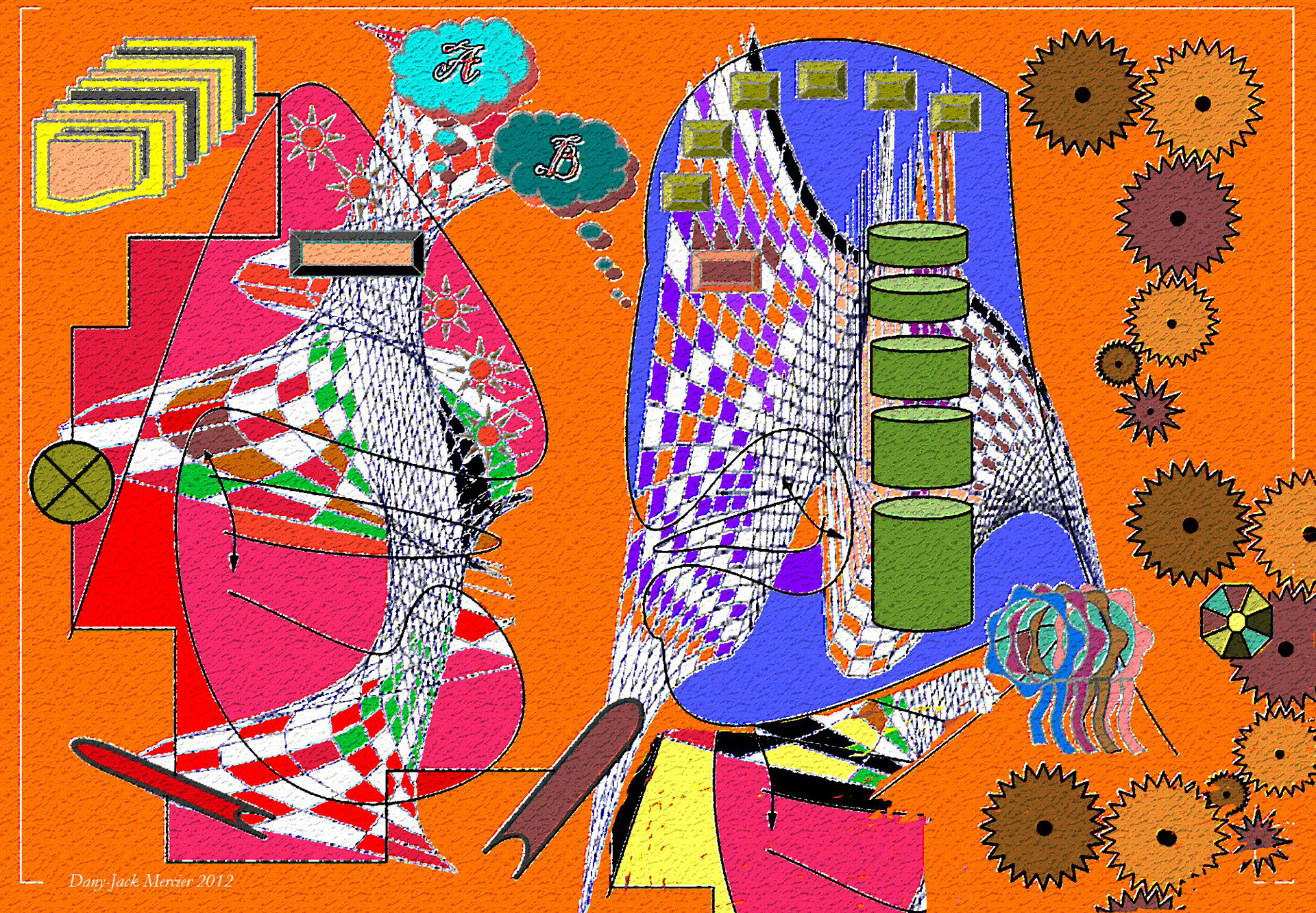
Mechanism Conversation by Dany Jack Mercier (2012)
GROWING UP GAY IN A FUNERAL HOME IN THE STICKS—REALLY!
Fun Home
Music by Jeanine Tesori
Book and Lyrics by Lisa Kron
Based on a graphic novel by Alison Bechdel
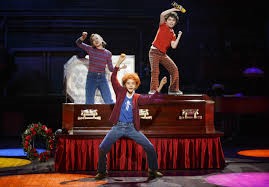
The Curran Theater, after a two-year makeover, reopened in January with the Tony Award–winning musical “Fun Home,” based on the controversial graphic novel of the same name by Alison Bechdel. The novel caused some controversy several years ago when it was placed on the syllabus of a public school English class and objected to by a few parents. A San Francisco audience will probably wonder what the fuss was all about.
The novel is presented as a memoir of the author’s childhood, growing up in a small town in Pennsylvania as the daughter of two school teachers. Her father’s hobby is fixing up the old family home, returning it to what he sees as its original elegance. The father also runs the family business, on the side. This happens to be a funeral home—referred to by the children with insouciant sangfroid as “fun home.”
The father has a secret; so does the daughter, which, she discovers, under macabre and tragic circumstances, is in exact parallel to her father’s. They are both gay. Later (no spoiler here, as the show lets us know early on exactly where we are headed) the father is killed in a road accident not long after his daughter tells him she is a lesbian, and there is some question whether or not his death was a suicide. The story takes a few weak stabs, none convincing, at exploring whether or not it was.
From this not always sharply focused material (there are at least three storylines that clash as often as they cohere), a musical has been made that is about what one might expect: a sometimes strained attempt to find a universal core in a sometimes distractingly bizarre complex of situations by forcing perfectly nice people to break into soaring if sometimes shapeless melodies, boisterous but sometimes unconvincing ensembles, set pieces that come out of nowhere and then return there, scenes of revelation, love and despair (and vice versa), and question-begging speeches and storylines that can only be based on fact as no fiction writer would have left us caught so inescapably in reality’s stubborn refusal to make sense.
Yet the show is more than worth a visit, if only because the situation it depicts, as messy as reality, is close to what many gays in this country have had to confront for a very long time indeed, even as homosexuality has become more accepted as a natural and valuable part of the human condition. This musical helps mark how far at least our urban culture has come over the last generation, and as a moral, if not always artistic, triumph, it is to be encouraged and its creators and performers applauded.
The daughter, Alison, is performed by three “actors.” (May I interrupt our show at this point to make a plea that we call female actors actresses once again? Calling women by masculine cognomens is, I submit, sexist; speaking personally, I disapprove of any form of sexism, including feminist sexism. Differences, I believe, should be honored and not erased, but they can only be honored if they are named.) These are Grown-up Alison, a cartoon artist who narrates the story, played persuasively by Kate Shindle; Youngest Alison, played (on the evening I saw the show) with bouncy vim by Alessandra Baldacchino; and College Girl Alison, played, in the best performance of the night, by a pitch-perfect Abby Corrigan, who looks like she walked out of an updated Archie comic with wondering eyebrows and an expression of perpetual innocent shock. These three share one of the show’s best moments, in a trio near the end that nicely captures the confusion of identities that lies at the heart of being human at the best of times.
One other performer was especially impressive, though her part is comparatively small and she is spared having to break into song. This was Karen Eilbacher, who plays Joan, revealer to the sexually uncertain Alison of her own gayness in a sweet and funny scene with Abby that is one of the show’s loveliest and most touching moments. Eilbacher does a great deal with a cool mien and perfectly gauged body language, to say nothing of a killing Mohawk.
The weakest link in the story is the depiction of the father (played by a game Robert Petkoff), who is never explored in sufficient depth by the script; he is kept at a distance as a nerdy, controlling, self-deceiving, closeted Log Cabin Republican−type gay man who we remain maddeningly outside of; a shell without an interior, unless the over-controlled, airless, funereal tastelessness of his home (revealed in a brilliant move of stagecraft in the middle of the show) is in fact his interior. The glasses he wears are both a sign of his inability to see the world on his own, and of our inability to see him, read his face and thus the man. Keeping him hidden behind his prosthesis for most of two hours hobbles an actor’s ability to give his expressions much nuance. (The same might be said of Grownup Alison, though to less untoward effect.)
Alison’s mother is played by Susan Moniz; it is a bit of a thankless role, as the mother’s motivations for staying with Alison’s father remain as murky as the man himself is. Alison’s younger brothers are played with energy and charm by Pierson Salvador and Lennon Nate Hammond, and with Baldacchino have one of the show’s best moments: a whacky ensemble in which they act out a make-believe TV commercial for their “fun home.” Too bad I couldn’t hear all the lyrics in an otherwise well-mic’d show; the ones I could hear were some of the show’s funniest lines.
The objects of the father’s interest down the years are nicely played by Robert Hager.
The instrumentals were performed onstage by the Fun Home Orchestra; John Doing’s percussion and Philip Varricchio’s clarinet made especially memorable contributions.
_____
Christopher Bernard is co-editor of the webzine Caveat Lector. His novel Voyage to a Phantom City came out in 2016; his new book—a collection of poetry called Chien Lunatique—will be published in May.