I light a candle in my heart for you in the evening of my life,
Remembering life that your eyes reflect,
I sit silently remembering your gentle words of kindness.
Your touch has awakened my spirit;
My soul glows,
Now the world makes sense.
Two Candles
Alone the light begins to dim, as my breath ceases
Sharing your breath with me, the light begin to rise and glow.
Sadness disappears into the shadows as life returns,
Your spirit burns within me,
Two glowing spirits of life in this one flame
Moments of Life
If this moment is true there are no lies.
Life becomes real, .
Love connects to lost souls.
Translated by Keith Ekiss with Sonia P. Ticas and Mauicio Espinoza
Tavern Books
66 pages
$17.00
A review by Christopher Bernard
There is a compulsive uneasiness to being a poet in the contemporary world. He (or she) has little place in a society that only respects makers of goods or providers of services that can “turn a profit.”
But poetry has little place in a market economy; neither the work itself nor any way of presenting it can make enough money to provide a poet with even a modest living, let alone anything like a fortune for himself or his publisher. And, as we all know by now, if your creativity can’t leverage you, at the very least, a few million in investments, with a hundred mill in loans, for the transparency of a billion in mid-term prospect (a modest enough ambition in the world of globalized twenty-first century capitalism), what real value does it have?
Because to be a poet in the modern world means knowingly and deliberately to choose a life of almost indecent poverty, or at best a tight little corner in the dwindling middle class doing something that does not deprive the poet of the time, energy and emotional and intellectual freedom to make the poetry that gives his life meaning. Poets keep the wolf from the door by doing something—anything—else.
In even the recent past, the respectable poverty of the poet was mitigated by respect, even fame: the poet was the voice of his people, of their hopes, loves, defeats, victories, during the great period of nationalism of the nineteenth and early twentieth centuries. The poet wrote his people’s love songs, laments, elegies, odes, satires, lampoons, manifestoes, gibes. People loved and admired their poets; they quoted favorite poems to themselves for pleasure and consolation. They found in poems the words they could not find for themselves.
Caleb Cheung, Oakland Unified School District science manager and former middle school science teacher.
Two months ago, at an enrichment lecture for volunteers at Oakland, CA’s Chabot Space and Science Center, Caleb Cheung led our group of adults in what seemed to be an ordinary children’s science demonstration. We stuck lit candles in wax and placed them underneath inverted jars in bowls of water, then watched as the candles burned inside the jars and water rushed up from the bowl inside the jar.
We formed groups and took turns writing and speaking in front of the group about what had happened during our experiment. Through hastily drawn graphs, charts and diagrams, we showed off what we had seen to the assembled crowd. Depending on our group composition and professional backgrounds, we drew upon explanations from the chemistry of combustion or the mathematical relationships among temperature and pressure in fluid dynamics.
The easy explanation for what had happened was that the candle flames burned the oxygen from the air inside the jar, creating a vacuum which got promptly filled by water from the bowl. So, we followed up the experiment by using two and then three candles. Lighting multiple candles shortened the time that the candles burned before going out and caused the water to rush up in the jar more quickly. However, wouldn’t the water rise within the jar at a steady rate as the candles burned and the oxygen got consumed, rather than rushing into the jar as the air cooled? That was what we would expect if oxygen combustion were the main factor at play here, but clearly the relationship was more complicated.
Going through secondary school, I wanted to be a lot of things: an
engineer, a writer, maybe even a farmer. My best friend, Ifeanyi, just
wanted to be a farmer, he just wanted to feed the nation. Today, we
are both medical doctors because my father made the same argument as
her mother: being anything other than medical doctors was a waste of
our brains…
My mother is a teacher, and my father was a teacher, as was his mother
before him. Ifeanyi’s mother was a teacher too. Yet we had to be
doctors, we had little choice. And therein, in open secrecy, is why
our students fail, is why the standard of Nigerian education has since
fallen and yet does, is why our graduates are schooled but not
educated, or educated but not learned!
More and more of our children fail standardized examinations, even
while the textbooks continue to be better written, simpler written,
and written for the lazy, even dummies! “Mathematics Made Easy”,
“Statistics for Dummies”, “Key Points”, “Exam Focus”, and we continue
to encourage laziness and promote mediocrity while we close our eyes
to the root of the problem: the internal brain drain!
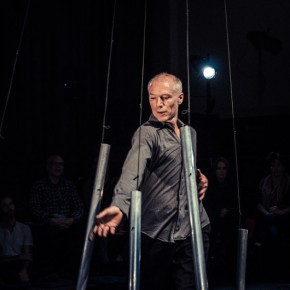
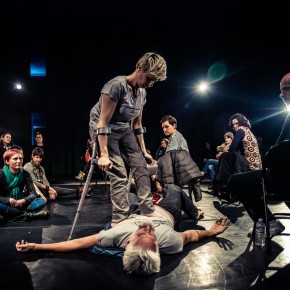
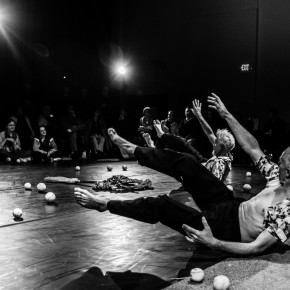
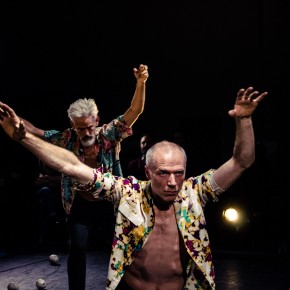
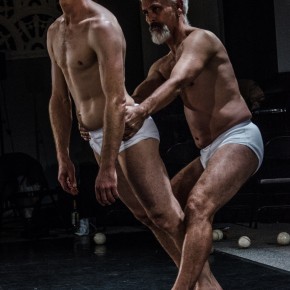
When I think of modern dance, I think of something like ‘literary fiction’ in novels: material meant to instruct and comment on society more than to entertain. And Jess Curtis’ show Gravity, which I saw at San Francisco’s Gray Area Grand Theater on Sunday December 13th, definitely lived up to the first objective.
The show left me with thoughts on the nature of performance, human relationships and the theory of mind that became much more clear after I stayed for the talkback with the dancers and UC Berkeley philosophy professor Alva Noe and when I later read more online about Dr. Noe’s theories. Yet, the evening also included fun, laughter, humor and mystery, which became apparent once I understood intellectually what the troupe hoped to accomplish.
During the first section of the show the audience sat on pillows on the floor of the small venue and the dancers pranced and gyrated through pathways around our seats. Scottish artist Claire Cunningham joined Curtis and another male dancer and moved with the aid of crutches. I watched this scene attempting to understand what point they were making: that Claire’s movements were just as lovely as the others? that she was out of place in, or equally a part of, a world made for able bodies?
For someone who enjoys a great story, is there anything better than a narrative that engages you from the very start? Imagine a world so rich you can almost smell the scents in the air, a delivery so clever it forces you to think in a way you never thought you would. I’m Ryan J. Hodge, author, and I’d like to talk to you about…Video Games.
Yes, Video Games. Those series of ‘bloops’ and blinking lights that –at least a while ago- society had seemed to convince itself had no redeeming qualities whatsoever. In this article series, I’m going to discuss how Donkey Kong, Grand Theft Auto, Call of Duty and even Candy Crush can change the way we tell stories forever.
What Videogames Teach Us About Writing Female Characters
It is tempting to say that games have made great strides in their portrayal of female characters since the early days of rescuing Pauline, Princess Peach, & Zelda but, in fairness, there has been a wide array of female (or female identifying) characters ranging outside the role of ‘damsel in distress’ since even the 8-Bit era. Some of the most readily identifiable of these include Samus Aran (Metroid), Carmen Sandiego (Where in the World is Carmen Sandiego?), Selan (Lufia II), Terra (Final Fantasy VI), and so on.
While inarguably outnumbered by male counterparts (particularly in playable roles), there is still much that games can teach us about writing for female characters.
It is no secret that part of the challenge in writing compelling female characters is to reconcile their character traits with the society in which they exist. There is a temptation to suggest that the best practice for writing a ‘good’ female character is to simply write her as one would a male character and merely replace the pronouns. However not only does this conflate the ‘male’ template as a sort of ‘default’ model, it can also be unnecessarily limiting the character’s scope. Yet, there is an understandable reluctance to dwell over-much on the fact that a character is, indeed, female when the story doesn’t call for it.
The Two Day Wonder / Memories of Pirate Mike
by Tony Glamortramp LeTigre
I’ll never forget two thousand eleven,
The year i died and went to heaven!
—A rhyme i made in 2013, the year i briefly shared a squat with Pirate Mike
A few pages in honor of my friend, Michael Clift, whom i knew as Pirate Mike, who was reportedly hit by a car while cycling in Texas recently.
Although we were both involved with Occupy San Francisco, i don’t recall meeting Mike there, but rather at Noisebridge hackerspace in the Mission district. I was taking a nap there one evening on “the hacker stacker”—a DIY bunk bed that was an experiment in officially-sanctioned sleeping for that oft vagrant-plagued space—and overheard this guy i hadn’t met before talking with friends about a marathon bike trek he’d recently completed. Mike crisscrossed the country by bike many times, from what i understand.I felt a kinship with him in that some of the technogentsia loathed people like him and myself for dragging radical politics into their supposedly anarchist hackerspace.
I remember reading a logical analysis of the Marxist materialist dialectic in the Noisebridge library one afternoon, and Mike saw me reading it and said something like, “That’s going to be a head full, that’s a serious read.”1
At one point I decided to emulate Mike & make a cross-country trip, but I decided I would make my trip on foot, squatting and hobo-ing my way from coast to coast. I told this to him, and needless to say he approved. So far, I’ve only talked about it, though. He’s the one who did it—and then some.
One night i led Mike and a couple other Noisebridgers on a walk up into Liberty Hill, one of my favorite walks in the Mission barrio. It was around midnight so polite people were asleep, and i brought us to the yard of a building where i’d crashed and stashed myself a couple times. It offered star-spangled hilltop view of the storybook City with its many lights. We hung out, smoked and joked, then moved on. I showed them other mysteries i’d turned up in my wanderings: the house that always had lights on and was eternally under construction that never seemed to move forward; right next to it, my dream house, which i called The Gatsby House, because i read somewhere that was the style of architecture it was built in; I wasn’t sure how to describe it, except that it looked awesome, it never had any lights on and seemed not to be lived in—yet somehow i could never work up the courage to investigate that place. Not far away, i walked us by another oddity set back from the road, apparently built in the style of a renaissance castle. I wouldn’t be surprised if Mike was familiar with all these spots beforehand, since he was quite the explorer. I was a mere neophyte compared to him in some ways. Nonetheless, he seemed pleasantly surprised by some of it, and thanked me for the tour.2
Another night at Noisebridge, i remember Mike preparing to leave for the night with his bike: “All right, i’m going to head off to one of my sleeping spots now.” Someone had vandalized his bike earlier that day at the hackerspace. He had detractors and ugly moments, i’m told, but I never saw them.
I remember Mike doing a live remote Q&A at Noisebridge for the premier of a documentary on the issue of veteran homelessness. Not sure if it was “his,” or if he was just promoting it. It was connected to a live premiere of some prestige in L A.3 As i recall, he was holding it down so well, so eloquent and strong with his answers to the questions that were being asked, that as soon as it was over i went up and complimented him on doing such a good job. An instance of saying the right thing at the proper moment. It made his day a little brighter, i think, so i’m happy about that. It should show up well in my next interlife review with the angels of light.4Continue reading →