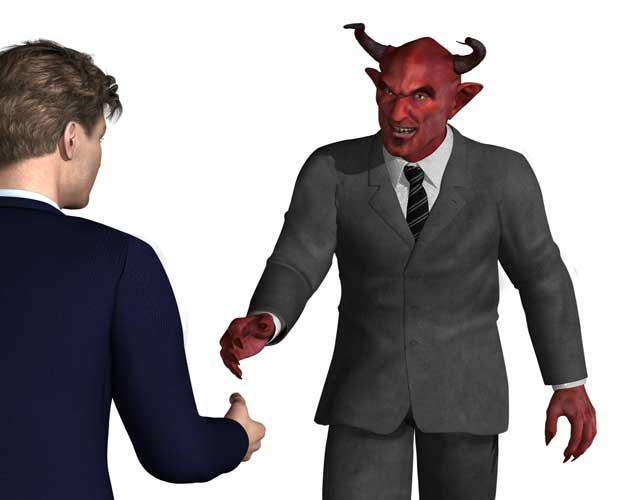
The modern world, that devil’s bargain …
—E.M. Cioran
The devil came to a man one day
and told him: “I will grant to you
undreamed of knowledge, wealth and power;
every hope mankind has known
will real become, or seem to be
on the verge of reality
tomorrow or, at the very most,
the next day, marvelously.
You will dominate the earth,
take your first steps toward the stars,
walk on the mountains of the moon,
touch the sands on the plains of Mars,
weigh the ice on Saturn’s moons,
on your fingers wear her rings,
weigh the universe itself
in the scales of your great mind,
measure its length, its breadth, its age,
its time to come, death and old age,
you will be so sage.
You’ll count the smallest elements
that make it up – the quarks, the strings,
the genes, the chromosomes of all things –
and play with them
to make new worlds, new life, new minds –
you’ll learn
the origin of space and time,
the source of life, the cause of thought,
everything that can be known
you, and you alone, will know.
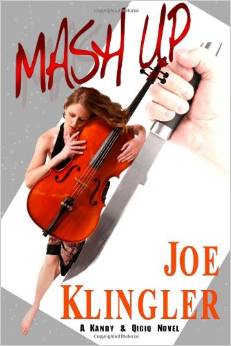
Joe Klingler’s mystery novel, Mash Up, is a page turner. Anyone who has read Dan Brown’s DaVinci Code knows that it just flows on and on, from one action to another, so that it’s almost impossible to put down.
Mash Up is the same way. Beginning with a small piece of gruesome—a severed finger mailed to a friend of the victim—Mash Up explodes out of the starting blocks into a 600-page dash, where each contestant is a different strand of a convoluted, but exciting, mystery.
The severed finger is the springboard for demented killers, skimpy bikinis, an Eskimo detective, marvelous classical music, shipboard sexpots, wild car chases, Machiavellian computer viruses, exploding iPods, beautiful musicians dancing naked on remote beaches, and more, and more.
All of which commends Klingler’s writing ability, because the story flows smoothly all the way through. The writing never allows the plot to slow down.
Or, How I Learned to Stop Hating and (Sort of) Love the Pride Festival
By Tony Longshanks LeTigre
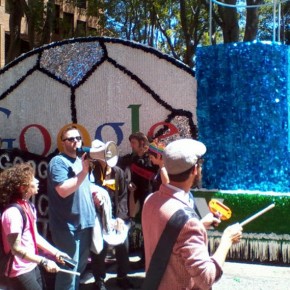
For my first five years in San Francisco I talked shit about the Pride Festival, without ever once attending it. This past June of 2014, during an inspirational phase of getting back on my feet after a long spell in limbo, I decided to give Pride a chance & accepted an invitation to march in the parade with a protest contingent led by ceaseless agitator Tommi Avicolli Mecca. An epic day ensued; it turned out to be tons of fun, enough to make me rethink old prejudices.
My distaste for Pride came second-hand from friends of the more radical persuasion. I’d heard much criticism of the festival, and its governing body, the Pride Committee, whose heavy-handed refusal to grant honorary marshal status to the conscientious objector formerly known as Bradley Manning in 2013 resulted in a firestorm of controversy. This year we had something to celebrate, for the Pride Committee had apologized & belatedly honored Chelsea Manning (as she now prefers to be known). This victory was enough to overpower doubts & premonitions I had, in the weeks leading up to the festival, that a terrorist incident like the one at the Boston Marathon might disrupt Pride.
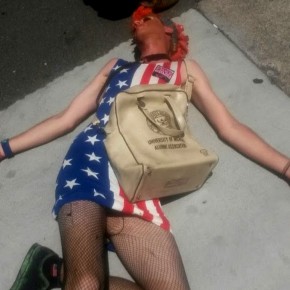
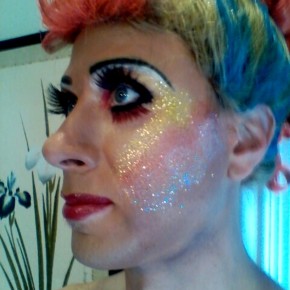
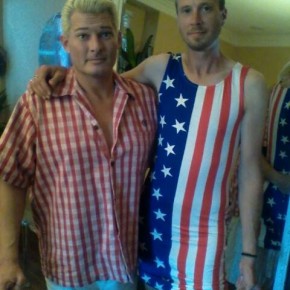
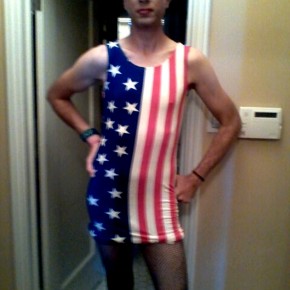
My cousin, whom I call Cousin, had graciously agreed to put me in hair & makeup for the big day, being a professional makeup artist & more gifted in these areas than my poor self. Sunday morning I arrived at his fab flat in Pacific Heights & we spent two glittering hours transforming ourselves into creatures of glamor. We were assisted by Cousin’s charming, civilized Persian lover of many years, who took the pre-makeup photo of the two of us together on this page. (Am I really that tall?) Girl drag hadn’t been my first impulse, I’d wanted to put together a sort of sexy super hero-meets-glam rocker outfit of my own design, but that didn’t happen in time, so I went with the path of least resistance: trying on things from Cousin’s magic closet, finally settling on an American flag dress & wig. I managed to punk-ify the outfit by pinning the dress up scandalously high, then decking my lower body in torn fishnets & old Converse sneakers sprayed with green paint. I was marching with protesters, after all; it would be unseemly to appear happily patriotic.
As you can see from the pics, Cousin did a marvelous job on my hair & makeup!
Never know they come from her, round his ankles, hanging on dear life across the room screaming in glee. Short squat, long lean between them they made complete. One.
For someone who enjoys a great story, is there anything better than a narrative that engages you from the very start? Imagine a world so rich you can almost smell the scents in the air, a delivery so clever it forces you to think in a way you never thought you would. I’m Ryan J. Hodge, author, and I’d like to talk to you about…Video Games.
Yes, Video Games. Those series of ‘bloops’ and blinking lights that –at least a while ago- society had seemed to convince itself had no redeeming qualities whatsoever. In this article series, I’m going to discuss how Donkey Kong, Grand Theft Auto, Call of Duty and even Candy Crush can change the way we tell stories forever.
What video games teach us about subverting a protagonist
In a conventional story, a protagonist is not just the main character in the story; he is our window into the universe the artist has created. Whatever his raison d’être in the story may be, it is ours to see him through to the end. For the story to move on without him is to beg the question why he was the protagonist at all. So it is with video games as well. Usually, when the game begins with a realized protagonist; it will end with that very same protagonist. It’s a position that the audience members (and even authors) often take for granted…and will often fail to realize how vulnerable a position it is.
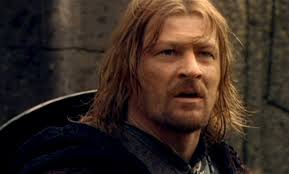
Well…Sean Bean knows how vulnerable it is.
‘Raising the stakes’ is a near-ubiquitous narrative device when telling a story. Usually it means that something about the status quo has changed for the protagonist to make his task that much more urgent/vital. In a classic ‘Three-Act’ structure, the stakes will continue to rise until the protagonist reaches the ‘lowest point’ (i.e.: the period where ‘all seems lost’). It is at this point that the audience is meant to sympathize with their hero the most and wishes to see him overcome the final opposing obstacle. In terms of gameplay, this might be translated into a sudden spike in difficulty where valuable equipment, companions, or powers have been taken away from the player.
However, even if he may die, the hero must always overcome his obstacles, right? According to the ‘monomyth’ theory detailed in Joseph Campbell’sThe Hero with a Thousand Faces(1949); of course he will! Campbell himself summarized the monomyth thusly:“Aheroventures forth from the world of common day into a region of supernatural wonder: fabulous forces are there encountered and a decisive victory is won: the hero comes back from this mysterious adventure with the power to bestow boons on his fellow man.”(The Hero with a Thousand Faces, 2nded.,1968)
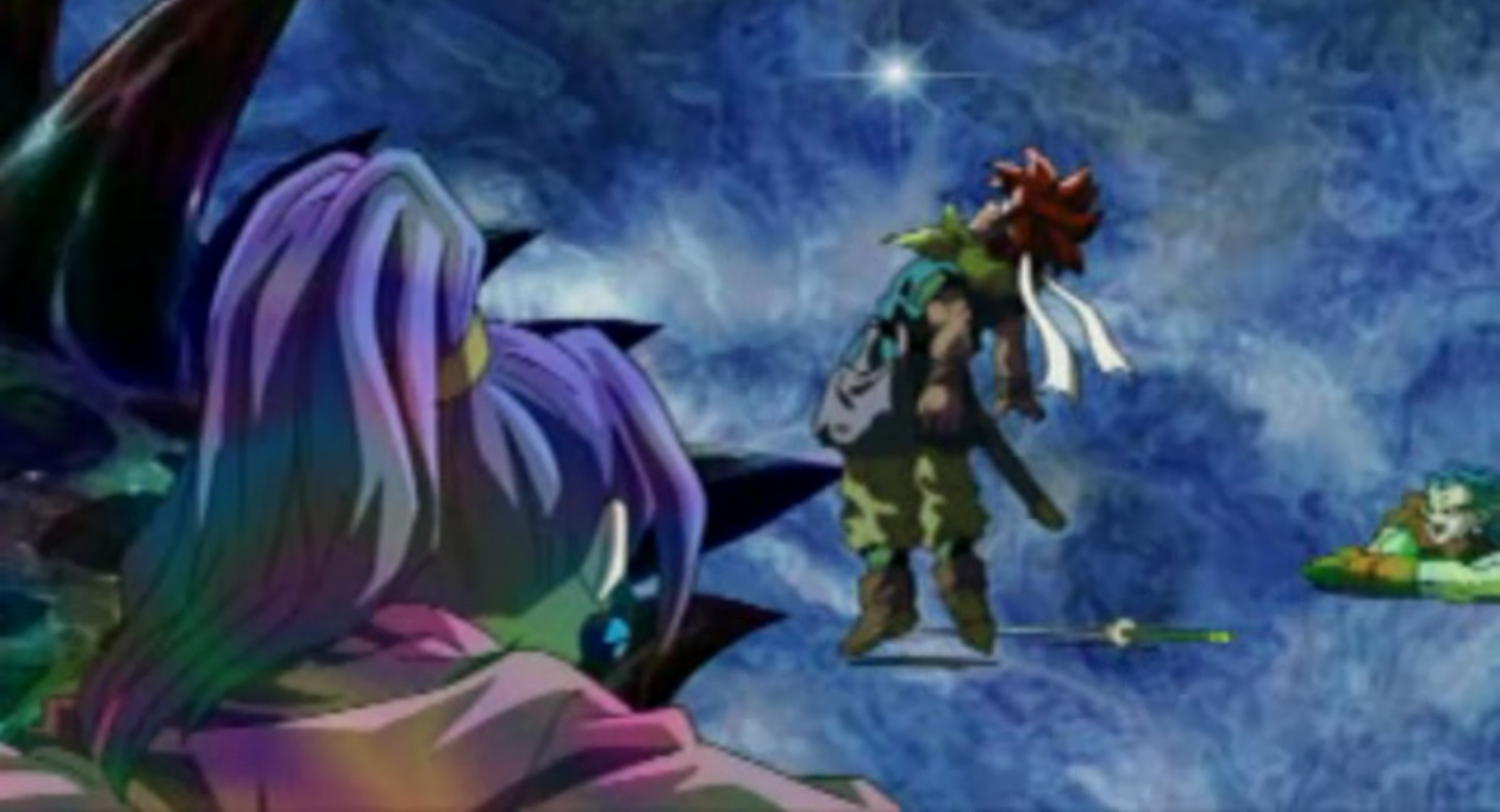
This is what I believed as the second Act of one of my favorite games,Chrono Trigger, drew to a close. After having spent hours besting horrors from across space and time, surely a hastily sprung trap from some just-introduced villain would simply be a bump in the road. At any second, we were going to figure a way out of this.
Any second now…
But we didn’t. My character was blasted to atoms, and rather than a ‘Game Over’ screen; the story simply continued.
The Clinical Pharmacy Clerkship in OOUTH, Sagamu runs for some 6 weeks and allows associate Pharmacists to receive clinical training and garner experience in clinical settings, to hone their skills, especially in the area of drug therapy, and to experience first-hand Pharmacy as a profession (of humanitarianism) in contrast to Pharmacy as a course of study.
Like many things scholarly, it is compulsory– and necessarily so. Yet, several occurrences make this experience worthwhile despite the compulsion: the dizziness from standing for so long during the rounds, seeing Consultants gb’ara le (unnecessarily rebuke) registrars and medical students, witnessing patients take offence to the frequency of students’ examinations while smiles yet light up the faces of recuperating patients, and particularly the vast knowledge available for grabs during rounds.
One fateful morning found me in Paediatrics, again on rounds. This time, the memorable moment was not the gb’ara-le of the Consultant or the stupefied look on the (helpless) recipient, it was the sight of three infants with Cerebral Palsy (CP). And after the Consultant in charge had questioned each mother and examined each child, it was glaring that the ignorance, poverty and poor practices of the mothers disabled these bundles of joy. I remember asking the soul beside me in hushed tones, “Should we not give birth?”
Prior to this memorable encounter, People Living with Disabilities (PLWD) were a much unknown existence to me, save the occasional encounters in motor parks where they have become a norm, begging for alms from all who cross their path. Yet, whenever I was that one in their path, I rarely gave out money for security reasons. Yes, that is so convenient. And, no, I ain’t that bad. I give them money once in a while, usually to get them off my back but sometimes out of pity as well.
Now, as irksome as that may sound, I am pleased to tell you that that account (and attitude) accurately depicts the prevailing acceptance of PLWDs: definitely below average! Ok, when was the last time you gave out of your heart, un-begrudgingly, to a person with disability? Hmm… I thought as much. Did you not rather scowl, or even swear? I have not bothered to ask about the hiss since that one is a given! Yet they need us to survive.