Travel essay from Jeff Rasley

Pilgrimage to Wounded Knee

I spent an hour hiking around the grounds of the Mount Rushmore National Memorial, but not seeing Presidents Washington, Jefferson, Roosevelt, or Lincoln.  Fog shrouded the mountain and hid the Presidents.

I competed with hundreds of bikers riding through the fog up to Mt. Rushmore on winding Highway 244.  The reward for risking a crash in the fog was to see more fog at the viewing sites up the mountain in the Park.  Thankfully, there weren’t any wrecks or laid-down cycles on the way up to or on the way back down the mountain with the carved faces of the four dead Presidents.

I wondered about the determination of the hordes of Harley riders braving the fog to reach their desired destination.  But then, we Americans are unique in our determination to cross barriers of land and space to reach our goals — whether good for us or not.  The Pilgrims and early colonists made the perilous Atlantic crossing to begin life anew in the New World.  The Pioneers crossed the Appalachians to clear the forests and break the sod in the Midwest and Great Plains.  The gold rushes and land rushes of the West propelled the greedy, the desperate, and entrepreneurial opportunists beyond the Mississippi and over the Rockies.  And, by God, we beat the Soviets and everyone else in the space race to the Moon.

The will and courage to cross boundaries, to tame the land and conquer whatever we encountered is one of the great American characteristics.  The strength and courage required to begin those journeys is admirable; the results of the conquests, maybe not so much for those who were in our way.

My mind was running down this course over a solitary breakfast at the 1880 Keystone House Family Restaurant in the town of Keystone, South Dakota.  Exactly what the hell was I doing here?  I hadn’t even seen the images of the four Presidents, nor Crazy Horse.  From the unseen stone faces my thoughts had turned to pondering the checkered history and relationship of Americans with the land, the trees, animals, and native peoples who occupied the land before we did.  I was seized with a feeling of loneliness and ennui.

I had spent two alienating days in Sturgis, South Dakota during the great biker hajj of Bike Week.  Sturgis was just a larger version of other Biker gatherings I’d experienced – macho exhibitionism, sex, drugs, and rock ‘n roll.  It had become increasingly clear in the two days I had spent in and around Sturgis that I no longer fit.  I had left the tribe and could not return.
I studied my map of South Dakota while eating scrambled eggs and bacon.  With map in one hand and fork in the other, I had an epiphany.  My eye landed on a place marked “Wounded Knee” on the map.  To transform this trip into a meaningful adventure I should perform a spontaneous pilgrimage.  I should go to Wounded Knee.

My cell phone battery was almost dead.  I turned it off, paid the bill and exited the restaurant.  I opened the trunk of the car and stuffed the cell phone into the pocket of my duffel bag.  I revved up Goldie, my faithful Sebring, and headed southeast toward the Badlands in a warm, foggy drizzle.

An ancestor of mine died as a result of the “action” at Wounded Knee on December 29, 1890.  He was not one of the hundreds of Indians killed in what has come to be considered one of the worst atrocities in the history of the U.S. military.  He was one of the perpetrators, Lt. James Defrees Mann of the 7th U.S. Cavalry.

My journalist mother wrote a story for our hometown newspaper, The Goshen News, published in May, 1977, about our ancestor, Lt. Mann.  My mom learned about our ancestor when she was invited by the U.S. Military Academy at West Point to represent the family at Lt. Mann’s “Last Roll Call”.  The Last Roll Call is the one hundredth anniversary of graduation from West Point.  My mom attended the ceremony.  Then, she researched Lt. Mann’s military career and wrote the article for the newspaper.  I had recently re-read her article while perusing the family scrapbook during a visit with Mom.

It struck me as intriguing and perverse that I have an ancestor who managed to get shot—most likely by friendly fire, since the Sioux weren’t doing much shooting—in one of the most notorious events in U.S. military history.  (Another ancestor is Cotton Mather, the prosecutor of the infamous Salem witch hangings.  But at least he had the compensating distinction of being a “Puritan Divine”, famed scholar, preacher, and educator.  And, he didn’t get killed by a witch during the Witch Trials.)   Anyway, my mom’s article was a revelation for me when it was published in 1977; not just about our family history, but also about the “action” at Wounded Knee.

Most of what I had learned about the Indian Wars and conquest of the Plains Indians by the U.S. Army in my American History class in high school was forgotten in the cobwebs of memory by the time I read through my mother’s scrap book.  Although, I still remember arguing with one of my teachers, Mr. Clason, about how Americans treated the Natives who got in the way of our “Manifest Destiny” to rule the land from sea to shining sea.  Mr. Clason didn’t claim the way the Indians were treated was right, just inevitable.  At least he was willing to discuss it, because the mistreatment of Indians was not a favorite topic of public school teachers when I was growing up.

We Americans had circled the wagons to defeat the threat of international communism.  We didn’t want to give Castro, Khrushchev, and Mao any extra ammo to use against us by dwelling on past misdeeds of our own.  So, most public schools taught us Baby Boomer kids the saccharine-sweet version of American history in our Civics and Citizenship classes.

Re-reading my mom’s article in the new millennium sparked enough interest that I did some further reading on Wounded Knee; including the worldwide best-selling 1970 book Bury My Heart at Wounded Knee by Dee Brown.  The book generated tremendous interest in the largely ignored native peoples who had been abandoned to their reservations for the last hundred years.  The book was criticized for presenting history only from the Indian point of view and for romanticizing Native American culture.  Seems to me though, it was about time the Indian point of view got some attention from the dominant white culture.

A sea change began to occur in 1970 in the popular consciousness of white Americans with respect to the treatment of Native Americans by our forefathers.  The movie Little Big Man was also released that year.  It starred Dustin Hoffman and was wildly popular.  For once, U.S. Cavalrymen were portrayed as the bad guys and Indians as the good guys.  Angst within the country about the Vietnam War was at a nadir.  The movie subtly but very intentionally compared the way the U.S. treated Native Americans to the way it was conducting the war in Viet Nam.

The conventional view of the dominant white-American culture was that the Plains Indians were unchristian savages who raped and pillaged innocent pioneer settlements.  Indians were devious and could not be trusted to live with civilized whites.  They needed to be restricted to reservations in order to keep the peace and protect white people.  This narrative had some basis in historical fact and received plenty of print and propaganda prior to and up through the 1960’s.  Alternative interpretations of history were out there, but were minority reports given little attention.

Growing up in the late 1950’s and 60’s, whenever neighborhood kids played cowboys and Indians, which we often did, the Indians were always the bad guys.  We had to take turns being bad guys, so that we got our turn being John Wayne-like good guys.  Where did kids in Goshen, Indiana get the idea that the Indians were the bad guys and the cowboys the good guys?

Losers don’t usually get to write the history that is imbibed by the descendants of the winners.  But change was afoot by 1970.  The new narrative of the wise and noble Indian (e.g., Big Chief in the 1975 film of Ken Kesey’s One Flew over the Cuckoo’s Nest) might have excessively romanticized Native Americans.  But, it was about time history was revised and popular consciousness evolved to incorporate the Indian point of view.

An Englishman I met on a recent trip to Wells, U.K. remarked to me that we have such “delightfully colorful-sounding names in the U.S., like Suwannee, Wawasee, and Wapahani.”  I replied, “Yes, we Americans are grateful to the Indians for bequeathing us their land along with the names that went with it.”  As the winner of the Indian Wars, we whites got to write the history and name the lands we won.  Apparently, we liked the sound of Indian names for lakes and rivers, since we kept them.  We just didn’t want the people around who named the landmarks.

There is no longer any dispute among historians that what happened at Wounded Knee on December 29, 1890 was one of the worst of the many terrible events in the sad history of Native American encounters with whites in the nineteenth century.  My mother’s 1977 article summarized the accepted account of what happened at Wounded Knee.  She described it as a massacre of Indians.  But her article also related our ancestor’s version of the events.

Lt. Mann might be the only casualty of U.S. Cavalrymen in “the action”.  The article describes and quotes a contemporary report about what happened in what was then called “the Battle of Wounded Knee”.  Lt. Mann was actually interviewed by a reporter from Harper’s Weekly after the battle while he lay dying from his wound.  The Harper’s article was also printed in Lt. Mann’s hometown newspaper, the Goshen Democrat, after the Lieutenant succumbed to his wound and died on January 15, 1891.  My mother’s 1977 article in The Goshen News summarized Lt. Mann’s interview by the Harper’s correspondent as follows:

“Lt. Mann was lying on his back with a bullet through his body.  The young officer grew stern when he got to the critical part of his story.  Lt. Mann said, ‘I saw three or four young bucks drop their blankets and I saw they were armed.’  ‘Be ready to fire men,’ I said, ‘there is trouble.’  There was an instant and then we heard firing in the center of the Indians. ‘Fire,’ I shouted, and we poured it into them.”

There is still disagreement among historians as to who fired the first shot.  My mother’s article relates that a gun accidentally went off while Indians were being disarmed by the government troopers.  Lt. Mann blamed “an old medicine man” for stirring up “the bucks”.  Although the Indians were surrounded by heavily armed government forces, Lt. Mann claimed that the medicine man stoked defiance and the Indians believed they were invulnerable to the bullets of the whites because they wore “ghost shirts … painted with magic symbols.”

Whoever fired the first shot, as my mother’s article notes, the result was that federal soldiers killed around 300 Sioux, mostly women and children.

As far as I know, no one from my family had made a pilgrimage to the place where our ancestor was shot while participating in the massacre.  The epiphany I had while studying my map over the course of my solitary breakfast in Keystone, South Dakota was that I should be the first.  Perhaps a pilgrimage to Wounded Knee by a descendent of Lt. Mann would qualify as some sort of atonement.

In retrospect, my “epiphany” seems more than a little presumptuous, really quite self-righteous and pretentious.  But it felt right at the time.  Plus, I figured a pilgrimage to Wounded Knee would relieve the anomie and alienation of Sturgis.

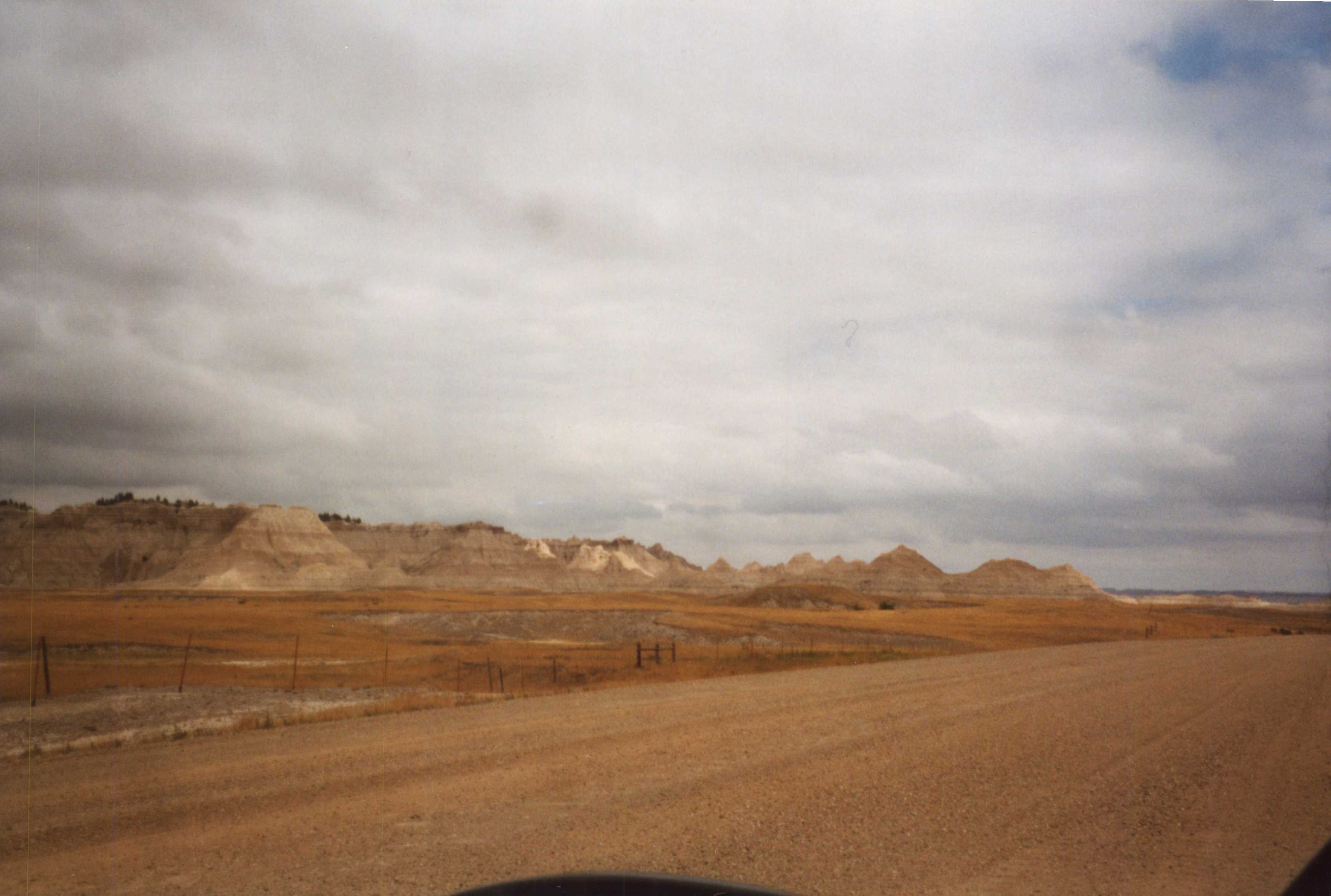
It is shocking and dispiriting to see first-hand the land the U.S. government “gave” the Lakota, Oglala, and Rosebud Sioux for their reservations in the Badlands.  We didn’t even reserve all the land for the tribes, because the government also cut out a major chunk of the Badlands for Badlands National Park.

This was the first time I had seen this part of America, southwest South Dakota.  Driving across this stark and bleak land, so different in its dry and rocky grayness from the rolling green of my Midwestern homeland, it seemed like it must have been a cruel inhumane joke of the government to have “reserved” this land for the Sioux people.  The cruelty of the joke seemed especially poignant as I drove through Custer County.

While there is beauty in the land to some eyes, it has to be indisputable that the Badlands are one of the most inhospitable areas in North America to human existence.  The landscape was harsh, grim, and the August heat was terribly oppressive as I motored along State Road 40; too hot to enjoy the convertible top down.  It was bad, yeah man, it was a bad land.

The cruelty of the joke on the Sioux manifested itself in another way as I drove on.  State Road 40 was a rough but decently paved and maintained road angling southeast from Keystone toward the Pine Ridge Reservation.  When it became a BIA (Bureau of Indian Affairs) road, it ceased to be paved.  Smackity smackity — poor Goldie endured forty miles of gravel whacking her undercarriage and wheel wells as we motored across the Pine Ridge Reservation.  Pavement appeared again when we entered the Badlands National Park.
The sole ranger at Badlands National Park Visitors Center looked the part in his green Parks Service uniform.  He was tall, lanky, and had the weather-beaten but reliable look of Gary Cooper.  He told me I might be disappointed visiting Wounded Knee.  He laconically explained that “there’s not much there.”  Turned out, he was right.  But then, there wasn’t much there anywhere in the Badlands.

On the east side of the road at the site of the massacre were a couple forlorn booths with beaded belts, necklaces, and other handcrafts for sale.  An old Indian in a stained white t-shirt with a Fruehauf Truck cap shading his eyes was asleep on a metal folding-chair behind one booth.  A couple kids played in the dirt beside the other booth.  On the west side of the road was a circular-shaped wood and concrete building.  It was the headquarters for the American Indian Movement (“AIM”).

Inside, the walls were covered with posters and propaganda for AIM.  There were testaments to Russell Means and Leonard Peltier.  There were newspaper articles and scrapbooks about the demonstrations, minor insurrections, and violence perpetrated against and by AIM.  The sparsely furnished interior had a long counter with an aged metal cash register, rickety tables with T-shirts, books, and handmade trinkets for sale.  There were no artifacts to commemorate the massacre at Wounded Knee.  Only a couple dusty books on a display table referenced the tragic history ending with the 1890 slaughter of mostly defenseless Indians.

Behind the building were two small hillock-like mounds.  On top of each mound was a small cemetery.  I looked around both graveyards, but didn’t see any monument to those who died in the Battle of Wounded Knee.  An elderly Indian wearing a faded cowboy hat, dirty jeans, and stained t-shirt was leaning against the AIM headquarters smoking a hand-rolled cigarette.  I asked him if there was a monument to those who were killed at Wounded Knee by the U.S. Cavalry.  He looked me up and down without expression.  Then, he pointed toward a fenced area of about ten feet by six feet near the back of the closest cemetery to the AIM building.  I thanked him.  He made no reply.

Within the fenced area was a six-foot high granite monument with names of victims and a description of the massacre.  Although my mother’s article reported 300 of the 350 Sioux at Wounded Knee were killed, I counted fewer than 40 names on the monument.  The skull of a horned steer rested at the base of the monument.  There was some broken pottery, a few faded flowers, ribbons, and a couple fake gold tokens scattered around the base of the monument beside the weather-beaten skull.
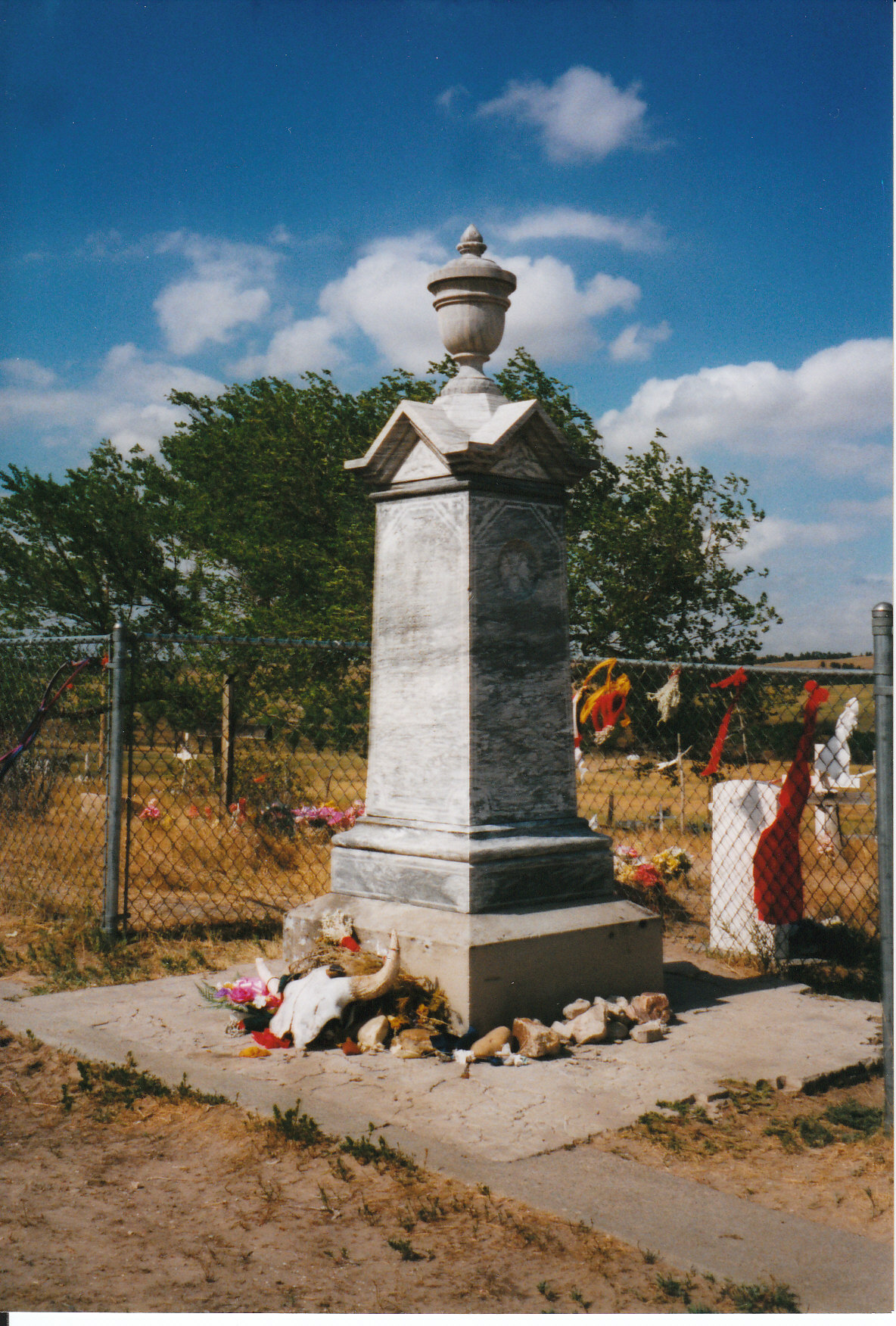
I placed two stones on top of the steer’s skull.  I wanted to think of it as an offering of symbolic atonement.  The gesture was ridiculously presumptuous.  I did it anyway.

I had purchased the rocks for one dollar each from two Oglala Sioux kids at the intersection of two gravel roads within Pine Ridge Reservation.  Their father told me he wanted to “encourage entrepreneurship” among his kids.  Apparently, the only goods and services the father and sons could come up with as an entrepreneurial venture were rocks.  Dad told me the kids find rocks, polish them, and sell the shiny stones at road intersections in the reservation.

That the father and his sons were trying to sell rocks to passersby seemed both brave and sad to me.  Brave and sad also described what I had learned of the Sioux resistance to the irresistible force of the whites’ sweep across the Great Plains.  It seemed appropriate to give back those two brave and sad little stones to the land my ancestors had taken from the Sioux.

________________

Copyright 2012, Jeff Rasley

World of Words: February’s Whose Brain Is It, a monthly neuroscience column by Leena Prasad


Presented within the flow of the lives of real people and fictional characters, this is a monthly exploration of how some parts of the brain work.


World of Words

Wendy has to stay at home with her mother while her siblings go to Universal Studios with their father. She is recovering from flu and her parents want her to take it easy. She is unhappy about the situation and sulks as her siblings go off to have a day of fun.

But when her siblings return from their adventure, Wendy is flush with excitement and does not even notice them. Her mother has given her a story book set inIndia. Wendy lives in a small town in theUS, nearLos Angeles. She is 15-yrs-old and has just started to discover the cultures of other countries. A particular scene in one of the stories fires up her imagination “a rainbow of colors swirled in the air and she closed her eyes just before the red-yellow-blue-green-purple powders landed on her white shirt.”

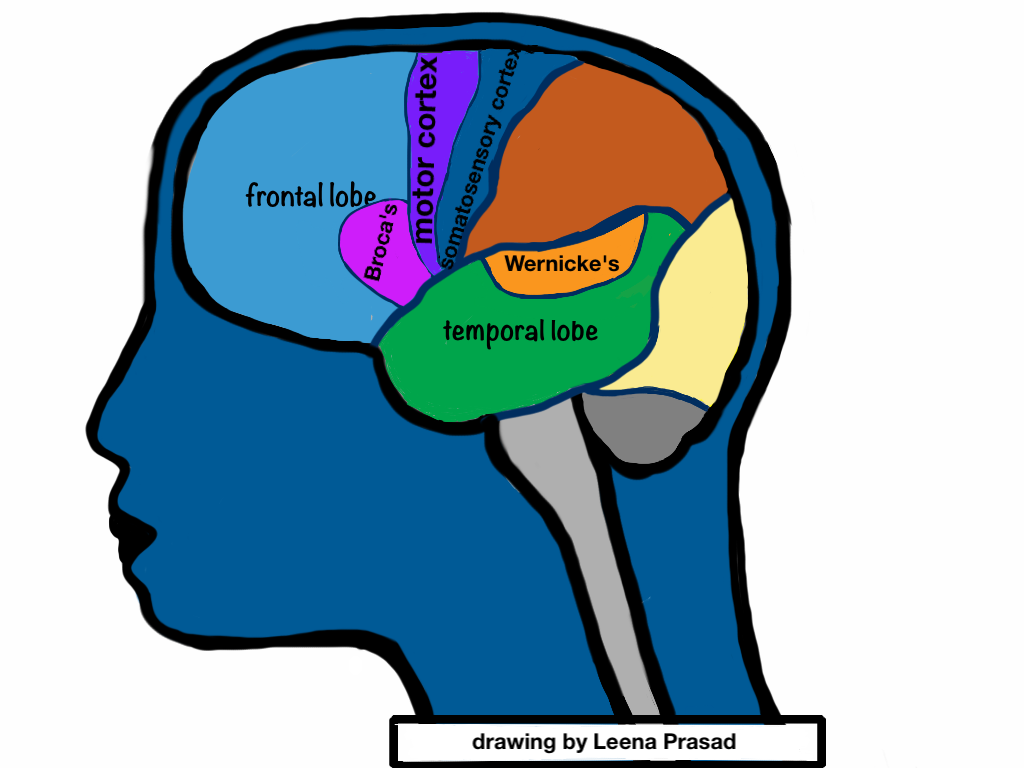
Wendy is engrossed in the exotic scenes in the book and her brain is having an adventure that’s comparable to that of her siblings’. The meaning of the sentences, paragraphs, and the entire narrative, is parsed by language processing centers in the brain called Broca’s area in the frontal lobe and Wernicke’s area in the temporal lobe.  For a long time, neuroscientist understood that Broca’s area is used for reading aloud and for producing language and that Wernicke’s is used for comprehension. But, according to studies cited in the New York Times and study results published in an article in the Harvard Crimson, Broca’s area is used for comprehension also.

The processing does not end once the meaning of the words is parsed. Some of the other regions that are involved in further analysis are motor and somatosensory cortexes. These areas catapult the experience from beyond the understanding of the story and characters into simulating the experience for the reader. It’s not exactly like the 4D simulation of Universal Studios, but it is much more individualized than the rides at the amusement park and can entertain longer depending on the length of the story being read.

Per neuroscience studies cited in the book Words to Brain and in a New York Times article, the actions of characters in Wendy’s book activate the motor cortex and the somatosensory cortex in the frontal lobe.  The motor cortex, as the name implies, sends signals to other parts of the body for the coordination of movements, like walking, dancing, eating, etc. The somatosensory cortex manages the sensations of touching. Other parts of the brain are also engaged in the process of simulating the reading experience and more research is being done to comprehend the details.

When Wendy’s imagination recreates the scenes and the experiences of the characters, her brain experiences the event as if the scene had occurred in front of her or perhaps even to her. As she reads about the Indian festival of holi, her mind’s eye sees the colorful powders falling, the smile people dresses in white, the colors landing on their clothes…The words on the page activate her brain in a similar manner that it would be activated had she been part of the story.

Neuroscientists are only beginning to study the biological basis of the power of reading but good storytellers have known how to exploit it for centuries. Most avid fiction readers are familiar with the experience of getting lost in a story filled with compelling emotions, evocative scenes, and hypnotic storyline. Of course, the success of a story in achieving movement and sensory activation of the brain is dependent on the skill of the writer in communicating the narrative to the reader. As the characters move around slyly and playfully, filling up water guns with colored water or their hands with colored powder, Wendy experiences the scene only as vibrantly as the author is able to recreate it.


topic words
regions Broca’s area, Wernicke’s Area, motor cortex,
somatosensory cortex, and other regions


Upcoming…

March:  aphasia, a disorder in producing and comprehending words


Leena Prasad has a writing portfolio at http://www.FishRidingABike.com. Links to earlier stories in her monthly column can be found at http://www.WhoseBrainIsIt.com.

Dr. Nicola Wolfe is a neuroscience consultant for this column. She earned her Ph.D. in Clinical Psychopharmacology fromHarvardUniversityand has taught neuroscience courses for over 20 years at various universities.


References:

  1. The New York Times. Your Brain On Fiction, March 17, 2012. http://www.nytimes.com/2012/03/18/opinion/sunday/the-neuroscience-of-your-brain-on-fiction.html
  2. Blackburne, Livia. From Words to Brain (Can neuroscience teach you to be a better writer?).
  3. The Harvard Crimson. Broca’s Area May Have New Function, October 19, 2009. http://www.thecrimson.com/article/2009/10/19/language-brain-brocas-word/
  4. Pub Med. Broca’s area plays a role in syntactic processing during Chinese reading comprehension, April 2008, http://www.ncbi.nlm.nih.gov/pubmed/18255103

“Spore Suite”: A poem by Teri Louise Kelly

SPORE SUITE


1.

Twisted like acid

Drops

My heart is a sanitary pad

No tears fall

In the desert of my soul

The wind howls

A serenade

My bones chime

Walking this empty land.


2.

Not fucked up,

Fucked down,

down to the pit

where beasts eat

& bodies squirm

where the pain is ecstasy

& the genocide reins

where sins multiply

& gargoyles laugh at impurity,

this hell you talk of,

exists within,

go to it,

consume its madness,

shit out its knowledge.


3.

Talk to me

through the bars,

I don’t bite,

listen to my words,

set me free,

hide me in

your chastity.


4.

Vomiting up boredom

pissing in the gutter

of dead end street

on another frail night;

shooting blanks into

another empty void;

needing nothing

wanting everything

fucking anything

drinking anything

chords & ropes & bells

& fists & boots & blood,

living here is ugly

in a beautiful way,

i was born on the tracks

run over by life.


5.

Those tenements of love we erected,

from bricks of lust & want,

crumbled in the tempest,

turning slowly to slums,

where bare-footed dwellers

& beggars, traded piety

for ammunition.

We could only sit and watch the fall,

stoned and inebriated,

through vacant eyes;

staring down wasteland promises

& shopping cart truths

wheeled through desolation

by promiscuous cunts

& vagabond slags.

We shed our clothes & our skin,

scoured rubble for clues,

until our bones bled;

builders we were,

Shakespearean sots,

architects of our own demise.


6.

Stilled by a bad blood transfusion;

thorazine shuffles toward identity crisis

inter-species communion, cerebral destitution

juice extraction – high-pitched screams

battery acid lozenges

creaking fairground rides

a non-ferrous  smile before you leap,

Out in the garden it/s raining ash

the running men sport surgical masks

jump-starting burned-out wrecks;

Beating hours on dead skin drums

with shinbone sticks

Re-winding time – re-engineering a house of pain stay

to meet all your serum needs

in pathos one they’re cooking spores,

spreading the word via pot-bellied microwaves

I can’t make it out on my own,

the exits are tied with intestinal tract,

the box is dead; the despot hung

All I got left to do, is sit here numb,

Dye my mind blonde

blend in with the pale-faced mob

as they run rampage

down dead clown alley

again tonight.


7.

despise it with a passion,

that four letter word,

loathe its manipulative device,

the way it blinds & corrupts,

spreads septic disease

tortures & kills romance

asphyxiates lust,

breeds infidelity;

that incestuous courtship it nurtures,

murders independence,

drags its swastika from the bedroom

to the courtroom.

Swaggering through lives

with bastard bravado,

& illegitimate sentiment,

bludgeoning honesty

coveting deceit;

love is a plague,

to which we all succumb . . .


8.

Let go or hold on,

watch the masks dissolve

the facts dissipate

in the murky gloom of innuendo

a moment dies

another is born,

there are no steps to retrace

no prints to track

this is the void between truth or dare,

the blurred line;

& you can stand or fall,

live or die,

on the strength of three words,

one heart,

two lies.

Synchronized Chaos, January 2013: Innovation

Welcome, readers, to the first Synchronized Chaos issue of 2013! A new year is a time for new ideas, and innovation is our theme for this month. Our contributors’ pieces involve some of the newest developments in a wide variety of fields—ranging from art to medicine to politics to economics—and all of them are well worth reading. Let’s take a look at this issue’s offerings and the concepts they cover…

This month, Michael Dickel provides us with three visual pieces—striking, colorful, and powerful—and also a set of four finely-wrought poems. Two of the paintings are inspired by a pair of very innovative musicians: one from the past (Parisian legend Josephine Baker) and another from the present (Israeli singer David Broza). The poetry, meanwhile, portrays issues of the modern world, from violence to inequality to the emptiness of urban life, with unflinching honesty.

Like Michael’s, Julie Shavin’s contribution is made up of art as well as poetry. Each visual piece displays a new and different subject and tone: they range from household scenes to depictions of caves and bridges to abstract marvels, but they share a uniformly high quality. The poems are equally well-crafted, containing a number of philosophical meditations on life, creativity, and human relationships.

Olivia Weaver contributes a set of three excellent poems to this issue. They’re heavily influenced by the bleakness of the natural world, with fog, ice, wind, and harsh coldness setting the tone for “Winter Sundays” and “Oblivion.” The third piece, “Movement,” has an interesting connection with innovation, linking the simple act of motion to a form of creation and performance.

Each month, Leena Prasad’s column “Whose Brain Is It?” educates its readers on the latest developments in neuroscience. Given that this issue is being published at the same time as the New Year’s festivities, this month’s topic is especially timely: “Your Brain on Alcohol” deals with the effect of liquor on the human mind, detailing some of the damage which can be caused by persistent overindulgence.

Moving from neuroscience to climate science, we’re also featuring Randle Aubrey’s review of Dr. John J. Berger’s new book Climate Myths this month. As a writer on global warming, Berger finds himself faced with the need for immediate action in a situation so controversial that forward movement is almost impossible. As Randle points out, climate scientists must look towards the past (learning from the mistakes of history and the actions of those persecuted for their ideals) as well as the future (developing new strategies which can keep the world safe).

Scientific tactics are hardly confined to the world of the laboratory: today, they’re being applied in new and unusual arenas. In this issue, Cristina Deptula reports on a recent lecture by Dr. David Leinweber, who is bringing scientific knowledge to Wall Street: he uses innovative, advanced forms of data analysis to detect stock market fraud and help hold down the financial fluctuations which (as we’ve repeatedly learned) can cause so much damage.

Innovative ideas don’t always produce positive results. In his second essay for this month, “The Anti-Sex League and You,” Randle Aubrey covers some of the increasingly-disturbing new tactics being used by the GOP to legislate against abortion and birth control access. He points out that these laws seem more Oceanian than American: the ideals behind them are frighteningly similar to those of the repressive government of 1984. Perhaps Orwell’s predictions were merely off by a few decades?

We close out the issue with another article from the pen of Leena Prasad, who reviews a show filled with new ideas and methods for interpreting the written word. “You Need to Read Poetry,” put on by Performers Under Stress, contains a variety of poetry-related performances, from simple recitals to poetry slams to collaborative readings.

We hope you enjoy this month’s issue of Synchronized Chaos! As always, feel free to leave comments for the contributors; if you’re interested in submitting some of your work to the magazine, please send it over to synchchaos@gmail.com.

Performance Review: Leena Prasad on Performers under Stress’ production of “You Need to Read Poetry”

You Need to Read Poetry

__a review by Leena Prasad


poetry, dramatized

as conversations

as a dance

as experiences —

shared.


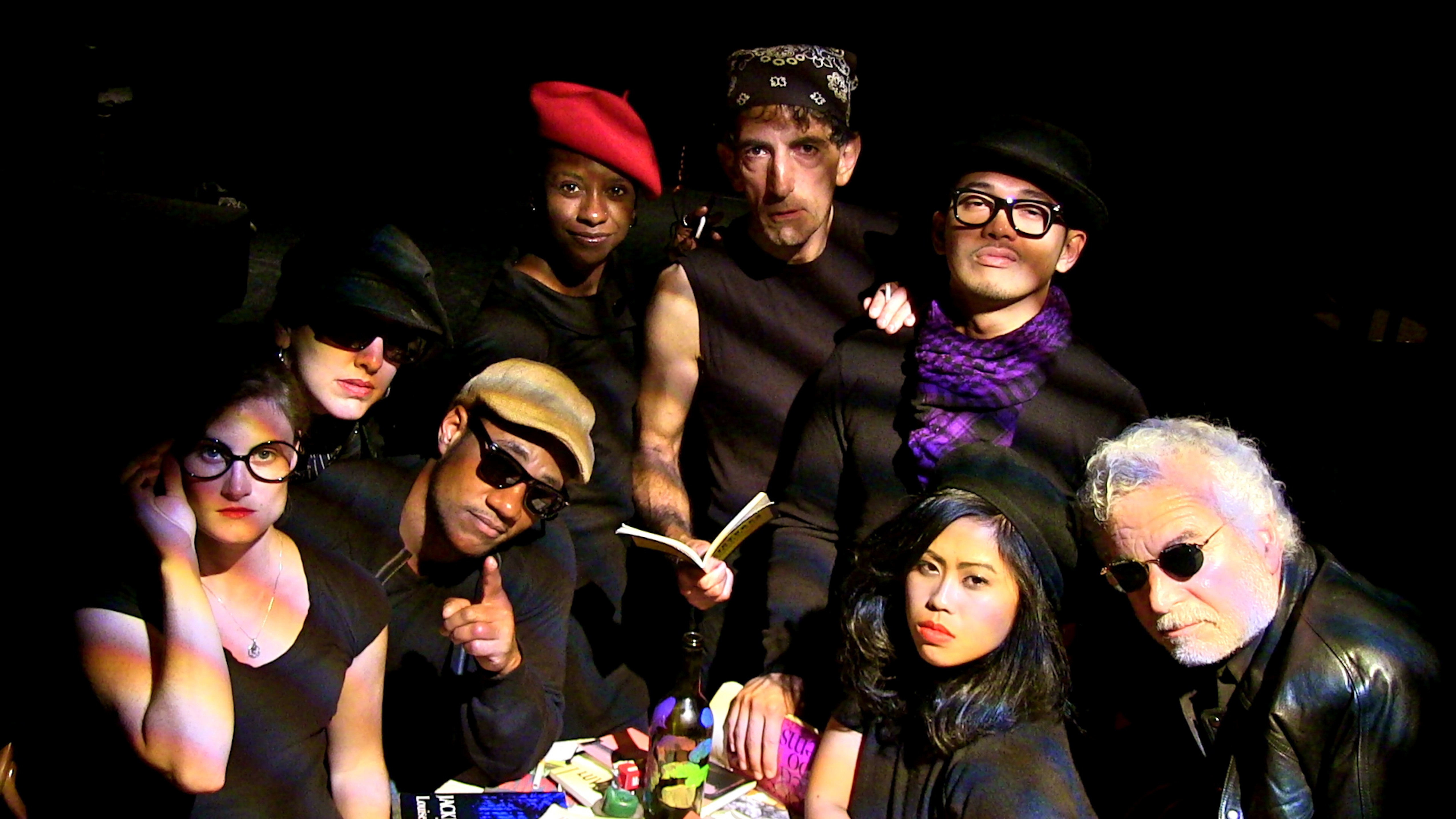
The group “Performers under Stress” has developed a unique and compelling presentation of poetry by invoking the dramatic arts of modern dance and theatre. The show titled “You Need to Read Poetry” had a run from November through December of 2012 in San Francisco SOMA’s Bindlestiff Studio. This is an enjoyable venture for anyone with even the slightest interest in poetry.

The actors infused life into the poems via dramatic readings in the form of interpretive dance, conversations, dramatic scenes, and sometimes simply by powerful vocal play. The eight performers of diverse ages, ethnicities, and genders worked together to create a poetic symphony. The black walls, ceilings and floor of the space and the (mostly) black clothes of the performers added another level of drama to the visual palate. A husky background sound, created by a woman playing a stand-up bass, infused a sense of intrigue.

The show featured over forty 20th and 21st century American poets, including Anne Sexton, Billy Collins, Charles Bukowski, e.e. cummings, Imamu Amiri Baraka, Jack Kerouac, and Lawrence Ferlinghetti.

“You Need to Read Poetry” was divided into two acts. The first act was outstanding. The second act has some room for fine-tuning.


Act 1

1. Let Me See Your Shadow

“Introduction to poetry” by Billy Collins kicked off the show. Then, the actors vocalized introductory phrases from many poets as the name of the poem and poet was printed in large white block letters against a black background film screen. In between, a black and white kaleidoscope of films rolled across the screen. One of the films was a clip from Martin Luther King’s “I have a dream” speech.

2. Love Poems

Delivered with a combination of seductive movements, theatrical performance, and vocal sultriness, the poems chosen for this set of scenes were captivating.  The scene header, however, should be Erotic Poems.

3. The Beats and Beyond

This was a full reading of several poems, executed in various forms ranging from dance to conversations to straight readings. The most remarkable performance was of the poem “San Francisco Scene” by Jack Kerouac. For this poem, the actors enacted a play set inside a bar where a poetry reading occurs with audience participation.


Act 2

1. Poetry Slam

This was the worst experience in the entire ensemble. The actual poets failed to show and thus the actors were inducted to present their own poems. One of the poets had to scramble to find one of his published poems on the internet. There were four readers. One woman sang, another one rapped, and two people read somewhat mediocre poetry. It did not have the spirit of a poetry slam, but the judges, selected from the audience, chose the rap song as one of the winning entries.

2. Stories from the Men

Several men shared the reading of one poem, adding their own individual interpretation to the lines, or one man read a poem in its entirety.

3. Stories from the Women

Similar to its male counterpart, this segment featured several women sharing the reading of one poem, adding their own individual interpretation to the lines, or one woman reading a poem in its entirety.

A particularly memorable rendition of the poem “Skin” by Lucia Perillo was performed by a beautiful Asian woman, who stood on stage wearing nothing but a red towel.  She used her exposed shoulders, bare legs, and voice to create a sultry effect. Despite being a heterosexual woman, I was completely enraptured by her sensuality.

The last performance in the show, “Cigarettes,” written by B.H. Fairchild, felt shrill and uninspiring, and it lasted too long. In my opinion, the show would be better off without this piece.

Overall, my friend and I enjoyed the night immensely and would probably go back to see another performance. I hope this show returns for another run in 2013.


This is Leena’s first formal poetry review. She runs a monthly poetry workshop and details on her experience with poetry can be found at her writing portfolio site: http://www.FishRidingABike.com.

More details about the show, the actors, and the director, can be found at http://www.PerformersUnderStress.com.

Your Brain on Alcohol: January’s Whose Brain Is It, a monthly neuroscience column by Leena Prasad


Presented within the flow of the lives of real people and fictional characters, this is a monthly exploration of how some parts of the brain work.

Your brain on alcohol…

by Leena Prasad

topic alcohol
region most of the brain
chemicals gamma–aminobutyric acid (GABA), glutamate

By the time Anand arrives at the nightclub, he is looking forward to a glass of single malt scotch. He walks in and immediately spots Matt.  “Your scotch is on its way,” Matt says. “You look like you need it.”

“Thanks, man.  My ex-wife—well, soon-to-be ex-wife—decided today that she doesn’t want to sign the divorce papers.”

Anand’s scotch arrives and they drink in silence while looking around at the stage at the far end where a DJ is setting up. “We are going to get drunk and pick up some chicks and have a great time,” Matt says. That is exactly what they do. Well, almost.

Drawing by Leena Prasad

Using alcohol to relieve anxiety is a common practice in many cultures. The reason that it works is because alcohol turns off many parts of the brain, thus numbing their sensitivity. All regions of the brain are affected by alcohol, but some of the regions are affected more acutely than others. The cerebellum which is responsible for motor coordination such as balance and movement is implicated. The limbic system, in the temporal lobe, which handles emotions, consolidation of information, and basic physiological functions is also partly disabled. Parts of the frontal lobe responsible for memory and learning are short-circuited.


After their second glass of scotch, Anand and Matt walk up to the dance floor and approach two women who are dancing with each other.  Anand, who is usually quite shy, takes hold of the hand of one of the girls and spins her around. She likes it, so he does it a few more times. At this point, the amount of alcohol is causing a lack of inhibition, thus making him feel comfortable dancing with strangers. But if he continues to drink, his current poise is likely to turn into clumsy, uncoordinated movements.

Stressed about his wife’s refusal to sign the divorce papers, Anand has sought easy relief. The alcohol in his bloodstream causes activation of gamma–aminobutyric acid (GABA) neurotransmitters which are the chemicals that shut off many parts of the brain. Thus, he is acting out of character because many of the circuits in his brain are essentially “not working” and reducing his normal inhibitions.

Time goes by. It’s 1 in the morning and Matt and Anand are still at the club. They have had several more drinks. The girls are gone. They have no idea where the girls went because now they are clumsily and unsuccessfully trying to dance with other girls. Alcohol inhibits the activity of the glutamate neurotransmitters which causes neural excitement required for memory and learning. This will result in the possibility that Anand and Matt will not remember the people they met and some or all of their behavior. The degree to which a person is affected by alcohol varies by individual genetics, environmental shaping of the brain composition and also by the history of alcohol use and abuse.

When Anand gets home at 3 AM, he is not feeling well. He vomits after eating some crackers. He feels better and goes to sleep. Since alcohol increases the level of GABA receptors which turn off brain circuits, the increase is directly proportional to the amount of alcohol in the bloodstream. Thus an increase in bloodstream alcohol leads to turning off of more and more of the brain circuits until the neurons responsible for controlling breathing and heart rate start to become dysfunctional. This, obviously, can lead to death. Vomiting is the body’s’ way of protecting itself by getting rid of the toxic substance.

Chronic excessive alcohol consumption can lead to permanent neural degeneration.  One of the most well know of the alcohol induced diseases is Wernicke-Korsakoff Syndrome, characterized by memory loss, vision problems, physical coordination problems and other mental deficiencies. Some of the damage can be fixed by restoring the thiamine (vitamin B1) levels that are lost via alcohol consumption, but research does not generally support the regeneration of lost nerve cells. The amount of damage varies from person to person and is a factor of genetics, nutrition, and other personal environmental factors.

Drinking alcohol is not necessarily bad for your brain. But irresponsible chronic overindulgence can cause permanent irreversible damage to the most precious part of the human body.  A single overdose can kill you.


Upcoming…

February:  how do written words affect the brain?

**************************************

Leena Prasad has a writing portfolio at http://www.FishRidingABike.com. Links to earlier stories in her monthly column can be found at http://www.WhoseBrainIsIt.com.

Dr. Nicola Wolfe is a neuroscience consultant for this column. She earned her Ph.D. in Clinical Psychopharmacology from Harvard University and has taught neuroscience courses for over 20 years at various universities.

References:

  1. Doidge, Norman. The Brain That Changes Itself: Stories of Personal Triumph from the Frontiers of Brain Science. Penguin Group.
  2. U.S. Department of Health & Human Services’ National Institute On Alcohol Abuse & Alcoholism, http://pubs.niaaa.nih.gov


Cristina Deptula on Dr. David Leinweber’s lecture on the stock market

Science and technology revolutionized the early stock market, beginning with telegraphy and Thomas Edison’s stock ticker machine.  Later on, computers made almost instantaneous transactions possible, lessening the need for specialists and bringing aboard wider pools of investors, including robotic traders directed by computer algorithms. Nowadays, researchers and investment managers such as Dr. David Leinweber, of Lawrence Berkeley National Laboratory’s Computational Research Division’s Center for Innovative Financial Technology, seek to safeguard the market from fraud and excessive fluctuations by drawing upon tools previously used only for scientific research.

In his December 5th talk at San Francisco’s Mission District restaurant Picaro, Leinweber placed his team’s work in a historical context. In this way he articulated the role scientists and academics can play in this practical aspect of our society, the past and potential contributions of the “Nerds on Wall Street,” the title of his latest book.

Over tapas and sangria, a group of quirky freelance writers and university communications personnel attempted to grasp the complexity of today’s markets and what we might need to oversee them. After watching the demise of the dot-com and housing bubbles, many understand the importance of relying on common sense and not getting caught up in irrational speculation. However, how can we apply common sense in a world where computer programs automatically trade millions of shares per millisecond?

Leinweber and others are working to create and develop advanced tools to monitor and temper fluctuations stemming from the technology operating our capital markets. For example, recently we’ve seen companies’ stock price crash in less than a minute, due to faulty trading algorithms rather than estimates of the firm’s value and future earning power.  He and his team aim to put infrastructure in place that will detect these occurrences and ‘break the circuit’ leading to this kind of automated panic.

The level of data-intensive analysis required to accomplish this has never before been applied to finance. Yet it has become necessary nowadays, with the size and scope of our global trading. Also, our capital markets now involve multiple complex systems working together, and the combination can introduce instability, even when each individual system is stable on its own. Luckily, recent advances in computer technology have increased our capability to process large volumes of information, making the tools our markets require feasible to build.

In Nerds on Wall Street, which he outlined at Picaro, Leinweber also dissects a variety of analytical rules and guidelines hawked by financial advisors to help investors maximize profit. According to his data analysis, many of them prove rather arbitrary and haven’t brought clients the promised advantages. Some even sound humorous, relying upon certain teams’ performance in the Super Bowl or on the national mood at certain times of the year. While common sense can help people avoid many foolish investments, devising an optimal investment strategy now involves more than inferring a few rules of thumb.

Although he works as a quantitative investment manager, providing advice on how dinner guests could invest wisely was beyond the scope of Leinweber’s talk. He did, though, provide insight into the research behind Nerds on Wall Street, which has received mixed Amazon reviews but many endorsements from business journalists and professors of finance and management. The book intends to illuminate in a clever, funny way the technology operating and safeguarding our markets and seems an interesting and unique read.

Cristina Deptula is a writer from San Leandro, California. She can be reached at cedeptula@sbcglobal.net.