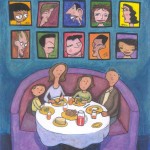
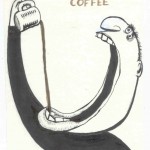
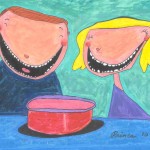
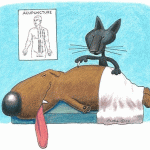
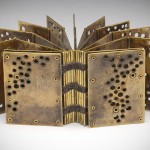
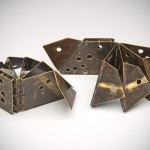
Béatrice Coron is a worldwide traveler and artist who began her career in New York, NY. Coron’s work has been featured in major collections and as public art, including the NY subway system. She describes paper cutting as “…hidden secrets behind the surface. The technique of papercutting creates dimensional drawings where the drawing is also a structure.”
“My art fuses my love for animals, concern about the welfare of the planet and twisted sense of humor. I call my work ‘environmental surrealism.’ Influences include kitschy portrayals of animals from mass-marketed popular culture, the nightmarish imagery of Hieronymus Bosch, Beatrix Potter, Maurice Sendak, the writings of Edward Abbey, and my work as a wildlife rehabilitator.”
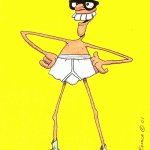
“I’m from a family of artists and have drawn since I was a child. I’ve made a living as an illustrator and a syndicated newspaper cartoonist while showing my art at galleries and cafes. I try to maintain an edge between the real and abstract in my work where I am able to maintain the creative mystery that leads to discovery.”
“I remember being in Tokyo taking the last train home from work. Due to the train’s congestion, the nine closest passengers were all pressing against me. If there were a way to lift my feet, the throng of commuters would have surely supported my weight. While floating without any control within this vessel, I remembered a passage from Laszlo Krasznahorkai’s novel The Melancholy of Resistance depicting the physical decay of a body. Over a number of pages, Krasznahorkai obsessively describes decomposition. Layer after layer of the body deteriorates letting fluids and cells loose until they meet another resisting force. Being still and yet in no control of my body, I remained enclosed in a train moving along its trajectory without remorse.
Drawing from moments like this, I charge the scenery of my large-scale watercolor landscapes with what fills the gap between specific experiences and their concurrent thoughts. What interests me in these events is the dislocation that occurs from the sensation of occupying multiple locations simultaneously. The grammar of space is fractured, and the route through this terrain is disorienting and full of obstacles. Each position must fight, debate, and negotiate to form interconnecting paths. I have to adjust and move around the surface to paint new passageways around barriers linking the space and the event as a whole. This attempt to understand what joins cognition to an environment often proves to be futile. Rather than looking for truth with this exploration, I am painting to be surprised by the failure to understand my orientation to setting and place.”
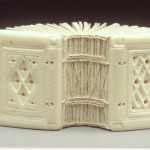
Shanna Leino lives and works in New Hampshire. Materials such as linen and handmade paper are often used, which results in the natural quality of the work. Leino describes her work as incorporating “…historical techniques and materials while bringing in my own love of tinkering and finding different ways to expand on the book as an object.”
“I can’t stay
for class tonight;
my eleven year old son has
been arrested for murder,”
matter-of-factly she murmurs,
pleasant of voice, expression,
as my eyes widen, widen
headache and hot-air balloon size
at just-another-distant-horror-story
that this time
has intersected my life,
breaking and entering
those insulating layers
of facelessness, namelessness,
and distance
that shelter my sanity
from the macabre dance
of the daily news.
The story is absurdly quick
and random: Night concert–
a father waits for his family.
Kids hit his car.
He gets out; they stab once.
He dies; they run,
while inside his daughter
coaxes her trumpet
to a joyous concert crescendo–
oblivious to her father,
dead,
outside.
Bruce Roberts is a poet, retired teacher, and past Synchronized Chaos contributor. He may be reached at brobe60491@sbcglobal.net.