You said, “If you’re my child, then know only my love.”
Forgive me, mother, for every time I complained,
Wrap me in your love, in your warmth unchained.
You are both my father and mother — my soul’s gleam,
May I walk beside you in Heaven’s dream.
You are my treasure, the crown of my fate,
The sun in my sky, life’s dearest state.
Surrounded by grandchildren, joy never parts,
You are every child’s strength, the queen of hearts.
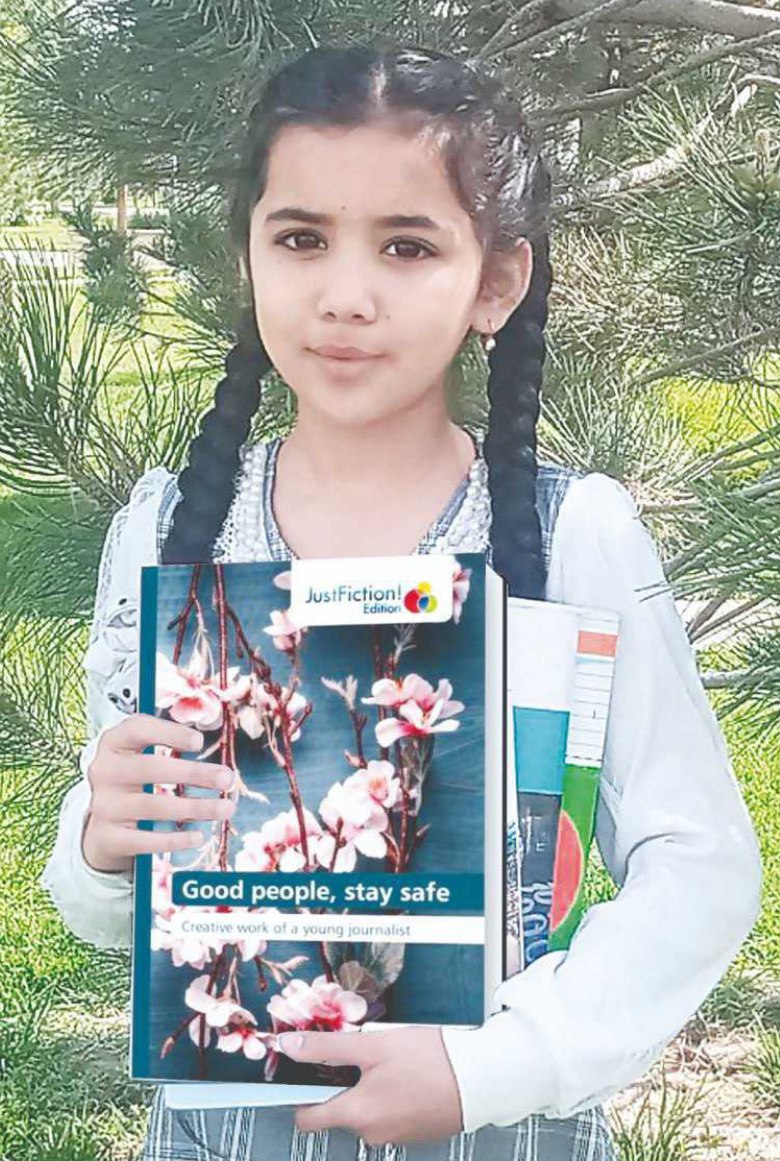
Gulnoza Valiyeva was born on April 30, 2006, in Okoltin district, Sirdaryo region.
A number of her poems have been published in the anthology “Towards My Goals…”, by one of the renowned publishing houses in the United Kingdom and the United States — JustFiction Edition.
She is currently a second-year student at the University of Journalism and Mass Communications of Uzbekistan. In 2024, she became the winner of the district-level poetry competition “Homeland Praised in Every Heart”, securing 1st place.
Between 2021 and 2025, more than 50 of her literary works—both in prose and poetry—have been published in national and international press. Her works have appeared in publications such as “Fergana Haqiqati”, “Dono Word”, “Tong Yulduzi”, “Smile”, “Yangiyer Tongi”, and “Ijodkor”, as well as international journals like “Kenya Times”, “Raven Cage”, “Page 3 News”, and “Thotem” in Argentina. Farzona’s writings have also been featured in collective anthologies, including “Girls Nation – Daughters of the Nation”, published by Amazon.com (USA), as well as collections printed in Khiva, Jizzakh, and Sirdarya.
Her first book was published in 2021 in Great Britain and Europe.
Competitions and Achievements
To date, Farzona has been awarded over 95 diplomas, certificates, and memorable gifts for her active participation and success in various contests.
“Tong Yulduzi” – A Source of Inspiration
The newspaper “Tong Yulduzi” (Morning Star) holds a special place in Farzona’s creative journey. A poem dedicated to the paper by children’s poet Ro‘zimurod Bolqiyev continues to inspire her. According to Farzona, the newspaper, now 96 years old, was known as “Lenin Uchquni” (Lenin’s Spark) during her grandmother’s school years. She has had nearly 30 of her works published in the paper to date.
Farzona expresses deep gratitude to the editorial team of “Tong Yulduzi”—including Feruza Adilova, Nodira Nazarova, Nurbek aka, and all staff members—for their continuous support and warm attitude toward students across the country.
She is also an active member of the “Creative Children” club under the Republican Children’s Library, where the creativity of over 234 young authors is showcased. On average, 4 to 5 children report daily that their works have been published in “Tong Yulduzi”.
A Memorable Victory in Bukhara
Since the 5th grade, Farzona has participated in many creative competitions. She fondly recalls her first victory when newspaper representatives visited her school to award her in person. Later, she received awards by post. In a recent contest jointly organized by “Tong Yulduzi” and the family of the great Bukhara poet G‘ulom Shomurod, she proudly won first place.
Accompanied by her two grandmothers, aunt, and uncle, she traveled from Fergana to Bukhara, crossing seven provinces in 15 hours. Throughout the journey, she received frequent phone calls from the newspaper staff, asking about their well-being. Upon arrival, G‘ulom Shomurod’s children warmly welcomed them and accommodated them in a prestigious hotel. The staff treated them with great respect, offering warm food and tea.
At the event, Farzona’s heart beat differently—filled with excitement and pride. She listened attentively to heartfelt words about the late poet G‘ulom Shomurod, and was deeply inspired to learn more about his works. When she was announced as the first-place winner, her joy was beyond words. She was awarded with a diploma, memorable gifts, and books, including a poetry book by G‘ulom Shomurod himself. She also received a book from Obid Qo‘ldosh, a renowned poet and journalist from Bukhara.
After the ceremony, guests gathered for a special lunch. Though the organizers wanted to give them a city tour, limited time meant the participants had to bid farewell to the “Tong Yulduzi” team and the Shomurod family.
Farzona sincerely thanks the family of G‘ulom Shomurod, especially G‘ayrat Shomurod, the editorial staff of “Tong Yulduzi”, and the administration of Jondor District, Bukhara, for organizing such a meaningful event. She was particularly happy to learn that G‘ulom Shomurod’s poetry has now been included in school textbooks, giving future generations the chance to get to know his legacy from an early age.
Conclusion
Farzona believes that finding her place and rising in the creative world would not have been possible without the guidance of her mentors—especially the devoted team of “Tong Yulduzi”.
Thank you, “Tong Yulduzi”!
— Farzona Hoshimova Ilhomjon qizi,
9th-grade student, School No. 18, Fergana City
Farzona Hoshimova Ilhomjon qizi was born on December 10, 2010, in Fergana city. She is currently a 9th-grade student at School No. 18 in Fergana. This young creative girl is a member of several national and international organizations, including the “Creative Children” circle under the Republican Children’s Library, the “Double Wings Writers’ Union” (Uzbekistan–Kazakhstan), the international “IQRA Foundation”, and the Writers’ Union of Argentina.
Truly I say to you all: I have been Resurrected over the last year and half through all the medical issues. Truly, I was legally dead for six minutes doing open heart surgery a year or so earlier. My rapid heartbeats have sent me to the emergency room several times.
The many hospital stays. Finally, the rehab center at Solaris in Apopka Fla on 5-27-2025 till 6-13-2025 was a living nightmare. Looking back over the last year and half I prayed with intensely to God this year and half. Praying, as I laid in bed. Praying day and into the wee hours of the morning.
I had focus and purpose to seek God like in childhood in the inner-city. I was created to be with the Holy Father for all eternity on earth or Heaven. Now that I fully understand Jesus total obedience to the Lord. Now I am coming to understand more fully what it means to live in total obedience to Jesus as Lord.
The walk to Calvary and Golgotha was at the place of the skull. The Cross was not only a symbol to wear, but rather a way of life taught by Jesus himself. Jesus taught me through my illness that I had to die to the physical world of man.
Jesus taught illness to my understanding was to die to the physical world of man. Man has many desires to be the creator and that man’s selfish needs and wants and desires are opposed to God’s purpose for man. In my recent experiences, I came to understand God, Jesus Christ, and the true purpose of salvation and redemption for us all, starting with First, trust that God cares for you no matter what, simply because you are His child. A child must grow into a man. A man of God’s creation or a man of the world? Man’s world is a world of deception and greed and ultimately death.
This is not Jesus’ death, because he was Resurrected into spirit, joining God presence among the angels. When Jesus died, his death was for the sake of resurrection and to re-join God in the third heaven.
The Cross was my walk the last year and half. Faith and trust and belief beyond your intentions to save yourself. I learned that you must have faith and trust beyond your intentions to save yourself. You will not save yourself but lose who you were created to be. Once knowing that Jesus lived beyond the physical death and was Resurrected to love and be one with the Father. Once you realize that Jesus lived beyond the physical death and was resurrected, you learn to love and to be one with the Father.
Beyond the symbol of the Cross to the reality that one must die to that which he loves. Jesus focused on His purpose to be crucified even through Jesus knew that he was to show us the path to the light of life and not the darkness of death.
God offers life.
Man offers death.
God offers love.
Man offers hate.
God offers truth.
Man offers lies.
Jesus revealed God’s truth and showed man’s deceit. Jesus walks to Calvary showed man nature for cruelty to man. Nothing could be crueler than the Crucifixion.
What kind of evil had to reside in men to do this to anyone? All of man’s inhumanity was exposed on that walk to Calvary. How about the events leading to the walk with the Cross? The lies and false accusations and the use of these accusations to have a man (the Son of God) crucified. How many of us have experienced these moments?
However, there’s a way out of the darkness and Jesus shines that light in our hearts with God.
Soviet Modernization and the Profound Changes in Uzbek Women’s Lives
ANNOTATION; This article examines the significant transformations in the lives of Uzbek women between 1920 and 1980, during the period of Soviet modernization. It analyzes how Soviet policies—despite their ideological, political, and cultural agendas—played a major role in shaping women’s identities, social roles, and life experiences. The research highlights the ideological contradictions, the impact of forced modernization, and the clash between tradition and the new Soviet worldview. It explores the path of struggle, adaptation, and active participation of Uzbek women within this historic context.
KEYWORDS: Soviet modernization, Uzbek women, social transformation, gender policy, traditional society, emancipation, ideological control
The Soviet period introduced profound and often contradictory changes to the social life of Central Asia, especially in Uzbekistan. Among the most affected groups were women, whose roles in society, family, and public life underwent radical transformations under the guise of liberation and modernization. The aim of this article is to evaluate the effects of Soviet modernization on Uzbek women between 1920 and 1980, based on historical facts, documents, and research1
From the 1920s, Soviet ideology launched an intensive campaign of social engineering. Uzbek women were expected to discard traditional garments like the paranja and chachvan, symbols of modesty in Muslim society, and join public life as workers, teachers, and activists. The infamous “Hujum” campaign (1927) symbolized this movement, where unveiling was both a political and cultural tool. While promoted as emancipation, this campaign often led to violence, social ostracism, and even death for many women at the hands of their own communities.
Despite such challenges, a generation of educated and politically active women emerged during this period. Names like Uyg‘unoy Abdullayeva and Tojixon Shodieva, among many others, became symbols of transformation. These women were trained in the newly established institutions such as the Women’s Departments [Zhenotdel] and pedagogical institutes, gaining access to education, legal rights, and employment opportunities that had been previously unavailable.
Nevertheless, the transformation was not entirely emancipatory. Soviet modernization was not a neutral, benevolent process but rather one that was tightly controlled, ideologically driven, and often repressive. Women were used as instruments of the state agenda: their visibility in the workforce was both a propaganda tool and an economic necessity. Yet many women continued to experience double burdens—working full-time jobs while still being expected to fulfill traditional roles at home.
In rural areas, modernization occurred more slowly and often encountered stronger resistance. While urban women were able to access state-sponsored opportunities, women in villages faced continued patriarchal pressure. Still, over time, even these regions witnessed significant shifts, particularly through literacy campaigns, compulsory education, and the rise of medical institutions that increasingly involved female professionals1
By the 1960s and 70s, the presence of Uzbek women in social, cultural, and academic life had become normalized. They worked as doctors, engineers, educators, and artists. However, it is important to recognize that these developments were not entirely organic but orchestrated through state pressure, quotas, and ideological control. Women’s organizations were heavily monitored by the Communist Party, and any deviation from Soviet ideals was quickly suppressed.
Despite these limitations, the Soviet era undeniably laid the groundwork for today’s gender dynamics in Uzbekistan. Women’s access to education, employment, and public roles—even if imposed—planted the seeds of long-term change. The Soviet modernization of women’s roles, although controversial, is a key part of understanding contemporary Uzbek society.
In conclusion, the Soviet modernization process brought irreversible changes to the lives of Uzbek women. Despite its many contradictions, pressures, and ideological rigidity, it opened previously inaccessible paths in education, employment, and public life. This transformation was not merely a shift in attire or workplace presence, but a deeper social and psychological reorientation. It disrupted centuries-old traditions while simultaneously creating new forms of dependence on the state. Uzbek women, therefore, were not passive recipients of change but active participants in negotiating their identities and futures within a highly politicized system. Understanding this complex process is essential for evaluating both the costs and gains of modernization in a colonial and ideological context.
REFERENCES
1.Kamp, M. (2006). The New Woman in Uzbekistan: Islam, Modernity, and Unveiling under Communism. University of Washington Press.
2.Northrop, D. (2004). Veiled Empire: Gender and Power in Stalinist Central Asia. Cornell University Press.
3.Edgar, A. L. (2004). Tribal Nation: The Making of Soviet Turkmenistan. Princeton University Press.
4.Bobojonov, H. (2005). “Oʻzbek ayolining faoliyati tarix zarurati sifatida”. Tarix va Hamdo‘stlik, №2.
5.Jo‘rayev, A. (2011). “Oʻzbek ayollari tarixidagi burilishlar”. Ijtimoiy fanlar, №1.
6.Tursunova, G. (2020). “Sovet davri ayollari: islohotlar va oqibatlar”. Yangi O‘zbekiston, №3.
7.Islomova, Z. (2019). “Oʻzbek ayolining ijtimoiy faolligi: tarix va zamonaviylik”. Fan va turmush. N6Sevara Olimova, [7/27/2025 6:25 PM]
Olimova Sevara, from Kashkadarya region. Born in Mirishkor district , 4th year student at the Faculty of History of Karshi State University
Silent Battles: Navigating Mental Health Challenges and Loneliness During Student Years
Introduction
In today’s competitive and fast-paced world, student life is often romanticized as a time of personal growth, academic achievement, and social connection. However, beneath the surface lies a silent struggle faced by many students—one of mental pressure, emotional isolation, betrayal, and the absence of support. For some, these experiences define their entire educational journey. Yet, even amidst such darkness, it is possible to emerge stronger, wiser, and victorious.
This article explores the often-unspoken psychological burdens students endure—particularly mental health struggles, academic stress, feelings of loneliness, and emotional pain caused by those they once called friends. By shedding light on these hidden experiences, we aim to foster understanding, advocate for compassion, and remind every student walking this difficult path: your victory is coming.
The Weight of Expectations
Academic institutions are designed to challenge and educate. But with that mission often comes a pressure cooker of expectations. Students are expected to maintain high grades, be active in extracurricular activities, secure internships, develop social networks, and prepare for uncertain futures—all simultaneously. For many, especially first-year students or those from underprivileged backgrounds, this transition can be overwhelming.
The societal narrative often neglects the mental toll of such pressure. Constant comparison, fear of failure, and the need to prove oneself—whether to family, peers, or society—can slowly erode self-esteem and mental well-being. When grades become the only measure of worth, students begin to equate failure with personal inadequacy.
These internalized pressures frequently lead to anxiety, depression, and burnout. Yet, few students feel safe enough to speak about it. The stigma surrounding mental health, especially in cultures where vulnerability is mistaken for weakness, forces many to suffer in silence.
The Quiet Ache of Loneliness
Loneliness during student years is a complex and painful emotion. Even in classrooms filled with hundreds of students, one can feel profoundly alone. Moving to a new city, adjusting to a new environment, or failing to find ‘your people’ can leave students feeling isolated and misunderstood.
Social media often intensifies this loneliness. While it paints the illusion of connection, it can also create feelings of exclusion. Watching others post about friendships, outings, and achievements can foster a painful sense of “Why not me?”—leading students to question their worth and their ability to belong.
Loneliness does not only stem from being physically alone; it often arises from emotional disconnection. It is the feeling of not being seen, heard, or understood. It is sitting in a crowded library with tears threatening to fall, and no one noticing. It is wanting to share your burdens but having no one who truly listens. It is the ache of invisibility in the most formative years of life.
When Friends Become Strangers
One of the most disheartening experiences during student life is betrayal or emotional abandonment by friends. For many, university friendships are a source of comfort, laughter, and survival. But not all friendships last—and not all friends are genuine.
Some students experience bullying, exclusion, or emotional manipulation from those they once trusted. Others are left behind without explanation as their peers form new cliques or focus solely on their own goals. The realization that your support system has crumbled can be both devastating and disorienting.
This emotional abuse—whether subtle or overt—leaves scars. The fear of trusting again, the self-doubt born from rejection, and the inner voice whispering “you’re not enough” can become constant companions. When betrayal comes not from strangers but from those you once called friends, it hurts with a deeper, more personal sting.
The Absence of Support
Perhaps the most paralyzing aspect of student mental health struggles is the feeling that there’s no one to lean on. For students far from home, the physical distance from family can feel like emotional abandonment. Even those with parents nearby may feel emotionally misunderstood or invalidated.
Many institutions lack the resources or sensitivity to identify students who are silently suffering. Professors are focused on delivering content, not checking in on emotions. Friends may be too busy or too self-involved. And in a world where everyone seems to be “managing fine,” it can feel shameful to admit you’re not.
The absence of support is not just about who is missing; it’s about the haunting silence in times of crisis. It’s about breaking down in a dorm room at 2 a.m. with no one to call. It’s about realizing that while you have hundreds of contacts, you can’t name one person who would truly understand.
This lack of support amplifies the mental health crisis among students. Without emotional anchors, students spiral deeper into anxiety, depression, and hopelessness. And yet, despite the darkness, some keep walking.
The Turning Point: Choosing Yourself
Amid all this pain—academic pressure, loneliness, betrayal, and emotional neglect—there lies a quiet decision: the decision to choose yourself.
This is the moment when a student realizes that they are their own safest home. It may not come dramatically. It may arrive on a regular Tuesday after a failed quiz or during a solitary walk. But it is powerful.
Choosing yourself means seeking help even when it’s scary. It means setting boundaries with toxic people. It means crying, and still getting up the next day. It means talking to a counselor, writing your truth, or simply breathing deeply through the storm. It means recognizing that your value is not defined by grades, followers, or others’ opinions—but by your resilience.
This turning point is not loud. It is gentle and consistent. It is the beginning of healing.
Healing and Growth: A Slow But Beautiful Process
Healing from emotional wounds is not a linear journey. There will be good days and unbearable ones. Some mornings you will feel like yourself again; others, you’ll wonder if you ever will. But growth lies in persistence.
During the healing process, students begin to rediscover themselves. They find joy in small routines—making tea, reading books, listening to music, journaling. They begin to seek genuine connections, no longer chasing popularity but authenticity. They start valuing their mental peace more than validation.
And slowly, something remarkable happens. They become the very friend they needed. They develop empathy, strength, and emotional intelligence. They learn to identify red flags, to say no, and to choose environments that nurture them. Their scars become sources of wisdom, not shame.
The Inevitable Victory
The journey through emotional turmoil is not just about survival—it is about transformation. Many students who endure such pain emerge with an inner strength that no textbook could ever teach. They become leaders, mentors, healers, and creators. They carry stories of overcoming, of rising from the ashes, of winning the hardest battles—those within.
Victory does not always look like a gold medal or a perfect GPA. Sometimes it’s simply waking up and choosing to try again. Sometimes it’s smiling after days of tears. Sometimes it’s graduating despite depression, or finding real friends after years of loneliness. These victories are deeply personal—and deeply powerful.
In the end, you win. Not because the pain disappears, but because you become someone who refuses to give up. You win because you fought with grace, because you learned to love yourself, because you did not let darkness define your story.
Conclusion
Student life is often painted in bright colors, but many live it in shades of grey. Mental health struggles, academic pressure, emotional loneliness, and the absence of support can make it a painful chapter. Yet, within this pain lies the potential for profound transformation.
To every student fighting silent battles: your story matters. Your feelings are valid. And even if no one else applauds your quiet victories, know this—you are not alone, and you will rise. Keep walking, keep breathing, keep choosing yourself.
In the end, you do not just survive. You win.
Surayyo Nosirova Elyor qizi was born on May 13, 2006, in the Narpay district of the Samarkand region, Uzbekistan. From an early age, she showed a deep interest in literature, languages, and creative expression. Her passion for learning and writing became evident during her school years, where she actively participated in various academic, literary, and cultural activities. Currently, Surayyo is a first-year student at the Uzbekistan State University World Languages university, specializing in English Philology and Teaching. She is known for her strong academic performance and her dedication to mastering the English language. Her commitment to education extends beyond the classroom—she is the author of three published books: Heartfelt Thoughts, Voices in Writing, and Beyond Words: Mastering English. Each of these works reflects her insights into language learning, writing skills, and the emotional depth of student life.
In the history of mankind, there are great personalities – they guided the whole society through their life, activities, and heritage, inspiring hearts. Ghulam Shomurod’s book” The Value of the Great ” expresses at a high artistic level the duty to such great people – the need to understand and preserve their dignity.
The poems contained in the book are not limited to reflecting the lives of historical figures. Through them, the poet encourages each reader to reflect, reflect and realize the national self.The words of Ghulam Shomurod are not simple-they are painful, but hopeful; whiny, but patient. In each line we feel the heavy but honorable burden of greatness.
In his work, the poet speaks of the dignity of our great – grandfathers-Amir Temur, Alisher Navoi, Jaloliddin Manguberdi, Zahiriddin Muhammad Babur-as well as figures of the pride of the land, each of whom makes a deep observation about what role model for today’s younger generation, what lessons their life and work are rich in. It is this aspect that determines the uniqueness of the book.
” The dignity of the great ” is
Great heritage of Bukhara.
In the history of mankind, there are great personalities – they guided the whole society through their life, activities and heritage, inspiring hearts. Ghulam Shomurod’s book” The Value of the Great ” expresses at a high artistic level the duty to such great people – the need to understand and preserve their dignity.
The poems contained in the book are not limited to reflecting the lives of historical figures. Through them, the poet encourages each reader to reflect, reflect and realize the national self.The words of Ghulam Shomurod are not simple-they are painful, but hopeful; whiny, but patient. In each line we feel the heavy but honorable burden of greatness.
In his work, the poet speaks of the dignity of our great – grandfathers-Amir Temur, Alisher Navoi, Jaloliddin Manguberdi, Zahiriddin Muhammad Babur-as well as figures of the pride of the land, each of whom makes a deep observation about what role model for today’s younger generation, what lessons their life and work are rich in. It is this aspect that determines the uniqueness of the book.
”The Dignity of the Great ” is not just a collection of poems. This is a textbook of values, a lesson in history, a path to spiritual purification. The book encourages everyone to look back at their roots, recognize their identity, and most importantly – to honor the legacy of our great ancestors.
Obviously, this work can be an important tool in the education of young people, especially in the preservation and strengthening of our nationality in the era of today’s information attacks. The melodic, sermazmun lines of Ghulam Shomurad help young people to find answers to questions about what is greatness, what is value.
In place of the conclusion, it can be said that “The Value of the Great” is a spiritual – spiritual guide book that should be read today and put into practice tomorrow. Each stanza in it is significant in that there is a memory of the nation, confidence in the pride and prospects of our people.
Mauro Montakkyesi, the celebrated scholar and great literary luminary from Rome reviews Epicasia Vol 2.
Thanks to you dear friend for your kind words.
CRITICAL REVIEW OF
EPICASIA VOL. 2
by Dr. Jernail Singh Anand
Introduction: The Prophet of the Post-Epic World
If Epicasia Vol. 1 is a dive into the shadowy soulscapes of postmodernity, Epicasia Vol. 2 is that reverberating thunderclap of an echo, sounding through the existential wastelands of a world where oracles have been replaced by algorithms and morality by mechanization. The indefatigable bard, the radical recorder of spiritual decay, the fearless Jernail Singh Anand brings forth this second epic entwined into twelve epics.
The book isn’t just a work of literature; it’s a mythopoetic manifesto — a confrontation with civilization in all its guises, posing in the form of an epic.
Form and Structure:
The Esoteric Mythos, Satire, Prophetic Voice and Alchemy
From Geet: The Unsung Song of Eternity to The Canterbury Tales, this book is a polyphonic symphony of philosophical dirges, existential satire, and moral cosmology. Anand’s formalism still radiates unconventional power — there are cantos and choruses, soliloquies and satanic stage directions, not to mention sprawling mythological allusions.
The result is not a linear narrative, but a circular explosion of meanings. The structure is cathedral-like: every poem an altar, every stanza a cracked stained glass through which light and darkness simultaneously stream.
Central Themes:
The Banquet of Chaos and the Starvation of Ethics
Post-Edenic Fall and Ontological Anguish
In Geet and beyond, the poetic subject mourns the loss not just of paradise, but of a why. The Adamic lament—“Why was I born?”—saturates the text with ontological exhaustion. Anand dramatizes the Fall not as a single sin but as a recursive error loop embedded in civilization’s DNA.
Satire of Institutions
Religion becomes a showroom of noise. Education, a “Manchester of Non-sense.” Marriage, a Faustian contract disguised in lace. Anand skewers these systems without mercy, not from cynicism but from ethical urgency. The grotesque parodies of The Satanic Guidemap and the Public Square Executions leave the reader appalled and awed in equal measure.
Love, Lust, and the Execution of the Human Heart
In Anand’s universe, Love is not merely spurned — it is guillotined in public. They dress themselves as saints and march in Satan’s infernal parade as Lust, Greed and Doublespeak! Anand’s upending of virtue isn’t just sensationalist, it is his poetic vehicle to diagnose our cultural autoimmune failure.
Philosophy and the Disfigured Logos
Socrates is dragged in chains. Shakespeare becomes a weapon. Plato is marked as dangerous. Anand reclaims them and is then relatable witness to their fall in the streets of corrupted modernity.
He mourns not just lost philosophers, but a lost philosophia perennis—a wisdom tradition defiled by pragmatism and profit.
Stylistic Register:
Sermon, Satire, Scripture, and Song
Anand’s language oscillates between scriptural gravitas and sardonic theatre.
He will channel the Gita in one breath, and call for Marlowe and Orwell in the next. It’s theatrical without being histrionic, moralistic without being tendentious. The rhythm is deliberately uneven: a literary jazz score that mirrors the very chaos it laments.
Innovation: The Dramatic Epic Reborn
Perhaps the most radical feature of Epicasia Vol. 2 is its reclamation of the dramatic epic. Anand does not merely narrate—he stages. Faustus is reborn as a demonic everyman. Satan organizes political conferences. Archangels deliver monologues worthy of dystopian theatre. The result is a hybrid form that redefines what epic poetry can do in the twenty-first century: not just sing of heroes, but dissect their disfigurement.
Comparative Legacy: Anand Among Giants
Where Homer chants the nobility of war, Anand reveals the banality of evil. Where Milton pities the Fall, Anand mocks it, autopsies it, and sets it ablaze. He is closer to Dante in moral scope but more ferocious, less forgiving.
Blanchot’s thought, with its endless horizon of emptied language, comes to mind, as does Bataille and Deleuze; and further back one can hear Blake and Nietzsche.
No modern poet — maybe no poet, period — has more consistently maintained the epic voice over twelve bloated works with such integrity and critical mass. He is not simply reporting on the fall of man; rather, he is erecting a new monument over its ruins with warnings and whispered prayers etched into stone.
Conclusion: Epicasia as Ethical Wake-Up Call
Epicasia Vol. 2 is a catastrophic symphony—an opera of the soul in a world that has replaced sacred rites with credit scores and conscience with convenience. Dr. Jernail Singh Anand offers no easy redemption, but he does offer clarity. And in an age addicted to spectacle, clarity itself is a revolution.
This book should be read not as a sequel, but as a counter-testament: the last light before the temple gates are shut. In Anand, we meet the last epicist standing—a man who will not stop singing, even as the world forgets how to listen.
Anand The Last Lightkeeper
Dr. Jernail S. Anand
In the quiver and digital dust of the age, where empires glitch and anthems fade, stands the Anand, lone upon the ruins’ crest,
a prophet unbent, a spirit unpressed.
His poems—cathedrals crumbled but full with heaven, carved with laughter, sorrow, and backbone, Geet rises as from a phoenix choir, songs unsongs, yet set afire.
He does not talk in sandals but seismic verse, drags Socrates through traffic’s curse, unmasks the Devil in a statesman’s dress, Angels are falling and oracles are a mess.
He cries to Marlowe, Plato, Blake, not for solace, but for the stake. A mythmaker in post-epic frock, his dirges for humanity’s sad sack.
Marriage to him becomes the Faustian mask, education—a mill of empty bands, and love—is guillotined on the marble stand, his pen, a scalpel. His muse, our rage.
A stanza, light cracking glass, a canto, a sermon in easeful night, he sings not of victories but of fall, of dimming logos, of moral crawl.
Oh Anand! Lost flame’s guard, weeps Dante, hides his Milton name. You roar where silence raised the beast, and feast on truth when lies have feast.
Then sing the stanza, chaos let hear,— Anand is the place where all disappear. Not to grieve, but to re-create the song, one last epic, fierce and long.