The humid summer where the breeze hesitated the mosquitos buzzed so loudly, like they were arguing with each other The grass stained my fingers Highland Place as I attempted to do cartwheels in the backyard. The sun sunk deeper into the tree-covered horizon, and the moths flew to the porchlight, I hurried inside, a child scared of the bugs that flew through the thick damp air, scared of the emerging darkness of the sky.
Today I will stare out the upstairs window, the green grass and swaying flowers stare back at me look at how the moss has crawled up the neighbor’s brown driveway, how the vibrant shades of green cover our backyards and among the green, my grandfather sits in the growing garden, picking at the weeds that bite at the roots of our flowers I’ll run down to the back door, and lay in that same garden, the grass breathing beneath me a cool exhale against my skin to give me a rest from the summer’s sweltering kisses bugs weave their way between my hair strands and the train sighs and sings this afternoon with the cars driving by on the other side of the house.
This evening, I’ll sit at the dinner table while the food sizzles on the stove when it’s brought to my plate, staring at me expectantly I’ll bite my tongue as my mother tells me I can’t eat until my grandmother sits in her chair and when she does, I’ll listen to family stories from generations ago and forget them all once I asked to be excused when the sun leaves the sight of the window, I’ll walk through this neighborhood say hello to horses that stand behind fences gaze up at the stars in the clear night sky, as they don’t shine the same in San Francisco and I’ll feel a breeze for the last time for a long time. and tonight,
I’ll lay in bed With blankets up to my lips and I’ll fight against my fluttering eyelids who’d like to sleep I’d like to stay conscious, like the feeble night-light who paints the walls a darkened yellow and the crickets sing me quiet lullabies beyond the window and the passing train that harmonizes upon their melody before I finish my fight to keep my eyes open.. It is the next morning,
When I awake, sometime between 11 and 12 pm, my blankets still cover my body, yet the crickets have left me “he’s gone” sings the fan, who does not provide any breeze to me whatsoever I don’t need someone to tell me what I already know the silence provides us an endless reminder anyways, The weeping of my mother, the confusion of my grandmother, the presence of my uncle, the complaints of my father, the overgrown weeds in the backyard and the poor flowers they have bitten, all provide endless reminders anyways.
Tonight when the lights begin to dim, I fight to close my eyes the crickets who once sung me to sleep, now scream like bickering parents and I toss and turn to their never-ending song, their endless reminder an endless reminder of what I once had, the grass-stains on my fingers and pants, the horses that stood behind fences, fences now broken and resting upon the ground, the moths attached to the porchlight, my impatience as I waited for my grandmother to appear out of the kitchen, the flowers of the garden, tall and proud, the bugs that crawled upon my body, the dimness of my room at midnight, lit by the feeble night-light the song belonging to the crickets, the sight of my grandfather picking at the weeds in the growing garden, an endless reminder of what I’ve lost.
I took inspiration from Yehuda Amichai’s poem with the theme of things that have been lost, along with the inclusion of family.
Natural support: diet with fruits, vegetables, fermented milk products.
Research-based recommendation: minimum 2–4 weeks of probiotic therapy post-antibiotics.
6. Conclusion
Antibiotics are powerful tools — but misuse converts medicine into a hidden toxin.
Microbiota protection should be part of every pediatric treatment plan.
Long-term child health depends not only on curing disease, but preserving biological balance.
References
1. World Health Organization. Antimicrobial resistance: Global report on surveillance. Geneva, 2023.
2. Blaser MJ. Missing Microbes: How the Overuse of Antibiotics Is Fueling Our Modern Plagues. 2014.
3. Arrieta M-C et al. “Early-life antibiotics, gut microbiota disruption, and metabolic outcomes.” Nature Communications, 2021.
4. Tamburini S et al. “The microbiome in early life: implications for health outcomes.” Nature Medicine, 2016.
Baxronova Vasila is a student of the Bukhara State Medical Institute, a member of Argentina’s “Juntos por las Letras” International Writers’ Association, Egypt’s “Iqra” Foundation, and India’s “Art and Culture International Forum”.
Her articles have been published in India’s “Intellectuals of the Third Renaissance” Almanac, the United States’ “Voices of Uzbek Girls” International Anthology, Qatar’s “The Voice of Uzbek Women: Bridging Cultures, Inspiring the World” International Anthology, and Turkey’s “Inspiring Voices of Uzbekistan” International Anthology. She is also a participant in the Republican Scientific-Practical Conference “Conference of Natural and Applied Sciences in Scientific Innovative Research.”
Her scientific articles have been published in India’s Editor KavyaKishor International Journal and Thailand’s Page3NewsThai International Journal. She is the holder of multiple international certificates.
THE ROLE OF COGNATES IN LINGUISTICS: COGNATES IN ENGLISH AND UZBEK LANGUAGES
Khasanova Azizabonu
Uzbek State University of World Languages
Email: xasanovaazizakhon06@gmail.com
Abstract
Cognates play a very crucial role in every language’s linguistics. Therefore, when we want to learn some languages or compare ours to other languages we definitely come across them during our learning journey. The concept of cognates can be found in nearly all languages, since languages are interrelated and, in many instances, words are transferred or adapted from one language to another, resulting in the emergence of cognates.
Keywords: Modern information technologies, interactive learning, e-learning, digital transformation, education quality.
If the history of cognate is discussed, etymology dictionaries trace present-day words to the oldest forms available, establish their primary meanings and give the parent form reconstructed by means of the comparative-historical method. In case of borrowings they point out the immediate source of borrowing, its origin, and parallel forms in cognate languages.
1. Cognate awareness One method of building vocabulary among English-language learners whose language share capitalize on students’ first-language knowledge (August et al.2005). Cognates are words in two languages that share a similar spelling, pronunciation, and meaning. Students often can draw on their knowledge of words in their native language to figure out the meanings of cognates in English. Because of their common Latin and Greek roots, as well as the close connections between English and the Romance languages, English and Spanish share a large number of cognate pairs. Not only in Romance or English languages but also in Uzbek we can see some cognates
2. Cognates in English and Uzbek languages ENGLISH UZBEK EXPLANATION Radio Radio Same form, same meaning. Taxi Taxi Similar pronunciation and meaning. Doctor Doctor Similar pronunciation and same meaning .Video Video Same pronunciation and same meaning. Virus Virus same form, different pronunciation. Bank Bank Same form, same meaning Hacker Haker Slightly different form, same meaning (loanword from same root) Menu Menyu Different form, same pronunciation and meaning. Mini Mini Same form and meaning. Idea Ideya Different pronunciation, same meaning. Season Sezon Slightly different pronunciation, same meaning Zebra Zebra Same form, same meaning. Cobra Kobra Same form, same meaning. Museum Muzey Different pronunciation, same meaning.
Types of cognates in English language: Actually the main types of cognates are true cognates, near-perfect cognates and false cognates. In true cognates have a identical spelling and similar meaning, but in perfect cognates have slightly different spelling but similar meaning, in false cognates have similar spelling but different meaning. Some classifications also include accidental cognates (which are words that are similar by chance), and partial cognates (which are may share a root not all affixes.
Conclusion To sum up the findings, it is clear that English and Uzbek share many type of cognates that reflect cultural and linguistic exchange. Words such as radio, computer, virus ,taxi demonstrates how global communication and scientific progress have influenced modern vocabulary.
References1.R.S.Ginzburg.A modern course in modern English lexicology.2.Agniezska Otwinowska. Cognate vocabulary in language acquisition and Use. 3. https://semantjournals.org/index.php/AJBP. 4.Cognate in foreign language learning: A cognitive and Linguodidactic perspective by Natalia Oberste-Berghaus(2025) 5.uz.wikipedia.uz
Azizabonu Xasanova was born on November 22,2006 in Buloqboshi district, Andijan region. From 2013 to 2024, she studied at School No.43 specialized for English and Mathematics.She has achieved remarkable success in her studies and extracurricular activities. In 2022, she won a competition organized by the Muloqot channel, as a result of which her CEFR exam will be fully funded by the government.As a result, she successfully earned a B2 level certificate with a score of 58 points.
Currently, she is continuing her bachelor’s degree at the Uzbekistan State World Languages of University, majoring in English Philology. She participate in regularly in some projects like University Pride, Kitoblarim Yuzi and others. As a second year student She has successfully transitioned from a self-funded (contract) student to receiving a 50% university grant this year. This achievement not only reflects her academic excellence but also provides her with significant financial support to continue her studies more comfortably.
Azizabonu Xasanova is an enthusiastic student with a deep interest in languages and cultural communication.
An Analysis of the Interrelationship Between Human Psychology and the Process of Language Learning
G`afforova Hadichaxon Abduhamid qizi – student of English philology faculty of Uzbekistan State World Language University
E-mail: gafforovaxadicha5@gmail.com
Annotation: The article provides information about the connection between learning foreign languages and human psychology, and recommends principles to effectively leverage the interplay between these two factors. It highlights experts’ opinions on the integral connection between the language and the psyche. Additionally, it discusses the psychological challenges encountered during the process of improving language proficiency and exploring their underlying causes. The organic connection between language learning and human psychology is such that progress in one area can significantly impact the other, leading to either mutual development or stagnation. As they are inseparable, this fundamental principle should be emphasized in any linguistics curriculum. The purpose of this article is to demonstrate to young learners that high levels of language proficiency are achievable with a healthy mindset. It aims to reframe language learning not merely as the study of grammatical rules, but as an engaging and enjoyable pursuit.
Introduction: Learning a foreign language is one of the most fascinating and challenging processes in human education. It goes far beyond the simple memorization of words and grammar rules. In fact, language learning is a deeply psychological process, involving emotions, motivation, attitudes, memory, personality, and social interaction. Every learner brings unique psychological characteristics to the classroom and these differences often determine success or failure more than intellectual ability alone. In recent decades, linguists and psychologists have increasingly worked together to understand how mental and emotional factors influence the ability to learn languages.
According to research by Gardner and Lambert (1972), psychological variables such as motivation and attitude play a more significant role than linguistic attitude in predicting achievement. Furthermore, modern statistics support this view: studies show that over 60% of learners who maintain strong motivation and confidence during a year-long language course achieve fluency faster than those with similar intellectual abilities , but lower psychological readiness .In this article, I will explain how psychology influences language learning, the major psychological factors involved, the common problems learners face, and practical solutions to overcome these barriers. Understanding the role of psychology allows both teachers and learners to approach language acquisition more effectively and with greater emotional balance. Among all psychological factors, motivation is often described as the most powerful predictor of success. A motivated student studies longer, practices more often, and shows greater persistence in the face of difficulty.
Psychologists differentiate between intrinsic motivation—which comes from genuine interest and personal satisfaction—and extrinsic motivation, which is driven by external rewards like grades or job opportunities. For example, a learner who studies English because they want to travel or communicate with people worldwide is more likely to stay committed than one who learns it only to pass an exam. A 2020 study by the British Council found that 72% of high-achieving language learners reported strong intrinsic motivation as their main reason for success. Many students lose motivation after the initial excitement fades, especially when they face grammar challenges or slow progress. Teachers and learners can set small, achievable goals, such as learning 10 new words per day or completing one short conversation each week. Celebrating small victories keeps motivation alive. Attitude towards the target language and its culture is another vital factor. Learners who respect and value the culture of the language they study are more open to new theories, pronunciation, and communication styles. In contrast, negative attitudes — such as believing a language is “too difficult” or “useless” — create emotional resistance.
Research by Dörnyei (2005) indicates that a positive cultural attitude increases learning efficiency by nearly 40% because it helps students engage more deeply with real-life materials like music, movies, and conversations. When balancing language learning with psychology human beings can face several problems. For instance, many learners view language as an academic subject rather than a living form of culture. This limits emotional connection. To address this problem exposure to cultural content — films, songs, literature or interactions with native speakers — develops empathy and cultural curiosity, which in turn improve learning motivation and understanding.
Language anxiety is one of the biggest psychological barriers. Many learners feel nervous, shy, or afraid of making mistakes when speaking a foreign language. This fear can block memory recall and reduce performance. For example, Horwitz (1986) described language anxiety as a “specific situational fear” that negatively affects communication. Surveys show that around 40–50% of language learners experience moderate to high levels of speaking anxiety, especially during oral exams or public speaking. High anxiety levels lead to avoidance of practice, slower progress, and lower self-esteem.
Another major problem is that students often believe that mistakes mean failure, which prevents them from taking risks and communicating freely. To solve this issue, creating a supportive and non-judgmental environment is essential. Teachers should praise effort, not just accuracy, and students should view mistakes as natural steps in learning. Relaxation techniques such as deep breathing or mindfulness can also reduce stress before speaking tasks. Each learner’s personality affects how they approach learning. Extroverts usually perform better in speaking and listening because they enjoy interaction, while introverts often excel in writing and reading since they prefer reflection and concentration. However, personality does not determine success; it only shapes the learning path. I think both extroverted and introverted learners can achieve fluency if they use strategies that fit their character. In addition to this, learners may feel pressured to behave differently from their natural style — for instance, introverts being forced to speak constantly in class. In order to address this problem teachers should apply differentiated teaching methods — offering both group discussions for extroverts and reflective writing for introverts.
Understanding one’s own learning style helps learners study more comfortably and effectively. Beyond these personal learning styles, successful language acquisition also relies on core cognitive functions, with memory being the most fundamental. Language learning heavily depends on memory — the ability to store, organize, and recall vocabulary, grammar, and pronunciation patterns. According to cognitive psychology, memory works best through association and repetition. For instance, learners remember words better when they connect them to personal experiences, images, or emotions. A 2019 study from Cambridge University showed that students who used emotional association techniques remembered 35% more vocabulary after two weeks than those who relied on rote memorization. Many learners forget new words quickly or cannot use them in context. Applying spaced repetition systems (SRS), using flashcards, and practicing words in meaningful sentences helps transfer knowledge from short-term to long-term memory. Teachers can also encourage learners to apply new words immediately in writing or conversation to reinforce memory connection.
However, memory does not operate in a vacuum. Its effectiveness is deeply intertwined with our emotional state, which can either enhance or hinder our ability to learn. Emotions directly influence how the brain processes new information. When students feel relaxed, curious, or happy, their cognitive performance improves significantly. Positive emotions increase dopamine levels in the brain, which strengthens focus and memory formation. According to neuroscience research by Immordino-Yang (2016), emotionally engaged students perform up to 30% better in language comprehension tasks. On the other hand, boredom, fear, or humiliation can block learning and reduce creativity. In many traditional classrooms, emotional needs are ignored, and the focus remains only on test performance.
Teachers can create a positive classroom atmosphere by including humor, encouragement, and interactive activities. Group projects, games, and storytelling promote enjoyment and emotional connection, making language learning feel more natural and rewarding. Language learning can also lead to deeper psychological issues like low self-esteem, perfectionism, or burnout. Some learners compare themselves to others and feel inferior if they progress more slowly. Others push themselves too hard and lose interest. Learners who constantly doubt their ability tend to avoid practice. Teachers can introduce peer support activities, where students work in pairs or small groups, encouraging each other’s progress.
Trying to speak perfectly often leads to silence and frustration. Instead, learners should focus on communication, not perfection. Real language use involves small mistakes, and fluency grows with experience, not fear. Too much study pressure without emotional rest causes exhaustion. Including breaks, fun materials, and self-care routines keeps learning balanced and sustainable. Teachers are not only language instructors but also psychological guides. Their attitude, feedback, and classroom management shape how students feel about learning. Research shows that teacher support increases student confidence and motivation by up to 45% (Ryan&Deci, 2017). Effective teachers use positive reinforcement, provide constructive feedback, and model emotional resilience. When students see their teacher as friendly and understanding, they become more willing to take risks and speak openly. Moreover, teachers can help learners set realistic goals, reflect on their progress, and develop self-regulation strategies. In this way, education becomes not only linguistic but also psychological growth.
Conclusion:In conclusion, whether it is nurtured by an insightful teacher or managed through self-awareness, the essential role of psychology in language learning is undeniable. The process of mastering a new language is not simply an intellectual challenge — it is an emotional and personal journey. Motivation drives effort, attitude shapes openness, confidence removes fear, and emotions determine memory strength. By understanding the psychological dimensions of learning, teachers and learners can transform frustration into progress. Encouraging positive emotions, cultural curiosity, and self-belief can dramatically improve results. As statistics and research continue to show, psychological readiness often determines success more than linguistic ability itself. Ultimately, to learn a language is to understand not only new words but also oneself. Psychology gives us the tools to make that journey deeper, more meaningful, and more successful.
Reference: 1. Robert C. Gardner va Wallace E. Lambert – Attitudes and Motivation in Second-Language Learning (1972). Rowley, MA: Newbury House. 2. Gardner, R. C., & Lambert, W. E. – Motivational Variables in Second-Language Acquisition. Canadian Journal of Psychology, 13(4), 1959.
https://publish.uwo.ca/~gardner/docs/phd.pdf3.
Zoltán Dörnyei – “The Internal Structure of Language Learning Motivation and Its Relationship with Language Choice and Learning Effort.” The Modern Language Journal, 89(1), 2005. 4.Mary Helen Immordino‑Yang – Emotions, Learning, and the Brain: Exploring the Educational Implications of Affective Neuroscience. W. W. Norton & Co., 2015/2016. “Times Higher Education” 2016. 5. Mantiri, O. – “Key to Language Learning Success.” Journal of Arts and Humanities, v4 (1).
G’afforova Hadichaxon was born on November 1, 2007, in Beshariq district, Fergana region. She is currently a first-year student at the Uzbekistan State University of World Languages.
Lakshmi Kant Mukul is an Indian writer, poet, critic, rural historian and serious scholar of folk culture, born on 08 January 1973 in a rural family in Maira village, District Rohtas, Bihar province, India. His literary journey began in 1993 as a Hindi poet and since then, he has published three books in Hindi and has been published in more than two dozen anthologies and hundreds of journals. Apart from Hindi, he also writes extensively in Urdu and Bhojpuri and also translates them into English himself. His two published poetry collections are- “Lal Chonch Wale Panchhi” and “Ghis Raha Hai Dhan Ka Katora”. His published book on rural and local history is- “Yatrion Ke Najriye Mein Shahabad”. He has received many awards for his work, including Aarambh Samman for his poetry writing in Hindi language, the prestigious Hindi Sevi Samman of Bihar Hindi Sahitya Sammelan. His English poetry has been published in many international anthologies and translated into many languages. The notable achievements of his literary career are – recognition as a farmer poet and expertise on the changes taking place in the rural environment in the global era. Having studied law, he has adopted the modern style of farming. postal address -LAKSHMI KANT MUKUL Village _ Maira, PO _ Saisar, SO _ Dhansoi, Buxar, Bihar [ INDIA] Mob.no._6202077236 Postcode – 802117 Email – kvimukul12111@gmail.com mob.no
Films “Anita”, “Book of Death”, “Chrysalis”, “Kamilah the Miracle Filly” Honored with the “Courage for Freedom Film Award”
“Anita”, “Book of Death”, “Chrysalis”, “Kamilah the Miracle Filly“ Honored with the Courage for Freedom Film Award
This is the first time in the history of cinema that an award has been given on the subject of “Courage for Freedom,” and it is the first time that a film award has been linked to the values of freedom imbued in heroes for freedom.
The “Courage for Freedom Film Award” is linked to the hero of two worlds, Giuseppe Garibaldi, so named because Garibaldi brought independence to countries on both sides of the world: Italy and Rio Grande do Sul (Brazil), but the hero also fought for the cause of independence of Uruguay.
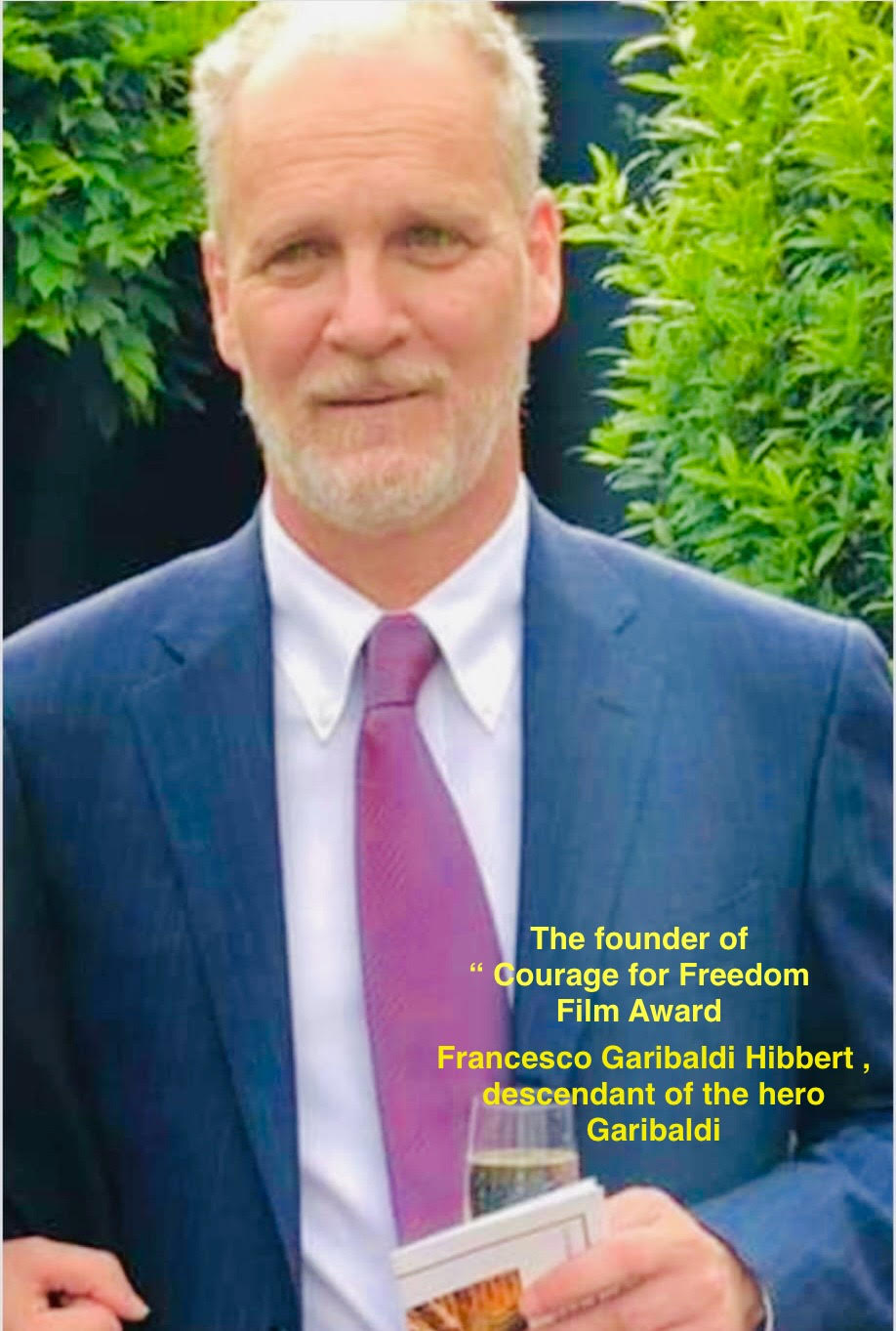
From October 28th to November 4th, with the participation of the Italian Ministry of Foreign Affairs, the founder of this film award, Hon. Francesco Garibaldi Hibbert, a descendant of the hero Garibaldi, was welcomed to the celebration of the 150th anniversary of Italian immigration to the state of Rio Grande do Sul.
The tour included thirteen cities in the Brazilian state, where the film “Anita,” produced by Assisi Suono Sacro and featuring Wardal and music by Andrea Ceccomori, was presented as a world premiere.
On November 9th “Anita“ received three awards at the Herbst theatre for SF New Concept INT Film Festival : Wardal : USA Excellence for acting a motion picture monologue, Maestro Andrea Ceccomori : best Score, Francesco Garibaldi: Best Concept .
The film centers on the powerful, poignant lyric “Anita” by Giuseppe Garibaldi, about the agony and death of his wife Anita.
The grand debut of the “Courage for Freedom Film Award,” founded by Francesco Garibaldi, artistic director Wardal, will take place on December 13th in Pompeii , at the Vesuvius Film Festival (Vesuviusfilmfestival.it) directed by architect Giovanna D’Amodio.
This year, the Vesuvius film festival is dedicated to Federico Fellini, with a photographic exhibition on Fellini curated by Giovanna D’Amodio and Graziano Marraffa, president of the historical archive of Italian cinema.
The “Courage for Freedom film award“ will be assigned, in addition to the film “Anita”, to three major productions such as the soon-to-be-released film “Chrysalis”, a human story of survival, on the life of Sir Daniel Winn, with Daniel Winn, directed by J. Robert Schulz and “Kamilah the Miracle Filly“ by Angela Alioto about the freedom to live and produced by Moe Rock, founder of the LA Tribune and Emily Letran, its co-founder, the documentary awarded by Pope Francis and the Dalai Lama: “Book of Death” by Jenny Thai on the drama of the refugees in Vietnam.