-------------------------------------------------------
simpatico


the soft brown skin


all the inside jokes


no one understands

us


it shouldn't work


love shouldn't be

anywhere near

whatever this is


but i see the look

in your eyes


simpatico


fuck the world


stack all the fucking

decks against us


we will break them

all down with glee


with love


with a never-ending

sense of what is right


i lick the honey off

of your finger and kiss

you with all of what i

have left to give


everything doesn't

do it justice


rescued an old soul

from the bitter edge


hopefully now,

we jump together
------------------------------------------------------
if we could get away with it


i remember being on vacation

with the family and my father

got us lost while hiking in

the great smoky mountains


it might have been the first time

i ever thought i wonder if we killed

him here if we could get away with it


trust me, it wasn't the last


as the dysfunction grew, the vacations

became crazier and crazier


eventually, i was driving and the

thought became a notion that i

actually had a say in


never did kill him


but i sure was a happy motherfucker

when he did die


i'm sure his family reads these poems


part of me wonders if they ever

understood the monster he became


the other part of me is pretty

damn sure they don't care


which is fine


not everyone is cut out

for the family life


one of the genes my father

has passed along to me
----------------------------------------------------------
like a beautiful woman


i treat my pain like

a beautiful woman


it will kill me and

it is a race to see

who gets there first


i'm just a bystander

along for the ride


sometimes, i even

get to participate


the pills never seem

to work but jack daniels

is always in my corner


every once in a while

i'd love for that beautiful

woman to grab the shotgun

in the corner and use me as

target practice


somewhere, burroughs is

shining up an apple


a soft embrace

on a sweaty night


two lost lovers

trying to make up

for all the moments

that have escaped


along the way, the pain

became love and love

will kill us all
--------------------------------------------------
the endless temptation


hopelessly devoted to

the last beautiful soul

i ever want to know


longing for that kiss


the look of desire


the endless temptation

on the tip of her tongue


dancing under a full moon


the autumn crisp in the air


she whispers i love you

into my ear


my heart starts to skip

a beat


if i'm lucky

i'll die in her arms


before either of us get

a chance to ruin the

moment
--------------------------------------------------
mister right now


remember the one that gave

you the stevie nicks vibes?


the one that you had the

most sexual chemistry

with


i was only mister right

now for her


she never was going to settle

for anything less than forever,

with whom she is still with


welcome to the other side

of the coin


where you are nobody's forever,

at least anymore


hell, mister right now hasn't

seen the light of day for years

now


there comes a time when you

can't deny how much reality

fucking sucks sometimes


losers are the glue of society


you remember writing that

a lifetime ago?


sure, still believe it


still understand my place

in it all


more people die alone than

you happen to read about

in the newspapers


J.J. Campbell (1976 - ?) is slowly wasting away in the suburbs, drinking away the pain from arthritis. He's been widely published over the years, most recently at The Asylum Floor, Horror Sleaze Trash, The Rye Whiskey Review, Horror Sleaze Trash Quarterly and The Beatnik Cowboy. You can find him most days on his mildly entertaining blog, evil delights. (https://evildelights.blogspot.com)
Life

Life's melody, a song we sing,
In every breath, a new beginning.
With each step taken, paths unfurl,
In the dance of joy, and the storm's whirl.
Moments shared, like treasures found,
In the silence, hear life's gentle sound.

Wazed Abdullah is a student of grade 9 in Harimohan Government High School, Chapainawabganj, Bangladesh.
Shout out

My eyes are covered with pain,
Think of my crying look without him.
The guilty part is handed over to the Haqq,
Sing a song for the unemployed heart.

Name your song love tune,
After all, I did not find "freedom" in the world.
Step by step, stepping on the threshold of pain,
The fate we have been waiting for is coming.

You read your book quietly,
The heart is dying before your eyes.

You can read a little bit.
Even your mind is as bright as a deer.

Write about me on the pages,
Because life does not die in lines.
Completion is in minutes,
If you forget, I'll die.

From broken buds of hope,
A bud will emerge.
I release my heart from the knots,
Because the story of my life has an end.

read my eyes know the truth
I loved you without seeing it.
Don't even think about it.
I met you in the spring...

Murodova Farangiz Asliddin's daughter was born on September 25, 2004 in Gallaorol district, Jizzakh region.
“Maybe I could take just one,” murmured Holly, seated on her sofa and overlooking the long wooden coffee table upon which all the medications were arrayed. Fumbling with a plastic vial of sedatives, Holly spread the contents out onto the table and began lining up the pills in various ways. Then she upended the oxycodone left over from her mother’s operation nearly two years ago and untouched until now. Finally, she poured out the pain pills she took every day for her neuropathy. She began counting.
After she finished counting—153 pills, caplets, and capsules in all—she began moving them about again. She wondered how many of this kind it would take to kill her. She bit her bottom lip, concentrating. What had brought her to this point, she wondered for perhaps the hundredth time. Well, Jack leaving her was the start of it all, claiming he “felt trapped” and “wanted to see other people.” Yeah, yeah, yeah, she’d heard that before. The kiss off. There would be no reunion, as he pretended. Finito.
Then Misty, her best and only real friend, took Jack’s part and called Holly an “ass.” Then she unfriended her online. And today, to cap it all off, she was sent home from the nursing home where she worked after testing positive for COVID-19. And she hadn’t worked there long enough, they told her, to qualify for unemployment benefits. And finally, it still hurt that her mother had died last year, leaving her this house and thousands of dollars in debt due to medical bills.
Holly took a deep breath, then sighed wistfully. Why was she alone, she thought, when she felt this bad? Other people should share her crappiness. Wasn’t there anyone she could call? She glanced up at the clock over the fireplace. Ten p.m. Sure, there was someone she could call: her ex-friend Misty. She was still her friend, deep down. She put the call through; it went immediately to voice mail. Damn it! “I know,” she murmured, “I’ll try her land line.” She put through the call, and the phone rang and rang and rang some more. She disconnected.
“I’ll call Jack,” she said softly and put through the call. Again, voice mail. The land line: again, it rang and rang. Irritated, Holly slammed up the phone. Where was everybody, she wondered? Everyone should be home by 10 p.m. Jack was probably out “seeing other people,” and maybe, just maybe, Misty was with him. She began a slow burn, imagining the unimaginable.
She went to the kitchen and returned with a bottle of beer—Jack’s brand—and resumed her seat behind the table with all the drugs. How could they do this to me? She wondered, distraught. Her best friend and her lover—ugh! Impulsively, she reached across the table, took a pill, and popped it into her mouth. She washed it down with a gulp of beer. She froze, not knowing what to expect. When there was no physical response to the pill, she was a little disappointed. Damn Jack anyway, she fumed, then took up two bright yellow capsules and swallowed them with another drink of beer.
She called Misty and Jack each four more times, and still the phones rang. Every time her bid for companionship was rejected, she took more pills. “I’ll show them,” she muttered, eating more sedatives and painkillers and draining, finally, her third bottle of beer. She hiccupped and swept her hair back from her face. She didn’t know if the drugs were doing anything, but she was getting a little tipsy. She hiccupped again. No, she corrected herself; she was drunk. She returned to the kitchen and pulled two more bottles of beer from the fridge.
Always an easy drunk, she drained one bottle, and some of the suds splashed down her sweatshirt. “Damn it to hell,” she raged, then tried to stand up but fell back heavily onto the sofa. Her head was spinning, and her movements were clumsy and sluggish. She shook her head, puzzled, then glanced down at the coffee table. Only about fifty pills remained. That means she had taken… Oh God! “What am I doing?” she said softly, then tried to stand again—without success.
She had been drunk before, she thought, and this wasn’t it. The pills! Moving slowly, she reached a clumsy hand out and pulled the telephone book from the nearby telephone table. She was too out of it to use her cell phone directory. Turning to the Yellow Pages, she looked up Poison Control Center and placed the call. The phone rang and rang, then rang some more. Didn’t they have anyone answering the phone there? Maybe, she thought bleakly, no one got poisoned after six p.m.
She had another idea. Looking up the number of the suicide prevention hotline, she placed yet another call. Her vision was getting bleary, and she was a little short of breath. God, what was happening? She didn’t mean to kill herself; it was all a kind of game. Her hearing appeared to be diminishing too. She put the phone on speaker. The phone continued to ring. Again, Holly attempted to stand but fell back heavily, knocking her bottle of beer askew and inundating what remained of her pills.
Holly felt lightheaded but also strangely calm, almost serene. Fumbling, she hung up the bleating telephone and fell back onto the sofa on her back. She pulled the thick afghan her mother had made over her body and tucked it under her chin. She began to have daydreams at night. She chucked softly, faintly amused. She wasn’t at all sure what at. All she knew now was that, finally, she was warm and comfortable and didn’t have a care in the world. Who knew that killing yourself could bring such pleasure, such comfort, and such relief? A pang of panic jolted through her, and she stiffened, but the pills took over, and she was calm again.
Suddenly, her phone began to ring urgently. She barely heard it and tried to ignore it, but as a child of the twenty-first century, she placed the phone on her chest and peered at the screen. Jack! If only he’d called an hour ago, things would have been so different, but now she didn’t care. She phone slipped to the floor and rang and rang and rang some more.
We arrive in Rome to the Ryanair fanfare that really means “You’re twenty-four miles away from your destination,” and not “You’ve arrived on time”.
I have pre-booked the coach from Leonardo da Vinci–Fiumicino which will take us to Termini Station in the city centre which is just as well because there are wildcat train strikes and taxi drivers have joined in unexpectedly.
It’s charcoal dark by the time we arrive at Termini and painted sex workers are beginning to ply their trade. Hectic hustle and bustle of unloading cases segues into other coach passengers melting away into the darkness and, when it’s our turn, I try to ask the driver how we’ll get to the hotel near the Vatican but he shrugs and suddenly doesn’t speak any English. My Italian is inadequate for unrehearsed conversations.
It looks too far to walk at night from my tourist map opened up under a streetlight and it’s in the days before smartphones and Google maps.
I am swithering about trying to get a room at the seedy hotel on the same street when a small man appears and asks, “Are you looking for a taxi? I can take you.”
I could take him in a fight, I think, so let him put our cases into the boot and we buckle up in the back of his tiny car.
Any feeling of relief disappears quickly when a huge, thin man squashes himself into the front passenger seat and childproof locks click down.
Trapped!
I grab my teenage daughter’s hand as she gives me the side eye. I want to remain calm for her sake, but my hands are clammy and there’s an acidic burn in my throat. My head throbs.
The driver and his partner chat away in their own language, and I stare out of the window trying to get my bearings. It suddenly twigs for the driver as he catches my eye in his rearview mirror and he starts to tell us where we are, pointing out the Colosseum, and “That way to the Trevi Fountain. You’ll get nice gelato there.” Il Vittoriano, Monumento looms like an old fashioned typewriter in the distance, the men laugh.
He drives too quickly through the cacophony of city streets. He seems to be an expert at driving too close, too quickly and weaving in and out of lanes without signalling. Horns scream and shriek and brake lights burst and spark in front of us. We seem to be washed by red light inside the car, faces eerily devilish.
I weigh up whether it would be preferable to die in a road accident or murdered in a strange city.
Finally I see a landmark close to the hotel – the rotunda, Castel Sant’Angelo – that I had been looking out for. Hadrian’s mausoleum looming above us might signal that this car ride isn’t as dangerous as it seems.
Miraculously, we arrive at the drop off point for hotel reception. I give the driver a twenty Euro note over and above his asking price.
The driver’s just been a chancer trying to earn extra during a strike, not a murderer or slave trader in cahoots with his lumbering friend.
in my country, as soon as the first days of spring begin, birds sing everywhere. This gives us a sign that spring has come. Spring is the beginning of seasons, the period of awakening. Animals that fall asleep in winter wake up in spring. that is, awakening, the beginning of a new page, the beginning of the road enters the beginning period.
There are three months of spring: March, April, and May. Although they are few, they embody the national holidays of our people. Just as every nation has its own national holiday, we also have holidays that reflect our nationalism. They include March 8, women’s holiday, Nowruz national holiday, and several other holidays. with the arrival of spring, buds begin to emerge from the trees. The hills will be green, and there will be many colors. The waters are overflowing.
The edges of the waters are rich, and mints are beginning to emerge. all areas are cleaned, various flowers are planted, landscaping works begin. Different types of seedlings are planted. Spring holidays are celebrated with great fanfare. Nowruz holiday, which embodies the nationality of our motherland, is a clear example of this. In the spring, the children’s voices reach the sky, because the mountains are going out to pick chuchmoma and bochachak. They play different games. The day and night are equal on the night from the twenty-first to the twenty-second of March of the spring season. From this day, our days will start to get longer. This is God’s gift to us. This is the new day of the Muslim New Year. Our grandfather farmers also slowly pick up their hoes and go to their fields. The lands that could not withstand the wrath of winter are melted and thrown away by the golden rays of the sun. The spring air will be cool. The days are slowly getting warmer. Spring brings love, happiness, and good health to each other, our kind mothers, our graceful women, our lovely sisters, and sweet sugar give beauty and elegance to our little girls.
Imagination is a gift given to a person by God. When a person thinks about something or wants to do something, he first imagines it. He makes it as far as he can imagine it, so that the fat does not pass. Another type of visualization is dreaming. There is a difference between a dream and an imagination. The reason is that to dream is to desire something that one does not have, and to imagine is to imagine something and bring it to life in imagination. Thinking of spring brings peace and dreams to one’s heart. our hearts flutter when we imagine spring.
We think of spring renewal as making new dreams, taking a step forward in life, making new plans. The spring season brings with it a world of news. when you imagine again, the smell of peach blossoms in the fields and tulips in the mountains comes to your eyes. Spring does not escape our imagination. We cannot imagine spring without our national games. Nowruz holiday comes to our mind first. tell us the stories of our grandmothers in it, the history of Nowruz and its origins.
We can’t imagine Navruz without a lot of wrestling, various sayings, and national dances. Nature has given us such blessings for which we should be grateful. we can’t imagine spring without fennel, summer without water, autumn without blueberry, and winter without white flakes. Therefore, let’s imagine the spring in our imagination so that we can see it in practice. I imagine spring. First of all, I see the blossoming of trees, the joy of people around me, the joy of people, the children playing and rejoicing on the hills
I imagine that sumacs are cooked in our dosh pots and shared with everyone, greening works are being carried out in all places, bringing joy to the hearts. I imagine spring, which includes all good deeds. we can’t imagine spring without swallows. The swallow brings a lot of hair.
I liken spring to a new era of rejuvenation and renewal. As soon as spring comes, it starts to spread its blue dress around. the surroundings become more and more beautiful and reflect elegance and sophistication. He is also compared to a bride. Bahar is compared to women again. The reason is that a woman can attract any man who is elegant, refined and demanding. Spring is considered a faiz of fortune-telling. spring season is as patient as the mountains, as strong as women. No matter how windy or rainy it is, it preserves its beauty. It brings the purest thoughts to people’s hearts.
I compare spring to a woman. Our women are certainly strong enough to share all their beauty with their loved ones. These are our women who are crying or laughing at the perfect time. I think spring is a comparison to women.
Among the seasons, spring is distinguished by its elegance, beauty, rejuvenation, and rejuvenation. Again, the spring season is as important to everyone as it is to sow the seeds of goodness in people’s hearts and do good deeds. spring spreads its dowry and excites the hearts of all people. In the spring season, our national holiday Navruz is celebrated. He gives all people the same joy, happiness, kindness, happiness.
In the spring, we all realize our identity once again. it stands out without losing its nationality. With our national dishes, games, and holidays. Spring is the first step of the seasons, the beginning of the road. spring is the flower of the seasons, it gives a special mood to existence. It is distinguished by these aspects. While watching the spring scenery, you involuntarily want to add more beauty to this beauty. it definitely stands out with such beauty. In my opinion, the spring season is distinguished among the seasons by its wealth of nationalism, harmony with beauty, kindness, creation, wounding, elegance and other aspects. there are many, the most important of which is harmony with nationality. You are the solitary queen of the four seasons, you are the end of all beauty
You are the wish of lovers!
Have you ever come back, spring?
You are the dream of the earth and the sky, You are the beginning of my song,
You are the companion of my golden cradle!
Are you coming back, spring? In fact, spring is likened to a bride. The reason is that it is rich in beautiful colors like kelinchak. Another reason is that the courtyards where the bride comes will be clean and tidy. When spring comes, people also collect all their places. Where there is cleanliness and order, blessings always rain. Every poet and poetess write a poem about spring. Every day of spring is a holiday, and every day is full of newness and change. Spring comes first in a white dress like a bride, then it shows itself in various colors. The reason is that almond blossoms are white, while tulips are red and peachy. In the hearts of people, rejuvenation encourages new thoughts. He remembers the name of spring again and again on various holidays. when there are holidays, the health of the sick is reported, the elderly come to see them and perform many other meritorious deeds. That is why it is said that it is the bride of the seasons, the love of love. And they don’t greet the bride for nothing on our holidays
The reason why spring and the bride are compatible is that both of them are symbols of elegance and beauty.
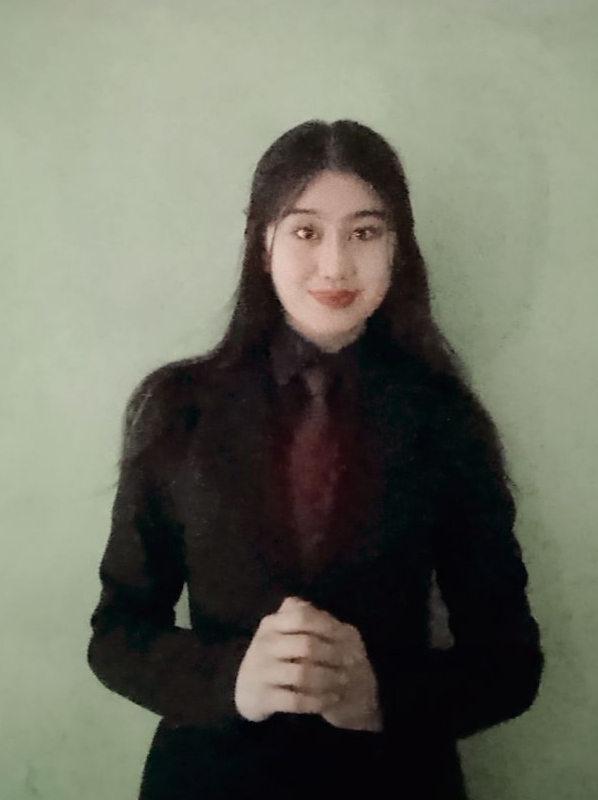
Habibullayeva Madina, a 9th-grade student of school 75 in Chust district. She is a poet, literary critic, entrepreneur and leader. Her articles and stories have been published in foreign magazines. She has published three books Article:”Spring”.