Essay from Ravshanbek Nasulloyev

PROBLEMS THAT ARISE IN THE PROCESS OF TEACHING A FOREIGN LANGUAGE AND THEIR SOLUTIONS

Annotation: This article highlights the description of useful options which helps to think in English.

With the development of the period, the need and demand for learning a language have increased so much that nowadays there is a need to know a foreign language in almost every field. In particular, English has become one of the most studied languages in the world. The demand and supply for young personnel who can perfectly learn this language and contemplate in this one are increasing more and more. However, a question arises: “Why is it difficult for us to think in this language?”, “How we can debate, praise and criticize in this language?”. These questions will be answered fully, clearly, and with examples in this article.


Some reasons that prevent us from thinking in English and one of them is the use of bilingual dictionaries. That is, if we want to know the meaning of a word or phrase, we use bilingual dictionaries, from English to native language or from native to English. Many students continue to refer to these translation dictionaries whenever they want to know the meaning of a word because they have been taught the grammar-translation method since kindergarten and school and it has become a habit for them, however, it is very urgent that we should break this mode. Because of big differences between languages in terms of vocabulary, translation, grammar, and structure, we confront with a plenty of obstacles when we want to know how a word in Uzbek is called in English, we may not find this word in dictionaries, or we may find a word used in a completely different meaning in dictionaries. We know that every language has its own and figurative words, and in the process of translation we come across words with completely different meanings from bilingual dictionaries. In addition, it takes a lot of time to think and translate in a conversation – this leads to pauses, hesitations and the inability to speak quickly and fluently.

The reasons mentioned above are known to eradicate our study on foreign language. Even so, there are several methods and specific rules to overcome such misunderstandings and defects. If we follow them strictly, we can soon notice a great revolution, and we can communicate in English fluently and become proficient in meditating on English. To begin with, we should surround ourselves with English. This does not mean going to an English-speaking country, and even we can accomplish this task at our home. For this, we need to do a day of English for 10 minutes every day, and we should regard this time not as study time, but as a fun and interesting process. Later, we can gradually increase this time from 10 minutes to 20, 30, 40 and more minutes. At this time, we can listen to podcasts, listen to the radio or music, read blogs, magazines and books or watch the English movies that we like, and during this time we can do two things. Firstly, we can listen passively. At that moment, we reduce the stress and pressure and it helps us to learn the language deeply. We also get the opportunity to get to know the speech and pronunciation of native speakers and increase our range of vocabulary. The other is that we have the opportunity to repeat the words and phrases we perceive and find out, and this is very beneficial for regulating pronunciation standards.

Moreover, we should only turn to account words that we know and have already learned. Sometimes we try to explain or express an idea while speaking, but we don’t acquire knowledge of vocabulary. At this time, we endeavour to find the translation of this word in the dictionary or ask someone for a translation. Maybe it helps us to increase our vocabulary, but it has a defective effect on the fluency of our speech. Therefore, it is preferable to use only words that we acquainted with. Although these words are very elementary, if the speech is carried out fluently without pauses and word searches, we will be successful. If we don’t have enough vocabulary to explain something, we need to look around the word, by this we mean that, we can think of synonyms or alternatives for that word. If we can’t find them either, it’s best to refrain from expressing that thought or idea.

The next point is that we should start learning from small and build it up step by step. It is challenging to ruminate about this non-native language, however, we can initiate this from learning only simple words, after that, we broaden this range by being informed of collocations, phrases, simple and complex sentences. One of the most conventional and predominant ways is looking at a picture and illustrating it. At first, we start by saying only the name of the item, subject, person and event depicted in this picture which we know the translation of. Then, we make phrases with adjectives or pronouns from the ones mentioned above. We make simple sentences from word combinations, and complex sentences from simple sentences. Then we get used to doing this exercise when we walk down the street, do shopping, go to the doctor’s office, wait in queue at the bank. By repeating this actions permanently, we learn to describe, analyze and evaluate the events and cases happening around us. Thus, we rise from the bottom to the top. Russian psychologist Lev Vygotsky said that the inner voice, our thinking came from the internalization of the outer voice. The inner voice in our head is the same as when we speak. There is one difference and it is our muscles. We do not make use of our muscles when we think, but we utilize when we speak. That is why, this process of thinking, speaking, thinking, and speaking through practice we can amplify it and help us to think in English.

Another strategy is that we should use English in our daily life. We should keep a diary and when we wake up in the morning, we should write in it our plans for the day, the tasks that we need to do, and at the end of the day, how our day was, what events happened, and what plans we made in our diary. Due to the repetition of such kind of workouts, we learn to use English in everyday life and use it correctly. Of course, there is a huge difference between speaking and writing, and they are separated from each other. But, according to some researches, writing and speaking are connected to each other in some cases. For instance, both of this skills require to meditate, criticize, prove or explain the phenomenon and it is depend on ourselves how to express this. However, we cannot write the way we speak. By taking notes, making some sentences on our diary, we learn to write cohesively and coherently in English without translation and a dictionary. As I highlighted above, we should only use the words we know.

In addition to this, as we know, practice is the most important part of learning language, as well as English. When we practice speaking with our friends, teachers, family members or other people, we will be more aware of events or things that are happening around us. So, we will more likely to think in English in order to make conversation with our partners.

The last option is that we should be monolingual. As I mentioned above, when we search words which we don’t know in bilingual dictionary, we may face some difficulties to find the exact translation or meaning. It is better to use monolingual ones that show the synonyms or definitions. By this, we can focus only on one language, enlarge our range of vocabulary and learn to think in this language.

All in all the discussion in this article has clearly shown some causes which disturb us from learning language completely and properly, and a huge number of options and strategies which help us to think in English, speak fluently and smoothly like native speakers and break up the barriers that we may face. By following these rules, we hope that students, even language learners can adapt to the English environment and live in it!


Poetry from Giddi Vivian Hembafan

I stand between God and Satan
Amazed by the angels
Their glow precious
Scared of the demons
Their presence a fallacy
Rejoiced at the glory at last
The world had turned down 
I craved for truth
Was surrounded with lies
Eating deep into my depths
I hungered for the words of righteousness
Was fed evil 
Wished for spiritual knowledge
Was led astray 
Far from the way
I watched the demise of souls
Those scenes made me scowl
Gushed at what kids became
T'was clear of what elders did to the youngsters

I stood in awe
Gazing in silence
As the devil controlled the beings of life
Men lured to their doom
Maneuvered to destroy themselves
With their own hands they spoilt the bonds they shared
Everything they created was lost
I was a witness
All I could say was, Ah !!!
Had we known.....
With my body vigorously trembling
I went on my shaky knees
With fear and hurt for the people
I cried, shouting out loud
Oh my God save us !!! 

I knew it was never too late
But we had long lost the opportunity
While reminiscing about our joyous past
The ever bright SON OF MAN came
I couldn't stop the hot liquids that fell
As I cried once again
Alas!!! Glory at last......

Poetry from Christopher Bernard

After Reading a Play by Aeschylus


Torn by the god
between the rocks of the Aegean
and the high wave of the Caucasus,
she falls on the black glass
of the stage –
Io, beloved of Zeus,
driven across the world,
maddened by jealous Hera;
turned, grotesquely, into a cow.

Prophecy lies:
there is no end
to the voice of her suffering.

The god’s love is the storm
of the ten thousand eyes of Argus.
He is blind as the sun
in its munificence
moving across the air
exalted after pleasure.

Humankind
is a child of water made of stone.
Their pain is darkness and silence.
The mouth of a hero
who knows everything and nothing
buzzes with gadflies and ashes.

Yet the woman’s cry is the daughter of generations.
It reaches us, gnarled in a distant wind.
It echoes long in the canyons of time.
It does not allow forgetfulness
or peace
in suffering traced 
in a poet’s words
wrought of gossamer and iron.

_____

Christopher Bernard’s book The Socialist’s Garden of Verses won a PEN Oakland Josephine Miles Award and was named one of the “Top 100 Indie Books of 2021” by Kirkus Reviews. His two children’s books, the first stories in the Otherwise series –  If You Ride A Crooked Trolley . . . (serialized in Synchronized Chaos under the title “The Ghost Trolley”) and The Judgment Of Biestia – will be published in November 2023.

Poetry from Zebuzar Yusupova

I thank to independence

There are no sadness in the heart, only happiness,
The spirit of people rose from joy.
Their sorrows turned into blessedness
I thank to independence!

Gardens thrive in various streets,
The mountains are amazed at the patience of my nation.
Even the spot of moon disappeared from the face
I thank to independence!

We gratitude our president,
Our heads always be safe.
We are united, come to our weddings
I thank to independence!

My words are endless to describe my country,
My eyes shine with happiness every day.
My friends, protect our motherland like heaven
I thank to independence!

My Uzbekistan, you are new, raise your prestige,
You are my golden cradle, my heaven.
You are dear to my heart, every moment in my soul
I thank to independence!

Poetry from Elmaya Jabbarova

White woman with long black hair and a black blouse with flowers on it.
Elmaya Jabbarova
Music is the voice of the heart

The sounds of music are balm to the heart, 
Who played it, 
To what religion, race, what nation, 
Searching, searching is a stranger! 

Most heart-poundingly penetrating, 
It is the sound of the call to prayer, 
the word of the Koran, 
Charming as an angel, 
Mother is a lullaby, Mother is a word! 

The sound of the spring, the thunder, 
Rustling leaves, raindrops, 
Howling wind, blizzard, 
Each is a note, oud! 

When a bird wants to fly for joy, 
Songs in his tongue like cranes, 
When you want to get into the heart of your loved one, 
Like waves in the roaring sea! 

Let the wishes be garlanded alone, 
May there be mercy and freedom in the world, 
Let a song be heard from everyone's tongue, 
May music be the crown of glory! 

Elmaya Jabbarova - was born in Azerbaijan. She is poet, writer, reciter, translator. Her poems were published in the regional newspapers «Shargin sesi», «Ziya», «Hekari», literary collections «Turan», «Karabakh is Azerbaijan!», «Zafar», «Buta», foreign Anthologies «Silk Road Arabian Nights», «Nano poem for
Africa», «Juntos por las Letras 1;2», «Kafiye.net» in Turkey, in the African's CAJ magazine, Bangladesh's Red Times magazine, «Prodigy Published» magazine. She performed her poems live on Bangladesh Uddan TV, at the II Spain Book Fair 1ra Feria Virtual del Libro Panama, Bolivia, Uruguay, France, Portugal, USA.


Essay from Iftikhar Zaman Ononno

Young South Asian teen boy with short brown hair with eyeglasses and a white collared school uniform top.

Tree Plantation

Tree plantation means planting trees more and more. Trees are important element of our environment. They are our best friends. They give us oxygen and take carbon-dioxide. They prevent the earth from becoming desert and they maintain the balance of nature. They give us food, shade and shelter. We get fuel and wood from trees. They save land from erosion. They are useful in many ways. They prevent natural calamities. But men are destroying them at a random. They are cutting down trees with the increase of population.

So, we should not cut down trees. Rather, we should plant more and more trees. All the year tree plantation is good. From June to August is the proper time for planting trees in Bangladesh. We can plant trees on both of road side, river side, pond, big field, small field, canal side and in the garden. Besides, any open space in and around homestead should also be used for planting trees. We should preserve the planted trees. Public awareness should be raised to make the tree plantation programs successful. If we want to preserve our environment, we should plant more and more trees. So, tree plantation is very important to make our nature safe.

Iftikhar Zaman Ononno is a student of grade 7 in Harimohan Government High School, Chapainawabganj, Bangladesh.

Essay from Marjona Qurbonova

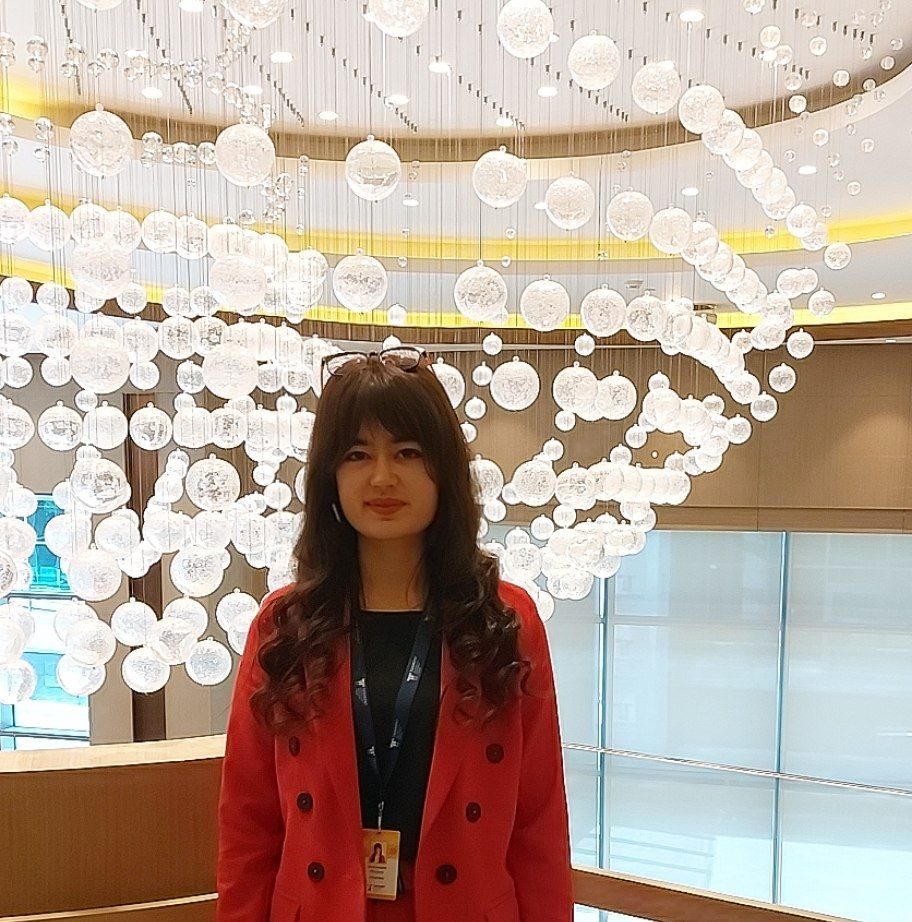
Young Central Asian woman with long black hair, a black top and a red jacket standing in front of a chandelier with many white globes of light.
Marjona Qurbonova
Achievements and challenges of online learning in teaching foreign languages

Qurbanova Marjona

Department of Applied Disciplines 

Abstract: This article discusses the importance of online learning in foreign language teaching. Nowadays some people in all countries prefer to learn something online in a position of staying at home and on the time they want. Online learning is creating a number of facilities if its drawbacks are not regarded. Now we shall see its advantages and disadvantages together.

Key words: online education, information, university, course, Internet, student, lecture, technology, screen, foreign language.
Education plays the most important role in the life of people. A big piece of new and necessary information appears every minute. Nowadays online study or learning turns out to be more and more practiced. Many universities started to share their courses online. So, what is online education?                                       

Online education is the form of education that takes place over Internet. It is called as ‘e-learning’ or ‘online learning. Students attend online lectures with the help of computer or a smart phone. Although online education has become popular nowadays, it has both advantages and disadvantages. 

Advantages
Online learning is convenient. These is obviously the greatest benefit of online learning; as long as you own a computer and have an internet connection, it does not matter in which part of the world you are. Learners can access information from anywhere, anytime.
It is flexible. Learning becomes easier when aligned with one’s learning needs and preferences. Online learning allows learners to study at their own pace, whether they are students, busy adults, or employees. 

Online learning is cost effective.  The cost effectiveness of online learning is quite impressive; no more travel and accommodation expenses, reusable online content. It can be tailored to different needs. Different people learn in different ways, and online learning does everything in its power to ensure that all learning needs are met. Looking for economically viable options online learning for students is the best way;

It is immediate. Not only learners are able to begin their online learning immediately, but they are also able to see immediate results; whether self-paced or instructor-led.
It is unrestricted.  With online learning location is no longer a barrier; neither are culture and nationality.

In addition to studying, you can also work. In fact the majority of applicants who choose distance learning drop out they don’t want to give up, but they want to learn. In online learning you can study on weekends, when you return from work, even at night;  
  
It saves your time! Students in online programs can effectively manage their time, learn the materials, and complete assignments on their own schedules to name just a few benefits of online learning. Transportation to and from training centers you can save the time you spend waiting. In online learning  if you want you will receive information on the spot;

If you consider yourself aspiring, distance education is the greatest way for you.   The advantage is that some classes are held in groups. There are some students in the group the faster some understand slowly. In this regard, distance learning is a method more efficient.

Disadvantages
It may be a “solo” act. It is true that, although online learning might be convenient and flexible, it is also a solo act... Some people absolutely need personal contact with their educators or trainers in order to learn successfully. It is difficult to have group discussions in online education. Student-teacher interaction is also limited. The probability of being distracted is high. In face-to-face communication there are no classmates who are constantly reminded of upcoming assignments. If you want to successfully complete a distance learning course, find yourself you need to be diligent and careful;
It may be impersonal. No matter how we try to fully transfer human communication platforms, no matter how natural it seems to form relationships behind computer screens; a virtual environment is just not human.

Nothing can replace human contact. Too much time spent in front of a computer screen may be harmful. Being constantly online is the new reality, but the truth is that using a computer or a tablet all the time can cause poor vision, strain injuries, and other physical problems. 

It requires self–discipline. If your e-learning audience lacks self – discipline, it is unlikely that they will be motivated to self study. Traditional learning and training have the benefit of easily tracking both progress and falling behind, this works for many learners as well, as some people prefer their progress to be closely monitored in order to perform.

Technology Issues – Many students face technical issues like slow internet connectivity. This hampers the learning experience. The biggest enemy of online learning is the internet's slow performance of providers or disconnection. In this case, the applicant the desire to learn leads to exhaustion or nervousness.
Cheating – Students can cheat easily if exams are conducted online. They can copy the answers as they give the exams from their own house.
Inability to focus – Many students find it difficult to focus on screen for long period of time. Students get distracted easily towards social media or other sites too.

Possible lack of control: No matter how carefully you design e-learning course, there is no guarantee that your massage will get across. There is always the risk of your learners just going through the material without paying any attention. It is difficult to measure program results. Question remains: are students learning what instructor is saying that they should be learning? Students must be self-motivated and disciplined to progress through his or her program in a timely manner. 

In conclusion, the facts are that there are advantages, and disadvantages to every type of learning environment. Students have to analyze both the pros and cons, factors which contribute greatly to making an informed decision, about the direction of his or her career path. Students have to decide, how they are going to accomplish their goals: online, in the classroom or a combination of both. Today’s online learning is better than yesterday’s; and online learning of tomorrow will be better than today’s.

References:
1. https://elearningindustry.com/advantages-and-disadvantages-online-learning
2. https://www.weforum.org/agenda/2020/04/coronavirus-education-global-covid19-online-digital-learning/