Evening brightness Slightly dew dropped pearl My butterfly winged dappled sunlight Hibiscus rhythms of night vapour That harbours a mild mellow film Rainbow trout and opal eyed souls My bright tea tree holes Labyrinths of turpentine palaces Singsong lyrical balance Yet a bright shimmery dew Whiter than heavens Celestial realms A bright future Beyond cause and effect Just celestial.
The Difference We Make
September 2013

Empty air was hissing
as from a gold string fob sifted on marble.
Some things take another thing
to make sense for them.

When I reached down to pick it up, the name
chestnut echoed as a keepsake to imagine
luck for my pocket, carried with change.

We gathered at Memorial Church to listen
to readings of your poems. None of them
were set in churches, allowing you this further
chance to resist yet also embellish
a welcoming exile and attempt to naturalize you.

One of the professors related your meditation
on the pastor’s beret, your insight into the thing’s
aerodynamic shape and lightness, holding it
like a frisbee between thumb and finger,
mind’s-eyeing it flung into the congregation.

The poet’s vision could perform the necessary
desanctification of the sacred, to share
grace for our laughter, which the pastor
for heaven’s sake might thank the poet for.

With vaults to echo the skies, the altar for
your or my supper table and by metonymy of use
the fruits of the earth, the earth itself,
a church makes a kind of poem of the world—
with acoustics especially for song
and speech, middle-earth in its edification
of a mind waking to meaning, to prayer, or to a poem
to articulate our wonder, to advocate for us,
for our reconciliation, to forge the soul
or, say, shape us, to belong, in the difference we make.

For something slightly unusual we guessed
our way down Brattle to the garden at Longfellow’s.
Starlings and a crow pecked in the grass.


A russet squirrel gnawing an acorn motioned
for us to follow the path along the beds
with labels for end of summer’s crestfallen roses—

onto a trellised vine. Wanting thoughts looked.
Were those real, clustered in perfect cone-shapes?
They couldn’t—could they be ripe? It would be wrong

to lift a handful—as my hand reached for the grapes
to roll and crush their tartness on my tongue
thinking this appropriate for a trade

poet’s memory, a frisson’s object
to flesh out the reed music Seamus Heaney made
with prudence and propriety to contradict.
Michael Todd Steffen is the recipient of a Massachusetts Cultural Council Fellowship and an Ibbetson Street Press Poetry Award. His poems have appeared in journals including The Boston Globe, E-Verse Radio, The Lyric, The Dark Horse, and The Poetry Porch.
Of his second book, On Earth As It Is, now available from Cervena Barva Press, Joan Houlihan has noted Steffen’s intimate portraits, sense of history, surprising wit and the play of dark and light…the striking combination of the everyday and the transcendent.
Beauty Is Where You Find It

We went to the art museum

But the art museum was closed.

My stomach hurts, and outside the clouds

Sit somewhere while I look at my phone.

That’s not art.
Closed Hearts


She said I’m not what they say I am

I can’t help but cry

Just a little

The knot in my throat

And weight on my chest


Leave it unsaid, he said

She never mentioned how his silence hurt her

Leave it unsaid, she said

He didn’t tell her how many things were seething to come out

Death by so many small nicks along the way

You never know what goes on behind closed hearts


Eating My Shovel


Rolling in the cold San Diego waves

the up brings life value

and the down, maybe not


I eat when I’m depressed,

when I’m happy, whenever

I self-medicate with coffee and food


So many people say that life is too short

I disagree

Life is so, so long


My hopes for happily ever after

faded to midnight


Every choice narrowed the prospects

Fewer possibilities now


I’ve dug too deep

and the only tool I’ve kept is my shovel.


My Dead Body


At the funeral of my husband’s best friend’s father, for the first time, we broached the topic of what we want to happen to our dead bodies.  I have always wanted my body to be useful to others once I have lost any need for it. I told my husband that I want all of my remaining healthy organs donated, and the rest of me donated to science.  I would be happy for my body to be a cadaver or thrown out into those body farms in the middle or south United States to help forensic scientists hone their craft.  My husband was appalled at this.  He could see himself donating organs, but he wanted the rest of him buried, so his family would have a place to visit him.  I pointed out how environmentally unsound burial is and what a waste of human tissue, when he could help science, even after death.  After a bit of back and forth, we settled on organ donation, then becoming trees to be planted where our loved ones could visit, but we’d be friendly to the earth in death.


He wants a headstone

I just want to help someone

We’ll see who dies first


San Diego Beaches


Heading north, waves chase my left side

As the water pulls back, little puckers appear in the smooth wet sand

The sand crabs are reaching toward the sun

If I’m lucky, I’ll find a sand dollar

Or one of those butterfly shells

The former home of a muscle

Clam

Or oyster

Splayed open

Revealing its shiny vulnerable inside

I remember when La Jolla’s seal beach

Was once the children’s cove

Instead of the home of so many ocean puppies

It was the perfect wading spot for little ones

Protected by the sea wall

Bordered by tide pools

We used to gently press our fingers

Into the center of the sea anemone

Until they recoiled into themselves

Now the seals take up all the space

And bark either in delight or warning

To all who dare to venture near


We Can All be a Stranger


She knows exactly how

to break my heart

My perfect little girl

with all those imperfections

Her cherubic face

makes me want to

give her everything

She wants and more

my obligation as her mother

is to not give her everything


When she lies

She’s a stranger

When she’s obstinate

She’s a stranger

When I raise my voice

I’m a stranger

When I punish her

I’m a stranger


I can’t just be

her best friend

I cant just give

her what she wants now

I have to help guide her to the best self she can become

My little girl is a woman

in the making

and the making is the hard part
CLS Sandoval, PhD (she/her) is a pushcart nominated writer and communication professor accomplished in film, academia, and creative writing who performs, writes, signs, and rarely relaxes. She’s a flash fiction and poetry editor for Dark Onus Lit. CLS is raising her daughter and dog with her husband in Alhambra, CA.
FOLLOW ME

 I'm giving you a secret sign, follow the white rabbit.
My shoulder tattoo says it all.
Yes, I forgot, we are not in the movie The Matrix.
I want you to be my companion,
but you don't know how to read the signs
which is set by the Universe through numbers and in the child's speech.
There is a celestial artist whose pen writes the signs of the horoscope.
All this is as clear as the future in the palm of your hand, in answer to prayer.
But instead of looking, you sleep and dream of me in a silk nightgown,
and you don't understand that I'm warm on a hot night,
and not to provoke your senses.
I am giving you a path that is walked without material desires
and to head to the Himalayas where we will see with different eyes.
We will dive into the mountain of snow, in whose interior there is a world of abundance.
Close your eyes and follow me. I will take you, companion,
when you learn that tattoos speak,
when you recognize the signposts written with a pen of gold,
we will not need a body made of earth. Follow me,
I'll take you to the abundance of dreams brought to life.
And once you step there you won't want to go back, but he wants it first.


I AM YOUR MASK

In kindergarten you wanted to be a clown.
I painted over your features
and you were so adorable with a round red nose..
You are at a ball in your youth
put a mask over his eyes yes poor girl
she wouldn't recognize that you are the son of a rich man,
It looked perfect on you because I can make you be what you want.
And in your passion you were afraid of illness
and convinced you to be your protection of polyester cloth over the mouth and nose.
Your ears started ringing, and no one saw the sad eyes
because they have become dull. I, who was your servant
and mask of life I humiliated you
and you forgot to be free man.
I shout to myself: "I am your mask, get off my face and smile, captive man, because there is a way out!"


Maja Milojković was born in 1975 in Zaječar, Serbia.
She is a person to whomfrom an early age, Leonardo da Vinci's statement "Painting is poetry that can be seen, and poetry is painting that can be heard" is circulating through the blood.
That's why she started to use feathers and a brush and began to reveal the world and herself to them.
As a poet, she is represented in numerous domestic and foreign literary newspapers, anthologies and electronic media, and some of her poems can be found on YouTube.
Many of her poems have been translated into English, Hungarian, Bengali and Bulgarian due to the need of foreign readers.
She is the recipient of many international awards.
"Trees of Desire" is her second collection of poems in preparation, which is preceded by the book of poems "Moon Circle".
She is a member of the International Society of Writers and Artists "Mountain Views" in Montenegro,and shealso is a member of the Poetry club "Area Felix" in Serbia.
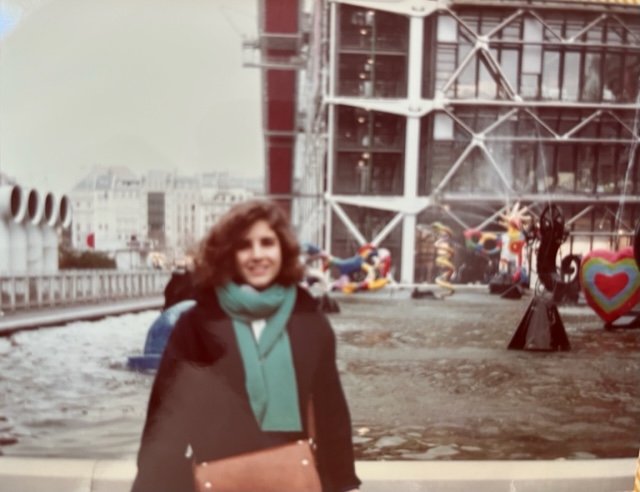
Pompidou

On a September afternoon in 1986, under a sunny Paris sky, my brother, Dorian, and I walked into a BNP bank to open a student account.  We had arrived from New York that morning, jet lagged and weary.

I was in my senior year of college, taking a semester abroad.  Dorian was 36 and had decided to come with me and stay for my first few days.

The mood in Paris was tense.  There had been a string of bombings in crowded places, and the French police were armed, suspicious, and everywhere. They seemed just as threatening as the terrorists, with their machine guns slung over their chests and their fingers resting on the trigger.

I was glad Dorian was with me. But even though we just arrived, I couldn’t stop thinking that he was going to leave. This was the longest time I would be away from home. Queens College was a commuter school, and I lived with my parents. When I had suggested going away to college, my parents acted like there was something wrong with me.  This semester abroad was supposed to be my chance at independence. Now it seemed like it might be very lonely.
We had come to Paris a month before my classes were to start because I had to take a French language proficiency exam in order to enroll in the university.  French was my first language and the language Dorian and I used when I was a child. Our parents were from Lebanon and spoke French and Arabic and sometimes a mixture of the two. The exam was scheduled for the next day.

At the bank there was a long line.  I told Dorian I wished he could stay in Paris with me. I told him I was worried because after he left, I was going to have a lot of time on my own, without any opportunity to meet other students. I pleaded with him, working myself into a panic.
The line at the bank was moving by small increments.  I sat on the marble floor with all the other students from overseas, waiting my turn. Dorian said, “I’m going to take a walk.”

The line snaked endlessly, and when I was finally near the front, Dorian reappeared.  “Les, come here for a second.”  He wanted me to meet someone.

I was afraid I’d lose my place, so Dorian turned to the guy behind me and unfurled his French, which was better and smoother than mine. Rolling his rs, he asked him to hold my spot, and then he took my arm and led me back to the lobby.

There was Terence, the one he wanted me to meet.  He was a student, like me. He went to Parsons School of Design.  He was stylish in a Duran Duran kind of way.  Dorian had met him the year before, taking Chinese classes at the New School.

After the introduction, I turned to leave.

“Wait,” Dorian commanded. “Exchange numbers.” I glared at him, and he said, “You’ve been bothering me all day about not having any friends.”

I blushed and got out a pen, my hair falling into my eyes. I told Terence I didn’t know anyone in Paris.  He said he had traveled from New York with his classmates and arrived with his social life intact.  This made me ache for my two best friends in Queens.

Terence and I were both renting rooms in someone’s apartment, so it was going to be tricky to get in touch with each other. We scribbled our phone numbers as fast as we talked, and I said, “Nice to meet you,” and ran back to the line, hoping I hadn’t missed my turn.

The next afternoon, I was seated in a room on a high floor of an old building, taking the language placement exam.  More than halfway through the test, there was a loud explosion that shook the floor and our desks.  The proctor was startled, but after a few long moments instructed us to continue with the exam.  Minutes later, sirens blared.  We weren’t let go until we’d completed the test.

All of us filed down the stairs. As I stepped out into the rainy night, I saw a commotion nearby. I saw people running.  A five-and-dime store called Tati had been bombed.  I learned from the people around me that five were dead, women and children, with dozens wounded.  I dug my hands into my pockets and walked in the opposite direction, wishing I could speak to my parents, conjuring their voices in my head.

A few days later it was time for Dorian to leave. I begged him to stay just another day, then I went with him to the airport and watched him go.  “You’d better write me,” I shouted.  “I will,” he said.

When I got back to my apartment, the landlady snarled, “Quelqu’un a sonner pour toi,” and handed me a paper with her scrawled writing. It was a message from Terence. It said, “Party tonight,” with an address.

I put on my jeans with the flower applique on one thigh, my tan cowboy boots and my brown leather bomber jacket and took the Metro to my destination.  Depeche Mode’s “Never Let
Me Down Again” could be heard a block before I got to the building.  The sounds of New York accents ricocheting through the stairwell made me take the steps two at a time.  There were many people my age, all potential new friends. They were more fashionable and sophisticated than my friends back home, drinking and swaying to the music.  Cigarette smoke hovered above everyone’s heads.
I wandered around the crowded apartment looking for Terence.

Someone was writing on a large paper taped to the wall.  As I stood next to him, he handed me the pen.  I wrote, “Dear Terence, I couldn’t find you.  Leslie.” I stayed a little longer, bopping my head to the music; I danced with a boy with spiked studs on his shoes and then went home.

Soon after, Terence left another message with my landlady for me to meet him at Place Saint Michel that night.  He was already waiting when I arrived, wearing a long wool coat.  We found a table in a tiny cave-like restaurant, and he told me that he had been in Tati when it was bombed. He had been buying a radio and cassette player when it happened.  His hands were shaking as he described the scene, the dead, all the blood. How he got out. Then he said, “I just wanted to go back home. Part of me still does.”  He was near tears when he said this last part.

After a long silence, I said, “Why did you take Chinese lessons?” He explained that although he was Chinese, he didn’t speak the language. He giggled, and it was infectious, and we both had a good laugh.  We finished dinner and stepped out to the street.  “Okay,” he said, “let’s meet next Tuesday in front of the Pompidou Center, say 6 o’clock?” He raised his eyebrows.

“I’ll be there,” I said.
The Kingdom of Foam
Whom I saw old yesterday
Is young today
Thinking dead who was buried
Is walking on the yard
The ill-fated man having no legs is running in the field
Today the vast sand dune is rambunctious with the sea foam
Dead fish are jumping and bathing in the river
Arjuna who never lost his aim
His arrows are aimless
Despite meeting again and again
Radha and Krishna were never in affair
The blind poet Thamyris is looking toward light
Wrinkle skinned Zulekha is
Becoming young gradually
But Jesus had not yet been taken down from the cross
From The Stage of Execution
I exactly don’t know why
From behind the prison cell I remember my mother
Mother used to say you know- writing poem doesn’t bring bread and butter
I remained silent in humiliation
But today I have time
I can ask question like a brave son
Mother, who don’t write poems- can they bring bread and butter either
My mother is now counting her last days
And the predecessors are lying in the graveyard
I don’t know if they died of hunger or not
And the science of the lords doesn’t blame
Hunger as the cause of human death
I will be hanged at the third watch of the night
To know the final message
The concern of rainy winds floats in the eyes of my comrades
May be my death has settled the dew of countless pains
In the sky of their eyes
That will be twinkling like pearls
In the sun of love
I am indebted and grateful to my fellow comrades
The poems written by me
Are the essences of their life indeed
I’ve just decorated them with immortal ink of the truth
I have not forgot their love
By the ordinary pain of death
The love that no one- can unearth
Even throughout his lifetime
Standing at the edge of death I feel that today
Now I am heeding toward the place of public execution
I’ve only one minute left to be hanged
Meanwhile what else may I leave for a nation in decline
Without the example of igneous death
Curiosity
I keep a cloud of many words
In my chest pocket,
I keep the anxieties of unknown
In my mind’s locket.
Where do the blue stars live
Or blue fairy wings,
Where does the red lotus
White seagull swings.
Where does the King Cobra dwell
In hidden hilly rest,
Where is the cave in the North or
In the Southwest.
In which sky does the eagle fly
Lays eggs in the sea
Why is the bird’s heart frozen
When cloud sounds bee.
To which distance the rainbow
Bend its face behind,
Why do these questions arise
In the corner of mind.
As a child looks everything
In the blinks of eyes,
So have I opened my eyes
To listen the cries.
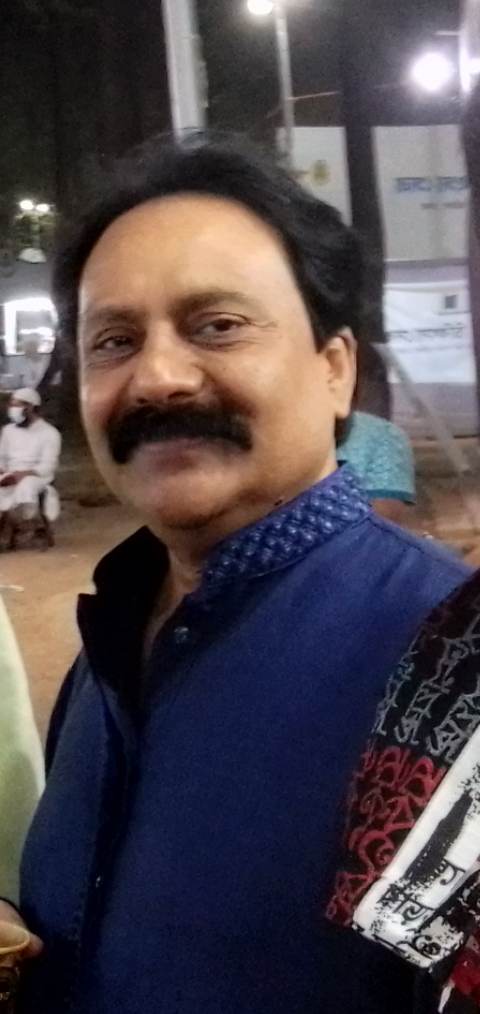
Rezauddin Stalin is a very famous Bengali poet, born in 1962 in Nalbhanga village of Greater Jessore district.
Many local and foreign awards including Bangla Academy. His poems have been translated into 42 languages of the world.
Along with poetry he established himself as a successful media personality. His basic thoughts on various issues of the society give us light. Rezauddin Stalin is now the international voice of Bengali poetry.