
1

fluffy goldfinches

at the birdfeeder

spring snow flakes


a feather fluttering down

signals an intruder


Christina Chin/Kimberly Olmtak Gomes


2


spring rain

fills the lily cups—

impassable stream


up to my knees

in a flooded street


Christina Chin/Kimberly Olmtak Gomes


3


sweet and plump

in the faded family photos

—aged envelopes


prying eyes search

for a birth certificate


Christina Chin/Kimberly Olmtak Gomes
Category Archives: CHAOS
Poetry from Rus Khomutoff
Poetry from Sayani Mukherjee
Celestial
Evening brightness
Slightly dew dropped pearl
My butterfly winged dappled sunlight
Hibiscus rhythms of night vapour
That harbours a mild mellow film
Rainbow trout and opal eyed souls
My bright tea tree holes
Labyrinths of turpentine palaces
Singsong lyrical balance
Yet a bright shimmery dew
Whiter than heavens
Celestial realms
A bright future
Beyond cause and effect
Just celestial.
Poetry from Michael Todd Steffen
The Difference We Make
September 2013

Empty air was hissing
as from a gold string fob sifted on marble.
Some things take another thing
to make sense for them.

When I reached down to pick it up, the name
chestnut echoed as a keepsake to imagine
luck for my pocket, carried with change.

We gathered at Memorial Church to listen
to readings of your poems. None of them
were set in churches, allowing you this further
chance to resist yet also embellish
a welcoming exile and attempt to naturalize you.

One of the professors related your meditation
on the pastor’s beret, your insight into the thing’s
aerodynamic shape and lightness, holding it
like a frisbee between thumb and finger,
mind’s-eyeing it flung into the congregation.

The poet’s vision could perform the necessary
desanctification of the sacred, to share
grace for our laughter, which the pastor
for heaven’s sake might thank the poet for.

With vaults to echo the skies, the altar for
your or my supper table and by metonymy of use
the fruits of the earth, the earth itself,
a church makes a kind of poem of the world—
with acoustics especially for song
and speech, middle-earth in its edification
of a mind waking to meaning, to prayer, or to a poem
to articulate our wonder, to advocate for us,
for our reconciliation, to forge the soul
or, say, shape us, to belong, in the difference we make.

For something slightly unusual we guessed
our way down Brattle to the garden at Longfellow’s.
Starlings and a crow pecked in the grass.


A russet squirrel gnawing an acorn motioned
for us to follow the path along the beds
with labels for end of summer’s crestfallen roses—

onto a trellised vine. Wanting thoughts looked.
Were those real, clustered in perfect cone-shapes?
They couldn’t—could they be ripe? It would be wrong

to lift a handful—as my hand reached for the grapes
to roll and crush their tartness on my tongue
thinking this appropriate for a trade

poet’s memory, a frisson’s object
to flesh out the reed music Seamus Heaney made
with prudence and propriety to contradict.
Michael Todd Steffen is the recipient of a Massachusetts Cultural Council Fellowship and an Ibbetson Street Press Poetry Award. His poems have appeared in journals including The Boston Globe, E-Verse Radio, The Lyric, The Dark Horse, and The Poetry Porch.
Of his second book, On Earth As It Is, now available from Cervena Barva Press, Joan Houlihan has noted Steffen’s intimate portraits, sense of history, surprising wit and the play of dark and light…the striking combination of the everyday and the transcendent.
Synchronized Chaos June 2023: Layered Experience
This month’s issue unearths the different layers of our life experiences. Pieces explore the influence of the past on our lives, our memories and heritage, and the legacies we leave for those who will come after us.

Boqiyev Sherkhan Ubaydullo outlines the history of Turkish trade on the Silk Road.
Maja Milojkovic poetizes nostalgia, the passion and grief of letting go of vividly rendered experiences: playing the violin and sharing a large family home. Steven Hill writes of personal grief at the loss of a friend and deep, sweeping thoughts about cultural memory of Nazi brutality and then on the vast complex weight of human history.
David Kopaska-Merkel’s time travel story raises the possibility of being stuck in the past. Jim Meirose’s surrealist wordplay centers on a ghost, while Taylor Dibbert references the uncomfortable digital “footprint” of a relationship that ended badly.
In a more positive vein, Mesfakus Salahin offers up a romantic glimpse of the moon, a traditional poetic subject. Hongri Yuan’s poems, translated from Mandarin to English by Yuanbing Zhang, evoke the mystical traditions of ancient Chinese scholarly poetics. Mahbub Alam waxes poetic about oneness with nature, falling in love amid the flowers and growing strong like trees. Elmaya Jabbarova contributes a paean to a more celestial, ethereal love.
Don McLellan describes a group of very individual and quirky seniors who form a neighborhood walking club that creates new memories. Farangiz Safarova speaks to the love and connection between a grandfather and his grandchildren and his dreams for their futures. Zarina Abdulina, who assists children with disabilities, encourages volunteering purely for the sake of helping others.
John Culp’s poem addresses what we create and leave behind for future generations. Laura Stamps’ pieces reflect a profound longing to pass love on to others, children or small dogs. Yahuza Uzman recollects children’s varied emotions as a sick mother teeters on the edge of survival.
Oona Haskovec ‘s poetic speaker turns to the past to save herself, clinging to the ideas of existentialist poetry to keep her from taking her own life, because of the effects of her death on others: blood would “spatter them” as well.
Francesco Favetta’s pieces celebrate the love of a mother for her children, the love between brothers, and hope and poetry and faith in a world torn by war.
Mykyta Ryzhykh’s poetry spans life, death, seasons, nature, war, and peace. Azemina Krehic draws on poppy fields for a metaphor about healing pain by facing its reality and connecting with others.
Channie Greenberg evokes a panoply of human emotions and experiences through arrangements of colored dots. Edward Supranowicz plays with brilliant and muted color and light to reflect feelings and sensations.
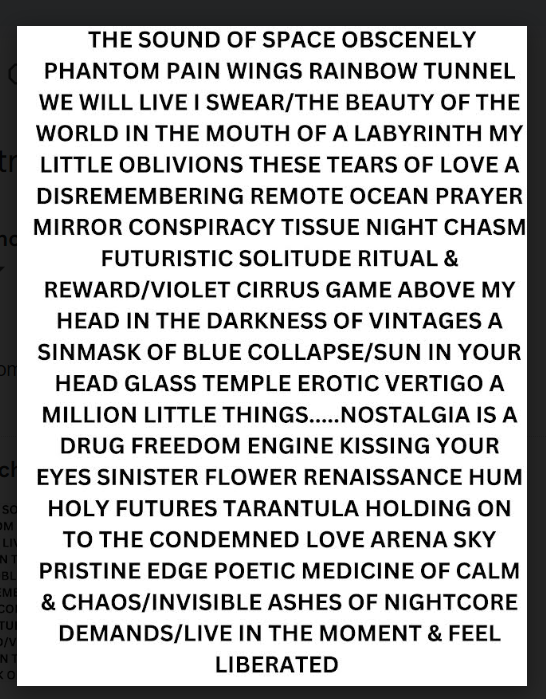
JD Nelson sends up random words and grammatical constructions, short bursts of thought reflecting fragmented consciousness. Mark Young weaves phrases of disparate sentences together to create new textures of sound and thought. Graciela Noemi Villaverde writes of the liminal space between sleeping and waking.
Some contributors focus on the heavy weight of histories that can pull us down, particularly when those shadows extend into the present day. J.J. Campbell wonders how to find pleasure in a fading and broken world, while Victor Obukata and Muhammed Sinan decry social injustice, power imbalances, and the tragedy of poverty. Tuyet Van Do’s poems concern ways people manipulate nature and society.
Pat Doyne offers a mocking farewell to departing Fox News host Tucker Carlson while Noah Berlatsky sends up a poem that reflects the experience of doom-scrolling, composed of surrealist images amidst language from today’s headlines.
Santiago Burdon evokes the weight of millennia of tradition in a humorous piece where the Pope steals his grandfather’s ring.
Ammanda Moore illustrates how purity culture heightens the pain of a woman being examined for reproductive cancer. Linda Gunther’s piece shows the cumulative effects of sexual assaults on women’s self-concepts and feelings of safety.
Sandro Piedrahita probes the ethical dilemmas and compromises people make in the name of revolution. Robiul Awal Esa contributes a meditation on divine justice and mercy.
Other writers take pride in the positive aspects of their personal or societal heritage.

Murodova Muslima Kadyrovna glories in the beauty of the Uzbek flag and the promise of her country’s founding ideals.
Daniel de Culla presents a unique take on his home country of Spain: photographs of cats, water, and flies, earthy bits of nature.
Still other writers’ pieces reflect or suggest new ideas, forward movement into the future.
Aminova Oghilay illuminates the beauty of spring flowers, and Sayani Mukherjee contributes a piece on lilies with some intriguing language.
Wazed Abdullah celebrates the joy and privilege of learning.
Lauren McBride invents a new kind of poetry, saturne binary poems, a reworking of the lanturne structured to mimic the rings of Saturn.

Christopher Bernard reviews poet Mary Mackey’s book Creativity: Where Poems Begin, which explores the sources of Mackey’s poetic inspirations. She seeks a “gentle path” to find creative insights without deranging her senses or relationships.
Garrett Schuelke dreams of his future summer travels. Chimezie Ihekuna extols the value of travel, what we can learn from seeing more of the world, changing up our mood and atmosphere.
Kahlil Crawford celebrates entrepreneur and business leader Dr. Kasthuri Henry. Don Bormon talks of the computer’s importance as an invention.
Leslie Lisbona reminisces about growing up and moving to a room of her own, independent but lonely at first without siblings at her side.
We hope this issue imbues readers with a spirit of hope and curiosity, taking comfort in or shedding the layers of past experience as needed.
Short story from Linda Gunther
Sparkle Gone!
Stick to the script Bradley. Learn the damn lines, she thought to herself. She deplored actors who didn’t take the time, care enough to digest their assigned dialogue. Most fought tooth and nail to snag as many lines as possible, coveted them, persevered like hell to learn them.
As soon as Cynthia received her script from the Director, she consumed her lines, dedicated to absorbing them as quickly as possible. Once she received the script, she would immediately read aloud every single word of dialogue into an old-fashioned tape recorder from start to finish, whispering her own character’s lines faintly into the microphone, and then audibly read in full voice all the other characters’ lines. She listened to the recording at least twice a day during both the rehearsal and performance periods, inserting her own lines, in character, as prompted. If she had a major role in a production, she would listen to the tape three times each day outside of scheduled theater rehearsals. She recited her lines every chance she got, during her hour-long car commute to work, while walking on the beach, in the check-out line at Safeway and even in bed before sleeping.
Cynthia memorized her dialogue within a week after receiving the script, even when she was the lead in the play with hundreds of lines. Hell, it was an adventure – a challenge, a new mountain to climb each time she was cast. Directors and fellow actors were duly impressed at her speed at picking up the lines and her ability to transform herself into the character. She could “become” anybody if she put her mind and heart into it.
But at 40 years old, Cynthia’s theater activities had become a job to her; more tasks to accomplish, a burden of responsibility versus a passion or outlet for creativity. Rehearsals had become another place she had to be by a certain time several nights a week.
She drove to the theater for the first rehearsal of her latest romantic comedy. This is the last play I’m doing for a while, maybe forever. She was pleased that she had been chosen as the lead in the production. The Director had personally phoned her and asked her to do it. With only three characters in this tale of lust and murder, each actor in their own right was critical to the show’s success. Although disenchanted with the downside of theater, she was tickled about this particular role; a great note for her to end on. Twelve years ago, Cynthia had performed the same lead role in the same play with the same Director. Being asked to revive the character of ‘Loretta’ confirmed that she was not yet too old to play the attractive young wife of a car salesman who ventures into a reckless affair with the family dentist, and then plots with him to murder her spineless yet lovable husband.
As Cynthia parked the car on the street by the theater, she sat by herself for a moment in the dark. I’m cranky. Too much on my plate at work.
Just before they finished blocking Scene 1, Bradley, who played the dentist, stood behind her, reached his hands under her armpits and firmly cupped both of her boobs full-on. His hands pressed her nipples. She felt his hot breath on the base of her neck.
“Wahoo!” he shouted, and let go.
Yes, Bradley Fisher, the dope who struggled to learn his damn lines in every show she’d done with him, had now sexually molested her.
She looked down at Gary, the fully-bearded Director, his dark hair wild and disheveled. He sat on a tall wooden stool at the foot of the stage, a dog-eared script in hand. Cynthia was astounded to see that he showed no reaction. His failure to acknowledge what just happened was inconceivable to her. Had he chalked it up to acceptable comedic actor shenanigans? Or had he accidentally turned away for that specific moment, and completely missed the blatant sexual assault which took place only a few feet away? Dan, the actor playing Cynthia’s bumbling husband, one of the most decent guys she knew in theater, didn’t seem to react either. She thought she saw Dan raise his eyebrows before he turned and looked down at his script.
Did the event really even happen? She considered the possibility. More ridiculous to her was that she said nothing to Bradley or Gary in terms of her outrage, disgust, confusion, all the things she felt inside. She wanted to scream but instead she froze.
“Cynthia, can you move downstage for Scene 2, first two lines?” Gary said, looking up from his script. She hesitated, feeling like she was in an episode of ‘The Twilight Zone,’ yet nodded, marked the blocking note with a pencil on her script, and moved downstage to say the opening line. The rehearsal went on, all the blocking done. “It’s a wrap for tonight,” Gary said, tapping his pencil on his script.
When she stepped down from the stage, Gary tapped her shoulder and whispered, “Great job Cynthia.”
“Thanks,” she said, giving him a weak smile.
Bradley picked up his jacket from a front row theater seat and moved towards her, his blue eyes wide, his blonde hair slicked back, an impish grin on his face. He seemed to want to hug her good-night. She glared at him, pressed her lips tightly together and moved away quickly before he could reach her. She grabbed her purse and sweater from the seat on the aisle, and started to rush to the back.
“Good-night, Cynthia,” she heard Dan call out.
She forced herself to respond. “Bye,” she said feeling fractured by his nonchalance and her humiliation. She pushed on the swinging door to exit the dimly-lit theater. Once outside on the street, around the corner and in her car, she dropped her head down on the steering wheel and wept.
Bradley never did anything inappropriate again for the remainder of the six-week rehearsal period. When she had to kiss him in a love scene, she wanted to puke, but kept her composure, hiding any hint of weakness. Bradley seemed devoid of self-awareness or regret, and actually invited Cynthia to be friends on Facebook two days following that first rehearsal. In disbelief, upset and angry inside, Cynthia considered calling his wife and spilling the beans. She daydreamed on how satisfying that would be. Cast members and stage crew had received the contact list, so Cynthia had his home phone number. Does Bradley’s wife know her husband’s a sexual predator? Has he done this before? How many victims?
Cynthia accepted Bradley’s Facebook invitation placing her only one click away from posting the sex violation for all his friends and family to see. That would help to settle the score. Some degree of vindication. But she did nothing about it. Nothing! She buried it, started to feel ashamed, awkward. The last thing she wanted was to rock the boat for the show, jeopardize the role she was so eager to do again, one last show; with performances sold out ahead of the three-week run.
On the night before their final performance, as she attempted to fall off to sleep, Cynthia felt restless, conflicted about not speaking up about Bradley. Her mind floated back in time to when she was 12 years old. It was a hot, muggy June day in the Bronx. Cynthia and her three best friends were in seventh grade, Sherry, Rebecca and Sally, and Cynthia had planned to board the Flushing Line and head to the World’s Fair at Flushing Meadow that afternoon because of teacher in-service training which meant school would end at noon.
Once they purchased train tokens and went through the turnstile, the girls giggled and chattered about their science teacher who was a dead ringer for Paul McCartney, each with a story about what he did or said in class during the past week. On the platform waiting for the train, they snickered about Miss Troskin, nicknamed “the Trashcan,” a doddering, red-rouged French teacher who could not see past her crooked nose. They reminisced about the hilarious time they had that morning in the back corner of French class, each of the four girls with their long hair pulled forward over their face, dark sunglasses over the hair, loudly popping their gum. To top off their prank, Sally hid a small radio under her desk and played Hungarian polka music at low volume. It drove the “the Trashcan” crazy as she paced the front of the room, spurting screechy phrases in French, her eyes darting right to left trying to figure out where the muffled music was coming from. They knew she could barely see to the back row of students. Once the bell rang, Sally, Sherry, Rebecca and Cynthia had rushed out of the classroom and bent over in hysterics.
It was close to 90 degrees that day – sticky, humid, and felt like a furnace in the jammed train car. Cynthia was used to the gross smells on the train, the bodies so close together, the putrid breath, the overly-scented perfumes, the stale food odors, not a slice of space to move or bend an elbow or raise a hand to cover a sneeze. New Yorkers accepted close quarters without complaint. As the car doors slid shut, the girls shook with laughter at some story Rebecca shared about Bobby Tuckman, the nerdiest kid in the 7th grade.
She felt a large hand lock onto her crotch. It seemed to come from in front of her but it was hard to tell. She looked down but couldn’t see beneath her chest with the bodies pressed so close against her. She tried to wedge her hand down to her thigh to push the grabbing hand away but couldn’t. She wriggled her shoulders to pivot her body, twist away but couldn’t move below her neck. Her friends talking loud and then laughing at some story. She pressed her lips together, turned up the corners of her mouth and pretended to listen to their chatter. She screamed inside her head. The rattling of the train on the tracks roared in her ears. Sweat dripped from her armpits. The hand took a tighter hold, thick fingers determined to pry into her gingham shorts clawing to pull away the fabric of her cotton underwear embossed with tiny pink flowers, the underwear which started to cut inside her. Even with all the noise in the crowded train car, she could hear heart thump, her head about to explode. The fingers seemed to give up getting inside her, but the grip of the hand grew tighter, wrapped from the front of her vagina to her butt, the hand determined to pry her thighs apart. She closed her eyes for a second. The hand released her. She let out a slow sigh of hot air. Time slowed. She turned her head to see if someone was watching her. To the left, she eyed the two men closest to her. They both looked bored, rocking back and forth with the motion of the train. The taller one stared down the jammed train car, squinted, his eyes almost shut, like he was falling off to sleep, one arm raised over a short plump frizzy red-haired woman, reaching to hold onto the leather strap. The other man was short, bald, his eyes focused on a Coppertone advertisement posted above the sliding door, the poster of a small dimpled, blonde-haired toddler, a tiny rambunctious dog at her back, his teeth playfully pulling down the girl’s underwear, half-exposing her butt. It was the ad that appeared everywhere in magazines, newspapers, on television, on the side of city buses, and in trains cars, the ad her mother routinely pointed out and said was so cute. Cynthia turned her head to her right, to her giggling friends. Sally was telling another ‘cute-boy’ story.
The train veered to the right, went into a dark tunnel, rose up on the tracks like a rollercoaster, then shot out of the tunnel back into daylight. They were in Queens. The tracks were raised up above the brick buildings. The train screeched to a stop. The doors opened. A few people got off but more rushed in pushing people even closer together. One more stop before they were at the World’s Fair. Oh God! The fat fingers were on her again, reaching into her shorts, in a frenzy. She felt the elastic being pulled away from her panties, the jagged edge of fingernails. The sound of the train seemed to get louder as it hurtled down the tracks. Her brain seemed to sway. The fingers crept up, almost inside her when the train jerked forward with the abrupt jolt of the stop. The fingers left her. She gasped. Her friends didn’t seem to notice. The sliding doors opened. She spotted the mosaic Flushing Meadow sign on the cement wall. She secretly hadn’t believed in God but in that moment, she did.
The crowd hurtled out of the train car. People pushed, yelled, laughed. Outside on the raised platform, the girls huddled together.
“You all have your entry tickets ready?” Sherry said.
Cynthia nodded, said nothing to her friends, nothing to anyone about the grabber. Inside her head she could hear Mom’s voice: “Just Pre-tend Noth-ing Bad Hap-pened.” Mom would say that same stinking phrase whenever Cynthia would cry or complain, like when Cynthia banged her head into a telephone pole in a snowstorm walking up the hill to their Bronx apartment and the football sized lump hurt like hell for days. “Just Pre-tend Noth-ing Bad Hap-pened!”Or when Mom took her three kids, and left Cynthia’s dad in the middle of the night when Cynthia was six. When Cynthia begged her mom, wishing she could see her dad again, she heard the same words. “Just Pre-tend Noth-ing Bad Hap-pened!” She detested the way Mom banged out each syllable, while she peered into her daughter’s pained eyes, beating the message into Cynthia.
On that hot muggy June day at the World’s Fair, Cynthia said the words inside her head. Pre-tend Noth-ing Bad Hap-pened! The four girls went on more than a dozen rides, visited all the exhibits, watched the “General Electric House of the Futureshow,” took photos in front of the giant globe, drank coca colas, and ate curly fries. Cynthia participated in all of it, repeating to herself over and over: Just Pre-tend Noth-ing Bad Hap-pened on that train.
Now, twenty-five years later, Cynthia felt the sting of that Flushing Line train ride to the World’s Fair all over again, wondering whether any of her friends on that stifling train had also been sexually violated but never said a word about it.
Damn it, I can’t sleep. After an hour staring up through the skylight above her bed in the dark, she reached over, pulled open the top drawer of her bedside table, and took an Ambien from the small plastic bottle. She had sworn off sleeping pills but her brain was racing, her hands clammy, her pillowcase damp with sweat. She had to get some sleep. Tomorrow was Saturday, a full day of tech rehearsals, and two script run-throughs, the show opening on Sunday evening.
The romantic comedy played to sold out houses in Santa Cruz. Each of the three actors portrayed their characters with great comedic flair, which is what the critic wrote in the local newspaper. Cynthia received kudos and flowers from friends, family and even roses from two theater-goers she didn’t know. Bradley missed some of his lines here and there during the run, but was still reviewed as hysterically funny. His two scene partners had successfully covered his flubs. Throughout the run, Cynthia never stopped wanting to slug Bradley, erase the perpetual grin from his face. But she didn’t do or say anything. Or maybe he secretly prayed that she wouldn’t expose him or make a fuss about his sexually offensive act? On closing night, when the actors took their final bows, Bradley turned to her, squeezed her hand and winked, a sly smirk on his face.
What he didn’t know was that she had been invited to have lunch with the producers of the show the very next day, both of them female. Cynthia had a story to tell and she wouldn’t hold back.
Linda S. Gunther is the author of six suspense novels: Ten Steps From The Hotel Inglaterra, Endangered Witness, Lost In The Wake, Finding Sandy Stonemeyer, Dream Beach and Death Is A Great Disguiser. Her personal essays and short stories have also been featured in a variety of literary publications.
Poetry from Victor Obukata
BALM THAT BURNS

We for our today,
Uncertain of the future.
We wail, victims of smiles of friendship,
And answer carrying saviours from beyond.
These agents of change.

We become preys to the mighty,
Habouring friendly enemies,
And a spirit of gullible reception lives in us.

They put off the chameleon camouflage,
And wears the democratic Adolf Hitler;
When our lives are not determined by them.

They eat fine foods while we scatter dungs.
Their tongues are soothing to their tummies,
To our bodies they actually burn harder than petrol fire.