I Held My Breath


We had been crowded into a low-ceilinged

room the size of a small church.   Cement

walls and floor.   The soldiers had confis-

cated all our clothes, our shoes, what jewel-

ry and personal effects that had remained

with us.  Most of it had long ago been

bartered away for food or clean water or

other privileges scarce in the compound.


We were completely naked:  the men, the

women, even the little children.  Our heads

had been shaved.  Rumor had it that the

Huns stuffed their pillows and mattresses

with our hair.


The room was entirely vacant but for the

human bodies; our pale white flesh was the

color of a fish’s belly, and we were stuffed

into the room like oysters into a turkey.


We had all been shipped to the death

camp--Todeslager--like cattle to the

slaughter, in box cars, with no food or

water.  With scarcely enough room

to breathe.  Once or twice a plane flying

overhead had strafed the train with

machinegun fire.  Perhaps our own

brave pilots.


There were no youths or middle aged men

and women; they had all been absorbed into

the vast slave labor network the Huns oper-

ated.  Only the crippled, the maimed, the

feeble and the old, like myself, were here,

save for the very young, who weren’t hardy

enough for slave labor.


We were in Treblinka.  It was June, 1943

and the rumor was that the camp would

be closed soon.  We had no room to lay or

sit or even turn around.  We were like the

kippers that were packed in oil or mustard

and that the inmates in labor camps--the

Arbeitslager--got from the Red Cross.  At

Treblinka we never received our kippers.

There were nothing but rumors flying

throughout the compound:  I had heard it

said that the German women made lamp

shades with our skin.


Some of the old men stared up at an aperture

in the ceiling, about a foot and a half over our

heads.  That, they said, was where the Ger-

mans would deposit the Zyklon B, the poison

they would gas us with.  The Commandant,

addressing the prisoners some time ago, had

bragged that superior German industry had

created many wonderful things.  This was per-

haps the example he had in mind when he

said that.  He had seemed very proud.


One of the younger of the men had been a

helper, removing the bodies from the chamber

after the gas had dissipated.  After everyone

was dead.  He told us all about how it worked.

The poison--prussic acid--he said, worked fast.

There would be a rattling over our heads, in the

chute that the poison was fed into.  Someone,

he said with a grotesque grin, always tried to

keep the pellet from descending.  But fall it

always did.  For his labors he had received

an extra crust of Brot.


We waited.  And waited.  Suddenly there was a

clattering overhead, in the chute.  The pellet of

Zyklon B was descending.  A tall man, as if act-

ing a part in a movie, attempted to prevent the

pellet from falling, where it would crack open and

then dissipate in a cloud of murderous vapor.

His hand slipped.  Suddenly, a large white pellet

crashed to the floor, burst open and a deadly,

diaphanous cloud rose up.  A woman cried out.

The lethal “showers” had begun.  I held my

breath.
This piece was originally published in Children, Churches and Daddies.
archaeùlogy

picking up
the remnants of what was,
the could haves and would haves
securing them in an amber
worn around her neck
laced with flesh-eating bacter(I)um
inflaming her voicebox
digging up corrosives
burying her confidence
with every negative
self-talk

xxxxx

petrichor

seeping into
pillows and sheets
housing your scent
and mine...
before i rain

Lorelyn De la Cruz Arevalo
Bombon, Philippines
How Lexi Howard’s Cassie/Hallie was actually Arthur Miller’s Marilyn/Maggie

Dangerous, Messy Blondes from “After the Fall” to “This is Life”
If Marilyn Monroe was alive in our times, everybody would have hated her.

What a ditzy blonde, obsessed with her sexuality, why can’t she get a grip? She should use her privilege to lift other women up, not fall all the way down the stairs?

Feminists would have been the first to attack her. Want proof? Here’s what happened to another sexy bombshell, Megan Fox, another beauty icon who instead of garnering sympathy and worldwide attention was thwarting attacks coming at her with the same frenzy of all the toxic men who wrote petitions accusing her of being a snob, a diva, and what for? She was young, inexperienced, and lacked the Old Hollywood glamour.

It’s so easy to hate Cassie Howard from Euphoria.
It’s so easy to collectively spite a young, blonde, flawless-looking -or so they are described- woman whose public humiliation and downfall alludes to the rise and fall of starlets like Marilyn Monroe, Nicole Richie, Britney Spears. These beautiful and haunted women give our societies so much pleasure in masturbating to their beautiful faces and delicate bodies. But as something that is so out of reach for us, we also enjoy crushing them, breaking them, watching them get raped or hurt onscreen, watching them lose it or publicly humiliate themselves, that’s when we can safely call it quits and roll the word on our tongues like caramel Mckintosh…yes, we got ourselves a big, bad, whore.

A whore. That’s what Cassie Howard became for everybody. A sensational, privileged, white-ass, pouty-lip whore. Everybody started hating her and creating memes about her. Cassie became the manifestation of the Britneys, the Marilyns, the Nicoles, and the Pamelas that we buried, long forgotten as they caved under constant critique. Despite being the byproduct of the industry and the culture from which they so rightfully emerged, these women were doused in hatred gasoline, lit and left to burn, only for a whole world of hungry onlookers masturbating to the slithering flames.

So Cassie Howard, if not patient zero, but she was the pinnacle, the head on the stick for every defamed, shamed, young sexual woman out there, who was not born with a catalogue as to how to navigate the modern world without being constantly abused by men, relatives, friends, and family.

Cassie might have been a fictional character, but to a lot of close inspectors, she was the manifestation of their worst nightmares. Women who were not yet enamored by the GRRRL Power anthems and the -somewhat hypocritical- inclusion themes of sisterhood and feminine friendships on basis of a so-called sophisticated form of white feminism. Would women accept Cassie in their all-feminist club? Maybe. But if that so, why wasn’t Megan Fox accepted? Was it because she was taller than everybody, hotter than everybody, sexy and unabashed about it, outspoken and vocal about her likes and dislikes, about how men treated her in a mute Hollywood, pre #MeToo era? If Megan Fox saw that treatment, then Cassie Howard would be no different.

It's hard to accept Cassie in a world where female celebrities who are cheered on their sexuality and sexual appeal to all sexes are constantly screaming independence, acting as if men are the least things on their minds. While some of them are sincere and true, some of them make it hard for a woman to show weakness, let alone admit that at some stage of her life she was obsessed with her looks or how she would look in the eyes of men.

In her book 90s Bitch: Media, Culture, and the Failed Promise of Gender Equality, Allison Yarrow describes the scrutiny a woman faces when she is under the public eye:

“Women touched by scandal, whether they were alleged perpetrators or victims, were hounded by the press. When any woman made the news, she often stayed there for days, weeks, months, and, in some cases, years. Meanwhile, news consumers blamed women for their own unceasing visibility, as if they had narcissistically engineered unflattering coverage of themselves for personal gain.”

Rings a bell? All that applies to Cassie, even though Cassie was the byproduct of an upbringing where she became well aware of her sexuality early on in her life, with two parents quarreling and getting at each other, the “father” her favorite who became her first letdown and her biggest heartbreak, and the mother who idolized her beauty to the degree of worship, creating a raft between Cassie and her sister Lexi, whose years were spent watching Cassie being idealized, catered after, and polished like the virgins who are raised and beautified only to be eaten by the dragon at the end.

Cassie had her share of toxic, manipulative, insecure men, who were so confused and helpless in the face of her sexuality. Her boyfriend McKay loved her, but as an insecure American teenager, held under the toxic masculinity grip from the neck, he doubted his love for her every second. He was unable to accept her for who she was; small, quivering, insecure, addicted to feeling loved and ogled over. Every step Cassie took was a mistake. She went from man to the other, most of them only there for that temple on which they would bow at first, then try to break at the end of the day, gaping viciously and aroused at the ruins.

Even to her sister, a compassionate female bystander, Cassie was nothing but the image of the mess she makes. She was the icon of failures and disrespect. She was a feminine woman reminiscent of the 1950s/1960s, she was a joke, a bad replica of someone who wanted to audition for the drama club rendition of Oklahoma. And to her sister, she was what Marilyn Monroe was to Arthur Miller; a Maggie, an archetype.

In his play After the Fall, Arthur Miller brutally dissects Maggie, calls her a joke, a beautiful piece trying to take herself seriously.
Lexi describes herself as an informed, smart, hardworking, and curious woman, while reducing her sister to the size of her tits. In a sort of meta/deux e machina theatrical interpretation of her life, Lexi savagely tears her sister apart, displaying all her embarrassing, pathetic, vulnerable moments. Lexi became a badass, a hero, a triumphant of all the side characters in real life. Essays were written about how Lexi was relatable since everybody felt sidelined in their lives, so Lexi’s revenge seemed, a work of art, but Cassie’s public meltdown seemed “pathetic, uncontrollable, shameful, and what Arthur Miller would use to describe his Maggie, “a tart”.

In Lexi’s After the Fall, Cassie was called Hallie, the resemblance between both Hallie and Maggie is undeniably brutal and scary. These two blonde, sexually attractive women who were mainly “known for their bodies” were put under the microscope, so that audiences at stare at their tiniest action and analyze their reactions, like a mirror that both women use respectively to discern the size of their pores during a night beauty routine. Intead of creating a safer narrative for women to grow without being judged, both Arthur Miller and Lexi have given viewers the opportunity to ridicule and make fun of these women.

Still with Allison Yarrow describing the ideal woman on TV in the 80s/90s:

“Television’s ideal woman in the late 80s and early 90s was “beautiful, dependent, helpless, passive, concerned with interpersonal relations, warm and valued for her appearance more than for her capabilities and competencies,”

So when Cassie emerged like a phantom from 90s TV grave, everyone was horrified. Why was she there to remind people of the things they need to forget. Female TV characters nowadays are strong, cold-blooded, vicious, uninterested in seeking romantic conquests, and they definitely…definitely, were not interested in finding the right man. So when Cassie; a drunk, gurgling mess, standing with her skimpy blue dress, her boobs showing during a lengthy scene, or being dressed like a Nabokovian Lolita by her abusive lover/her BFFs on-and-off boyfriend while the camera glazes over her soft skin and her long, well-coiffed blonde hair, people couldn’t help it but glare. They couldn’t help but reduce her to a joke, a meme, a funny incarnation of a woman. Cassie, to them, was a dark mirror in which they saw shadows of self-destructive women that they obsess over but insanely want to ignore, gaslight, or interpret as creatures unworthy of their time.

But in the end Cassie is not the victim nor the perpetrator. She’s neither a hardcore feminist nor a brainwashed Southern girl, she’s a woman who has not been handed a catalogue on how to live life like a free soul, regardless of her gender, her sexuality, or sexual desires. She was not being told any compliment beyond her looks, to the extent of craving them, and when she is denied that pleasure, she sits there like a broken China doll, wilting in shame, regurgitating all her moments of public humiliation, accenuated by her sister’s satirical portrayal of a Cassie-like blonde figure, masturbating in front of the eyes of a hungry audience, reducing her to a mad woman lashing out at those who harm her, wanting them to stop. Britney Spears of the 00s anybody?

At the end, I will quote Allison Yarrow’s book again, just to highlight some points in the Cassie argument:

“…let’s reexamine the stories that are told and sold about women—that we tell and sell ourselves. Probing the failed promise of gender equality for truth and meaning is the first, essential step in confronting the sexism that suffuses women’s lives today—and to prevent it from suffusing the lives of our daughters and sons in decades to come.”
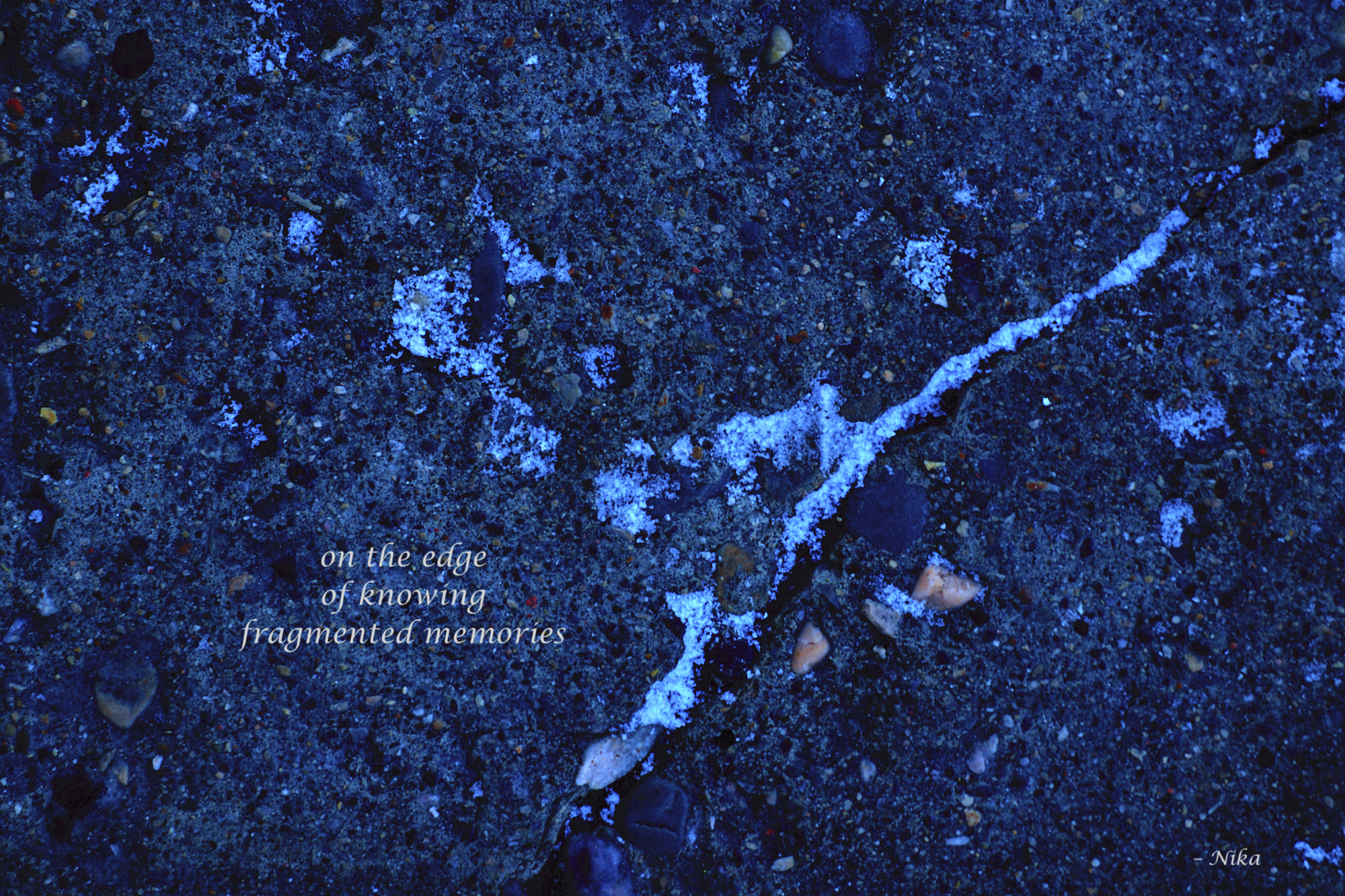
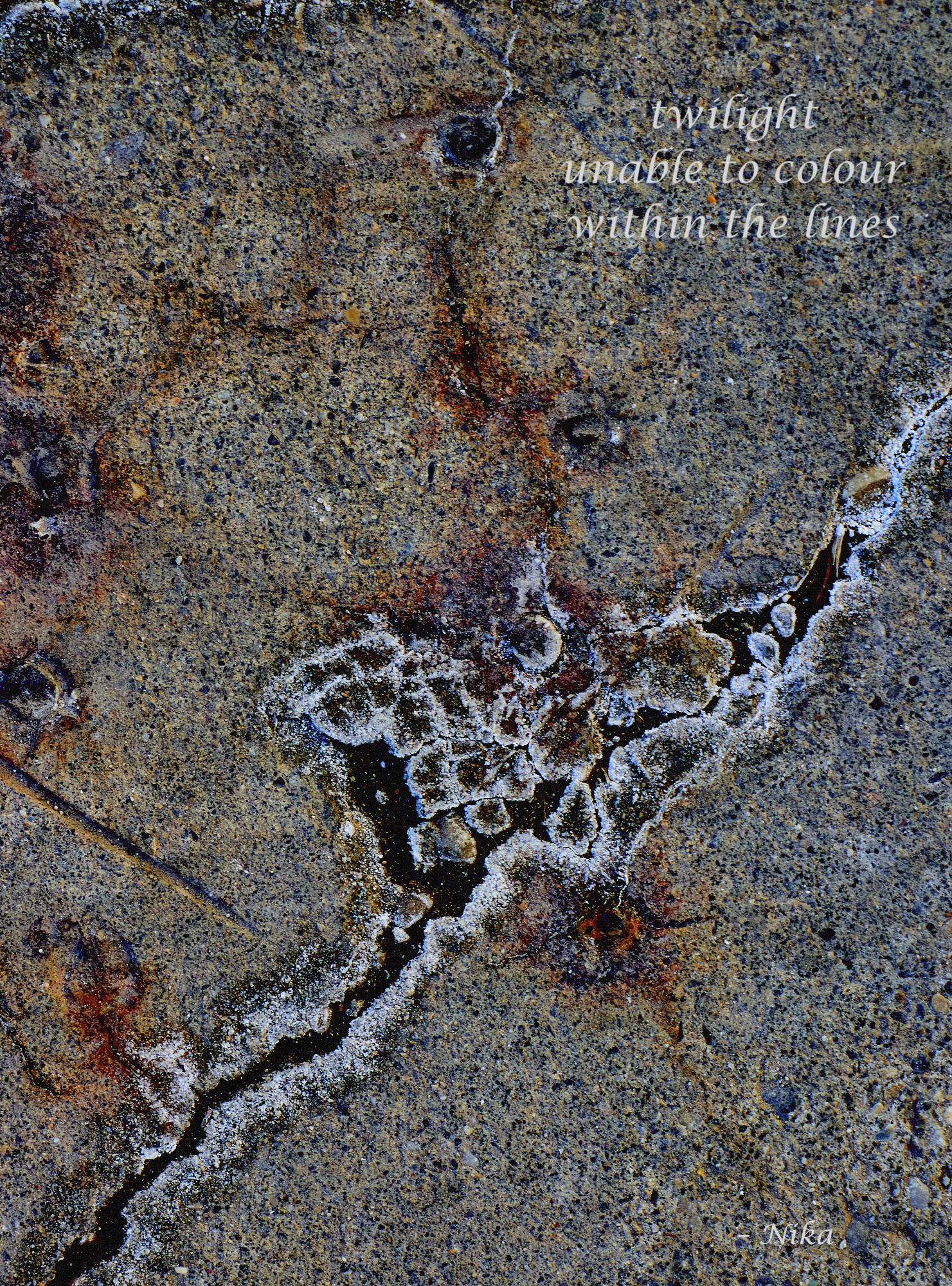
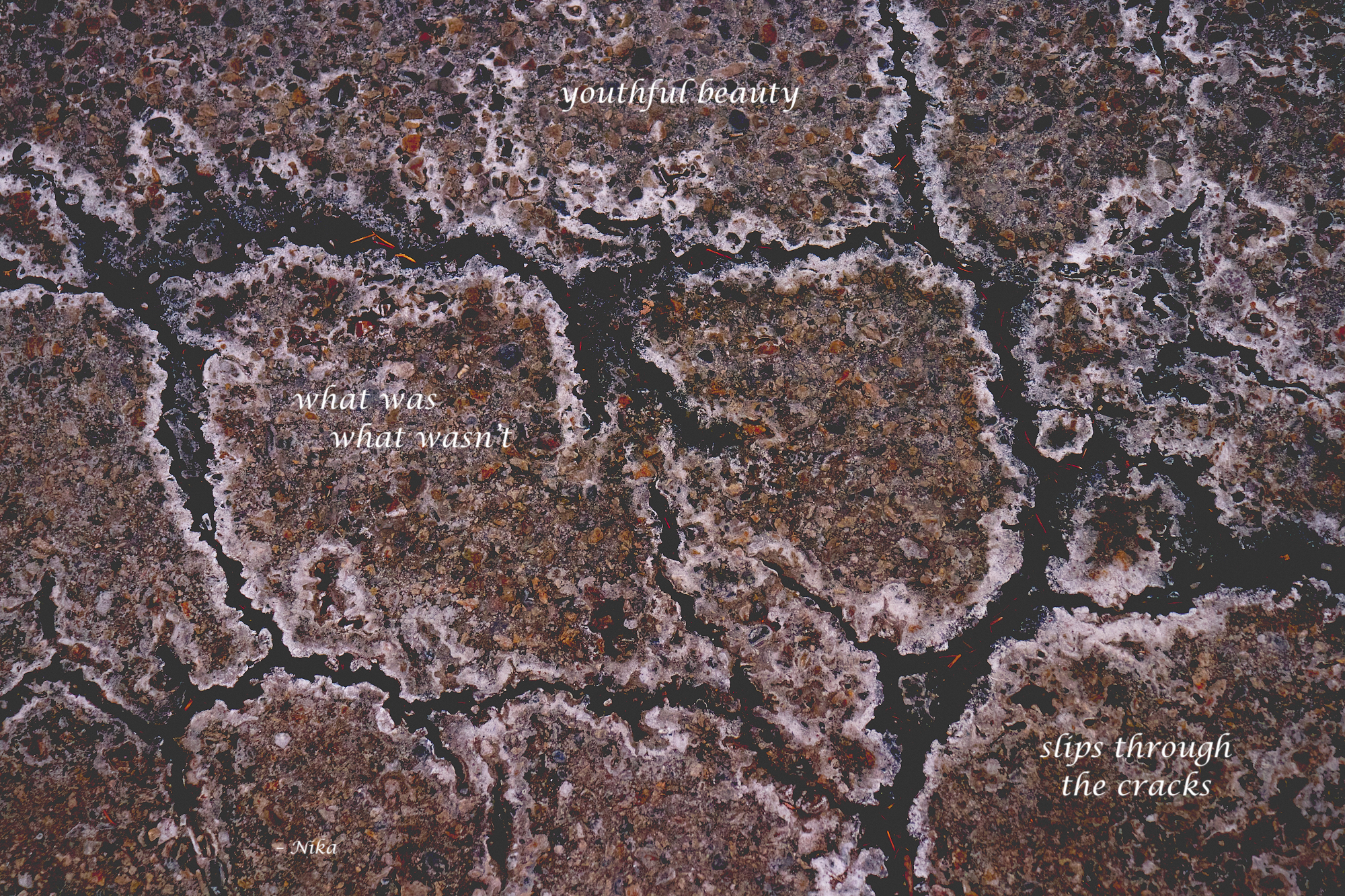
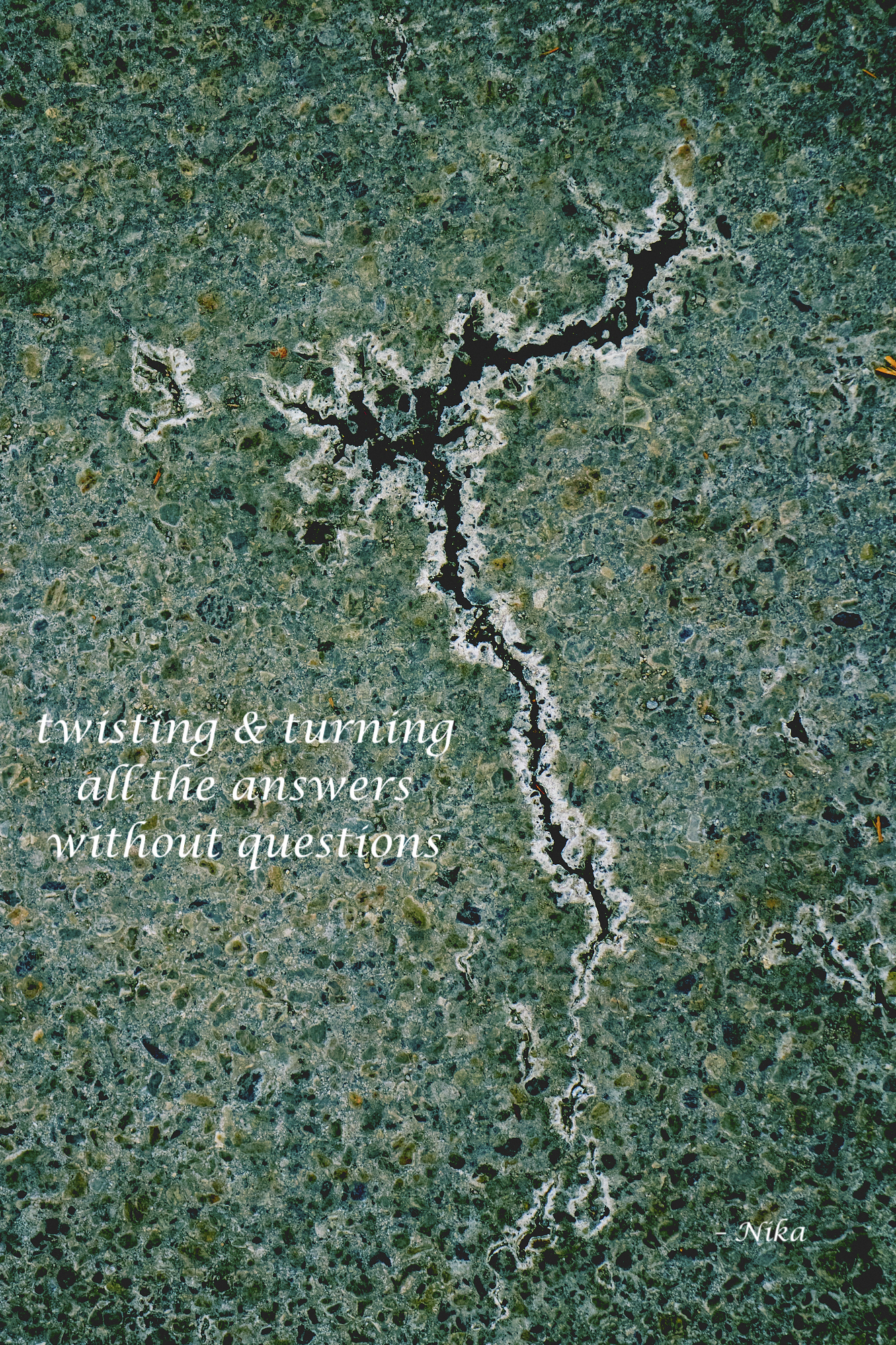
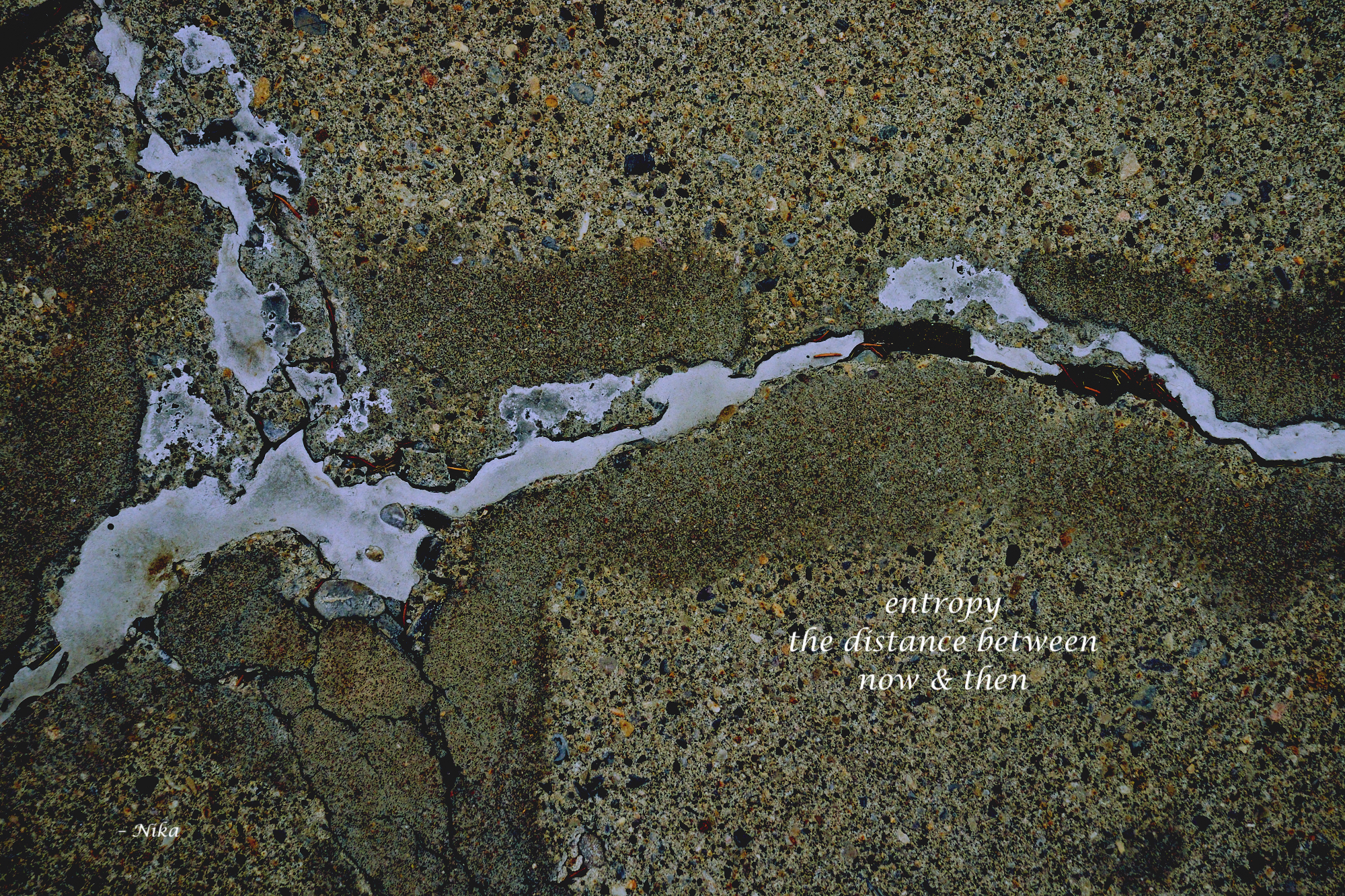
On the EdgeTwilightYouthful BeautyTwisting and TurningEntropy
Introduction/Bio: Nika is the pen name of Dr. Jim Force, a retired educator. He is a passionate haiku poet who combines his haiku with his passion for photography. Both haiku and photography reflect his minimalist approach to life in general. The images used in entropy are of sidewalk cracks that he encountered on his daily walks in his neighbourhood. Adjustments in exposure, dynamic range, levels and curves are the only manipulations of the images. Nothing has been subtracted or added to the images. He lives in Calgary, Alberta, Canada with his wife Colleen and their two cairn terriers.
The roar of the sea is in my chest

I hear the sound with my best

I am alone in an island

The sea is without water but sand.


Nobody is alive here

Dreams visit rare

Life sleeps in far

Everything cries in an empty jar.


Time is desert

I am without heart

Breath swims in the waste land

I walk with motionless hand.


I am right here for you

Everyday is same not new

Can you feel my pain?

Can you draw rainbow in the rain?


No water can remove thirstiness

Your sea is very vast and fearless

I am very tiny

This is an endless journey.
swamp

sounds at dusk

the moon and sea

in my palm —

they meet


campus laundromat

back and forth

graduates move

in and out


… life's cycle


gratitude —

practicing the art of war

morn after morn

i wake


to fake news


world atlas

a jigsaw puzzle

global event —

my country and I


not in attendance


clear

thinking

in the quiet storm

a calmness sits


rooting


vertically challenged —

the curve goes round

and round

the flying trapeze


somersaults


supper —

at the table

the long-lost aroma

of his late mother's

food


we say:

it is faith

through the sea of reeds

grebes dance


on water


sober

morning

breathing a new day

under the oak tree

i coexist


different time zone

celebrating

the feast of a saint

bowing low to the sun


to kiss her foot


Christina Chin / Uchechukwu Onyedikam
Dark Alley
By Sayani Mukherjee

The higher power is a dark realm
A pregnant egg of alluring fantasies
Laced with savages
Of nobility of muzzled openings.
I wish upon the cave
Abandoned ruggedly inspired
Diabolically and Divinely
Closed off stream of a simple stare
A sudden maneuver
Peeping slowly, hooking within
The black cuckoo is always nasty
Her songs, mythically beautiful
Tap dance within her bosom fare
Rides my homebody fevers.

An abandoned alley smudged between
Practicalities mundane
My paper knife to hold my worth
Sweepingly not to prove anything
Just a sullen sweet song
To lie beside me the lake house ground
To build nests
Green reds blacks ribboned whites
Ego death of survival guide
My womanly virtue vices
Boldness coyness
All dived down-
Under the cave the siren song
The dark alley
Allowing the evenings to drop down
Hushly steadily making no noise
The evening prayers
Higher powers
Dark coins
The woman, a dark alley.