
Poetry from Andrew MacDonald

Seasoned inductions

Drifts-in with clenched brow 
a hovered frost clear.  
It stands for dark streets 
their catchments 
marketed cards sing.  

The stilled winter scene 
resigns to shadows effective 
what forbids we praise it that
music to these ears 
it could not rinse in 
but elaborate for frames
eloquence withstood.  

Now there’s no place to call as own 
beyond what scene depicts 
and this its shallow friends—
solstice, snowman, if then birds—
all un-cheered, outcried
in solitary spring-fraught wish.


A room to labor

If comes prominence
its course is run 
in lit remarks kept sleek
these fastened nights that did.

But the shorted feast
clasps urge to rift
and brings a heart entranced
to levelled fields that mend 

that light as dusk bursts in 
and veers the gathering made 
to last-out careless breaths
a ribald company shapes,

sunk in soft knits
crisp allotments show
so that more, not less,
should beat the heart to quick.

These are both pieces that celebrate moments of encounter. They attempt to show a cohesiveness that can arise out of random events or spontaneous milieus.  


Seasoned inductions describes the randomness and chaos inherent in a winter scene and the profound effect on the viewer, in this instance regarding through well-ordered panes of glass.  The spontaneity of a storm is met through the comfort of a home. A room to labor is a chronicling of events, if planned or spontaneous but in many ways haphazard, that arise out of an initially discomfiting office party.  Again, it is the milieu that fashions encounter.
In both poems I have experimented with an ordering of lines that would indicate shifts in energy for the voice.  The degree of rhyme, itself somewhat a manner of synchronization, is only to serve this purpose.

Andrew Cyril Macdonald considers the role of inter-subjectivity in poetic encounter. He celebrates the confrontations between self and Other and the challenges that occur in moments of injustice. He is founding editor of Version (9) Magazine, a poetry journal that implicates all things theoretic. You can find his words in such places as A Long Story Short, Blaze VOX, Cavity Magazine, Fevers of the Mind, Green Ink Poetry, Lothlorien, Nauseated Drive, ODD Magazine, Unlikely Stories and more.  When not writing he is busy caring for seven rescued cats and teaching a next generation of poets.
Short story from Abdulloh Abdumominov

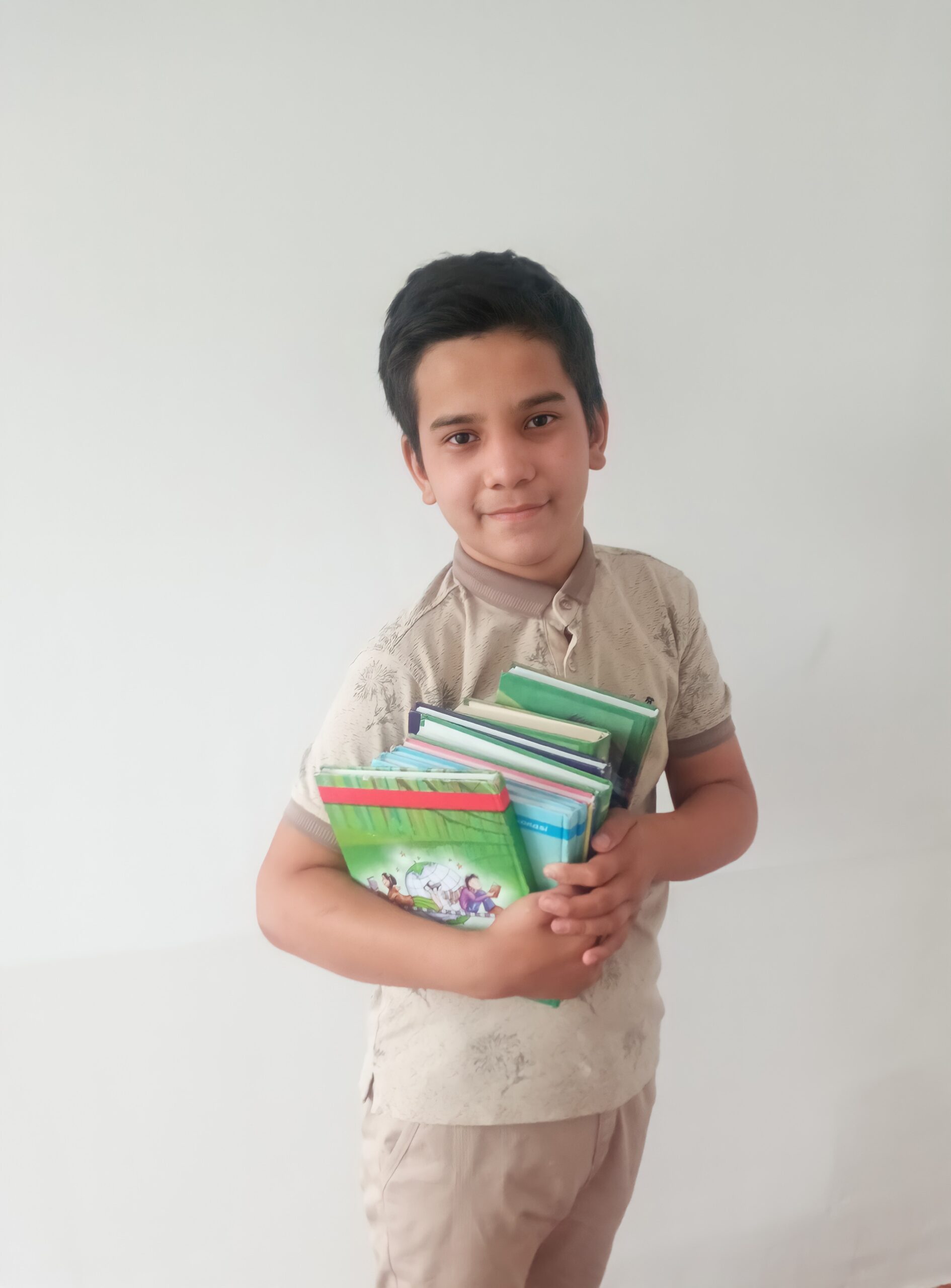
Boy with light skin and short brown hair carrying an armful of books
Abdulloh Abdumominov
The world of books

Books lived on a beautiful ground. Books controlled children to read books. The books were like family. They were upset that a child was reading a book. The boy's name was Ozodbek. He didn’t really read books. He was just tired of computer games. The houses were a mess, only computer games could be played. Books in the World of Books interviewed the Book Council with the intention of inviting him to read a book. 

The books worked hard. The child was sent to a dark room. There was a book on a table in the room. There was also a lamp next to the book. Ozodbek used to say, "I will not go there even if I die." Because he couldn't get a book at all! From somewhere he would say, "We have four conditions for you. If you fulfill them, you will go home, and if you do not fulfill them, you will remain in this darkness." Ozodbek, who are you? Why did you bring me here? 

There were more "meet the conditions" calls. In desperation, Ozodbek read the terms. He began to fulfill the first condition. The first condition was: "He must work examples from the science of mathematics." Ozodbek could not work the examples in the first. He could not solve the examples even with his hand. Anyway, there was no result. He was very sorry he hadn't read the book. Then he started reading the book from beginning to end, and he did it, he read the book. He then slowly began to solve the examples. He couldn't solve one example, it was the last example, because it was a very difficult issue. 

Ozodbek was playing on the phone when his teacher explained. It is not written in the example book. He thought, unable to remember. His friend Diyor had explained the example to him. Diyor's words were memorable. Ozodbek did not like his friend Diyor, he thought his friend was very smart. But, after that, he found out he was a good friend and solved the example. After solving the example, he was given awards from the world of books and a “congratulations” sounded. He moved on to the next condition. The next condition was very helpful to him. Because he had to introduce himself in some language. 

He had bought a book when the book market came to his school. At that time, Ozodbek received a lot of money from his father for the book. However, he had taken a cheap book and used the rest. But that book helped him. He taught the book German. He nodded and introduced himself. He also passed this condition. Those who could not get the books were amazed to see the change in it. Then the boy moved on to the third condition. The third task was difficult for Ozodbek. He did not pass this condition well. 

Because this condition was to tell the life and work of a writer. Ozodbek regretted that he had not read the book and had not listened to the teachers. This condition helped him. He hated learning about writers. But Ozodbek liked to study writers. And he was given the last fourth task. He was given a book, he had to read the book. As he read the book, his hands trembled and he cried incessantly. 

Because this book was written about a child who had never read a book ... He had read about the plight of a child who had not read a book ... Unfortunately, Ozodbek was sent home from a dark room. The world of books was glad that the boy was back to reading again. When Ozodbek came home, he cleaned his house and immediately began to read a book. After that he started reading books. Ozodbek left new impressions ... The world of books was calm. It all ended well.

Abdulloh ABDUMOMINOV,
is a 7th grade student at School No. 102 in Tashkent

Poetry from Jason Visconti

When Electricity Falls In Love

Something in the sockets so crazed that romance has dizzy dates,
For the wiring is false as soot and meaningless as lint,
Cables that hang in the air as if the sky arrived late,
A rod nipping the flesh until the tinge burns prints,
Explosives are the voltage of a lover’s fate.

Poetry from John Thomas Allen

The Dumbwaiter

Here she is, anything
can be asked of her
sea gravel underfoot.
Behind a guillotine before
the soda jerk opens it
to a glass vegetable spread
with cutlass smiles,
her mime complexion
in this 8mm photograph
to be still life beauty
before a night of trekking
because she only wants
to escape our plan
to move away from a Lady in a Lake
through dumb waiter
lobbies filled with hands
crawling to catch her
spilling voodoo guitar hands
The bug carnies sing
the same song,
but different as a melody
polished
by children with cancer,
or to brush
her filament wings as angel flutes
which can break the sound mirror
with a cough;
to share a tune
with black space,
and kinless troubadours
to light a wick
over their tents
so they can run back
with flashlights.

John Thomas Allen wants to be a cat man instead of a cat lady, thus engendering a gender revolution. He likes Christian tarot, JK Huysman’s, and Charles Wright. He’s been in Arsenic Lobster Journal, Sein Und Werden, and Grey Sparrow Journal.

Poetry from Joe Balaz

RIGHT ON KEIA


Wen you play 
dis crazy game

nutting is really da same

so you go easy, easy,
and be right on keia.


No freak ‘um out,
just blow kisses from da mouth,

and make dem realize
dat you know wat it’s all about,

right on keia 

half and half
hurricane and gentle wind.


Watch da leaves in da trees

and see da various degrees
on how tings stay gusting.


Read it all like wun map
and give ‘um right on keia

half and half
hurricane and gentle wind.


No even trip it,
moa bettah you HIP it,

so bebop da constant cop

trying to arrest
your innate sense of reason

and continue wit 
right on keia

half and half
hurricane and gentle wind.


Keep it level to da eye

even dough 
you stay up in da sky

and make 
da buggahs question why

dey no can bring you down.


Deah’s only one way to play,
as you move from day to day,

right on keia

half and half
hurricane and gentle wind.


right on keia        Keia means “this” in Hawaiian.
HIP                      Acronym for Hawaiian Islands Pidgin. 


Joe Balaz writes in Hawaiian Islands Pidgin (HIP) and in American English. He has also created works in visual poetry and music poetry.  He is the author of Pidgin Eye, a book of poetry.  Balaz is an avid supporter of Hawaiian Islands Pidgin writing and art in the expanding context of World literature.  He presently lives in Cleveland, Ohio.

Poetry from Edwin Olu Bestman

Postcard from the heartbreak residence 

too many times, i have lay on my bed for a girl who doesn’t understand the worth of my tears.
how can a camera man keeps taking many shots of me & there’s no proof to show my existence? 
i believe i am just another sad nightmare getting used to viewing myself through broken objects. 
i remember when i prayed for her kingdom to come like the bible teaching us to seek first the kingdom of God & everything shall be added to it. 
i have done many things to her body: i asked & nothing was given. i sought & nothing was found. & i knocked but her body refused to let me in. 
this room of mine no longer knows her name. i have burned pictures of her drawn on my pillows, bedsheets & curtains.
once she was a river where i could swim for days. but she transformed herself into an ocean where i fell before her feet. 
i still do remember the love we held. of kisses & touches we shared on my father’s back porch. 
i still do remember those long conversations, those long walks & cold night hugs.
right now, there’s no history of her in my cellphone: whether received, missed or dialed calls. 
i have regretted of singing her back to sleep & blessing her tongue with rich ingredients of salivation. 
it was a sinful love affair. i pray & promise to never give myself whole or enough to a girl.


Biography: 
Edwin Olu Bestman, poet and engineer, writes from Monrovia, Liberia. He has co-authored several anthologies and the author of two books, Genesis and Raindrops. His works have been featured in Ducor review, WSA, Spillwords, Odd Magazine, African Writer Magazine, Agape Review, Eboquills, Literary Yard, Poetry Nation, Ngiga Review, SIM, Nantygreens, Sipay Magazine, Afritondo, Rising Phoenix Review, AfroRep Journal, Madness Muse Press, Rigorous Magazine, Arts Lounge, Fiery Scribes and elsewhere.

Poetry from Ian C. Smith

Foreknowledge

My mind drifts to arcane words, then I read,
turn pages, find them waiting for me there.
Are these eerie messages I should heed?
Chance?  A higher power, malignant, fair?
Loose thoughts alight on out of contact friends,
presaging their emails in my Inbox
banjaxing me, more disturbing godsends
nearing my final act, hands circling clocks.
In these times of surveillance, a feeling
of being monitored persists, a weight,
also, mumbo-jumbo’s cant, this reeling
from sense for one dubious about fate,
yet I like the image of shadows cast
by guardian angels’ wings.  Safe at last?
                    **************

                                                  
Their Names

Daydreaming of youthful trove’s cloth of gold,
I can’t recall the name of an old flame,
names’ past mode gentle, today’s, blazoned, bold.
I see her, hear her voice, this long-gone dame.
Stab in the dark searching keeps us apart.
Stymied, my tired brain reaches impasses.
I tick off the alphabet, letter smart,
cease rummaging, revisit schools, classes.
Alma, Beatrice, Cassandra, Diane,
Elvie, Florence, Gwenda, from days sublime,
Helen, Irene, Judith, her golden tan.
Katie, Lorraine, Meredith, down through time,
names’ threnody, faded array of choice.
I think that haunting flashback dame was Joyce.

Biog:  Ian C Smith’s work has been published in Antipodes, BBC Radio 4 Sounds,The Dalhousie Review, Griffith Review, San Pedro River Review , Southword, The Stony Thursday Book, & Two Thirds North.  His seventh book is wonder sadness madness joy, Ginninderra (Port Adelaide).  He writes in the Gippsland Lakes area of Victoria, and on Flinders Island.