“Who needs atheists?” he said. “ ‘We
do not believe in God’? Well, I
don’t b’lieve in your blessed humanity.
The sooner humans are wiped out,
the sooner the rest of us can rot
in peace.”
I was intrigued, if startled. Cool,
he looked, rational, serene.
He smiled wanly. But it was no joke
to him, I could see. Nor did he preen
himself on his intellect or heart,
his courage to face the monstrous worst.
“We are, to put it bluntly,
the condign damnable Nazis of the earth,
her Kozentrationlagers’ kommandants,
her curse.” He looked grimly
around at the rumpled bustling street.
Translated by Keith Ekiss with Sonia P. Ticas and Mauicio Espinoza
Tavern Books
66 pages
$17.00
A review by Christopher Bernard
There is a compulsive uneasiness to being a poet in the contemporary world. He (or she) has little place in a society that only respects makers of goods or providers of services that can “turn a profit.”
But poetry has little place in a market economy; neither the work itself nor any way of presenting it can make enough money to provide a poet with even a modest living, let alone anything like a fortune for himself or his publisher. And, as we all know by now, if your creativity can’t leverage you, at the very least, a few million in investments, with a hundred mill in loans, for the transparency of a billion in mid-term prospect (a modest enough ambition in the world of globalized twenty-first century capitalism), what real value does it have?
Because to be a poet in the modern world means knowingly and deliberately to choose a life of almost indecent poverty, or at best a tight little corner in the dwindling middle class doing something that does not deprive the poet of the time, energy and emotional and intellectual freedom to make the poetry that gives his life meaning. Poets keep the wolf from the door by doing something—anything—else.
In even the recent past, the respectable poverty of the poet was mitigated by respect, even fame: the poet was the voice of his people, of their hopes, loves, defeats, victories, during the great period of nationalism of the nineteenth and early twentieth centuries. The poet wrote his people’s love songs, laments, elegies, odes, satires, lampoons, manifestoes, gibes. People loved and admired their poets; they quoted favorite poems to themselves for pleasure and consolation. They found in poems the words they could not find for themselves.
Gratuitous piece of poetry from a regular contributor, posted today in preparation for the upcoming January issue, which goes live at midnight PST tonight. Please enjoy!
Last Day of 2015
By Christopher Bernard
As in any other year
each day the sun rose, it set.
Mothers, friends, partners, lovers,
after laughing at us for longer than we cared to remember,
vanished overnight.
Where they used to be now is a hole in the air.
The monarch butterflies move in mists of wings
across the plains between Canada and Mexico,
rain takes a stroll across parched California,
and the moon glows down on everything on the earth.
The snow lines the pockets of the mountains with rebukes
as sharp as memories of kitchens on winter mornings.
A crocus breaks through the whiteness, a small pink fist,
sleek as rebellion, calm, deceptively delicate,
wagging in the wind.
Your partner is ice, hollyhocks, poppies.
Your lover is a fox hiding under a felled cedar.
Your mother is the wind.
Every day the sun set, it rose.
_____
Christopher Bernard is author of The Rose Shipwreck: Poems and Photographs. His poetry can be read at The Bog of St. Philinte.
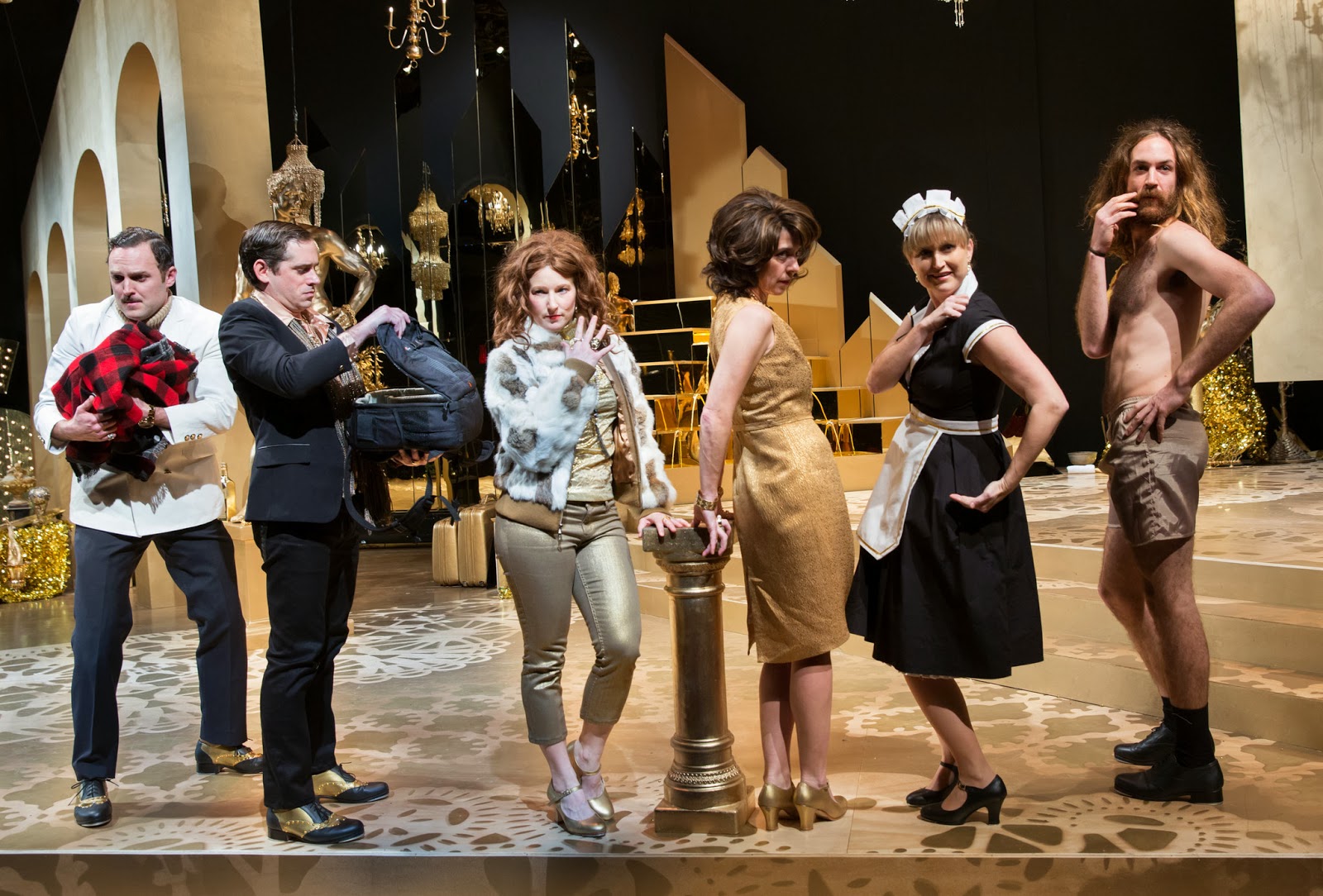
Cal Performances brought Austin, Texas’s zany theater collective Rude Mechs to Berkeley for a weekend of their 2014 New York hit. And a hit it was, hitting me, at first silly, then awake, with its brainy provocations, savage wit, and the cruel tickle of truth.
The show is an inspired combination of a classic Hollywood musical, a pithy allegory on contemporary mores, sudden outbreaks of wacked-out dance routines, witty seductions into audience participation, moments of unexpected confessions by the cast, and a fable on the inner conflict, at the heart of American life, between today’s brutal culture of narcissism, rapacity and greed and ancient ideals of selfless love, kindness to neighbors, the sanctity of nature and the basic decency of the common man and woman.
Yes, I admit it! All my previous girlfriends were right. It was, in fact, all my fault.
I reach this conclusion with the deepest reluctance, even embarrassment. It’s a horrible responsibility to have to confess to. It came as a surprise, even a shock. But one day I stumbled on it, staring me in the face. And ever since, it has never left me in peace.
I had always believed my sins were, at the worst, venial—I mean, I’ve never stolen, or robbed, or knowingly cheated anybody. I don’t do drugs, I drink in moderation, I stopped smoking ages ago.
I’ve never killed anything bigger than a mouse, and even that I mourned as, unable to save it, I watched it die miserably in a roach trap.
My lies are the innocent kind (“Doing great. How about you?” “No, it does not make you look fat”).
It’s true I have an occasional fit of uncharitableness, but as a rule I bend over backward to be fair-minded and I don’t discriminate against people based on race, sex, gender identity, mental health, financial status (well, I have problems with the super-rich, but I don’t think I’m alone in that), nationality, religion—whatever.
The Unheard of World. Joan Howard pictured center. Photo by Robbie Sweeny
(IN)COMPLETELY ABSURD
The Unheard of World
By Fabrice Melquiot
Translated by Michelle Haner
Exit Theater
San Francisco
A review by Christopher Bernard
Even with the best of intentions, to say nothing of energy, intelligence and talent, world premieres can be treacherous things. The premiere of an English translation of a modern French play can be more treacherous than most, given the great differences of premises and expectations between French and American audiences—including such things as their different senses of humor and attitudes toward philosophy, which can quickly become awkward in a philosophical comedy.
The latest production by one of San Francisco’s most audacious companies, foolsFURY, which in October premiered, as part of its Contemporary French Plays Project, Michelle Haner’s translation of Fabrice Melquiot’s magical realist Le Monde inouï is a textbook case. (Melquiot is a prominent contemporary French playwright; foolsFURY produced The Devil on All Sides, in artistic director Ben Yalom’s translation, to much acclaim in 2006.)