Christopher Bernard on the Aurora Theater Company’s production of Amy Herzog’s After the Revolution


“Après moi, la revolution . . .”


After the Revolution

A play by Amy Herzog

Aurora Theatre Company

Berkeley, California

Extended through October 6


A review by Christopher Bernard


One of the lessons of the 20th century was the delusory successes, and persistent failures, of our major political systems, including liberalism and capitalism, and the absolute horrors wrought by what seemed to be the only alternatives, the class collectivism of the left and the racial collectivism of the right.

Now we stand in the early 21st century, the best of us confused, others stymied, the worst fanatical. We all seem to have been wrong, though some have the learned the “collectivist” lesson too well – “overlearned” it such that we have driven ourselves to a bloody-minded individualism with most of the blood on foreign shores, and, at home, ignorant brains and addicted bodies, bloated self-images, a raging sense of entitlement, a culture of self-deception, and spirits cynical and half-criminal; a spirit of “sinister giddiness” dancing drunkenly across the land.

We have forgotten the moral idealism, some of it deeply inspiring, even when based on shaky premises, of some of those movements we have turned against, in particular, the socialists and communists. It is still difficult for us Americans to speak sanely and rationally – well, about anything, really, but especially about communism, equating it, as we now usually do, with the worst depredations of Lenin, Stalin, Mao Zedong, Pol Pot, and their ilk. And we are not entirely wrong to do so – except that we forget that the communists in this country, were among those who fought most strongly for the rights of the working man, and, ultimately, the middle class, during the Great Depression, and saw most clearly the dangers of fascism in Europe and at home.

Without the communists, the socialists, the trade unionists, and other members of the radical left of the ’30s and ’40s, we almost certainly would not have the New Deal safety net that the middle class takes for granted today – nor in all likelihood would we have a middle class, despite the neoconservatives’ attempt to destroy it over the last thirty years.

But now we have an opportunity to revisit those issues, and remind ourselves of what we have almost lost, thanks to this enlightening, honest, morally engaging, politically dynamic, intelligent and humane, and very satisfying, play by Amy Herzog, a playwright who is in serious danger of giving the battered and often disdained values of intelligence, good sense, humanism, and moral probity back their good names.

“After the Revolution” – a revolution that, pointedly, never happened – examines three generations of the sort of American family that is rarely shown in popular culture, vociferously political, outraged at the world’s evils and refusing the temptations of moral disengagement, steeped in Marxism and the traditions of the radical left. Emma (played admirably, and endearingly, by Jessica Bates), of the youngest generation, has created a fund, named after her admired dead grandfather, for left-wing causes. The grandfather, who has given his family a memory and legacy of moral integrity and political heroism, was an active communist in the ’30s and ’40s, and a martyr to the McCarthy hearings in the decade following. A series of revelations then ensue, that force the smart, idealistic, forthright and thoroughly likeable Emma to explore, excruciatingly, her family’s past, and the complex of truths, half-truths, and lies, on which she has based, not only her understanding of herself and her world, but of her past and her future.

This play does what the modern play, at its best, can do so well: confront the audience immediately, under a probing, sometimes stark, but never gratuitously harsh, lamp, with the moral, social, and political dilemmas of being a human being at our time, and in our place. The problem play invented by Ibsen lives on and shines.

The relationships in the play are developed with a fine acuity – in particular, between the grandmother (superbly performed by Ellen Ratner), who, like many of the Old Left, remains, at heart, something of a Stalinist, in denial of the revelations of what “Uncle Joe” did throughout his time in power. And the relationship between Emma and her sister, Jess, a drug addict constantly in and out of rehab, provides the play’s most endearingly bizarre laughs. (The druggy, uncensored sister is caught very well, with only a few over-the-top moments, by Sarah Mitchell.)

But the central relationship is between Emma and her father (performed by Rolf Saxon with just the right amount of flaming indignation and helpless bafflement at the moral bind he is caught in), and on this the drama mainly turns, like a door on a hinge. And this relationship – and it is refreshing to see a modern relationship between father and daughter depicted as based on genuine respect and love – shows how even the deepest love between people can trick us into the kindest, and yet most dangerous, temptation of all. Nothing threatens honesty, integrity, truth, so much as love – because love can seem at times, not only to condone, but to require, lying. And this is not only true in family politics, of course, but in politics at large. Because the lies of love of the left have remained with us so foul that, for some, they have fouled that love – a genuine love of humanity and pity for its sufferings – itself.

Someone else who must be mentioned is Peter Kybart, who plays one of the donors to Emma’s fund, a fellow-traveler from decades back, who does not quite understand the depth of Emma’s dilemma, and brushes it off with a breeziness that displays not so much cynicism, as a lack of understanding of the real issues involved (this is one of the play’s weaker moments, as Emma seems too easily persuaded). A further weakness is Emma’s romantic relationship, which unravels with implausible speed as Emma sinks deeper into despair, because of the moral dilemma she finds herself in. The somewhat thankless role of Emma’s lover is ably done by Adrian Anchondo. Emma’s apolitical uncle, a necessary counterweight to the sometimes hopelessly unrealistic political flights of the rest of the family, is played with staunch (but, unfortunately, unexplored in the play) good sense by Victor Talmadge. The fine direction is by Joy Carlin, and the clever, imaginative set by J. B. Wilson.

This play really should be seen by anyone involved in left-wing politics now, or in the last century. And indeed, by anyone who cares about the political prospects of compassion in the cold, bloody early decades of this one.


Christopher Bernard is a poet and novelist living in San Francisco. He is author of the novel A Spy in the Ruins and a book of poems and photographs, The Rose Shipwreck. He is also co-editor of the webzine Caveat Lector.


Poetry by Christopher Bernard


 Drone pilots in training


Citizen Taxpayer

By Christopher Bernard


Every April he paid his taxes

(by mail, years ago—today, by the ’net –

he was law-abiding, innocent,

responsible, dutiful, no slacker, not lax, is

our upstanding taxpayer)—

and a penny went


into the hand of a homeland spy

who collected his emails,

tapped his phone,

followed his clicks on the worldwide web,

and saved them forever on servers in a mountain

in the gut of the Rockies, to make him (he said)

safer from the enemies of the United States,

“even if they’re me” (faunlike, nerdlike, he grinned).


The taxpayer, uneasy, returned his grin.


He didn’t mind, no, he got it, the need

in a warlike time

for deeds like these:

security required less liberty.

He had nothing to hide—

oh no, not he!

He wasn’t guilty,

though he felt mildly terrified.

Then he thought, “But that’s what

they want us to be!

The terrorists, that is.

They want us to be horrified, scarified, terrified!”

And he felt properly edified, dutified, mollified.


A penny went

to a caterer in Livermore,

and another to a weapons maker’s part-time chauffeur,

a penny to a Homeland Security clerk,

another to a therapist of a faceless veteran

(his face had been blown off on a road near Najaf),

a penny sequestered

the winter before.


And the taxpayer nodded

shrugged, grunted, and sighed.

He grumbled, “There’s a war on,

it’s not played like canasta.

They want to kill us,

so let’s first kill them.

What would you do, huh?”


A penny went

into the pocket of a drone jockey

who showed his mojo in the snowy state

better than at the local bar,

where he was known to play none too shabby or shoddy darts,

by crashing wedding parties in the Yemen hills

8,000 miles away into a thousand body parts.


A penny went

to the pension of an enhanced interrogator

who, under W., tortured Khalid,

and persons of interest in Waziristan and Kut,

and lives, under Obama,

anonymous, retired,

on the farthest flung of the Florida Keys.

A penny went

to the SEAL who killed bin Laden,

a penny to his boss, his ace buddy, his driver,

to the helicopter pilot who dropped him at Abbottabad’s savage gate,


a penny to a special op at Lahore,

a turned jihadist in Somalia,

a janitor at a black site in Iraq.


A penny went

to a recruiter in Davenport,

Tracy, Laramie, Charlotte,

Peoria, Duluth,

Boise, Stockton, Detroit,

to collect young men and women

“to teach them to kill for me.


Because I pay them.

I pay them all.

I am their paymaster, their leader, their boss.

They do what I pay them to do.

I am Taxpayer.

And what I pay them to do is to kill.”


And he bravely clicked Send My Tax, next April.


_____


Christopher Bernard is a poet, novelist, and essayist living in San Francisco. He is author of the novel A Spy in the Ruins (www.regentpress.net/spyintheruins) and co-editor of the webzine Caveat Lector (www.caveat-lector.org).


Poetry from Christopher Bernard


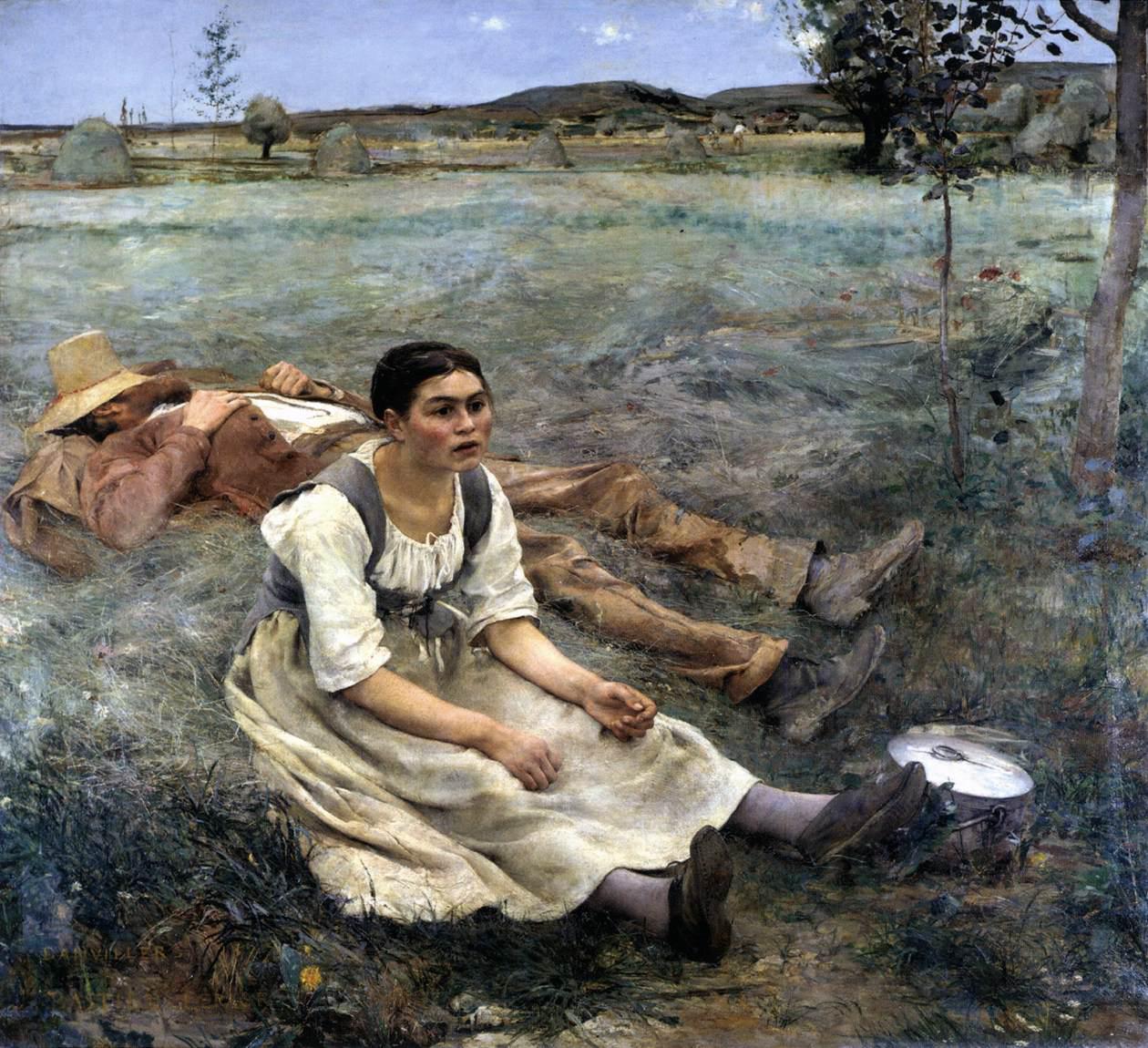
"Haymaking" by Jules Bastien-Lepage


Haymaking

by Christopher Bernard


It’s a big picture. It appears to be dead noon, under shrilling grasshoppers.

The heat looks as heavy as a vice.

Off center, a peasant, wearing a pair of
eloquently battered boots, dozes under his hat.
A metal pail that once held a mid-day meal
pewters dully in the weeds.

Straw-yellow grays ride up to a line of hay ricks,

low hills, a sky pocked with little clouds.


A woman sits by the peasant’s side, slouching forward,
half asleep, awkward, unaware of the observer,
for a moment lost in a wild country of thought
that fills her thick features,
her surprised and dismayed black eyes,
with . . . well, what might it be?
shock?
fear?
an unexpected, and unwelcome,
discovery? –
Whatever it is, it came to her as she drifted asleep,
and thrust her awake with astonished pain.

There’s no way to know: the painter has told us

only what we see.

We know nothing but this fragment,

nothing before and nothing after –

a quick snapshot in oil


on the magisterial canvas.

Then it’s gone.


You step back into the museum crowd,

and her blind, wondering face,
frozen on canvas for as long as the canvas will last,
disappears behind a wall of cloth and backs
into the gallery’s subdued glow,
and the sounds of shuffling feet,
and the bored, suspicious gaping of the museum guards,
and the scratching scratching scratching on paper pads of art students. . . .

It does not disappear:
it follows you out, into the sun,
nagging, futilely, yet with an odd sweetness –
you ponder the woman in the picture as you might
the most obscure philosophical questions,
the metaphysics of loss, the holiness of unknowing,
or a lover’s impenetrable enigma:

a strangely enchanting question that has no answer.


Christopher Bernard is a poet, novelist and critic. He is author of the novel A Spy in the Ruins (http://www.regentpress.net/spyintheruins) and the founder and co-editor of Caveat Lector (www.caveat-lector.org).


‘The Rose Shipwreck,’ poetry from Christopher Bernard


The Rose Shipwreck

By Christopher Bernard

Such a shipwreck of flowers – a petaled wreck
on an azure sea, of blood-red salmon 
stained with peach, with a steady clear
tolling of deep bells under a sheer blue sky
half-deafened in the gale – flowers staining
 
the sea in disintegrating color, like the heads of children
drowning – and the magnificent ship slowly dissolves
in the whirlwind of its wreckage,
a dream of itself, a littering of its losses
to wind and tide, a fatal cry of roses
brimming its mouth – the thunder heaves a shout,
and the sea rumbles like a vast
train in a tunnel – a flare of lightning
disappears, silent as the shipwreck sinks,
spilling its wreckage across the white floor
of a seasick ballroom, bales of flowers
splitting till the petals cover the wastes,
like the Roman’s feasters, drowning them in roses.

The ghost of a sea swallows the ghost of a ship
under the ghost of a sky: listen, you can hear them,
the ancient sailors singing like the sirens,
calling you to sea – to sea – to sea –
steel gray, enamel blue, and white with foam,
to join the ships that blossom like so many roses
and scatter their petals as they perish, and drown, and sing,
like them, calling the next generation
to sea – to sea – like us – well? will you brave it?

will you build your ships of roses and brave the sea?
or is its storm a terror worse than childhood’s,
not to be escaped, the waves and wind
the white of a cage, the ice and snow cold bars
in a burning sky that seals the world and twists
down on our heads even as we heave
out into the open sea, our white sails out
like butterfly wings, our hopes so many hooks
the wild sea can catch and hold us with,
like love itself, a bark, a cage, a brand?

Shall we build our ships of roses and brave the sea,
that rose of fire, garden where winds take root 
and grow into forests?
Though night is coming, shall we aim our bow toward the dark,
though the storm is coming, shall we spot the thunderhead
and steel our sheets till they thrum in the underwind
and the water flails and hisses over the bulkheads
and churns and cries and crashes in our wakes
like an arrow thrusting us ahead, to sea,
to sea, far out, pushing us till we fly
into the storm? Shall we build our ships
of roses? Shall we flower over the whirlwind sea?


Christopher Bernard is a poet, novelist and critic living in San Francisco. His novel A Spy in the Ruins was published by Regent Press (http://www.regentpress.net/spyintheruins). He is also a co-editor of the literary and arts webzine Caveat Lector (www.caveat-lector.org). “The Rose Shipwreck” was originally published in Caveat Lector.

Christopher Bernard reviews Jean Cocteau’s La Belle et la Bete


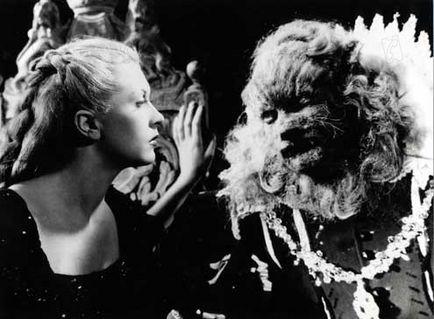
Josette Day as “Belle” and Jean Marais as “the Beast” in Jean Cocteau’s La Belle et la Bête.


GIVE ME BACK MY BEAST!


La Belle et la Bête

An Opera by Philip Glass

(based on the film by Jean Cocteau)

The Philip Glass Ensemble, with vocal soloists

Conducted by Michael Riesman


To celebrate Philip Glass’s 75th birthday, the Philip Glass Ensemble came to San Francisco to perform the magisterial minimalist’s opera, La Belle et la Bête (“Beauty and the Beast,” based on Gabrielle-Suzanne de Villeneuve’s celebrated fairy tale).

What makes this work unique is not that Glass based his work on a film; he had already done so with the first of a trilogy of works based on work by the unforgivably talented, unapologetically gay, and compulsive appropriator of surrealist gestes, Jean Cocteau: the chamber opera Orphée.

Here he went a good deal further. He stripped out the entire original soundtrack (which took some gall, as it’s a very fine one, composed by Georges Auric, an original member of the bad boys of French modern music, “Les Six”) and replaced it with an original score, with singing parts for the original spoken ones, the entirety performed live as the film is screened overhead.

And he chose a nearly perfect source, as Cocteau’s 1946 film – with actors Jean Marais, Josette Day, and Raoul Marco, and handsome camera work by Henri Alaken – considered by many critics to be Cocteau’s masterpiece, is a work itself of near-operatic fantasy.

What might have turned out to be one more lamentable exercise in postmodern kitsch is a near-masterpiece, a posthumous collaboration that would probably have tickled the ever-experimenting Cocteau.

The story is almost too well known to recount, yet is told with a few fresh twists: Belle, a Cinderella-like figure, is scorned and exploited by her two wolfish sisters and ne’er-do-well brother, though doted on by a father oblivious to his daughter’s misery – Belle is an unwittingly willing victim, in which those who love her, and even she herself (through an ideology of self-denial that reinforces the victim’s weakness and the power of the dominant – sound familiar?), comply in her servitude. She has a lover, a companion of her irresponsible brother, whom she refuses to marry because she feels bound to take care of her oblivious father, who allows Belle to be bullied and exploited by her two older sisters, who intend to get married and out of the household as soon as they find victims – er, husbands.

The father goes off to the city after promising Belle he will bring her back the only thing she asks for: a rose. After a business venture goes badly awry, he rides back home through a forest at night, where he discovers a magic castle, magically alive, which he enters and is served a feast by magical servants. Later he visits the castle’s garden, where a rosebush blossoms. Remembering his promise, the old man plucks the loveliest rose for his daughter. Upon which the prince of the castle, a hideously deformed monster (in the film, he looks like a giant cat, with sensitive ears that telegraph his feelings, perking him up when he says a prey for his next meal in one of the film’s deftly humorous touches), appears and tells the old man he has committed the one crime that is unforgivable in that castle, and now must die. The old man pleads for his life, and the monster relents, telling him he can go home to give the rose to his daughter, but only if he promises to return.

Once the old man is home again and tells his children of his plight, Belle refuses to let him go back, and goes in his stead, to face death as punishment for her father’s crime. But the monster, upon seeing her, falls instantly in love and instead of killing her, imprisons her in his castle and begins to woo her, even though he is aware that his hideous ugliness makes it impossible for anyone to genuinely love him.

Some men feel a curious self-contempt when they become aware of the strong physical feelings they have for women they admire and love; this story works well as an allegory for this, in an age that likes to pretend it is beyond such callowness.

The film, while never losing its fairy-tale quality, never falls into camp or archness, satire or over-sweetness, even at the dangerous happy-ever-after ending: it has a darkness, a fadedness and grittiness, that gives it, for all its fantasticality, a hardness, an actuality – like any poem worth its salt. This helps make the film’s final transcendence peculiarly credible and moving. Never has wishful thinking had a kinder, more eloquent advocate. (Though the final transformation of the Beast into a prince has disappointed some; is fabled to have made even Marlene Dietrich cry out, “Give me back my Beast!”)

Cocteau, who had made only one film before this one, in 1930, the surrealist classic Blood of a Poet, had refined his cinematic technique so that he knew just how much magic he needed to create in his world: disembodied arms holding candelabra in darkened hallways, disembodied hands pouring wine into the old father’s goblet, the masklike heads carved into the fireplace mantel shifting their eyes in curious glances at the innocent human partaking of his magic fare without so much as a question, Belle moving down a long corridor wafted by curtains blowing from floor-length windows, on invisible wings, without stirring her dress or seeming to move a shoe.

Joining Cocteau’s magie, douceur et poésie is Philip Glass’s. The signature style of the master musical stylist of our time is much in evidence. The essentials are all there: a steady rain of eighth-note ostinati, with the occasional long arpeggio, broken unpredictably by stately static chords; a steady house-music like pace that rarely varies over the 90 minutes of the work; continuous harmonic variation; and a keen sense of orchestration, which his ensemble, which includes several keyboards that can produce a theoretically infinite number of different sounds, makes possible.

Glass does not always avoid the danger of monotony, though what is remarkable is that he fails so rarely. He does this by constantly varying the melodic shape of the rhythmic ostinati and rarely allowing the music to sink into a groove of exact repetition except where such figures work to create a feeling of oppression or suspense. The singing lines are not arias but quickly paced, almost conversational lyrical recitatives, which cut through the ostinati like shards of roughness through what is sometimes an excessive smoothness of musical texture.

One peculiarity (noted by Romancha Pralapa) is that the original film is 94 minutes long, but the opera is only 90 minutes, as Glass, when composing the score, seems to have used a version of the film projected at too fast a speed. The result is that the performers in the film act and speak at just slightly too brisk a tempo, which has the effect of making the film seem a little like old-fashioned screenings of silent films before modern projectors were able to project them at the originally intended speeds.

The Ensemble has this music in their blood and clearly love the score. The admirable singers were Gregory Purnhagen, Hai-Ting Chinn, Marie Mascari, and Peter Stewart.

The opera was performed, as part of San Francisco Performances, at Yerba Buena Center for the Arts’ Lam Research Theater.

Christopher Bernard is a poet, novelist and critic living in San Francisco. His novel A Spy in the Ruins was published by Regent Press (http://www.regentpress.net/spyintheruins). He is also a co-editor of the literary and arts webzine Caveat Lector (www.caveat-lector.org).


Christopher Bernard on Words and Places: Etel Adnan (California College of the Arts)

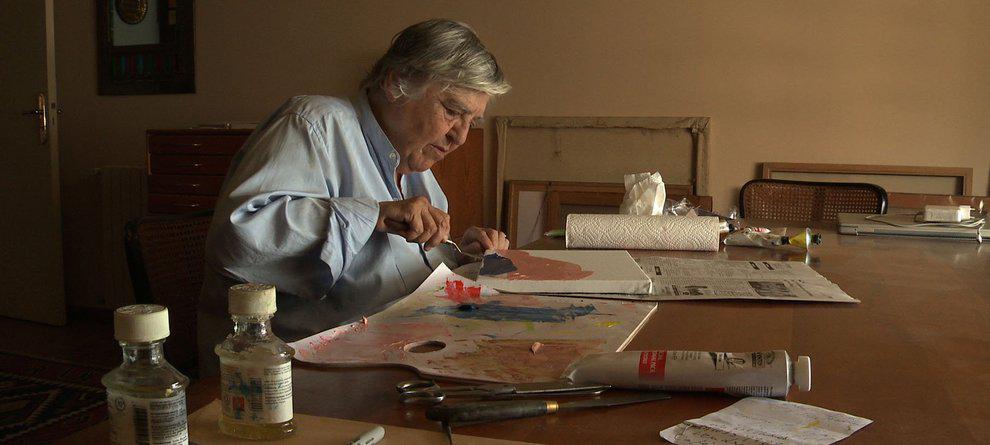
Etel Adnan @ Work

Why is a Solar Ray Burning My Eye When the Sky Still Lies in Ice?”

Words and Places: Etel Adnan

California College of the Arts Wattis Institute for Contemporary Arts

Through June 29

A review by Christopher Bernard

This retrospective of the artistic and literary career of the Lebanese artist, poet, novelist, essayist and journalist Etel Adnan is a major event, not only for the local art and literary community, but also for members of the Middle Eastern diaspora in the San Francisco Bay Area, and for the many, displaced by conflict and war, who have had to bestride cultures in an attempt to maintain a complex identity in a constantly and often violently changing world. Etel Adnan’s resilient spirit, her vitality and warmth, glow in the work like a tough flame.

San Franciscans are fortunate to have this wide-ranging exhibition of drawings, paintings, poetry, videos and films by, or about, one of the most important living writers of Middle Eastern descent – it is one of history’s minor ironies that Adnan, who was born in Beirut in 1925, then moved to Paris, where she was just young enough to meet the ageing André Gide, lived in the Bay Area for several decades and only now is getting a major exhibit here (she currently lives in Paris again).

The centerpiece of the exhibit, for me, is Adnan’s arguably most dazzling creations: her leporellos, or folding art books: accordion-like “scrolls,” from a couple of feet to several yards long, some made up of ink or ink-and-watercolor drawings on separate panels or smeared and blotted between folds, others painted in large strokes like Japanese foldout landscapes – displaying drawings like abstract ideograms, smudges of explosions or flowers, of a striking energy and delicacy. Other leporellos include scraps of verse, surreally enigmatic aphorisms, and entire poems, including what may be Adnan’s masterpiece, from 1968: “Funeral March for the First Cosmonaut,” on the death of Yuri Gagarin.

Another leporello of note is “Late Afternoon Poem,” also from 1968, in which the poet and artist asks the perennially relevant question, “Why is a newsman caught in a crossfire while reporting something he does not care to know?” and later asks the profounder one: “Why is a solar ray burning my eye when the sky still lies in ice?” Other leporellos include “Five Senses for One Death” and several smaller ones, including “Sausalito” and “View From My Window.”

The exhibition is of interest not only for the light it sheds on Adnan’s exuberant synergy of talents but also because it places her work in a context of work by other important artists whose work addresses similar themes and follows similar approaches: filmmaker Chris Marker, director and visual artist Rabih Mroué, and the artist collective, The Otolith Group.

Marker, the late doyen of experimental cinema, is represented by his film Junkopia, about the outdoor statues along the bayside in Emeryville, which he made on a visit to the Bay Area in the early 1980s. There are rhymes and echoes between his shots of the bricolage spooks and cast-off avatars on the mudflats of the East Bay and the lively explosions of black, like midnight roses, that populate many of Adnan’s ink paintings.

Fellow Lebanese Mouré is represented by a short film of a house in Beirut being blown to pieces, the film shuttling back and forth in time, so that the exploding house seems to move from ruins back to wholeness, then ahead again to ruins, in a jagged, jazzy rhythm, while a voiceover speaks about the tension between remembering and forgetting, or rather the compulsion to remember and the need to forget: “I am not telling in order to remember. On the contrary, I am telling in order to make sure that I have forgottten, or at least to make sure I have forgotten something . . .”

Lining the walls of the gallery are drawings and oil paintings that Adan has made over the decades: the paintings are often simple geometries that evoke landscapes and still-lifes, some with an awkward luminosity reminiscent of an abstract Morandi.

Also included is a slideshow of articles Adnan wrote in the 1970s for the francophone Beirut newspaper Al-Safa, and a table displaying Adnan’s books, including the modern classics of displacement, Sitt Marie Rose and The Arab Apocalypse.

In the back gallery is an installation where a film about the poet by The Otolith Group is screened, titled (quoting from a poem by Adnan) I See Infinite Distance Between Any Point and Another. The French filmmaker Jean-Luc Godard is quoted as saying it is almost impossible to film a person reading – the experience is entirely internal, indecipherable: the only filmable signs are the blinking of the eyes, pursing of the lips, a deepening frown of concentration, a body changing position on the chair, in bed, on the beach; the turning of a page. How does a person reading Jane Austen look different from a person reading James Joyce or Karl Marx? How would you be able to see the difference from outside? Perhaps the only way to film it would be to film how that person acts after the reading is over: the reader of Jane Austen tries to say witty things to her lover; the reader of Karl Marx organizes a revolution. This film tries to answer Godard’s challenge by filming the act of reading aloud by Adnan of one of her poems, “Sea and Fog,” with intense close-ups of the poet, thus emphasizing the bodily presence of this most spiritual of acts.

Several films will screen during the exhibition, including Chris Marker’s Sans Soleil, Soad Hosni’s Three Disappearances of Soad Hosni, and the delightfully frank and engaging Autoportrait, a filmed self-portrait (perhaps the first of its kind) by Simone Fattal, Adnan’s longtime companion and publisher.

Along the back wall, an installation film Adan made, a celebration of the California landscape, screens in a continuous loop.

Last but surely not least, as part of the exhibition, local artist Lynn Marie Kirby has created a short, witty online collaboration with Adnan, called “Back, Back Again to Paris”…It is a kind of love letter to the poet.


Christopher Bernard is a poet, novelist and critic living in San Francisco. His novel A Spy in the Ruins was published by Regent Press . He is also a co-editor of the literary and arts webzine Caveat Lector (www.caveat-lector.org).

Christopher Bernard on Continua in Light: Three Acts, at San Francisco’s Mystery Venue


From Continua in Light: Three Acts

Hold On: Rehearsal at Mystery Venue in Dogpatch

Continua in Light: Three Acts

Cheryl Calleri and Thekla Hammond

Nancy Karp + Dancers

Music by Morten Lauridsen, Pauline Oliveros, Nik Bartsch and the Tin Hat Trio
Thekla Hammond, Soprano; Lucy Collier, Alto; Marguerite Barron, Alto; Griff Hulsey, Tenor;
Dean Fukawa, Tenor; Glen Leggoe, Bass; Richard Stanton, Bass.
At the San Francisco Performance Art Institute


Performance: May 4, 2013

By Christopher Bernard


I couldn’t make it to the performance of “Continua in Light” at the San Francisco Performance Art Institute, but was invited to the dress rehearsal the evening before.

The stars were in conjunction, the talents were promising, the evening was bright. I was ready for a little adventure.

The institute is housed in a big, blocky facility that looms at the edge of San Francisco Bay with a lonely and mysterious banality, like a building out of a de Chirico painting, in a part of the city I had never heard of: Dogpatch.

Hold on. Here was a moment of surprise, puzzlement, charm. I was intrigued: anyplace called “Dogpatch” has already half won me over.

I was instructed to take the “T” Metro line to 23rd and 3rd Streets. Hold on! Don’t numbered streets run in parallel – except, perhaps, when they meet in infinity?! Where, by all the stars, was this place?

Simple: tucked between the southern end of Portrero Hill and the bay, a mile or so south of AT&T Ballpark, this place where (it seems) all parallel lines meet is an old working class cum industrial neighborhood, made up of half-retired warehouses, abandoned wharves, a neglected electrical generation plant, acres of parking lots, and a string of residential blocks built in the early twentieth century that – partly because it’s so little known, and so comparatively cheap, and partly thanks to the new “T” line – has been discovered over the last few years by artists and the evening set. A dance studio, the aforementioned PAI, and live-work spaces, and a handful of wine bars, clubs and restaurants have made it their home. There’s even a Dogpatch Saloon.

I swallowed my skepticism (which I have found can be as useless as another person’s unquestioning faith) and, trusting my instructor, took the “T” down down down the rabbit hole of Third Street, miraculously, to the implausible intersection.

I’d been told to walk from there toward the bay, go to the second of three walk-in gates at the building’s address, wait to be let in, make smoke signals with my cell phone in case of distress, and, if my psychopomp to this new underworld showed up, accept from him further directions to the mysterious venue.

After walking down two long, lonely blocks through a wasteland of open lots, with a half-abandoned electrical generation plant in the distance, its enormous unused chimney stack, the color of blood-red brick, towering against the sky, I came to a warehouse-like building with the word “STORAGE” painted in huge letters across its western face.

An amiable white-haired gentleman greeted me as if he’d been expressly sent for me, and another invitee (who appeared mysteriously behind me – hold on: where in heaven’s name had he come from? but by now I was starting to get used to this) and I wound our way up to the second floor and through a cluttered maze of artist’s quarters to a dark, cavern-like space at the back, divided in two by a long white backcloth, in front of which was a performance area and a several rows of small pale chairs.

A muttering of greetings in the dark. A moment to find a seat. A quick look around at other shadowy forms come to witness the ritual of rehearsing. A little eavesdropping on furtive laughter and chatter between the women. Then a little flash of light from two hanging bulbs. A stringing together of two hauntingly lovely female voices. And two female dancers work through the motions of a delicate, highly formal dance in a pre-full rehearsal version of the performance to come.

Think of yourself as watching the tracing of a bare-bones sketch before you see the full painting. That is what I felt, though I didn’t realize it at the time.

The air of a rehearsal is often one of casual informality alternating with intense focus. Stagehands put up ladders, remove ladders, disentangle lights, confer, change their minds, try again. The choreographer (the warm, quietly intense Nancy Karp, one of the Bay Area’s most admired dancers and choreographers) suggests this, that, the other thing – sits on the stage with her dancers giving notes, advice, encouragement. 

Much of the music is staged live, and part of the rehearsal is strictly musical, with a small chorus singing in subvocalized polyphony off to the side.

As it turns out, only the first two “acts” are being rehearsed tonight. The first, “Gioia and Sine Nomine,” incorporates music and a large video projection. The second adds two graceful and tireless dancers, Diane McKallip and Randee Paufve. The third act, with its promise of audience participation, makes rehearsing it largely moot.

After half an hour, the rehearsal lights are finally disconnected, and a full dress rehearsal takes place. As so often happens, seeing and hearing the parts rehearsed separately gives no idea of the particular magic that will occur when the parts are finally blended.

What I then see is the final bit of mystery in an evening that has been, since its beginning, of a most lovely strangeness.

The opening act begins with a double projection against the large backcloth, of partly abstracted views of what I imagine are immensely long traffic flows at night along busy freeways, seen from a distance, the lights elongated through some sort of filtering, mingling and mixing, in long diamond shapes, pencils and pins of light, with starry foci generating them; the end result being an almost mystical play of light, random and yet directed, free yet orderly, bright and vague and shapely, created from the most ordinary of sources. Another projection includes a single light, stretched vertically so it looks like an electric candle flame. (This projection will return at the end, when the lights, stretched vertically before, will be stretched horizontally before re-emerging into their attendant darkness.)

With these projections are performed two pieces by Morten Lauridsen, “O Nata Lux” and “O Magnum Mysterium,” and the modern classic “Deep Listening,” by Pauline Oliveros, sung by a small, tight chorus and a soprano and alto duet.

There seems to be no break between acts one and two. In act two, the two dancers join the video projections, with piped-in music by Nik Bartsch. The dancers perform, stretch, turn, reach out, reach up, reach forward, turn toward one another, then away, summoning and rejecting, embracing, meeting, parting, on an almost entirely dark stage, with low lighting placed along the stage front that projects the shadows of the dancers against the back-projected screens, creating a complex, immersive fusion of light and shadow woven together by the mildly pop-jazz-flavored score. A strikingly beautiful effect results, as the dancers dance not only with each other, and with their own and each other’s shadows, but with the video projections, continua of light and shadow in darkness and light. It is especially fascinating when the shadow of one of the dancers momentarily disappears (while the other dancer’s shadow remains), and the dancer seems to dance, shadowless, with her darkly doubled partner, like a spirit, a ghost, against a backdrop of dazzling streams of brightness. At the end, I could hardly believe I had been watching only two dancers; the stage seemed to be occupied by a perfectly coordinated corps.

I think I detect a story I have often felt in Nancy Karp’s work: a story of independent inspirations working together almost by osmosis, but without willfulness or constraint, to create a mysterious whole larger, more ramifying, more suggestive, than the mere sum of its parts would suggest alone.

Out of the simplest of elements, and imagination, trust and skill, a “magnum mysterium,” truly, emerges.

The next night the show went up. For one night. Then, like a candle, went out. Hold on: you mean, that’s it?

Christopher Bernard is a poet, novelist and critic living in San Francisco. His novel A Spy in the
Ruins was published by Regent Press (http://www.regentpress.net/spyintheruins). He is also a
co-editor of the literary and arts webzine Caveat Lector (www.caveat-lector.org).