Christopher Bernard’s review of the Cult of Beauty: the Victorian Avant-Garde (1860-1900) at San Francisco’s Legion of Honor


THE VICTORIANS’ BLISS


The Cult of Beauty: The Victorian Avant-Garde, 1860-1900


The Legion of Honor, the Fine Arts Museums of San Francisco


Through June 17


A review by Christopher Bernard


For a shining moment in the savage tale called history, pleasure was held as the highest good rather than as the road to damnation for a weak and sinful humanity. Happiness was seen, not only as a legitimate aim, but as the sole aim of human life. What was virtue without pleasure; what indeed is goodness without happiness?

We’re still not sure: our meaner impulses insist on what some may see as a preposterously heroic view of life in the pursuit of money, power, celebrity – if you’re not training for the Olympics, what’s wrong with you? “No pain, no gain” is many a person’s mantra; though to gain what, they don’t always say, or perhaps know. The pursuit of mere pleasure, the right to a happiness made of the sweetness of life, we darkly suspect are signs of laziness and a lack of courage, a romantic withdrawal from the Darwinian struggle, rather than the civilized repudiation of the mindless callousness of nature, of evolution and its economic incarnation, capitalism.
So it’s quite a revelation to be reminded of something many may remember from their art-history classes: in the middle of the era of those old, dull Victorians, the Aesthetic movement flowered for almost two generations, and pleasure, happiness, love, and their objective correlative, beauty, were honored, pursued, worshipped, even adored.

The very success of the movement led to its own repudiation by the early modernists, and much of the art and criticism of the last century dismissed many of its products as kitsch. Yet, as often happens, the impulses behind the repudiated style went underground, and continued to nourish arts less susceptible to public ridicule; in this case, the crafts, home decorations, fabric design – the domestic arts in general. In fact, the very idea of a beautifully designed home, of the “house beautiful,” with stylish but not costly furnishings, that people might actually be able to afford – an idea most of us now take for granted – originated during that time.

And now we have an ambitious exhibit of work from the Aesthetic movement and the sister movements that followed – from the Pre-Raphaelites to art nouveau – now at the Legion of Honor museum in San Francisco, that succeeds wonderfully, even spectacularly, in bringing back to the center of our attention this often-dismissed but enormously fecund movement in the arts. Not only is it about “the cult of beauty,” it is itself a feast of beauty and offers revelations around almost every corner.

The exhibit, a model in how to be richly informative and enlightening without condescension or dry academicism, unfolds historically, establishing immediately the harrowing social conditions and the peculiar circumstances that inspired, and made possible, the movement. For Aestheticism was a reaction to the industrialism of mid-Victorianism, to its ugliness and social carnage, and was one of the roots of the various progressive movements, from feminism to the trade union movement to socialism, that germinated in the rich humus of Victorian society.

One of the causes of the movement was sheer embarrassment and shame when, during the international exposition of industrial products presented at the Crystal Palace in 1851, English goods appeared shabby and poorly designed when compared to similar products from France and Germany. Well, the intensely competitive English would not put up with that. And there was, as it were, a national decision to make up for lost time.

In the following decade, such designers as Owen Jones, Edward William Godwin and Christopher Dresser were hard at work creating designs for the home meant to appeal to the eye as much as the pocketbook: wallpaper, cabinets, sideboards, chairs, tea services (regarding the last: some of Dresser’s are so remarkably sleek and functional they remind one of the height of the Bauhaus several generations in the future, and others are so avant-garde they wouldn’t see their like again until a century later, in the studios of Italian designers in the 1970s).

The early years also saw the paintings and poetry of Dante Gabriel Rosetti, the poetry of his sister Christina, the paintings of Edward Burne-Jones and Frederick Leighton, the domestic designs of William Morris (several spectacular examples of which are show highlights) and Frederick Hollyer, Thomas Jeckyll, Philip Webb, and Lewis F. Day, and later on the flowering of the greatest artist of the lot, James McNeill Whistler, two of whose “Symphonies in White” are on display along with a satisfying offering of work by artists and artisans already mentioned, as well as Whistler’s etchings (a deliciously sensual sleeping Venus rests permanently in the mind), and several of the famous Nocturne, Harmony and Arrangement series, not least the famous portrait of Thomas Carlyle.

One gallery is devoted to the influence of the newly discovered Japanese aesthetic and the ancient influence of classicism, now more frankly hedonistic than the usual nod to Roman virtue and Greek grace. Elsewhere there are small gatherings of photographs from the period, in particular the romantic portraits of Julia Margaret Cameron.

Some of the furniture deserves special mention, including “The Seasons” cabinet, by Godwin, of mahogany, satinwood, brass and ivory, with painted and gilt panels (of medieval peasants in seasonal poses of sowing and reaping, possibly painted by Godwin’s wife, Beatrice); the masterly “Ladies and Animals” sideboard by Burne-Jones in trompe-Renaissance style; a tall folding screen, decorated with images of cherry blossoms and birds, by William Nesfield; and another piéce de resistance of pre-emptive modernism, a grand, black Mondriaanesque sideboard by Godwin.

In fact, the most satisfying artwork in the show tends to be in the domestic crafts: a pair of cast copper candlesticks by Philip Webb, of a kind of stout elegance, colored like honeyed gold, and originally designed for William Morris’s Red House in Bexleyheath, Kent; a black wall clock of ebonized mahogany and pained en grisaille; Morris’s big, shimmery, almost statuesque tile panel for Membrand Hall, Devon, richly colored in dark and light greens with pale-brown branches woven among them; a hanging fabric by Lewis Day of faded yellowish narcissi (a favorite flower, emblem and motif of the Aesthetes) against an almost-black background; a nobly subdued study of lilies by Hollyer; simple but elegant, and reportedly comfortable and affordable chairs by Webb and Morris, and a throne-like armchair by Alma-Tadema; and swatchbooks and “grammars of ornament” and books of designs for wallpapers and other domestic uses.

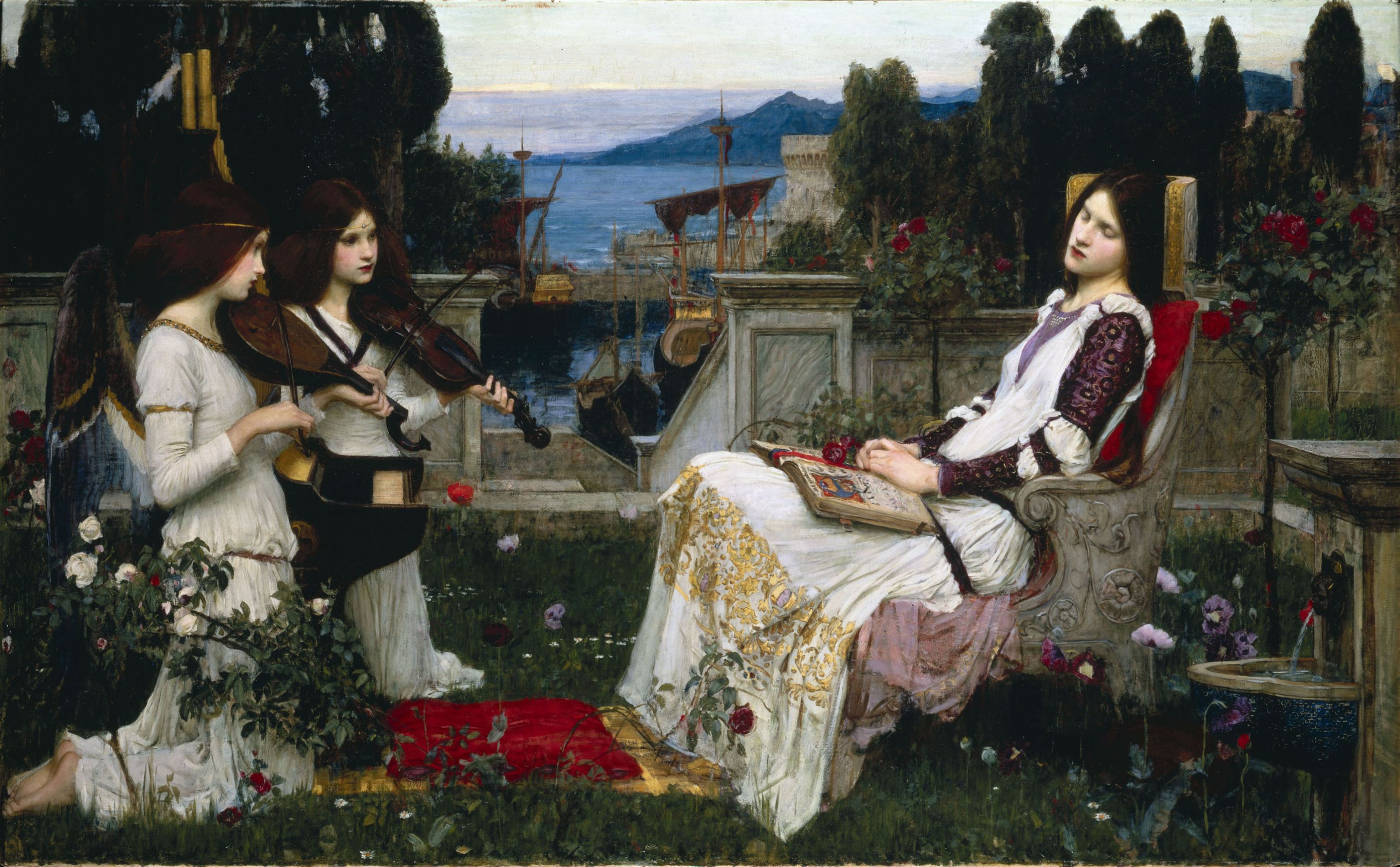
Not that the “high arts” are neglected: besides the Whistlers, there are some fine paintings, including Rosetti’s “Bocca Baciata”; a nude by George F. Watts that presents an Eros frank among the Victorians; Leighton’s study in serene sensualism, “The Bath of Psyche”; and John William Waterhouse’s sweet, if a little overly elaborated, masterpiece, “Saint Cecilia,” where two angels kneel, poised over their viols, wondering whether they should continue playing for the saint sitting in a chair across from them, asleep.

This wonderful exhibit is curated Dr. Lynn Federle Orr, of the Fine Arts Museums of San Francisco, and Stephen Calloway, of the Victoria and Albert Museum, in London (the exhibit was seen at the latter museum and at the Musée d’Orsay before coming to San Francisco, its sole U.S. venue).

After spending some time here, you may find yourselves agreeing wholeheartedly with the quote from Richard Jeffries: “The hours when the mind is absorbed in beauty are the only hours we live.”


Christopher Bernard is a San Francisco poet, critic and novelist (A Spy in the Ruins) and co-editor of Caveat Lector magazine (www.caveat-lector.org).


What Do the Occupiers Want? An Op-Ed Column by Christopher Bernard

[Article by Christopher Bernard]

What Do the Occupiers Want?

The news media seem confused about what the Occupiers of Wall Street, San Francisco and other cities around America, and now the world, have been demanding. The Occupiers are mad – they’re mad at Wall Street, and mad at the rich, and mad at Republicans and Democrats who have coddled the rich for decades. The pundits and reporters say the protests are all wonderful and signs of a vital and energized democracy – but what in the heck do these people really want?

Jeffery Sachs recently published a new book called “The Price of Civilization.”

Well, the answer is simple: They want the top 1% to pay their fair share of the price of civilization.

For the last thirty years the richest Americans, whether individuals or corporations, have taken for themselves everything they can get their hands on. They have not shared the spectacular gains our economy has made either with the people who work for them, or to pay for the collective actions that make up government, the services we all use, including police protection, transportation systems and the military.

This has resulted from the hyper-individualistic Reaganism that has dominated our national life since the 1980s. But Americans are not merely a collection of individuals seeking to maximize their returns. America is a society, not just an economy, and a society functions well only when everyone pitches in to make it work. The middle class has been doing its part from the very beginning, and over the last few decades has borne the brunt of the costs of our deepening economic and political dysfunctions.

Christopher Bernard is a novelist, poet, and co-founder Caveat Lector magazine. He is an active supporter of Occupy San Francisco.

Continue reading

Poetry by Christopher Bernard

Bike Angel

I fly down the hill on my black bike.
I know what I love, I know what I like.
I conquer the slopes on my bike’s back
like a wild black angel, the way I like.

She’s a Raleigh ten-speed, phat and sleek,
titanium light and chrome with slick,
quick to the touch and smooth on the road,
hot and fast and rad and black.

We cut close capers, free and all,
skid on concrete and never fall,
we weave a spell as I ride tall.
The girls smile deeply, all the girls, all.

With her, I’m my own man, we weave and spin
between the traffic, and always win.
Trucks and us, we’re real close kin:
they win with big, we win with spin.

I know all the looks, I know all the moves
as I race my own shadow, the way it grooves
just ahead like a ghost, the way it proves
it’s always beyond me, like storming horse hooves.

I dream as I ride of Larissa and me,
She rode me and rode me like a demon of love.
Then one day . . . the silence went dead like the wind.
Bike and me are now steel heart in a chrome glove.

I learned how to fly the other night.
I put on my shades against the light,
and rode my angel so out of sight
I didn’t need love, I didn’t need light.

I’ve been riding for days now, for months, for years
it feels like; nobody sees me, the tears
in my eyes are like spirits, I remember the day
I left for a long ride – to forget, let’s say.

The sun in my eyes, the wind in my face,
the shadows beside me kept pace, kept pace,
till the turn at hill’s bottom and I came face to face
with a dark car. That was the end of my race.

I conquer the hill on my bike’s back
like a wild black angel, the way I like.
I know what I lost, I know what I like.
I fly down the hill on my black bike.

Christopher Bernard is a widely published writer, critic, playwright and poet, co-founder of the literary and arts magazine, Caveat Lector (www.caveat-lector.org), and author of the novel, A Spy in the Ruins. Contact Bernard at christopherwb@msn.com.

Continue reading

Poetry by Christopher Bernard

Rag Elite

Ah, it’s hard to be an elitist,
and not be a defeatist,
in this populist purgato-ry.

You’ve got to feel swell
even as you go to hell,
and remember most of literary
his-to-ry:

there was Tolstoy, Dostoyevsky,
Flaubert, Balzac, Chernychevsky,
Baudelaire and Mallarmé,
frenzied, tragic, or blasé;

there was Thackeray, there was Dickens,
Eliot, George, and no slim pickin’s,
all those Brontes and Jane Austen,
witty, goth, and little costin’,

Lord Tennyson paired with Browning,
Lord Byron and Grace Abounding,
and, not taking up the rear,
the one and only Will Shakespeare,

raving Homer about that roamer
and the burning of Ilium,
Virgil, Dante, Poe, Cervantes,
Aeschylus and Sophocles,
and that ancient Grecian tease
we all know as Euripides,

there was Faulkner, there was Joyce,
there was Hemingway and Stein,
and no writer worth his voice
could refuse the heady wine

of Spencer, Milton, Shelley, Keats,
young Rimbaud and old man Yeats,
and even though the fates
were or-ne-ry,

they’re now Famous and Admired
by librarians and graduate students and professors and junior high school English
teachers and the lame and the retired,
and will be for Eter-ni-ty.

Christopher Bernard is a widely published writer, critic, playwright and poet, co-founder of the literary and arts magazine, Caveat Lector (www.caveat-lector.org), and author of the novel, A Spy in the Ruins. Contact Bernard at christopherwb@msn.com.