The Key of Heaven


If your soul wakes up and see golden heaven
At this moment, the fragrant honey makes you suddenly realize “Emptiness in Non-emptiness& Being in Non-being”
Even in  black forest of the hell, you still hold the key of heaven
And the lightning of your mantras makes the python spit out those gems of time,
and those golden books of jade version from the gods in prehistoric.
8.14.2017

天国之钥


如果你灵魂醒来看到金色的天堂
这一刹那的芳馨之蜜让你顿悟了空空之妙
即使在地狱的黑色森林也依然手握天国之钥
而你的咒语之闪电让巨蟒吐出那时光的宝石那史前诸神的玉版金书
2017.8.14

Cherish: The Memory of the Heaven


Today I would like to thank the world that looks like the hell.
It makes the fire that cherish the memory of the Heaven burning inside me;
it reminds me of the precious fruit of the sweet golden tree.
Those palaces and towers swirling music from outer space,
those giants whose bodies are limpid and happy,
those oceans are blue cocktails,
those rivers are the nectar of the soul;
However those mountains float in the sky like clouds, layer upon layer.
None of stone has no transparent smile.
The wind pass through the body and sings mysterious words.
None of flowers will wither,
as if old sun is both eternal and young.
8.26.2020


怀念天堂


今天 我想感谢这地狱的人间
它让我体内燃起怀念天堂的火焰

让我回忆起甜蜜的黄金之树的宝石之果

那飘洒着天外乐曲的宫殿楼阁

那身体空明而欢喜的巨人

那海洋是蓝色的鸡尾酒

那河流是灵魂的琼浆

而那山岳如云朵般飘浮

在层层叠叠的天际

没有一块石头没有透明的笑容

风穿过身体吟唱 神秘的词语

没有一朵花会凋谢

仿佛古老的太阳 永恒而年轻
2020.8.26


Don't Forget The Other You


Don't forget the other you,
those numerous you who either in the body or outer space,
those sweet smiles and the diamond flowers that never withers,
make boundless years on earth turn into a snippet of bird song.
Yes, that's crows of Phoenix from heaven.
Those sweet lightnings hit you,
let you suddenly wake up and see Gold Heaven is with you.
And your body is  golden body of giants,
make all time to become sweet.
6.10.2019

不要忘了那另一个你


不要忘了那另一个你
那在身体里在天外的众多的你
那甜蜜的笑容永不凋谢的钻石之花
让你在尘世的漫漫岁月化成一声鸟鸣
是的,那是天国鸾凤的啼鸣
那甜蜜的闪电击中了你
让你恍然醒来 看见黄金的天国与你同在
而你的身体是巨人的黄金之体
让一切时光变得甜美
2019.6.10


Bio:Yuan Hongri (born 1962) is a renowned Chinese mystic, poet, and philosopher. His work has been published in the UK, USA, India, New Zealand, Canada, and Nigeria; his poems have appeared in Poet's Espresso Review, Orbis, Tipton Poetry Journal, Harbinger Asylum, The Stray Branch, Pinyon Review, Taj Mahal Review, Madswirl, Shot Glass Journal, Amethyst Review, The Poetry Village, and other e-zines, anthologies, and journals. His best known works are Platinum City and Golden Giant. His works explore themes of prehistoric and future civilization.
Yuanbing Zhang (b. 1974), is Mr. Yuan Hongri’s assistant and translator. He himself is a Chinese poet and translator, and works in a Middle School, Yanzhou District, Jining City, Shandong Province China. He can be contacted through his email-3112362909@qq.com.
The farmhouse auction
Citadels shot golden while
farmyards purchased
long summer nights orchids watched.
Their patience fell into arms
that gave what needed—
prize blooms candescent
the silo’s hover.
The scene paled in memory now,
there’s shock when
death of one announces;
it avows boons doors had shouted
to youth gathered for deep appraisal
when their childhood was wonder
marked love shared with
nights that followed.
Each our yes from out them—
a sequence years form of
if failed undertakings
dreamed in the past stand
us envisioned
for glorious futures
cleft presence
abandons.
Night visions
The heavy land coils under
bond of peace.
Its reach affords
proved love’s ground
dying gives way to
in hollers firmament cheats.
Those passing shots comb the rage
planets succumb of
as ours barely alone
feels confidence
treason bothers
along owned nights agape at stars
their shower with dreams
this holy lounge,
trimmed fields doctored.A holding innocence
The clock tames their racked world with justice reluctant.
It forgets the passions that
rummage in their veins
as they seem an ounce of heaven harrowing
that tic-toc feeling desire ascends with
when youth climb to extend the
cut-life that wants its reign
pulled over the eyes of
what remanded—
lines pressed by Time
and the martyrdom
upheld with
so that shock blames each
the vaulting defendant.
 NOW (SONNINA)

                Another sick excuse
                  to postpone now.
                   We won’t excuse
                  this: a proper now
                 must clear our field
                              of lice,

                        must firmly field
         short-ra(n)ge objections. The matter lies
   beyond defensive asset orientation allowing fuel
              to sap its alleged beneficiaries.
             This now calls everyone to fuel
                  hospitably. Beneficiaries

                               spring
              forward. To reactivate spring.


 EXECUTIVE SOLILOQUY

 You’re the style
 of dog that spays its dozing master.
 This season’s
 consumption record: wretched. On
 the edge of treason.

 But we’ll see
 about that, Buster.
 We’ll turn you
 into a sound investment.

 Some stellar
 magnetisms remain to be
 unearthed by an imminent

 name brand who
 figures how to plant a miracle.
Thomas Fink has published 11 books of poetry– most recently A Pageant for Every Addiction (Marsh Hawk P, 2020), written collaboratively with Maya D. Mason, Hedge Fund Certainty (Meritage P and i.e. P, 2019) and Selected Poems & Poetic Series (Marsh Hawk, 2016). His books of criticism include “A Different Sense of Power”: Problems of Community in Late Twentieth-Century U.S. Poetry (Fairleigh Dickinson UP, 2001) and the co-edited anthology, Reading the Difficulties: Dialogues with Contemporary American Innovative Poetry (U of Alabama P, 2014). His work appeared in Best American Poetry 2007, edited by David Lehman and Heather McHugh. His paintings hang in various collections. Fink is Professor of English at CUNY-LaGuardia.
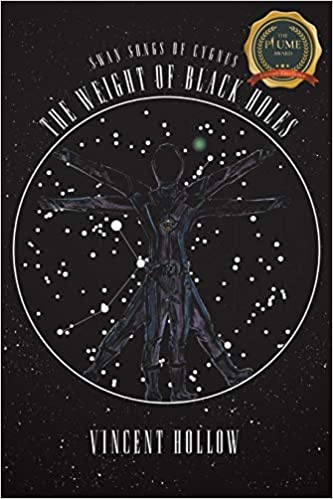
Vincent Hollow’s poetry collection Swan Songs of Cygnus: The Weight of Black Holes
Vincent Hollow’s The Weight of Black Holes
The Weight of Black Holes is a science fiction story that is written in a unique form. An astronaut signs up for a one-way mission into the furthest reaches of space. In order to go on the mission, he has to have body enhancements throughout his entire body to keep it from breaking down. Although he will have no human contact or companionship, he will have a computer to talk with and to help him through the mission. The astronaut composes love poems to his love who has vanished throughout his mission. This is quite the interesting read for the sci-fi lovers out there.
 A line from Samuel Shuckford

 Recruited & looted from WoW's Faceless
 Corruptor, tectonic action is dragging a
 full-grown mouse straight up the side
 of a refrigerator. Enormous fragments

 fall into the abyss, supporting certain
 recent scientific arguments that claim
 to have irrefutable proof giant volcanoes
 are driving Big Data technology today.


 Sous-chef

 Skeptics say there is
 no easy way to test

 claims that any loosely
 defined subset of furry

 ponchos, fur-lined flip-
 flops, or sweater sets

 adorned with brooches
 will continue to float

 when cream is added
 to the pumpkin broth.


 Three geographies:

 Puerto Montt

 Earthquakes have eaten the eye
 out of the cathedral. A fish was

 caught on camera attacking &
 eating a baby bird. There are

 two sides to every story. These
 are the first five to be displayed.


 Bratislava

 The oligarchs of the
 Little Carpathians offer
 redemption in the form

 of chocolate-topped do-
 nuts covered in rainbow
 sprinkles. They ask only

 for a sum of money to be do-
 nated to ensure the efficacy
 of their ministrations.


 Gdańsk

 The Teutonic Knights came &
 went, usually accompanied
 by bloodshed, until the minting
 of Polish coins was regally
 approved. Much later Freie
 Stadt Danzig. Then Lech Wałęsa
 sometime after the city had re-
 claimed its name. The diacritic
 over the "n" is often omitted.
 Love

 Love is what rules the world
 Love is the basis for relationships
 Love is what you feel for your boyfriend and    girlfriend
 Between husband and wife as well as
 even a thief feeding his family.

Buddha and Christ were men who left a legacy of love

 But I am only trying to keep perfect relationships
 I don’t know why all people are running after money.
 Money can't give happiness to you.
 Happiness should be inside you so know these
 things, if money could give happiness why do   people suffer from illness and disease and problems money cannot settle?
 I know that I could live without materialistic things.


 You also can become non materialist like me in your life
 Why can’t you live like me with no desire and no pain in life
 We came here naked and go out naked so let’s live
 Today as our first and last day of life. Death may come at any time so let’s welcome death. Let's have no fear, all things of the
 world are supernatural, all thinking and imagining is omnipresent and omnipotent
Whether you are a God or a devil depends on your behavior
 Let’s live seeing the perspectives of all
 living beings and non living beings of the world. This love is benevolent, let's have that type of love for all without any bias. All living and non living creatures are equal
 Let’s listen to the pain of all so
 we will have a mind without fear, without any problems.

 Let’s end selfishness and greediness
 and be happy with what we have
 In this is the meaning of life: you are me,
 I am you, you are the other, others are beings like us, beings can survive without killing others for our own benefit.
 You are perfect, let’s live like
 that then God will be happy

 Remember one who has hope has everything, has all things. Let’s hope till our last breath remains.

 Live as happily as you can then nothing of this world can stop your happiness.
 Be extra in living, live as a perfect dozen. Let’s erase tension and other unnecessary division. You are equal to all others, no class no bias no property, no matter. Sagelike, live in a perfect manner. Live life sweetly and freely always.

 Enjoy, relax, be cool, be kind and be patient.
 I only see love and power rule the world.  Power lets us make a difference. Love could be the key material of the world. So let’s try to create smooth and kind love.

 For all of you are spirit and spirit are you, so be the best of best like God.
 Become the best and most excellent, be enlightenment. Be crazy, live madly.
 Not sadly. Every season has a fixed time so let’s love forever all things of the Universe.
 Be happy not sad, not afraid. Be patient.
The Ghost Trolley: A Tale for Children and Their Adults
Chapters 8, 9, and 10 (earlier chapters are in prior months’ issues)
By Christopher Bernard
Chapter 8. The Black Tent
A dozen yards from the tent stood a rock outcropping in the shape of a perched falcon, and the children crouched behind the rock and watched.
Then they heard the sound. At first it was soft, almost gentle, something between a sigh and a groan; except that it seemed to go on too long. Then it slowly became louder, until it was almost a low, deep wail, going on and on, on and on, until suddenly it burst into a ferocious yell, followed by a sound of deep sobbing, and then the words “No . . . ! No . . . No . . . ” The words turned into a whimper and finally trailed off into silence.
Sharlotta suddenly curled up against Petey’s side.
The sounds started again.
Tears appeared on the young girl’s cheeks as the sound again grew again to a climax before again fading away.
“Me deddy,” she said in a small, trembly voice, and her little arms hugged Petey.
Petey awkwardly put his arm around the girl’s shoulders.
They sat there for a long time, holding each other as they listened, but no more sound came from the tent.
Then something caught the corner of Petey’s eye and he looked over Sharlotta’s shoulder.
It was stepping carefully through the trash and garbage, making its way past the snarling dogs, which yipped at it and made it stop briefly and hiss and growl before stepping carefully ahead again. It didn’t seem to notice the children, even when it passed near them, but continued on toward the black tent as though with a definite destination. Petey watched it casually walk past the guards to a corner of the tent far behind the entrance. Then, glancing back as if directly at Petey, she stuck her nose inside a tear in the tent wall and slipped inside.
It was a large tabby cat—just like the mother of the kitten they had saved from the Korgan kids that morning.
There was a gleam in the cat’s eye just before it slipped into the tent, which made Petey think of something.
“I have an idea,” he whispered.
“Oh?” said the girl, miserably—it was not the first time she had heard those words—as Petey snuck away.
Sharlotta was beginning to wonder where the boy from Howtiz had gone when a shout erupted from one of the guards as a cloud of smoke brewed up from a trash pile nearby on the other side of the tent, and the guards ran to stamp it out.
A few moments later she nearly jumped when she heard someone run up behind her and turned around, with a flinch. Petey stood near her with an uncontrollable grin; flashing a half-used-up book of matches with a picture of Jackie Robinson on the cover that he always kept with him as a lucky charm.
“Wait!”
“What?” Sharlotta’s whisper came from just behind his left ear.
“Don’t push!”
“Why not?”
“Because there’s a big hole and I don’t want to fall in.”
“But me foot be sticking out! Maybe they see me!”
“I can’t go forward or I’ll fall into the hole!”
The darkness enfolded the two children like a blanket of untouchable velvet.
They had had just poked inside the tent where the cat had gone, the torn flap just big enough to accommodate them.
Petey’s eyes had not yet adjusted to the darkness, and he had stopped because his outstretched hand was dangling over a void, groping for a floor that wasn’t there.
They had to wait what felt like an agonizingly long time before their eyes adjusted to the darkness. They could hear the guards busy stamping out the fire outside.
Slowly out of the darkness the two eyes of the large tabby appeared, looking at them from where it sat perched not far away. What was wrong with these peculiar animals? it seemed to think. Couldn’t they see in the dark? At least they’d had sense enough to follow her into the tent.
Petey saw a shadowy light rising from below, then the outlines of a deep pit at the bottom of which he and Sharlotta could have broken their necks if they had fallen in.
Except for the sounds from the frantic guards outside, there was dead silence in the tent, and a cold smell of damp earth penetrated the air.
“There be steps,” Sharlotta whispered, her eyes adjusting quicker than Petey’s. “Down the hole.”
Petey made out a set of rough wooden steps winding down the sides of the pit to its distant bottom.
The tabby blinked, then started nonchalantly washing its face.
Petey crawled over to the top of the steps, with Sharlotta, who was finally able to pull her exposed foot into the tent, close behind. Then they cautiously descended, only once making the wood creak loud enough to waken whatever slithering creatures inhabited the pit.
The bottom of the steps led to a short corridor lit by a burning lamp sputtering in the gloom. A rusty iron door stood at the other end. From behind the door came an eerie stillness, especially after what they had heard outside the tent. Then the door creaked and started to open.
The steps were openwork and gave little cover, but the children had no choice but to scurry under them as quietly as they were able.
One Eye came out with an irritated look – the sounds of the guards fighting the fire could still be heard coming from above – then he closed the door and walked up the stairs, his dirty boots passing within inches of Petey’s face: the same boots he had seen on the embankment.
The children hunkered down.
“He not lock the door,” the girl whispered.
As soon as the steps stopped shaking from the Korgan’s tread, the two children scurried out and down the corridor, then pushed against the door, which opened silently.
The boy sucked in his breath.
Chapter 9. The Secret of the Tent
Lined up along one wall of the small, airless room, tied and gagged in a squat on the dirt floor, were a very young boy and an even younger girl and a young adult woman, all with the same soft, cocoa-colored skin as Sharlotta’s.
They looked up tensely at Petey as soon as he came in, as though expecting only the worst: Petey realized he must look like a dwarf Korgan. But when Sharlotta came in behind him, pulling her matted, muddy hair from her face, their faces widened with a shock of joy, and they began giddily trying to talk through their gags. The look on Sharlotta’s face when she saw them was even more startling: she looked like she wanted to shriek with happiness, but was doing everything she could to keep silent, and the result was that her face flushed a deep purple.
But Sharlotta’s joy turned into something more terrible when she saw, in the far corner of the room, tied to a chair under the room’s only light, a middle-aged man with torn clothes and a bruised face and a cut above his left eye, blood trickling down a gray-streaked, bearded chin. His right leg was twisted in an unnatural way. An empty stool stood in front. The man looked up at them, with a look in his eyes of defiance and fear. Then an incredulous smile flickered to his lips as, through his daze, he recognized his eldest daughter.
“Deddy!’ Sharlotta cried out despite herself.
“Sharlee . . .” her father murmured, and fainted.
“Quick, quick!”B
But Sharlotta was already busily untying the ropes binding her father. Petey soon untied and ungagged the others, telling them to keep silent, while Sharlotta, after undoing the knots, tried to revive her father by hugging and coaxing him and whispering in his ear. He had woken but was groggy and weak. He could barely walk (one leg was almost dislocated) and could only stand with the support of his wife, who, in terror and exhaustion, seemed to feel she had no choice but to look to Petey and her daughter for guidance.
“We be blindfolded when they bring us here,” the mother said, “before they begin . . .” She couldn’t use the word “torture” “. . . on your father. No knowledge have I where we be.”
“We be in black tent in trash dump in Korgan camp on Quixiona Plain at edge of Avana Forest,” said Sharlotta. (So that’s where we are, thought Petey. He had been wondering, though the information was not entirely enlightening.)
“But how you be here?”
“Too much to explain!” said Petey. “We gotta get out of here before One Eye gets back.”
They didn’t need to ask who he meant by that name.
Seeing the ropes used to tie up Sharlotta’s family, lying on the floor like sleeping snakes, had prompted a thought in Petey, which he whispered to Sharlotta and her family. They agreed it was their only hope of escaping.
Petey took the longest of the ropes—the one that had tied up Sharlotta’s father—
and carried it with him into the corridor.
“I be coming with you,” said Sharlotta in a hush, following him on tip-toe.
“Okay,” whispered Petey. “Close the door.”
“Why?” said Sharlotta.
“It’s got to be dark.”
“But what about . . .” and she pointed toward the corridor lamp hanging above their heads.
“Just close it!”
Sharlotta scowled; she didn’t like being ordered around, especially by a boy, but, since this was his idea, and so far his ideas had worked, she complied and closed the door.
Petey swung the rope up toward the sputtering lamp and, after a few swings, managed to extinguish it. The hall went pitch black. Then they groped their way to the winding steps and quickly ascended toward the half-light penetrating the tent till they were nearly at the top steps.
“Good enough,” a voice said outside the tent above them. “You can handle the rest.” It was One Eye.
Petey tied one end of the rope to a post at the side of the steps, then stretched it across, a few inches above the step, tying the other end to the opposite post. Then he did the same thing across the next step down. The two children snuck down and hid under the steps at the bottom.
They had just gotten there when they heard someone take a step on the wooden stairs above them: one step, then a second, then a third, regular and heavy, making the wood creak slightly.
Petey felt a seizure of panic. Had the rope come undone?
Suddenly there was a curse and a cry, followed immediately by a clattering thundering and the steps clattered and swayed as though about to collapse over the heads of the children, and a body came tumbling to the bottom and along the ground several feet in front of them in the pitch dark, then gave out a long groan and sigh, and was still.
Sharlotta whispered after a moment of silence, “He be dead?”
“I don’t know. I don’t think we should find out.”
They gingerly tip-toed through the dark, feeling for the Korgan and sneaking around the big outstretched body, which was shuddering and wheezing (Not yet! thought Petey as he squeezed past), then they opened the door to the cell. Petey looked back at the unconscious Korgan. He looked like a sleeping giant that might wake at any moment. His single eye was open and stared crimsonly at him.
“It work!” said Sharlotta.
The eyes of her own family shone in the light of the room’s little lamp, and Petey opened the door wider and showed them One Eye outstretched on the floor.
Petey led them out and around the unconscious Korgan, then up the steps, slowly, as the father was unable to move fast; Petey untying the ropes when he got to them and giving them to Sharlotta, who tossed them into the darkness below, like slithering snakes dropping down a well.
There was only one way out of the black tent now, Petey realized, as Sharlotta and her frightened family sat on the topmost steps near the flap where he and Sharlotta had entered. He took his little book of matches with Jackie Robinson on the cover and went over to the side of the tent furthest from the flap.
There was only one match left.
Then Petey heard a distant groan, coming from the bottom of the pit.
He was recovering. If he found them, they’d be worse than dead.
The boy hastily struck the last match – a little too hastily. The tip sparked and sputtered, and almost went out (the matchbook had gotten wet from the mud), till he moved his finger down so the rest of the match could catch fire, by so doing almost burning himself. Then, biting his tongue hard so he wouldn’t cry out as the flame bit the end of his fingers, he knelt and touched the flame to the bottom edge of the tent wall where it almost touched the ground; he hoped the canvas was not wet.
Please burn, tent! thought Petey, biting his tongue as hard as he could. Nice tent! Come on! Please! Burn!
He was about to either drop the match or shout out with pain when the canvas slowly began to respond.
It was a very small and very weak flame, and Petey, afraid it would die before it had half a chance, took out his handkerchief and fed it, like kindling, to the little crescent of red eating its way a little at a time up the black canvas.
Then, suddenly, the fire took.
Chapter 10. Escape
He ran back to the torn flap and cautiously looked outside.
“Fire!” cried one of the guards, as smoke began billowing from the back of the tent. Both guards ran toward the new fire.
Almost simultaneously a shout came up from the bottom of the steps.
Petey pulled Sharlotta out by the hand, who pulled her father, who pulled her mother, who pulled her little brother, who pulled her little sister, and out of the tent they slipped, the father hobbling painfully, over to the rock outcropping in the shape of a falcon a dozen yards from the black tent. The tent was rapidly being eaten by the flames.
The wind had grown in force, whipping from the north.
A flame shot up behind the tent, like a great yellow and red tongue, with the sound of an explosion. In the distance Korgans turned with startled looks and after a moment began running toward the tent.
The escapees ran as fast as they were able (the mother helping the father hobble along at a pace that was agonizingly fast for him), weaving through piles of debris, past wreckage and heaps of cast-off equipment and slurries of blasted rock, to the far side of the dump and a half-collapsed wall along the edge of it, far from the fire. As they stopped and were huddling down in the narrow shadow of the wall (the sun was high and hot), Petey slipped and fell on his face. The ground where they were standing was thick with mud.
Sharlotta stared at Petey as he picked himself back up, blushing from his clumsiness through the new layer of mud on his face, then said excitedly to her family, “Do like we do!”
And she started speading mud over her brother and sister’s faces and clothing.
“It be our disguise.”
“Of course!” said her mother, with a flash of pride in her clever daughter. The father weakly began applying mud to his face. “I doubt I ever be able to make this ugly mug look like a Korgan,” he said. “No matter how hard I try.”
“We see about that,” said the mother, who began vigorously spreading mud over his head and hair where he couldn’t see. Her husband returned the favor, smoothing mud over his wife’s pretty, cocoa-butter face. It was curious to Petey to see the two adults, enthusiastically smearing dirt all over each other – the contrary of anything his own parents had ever commanded of him.
“You know, this be fun,” the father said, with a pained chuckle, “if we be in less of a pickle.”
Soon they were daubed all over with mud, with wild-looking eyes and dirty clothes and faces half-hidden under tangled and ratty hair.
“There,” said Sharlotta, looking everyone over critically.
It was unfortunate her parents stood out so much, by their height and spareness: there was no way they could be disguised as Korgan children, who were, of course, short and almost all squat. But there was nothing to be done about it: they only hoped the adults could be made to look like sick and ailing Korgans, keep their heads down, and take their chances. The mud would hopefully hide the beautiful chocolate brown of their skins.
Petey, now something of a masterpiece of filthy slovenliness, was about to speak when something struck the back of his head.
“Ow!” he cried as he spun around indignantly.
The two Korgan children they had met earlier stood a few yards away, Bang Bang laughing tauntingly and pointing at Petey. Blue Moon stood, giggling, at his side. What were they doing there? Had they been following them? There was no time to figure that out! The two of them began singing out in childhood’s universal chant of mockery:
“You – are – Pao – nas! You – are – Pao – nas!”
Petey picked up a handful of gravel and threw it at them, and they laughingly side-stepped it and started throwing rocks back in rhythm to their chant, which was soon returned in kind, and the rock and mud throwing was in full spate.
Beely, Sharlotta’s little brother, grandly smeared from head to foot, began wailing when a pebble struck his nose.
The two parents realized any attempt to stop the fight was likely to call attention to them, so they huddled against the wall and waited for the contest between the children to be resolved.
“You – are – Pao – nas! You – . . . !”
Sharlotta interrupted them, shrieking back in her loudest voice:
“YOU arrrr Paonas!”
Petey picked it up, yelling, with Sharlotta, “You – arrrr – Pao – nas! You – arrrrr – Pao – nas! You – arrrrr – Pao – nas!”
Soon, Sharlotta, Petey, Beely, who, at four, felt he was almost grown up, and Sharlotta’s sister, little Johja – who, only three, had no idea what they were shouting – were all chanting together, “You – arrrr – Pao – nas!” outshouting Bang Bang and Blue Moon, and (all except for little Johja, whose attempts at rock throwing got no further than her shadow) assailing them with a crescendo of gravel and handfuls of mud, until Bang Bang was struck on the top of his head by a small rock from the hand of Sharlotta.
He yelled, shocked he was not invulnerable, then started bawling at the top of his lungs. This was the sign for the others to launch an all-out attack, swooping in a stampede. Blue Moon yanked at the blubbering Bang Bang, and they dashed off, the sounds of the boy’s bawling floating back on the wind.
“Let’s follow them!” Petey called to Sharlotta in triumph – a little too soon, in Sharlotta’s estimation. How like a boy! But Petey went on excitedly, “We’ll be safe! The Korgans are worried about putting out the fire, they’ll just think we’re a bunch of kids playing chase!”
(“I be no kid!” protested Beely.)
“ . . . and Bang Bang and Blue Moon might lead us to an exit from the camp! Anyway, we can’t stay here.” Looking at Sharlotta: “Can we?”
“But what about me parents?” said Sharlotta, looking at them in their resplendent muddiness, her mother holding her father, who was still weak from the terrible things that had been done to him in the tent.
“I can come back for them as soon as we know how we can get out of here.”
“He be right, Sharlee,” said her father. “It better than all us stay here. But best you hurry. I no like the look of that fire. You go with them, Meena.”
“Faar, I no can leave you here,” said the mother.
The fire was growing on the far side of the dump despite efforts by the Korgans to put it out. Shouts echoed across the camp.
“We can’t wait!” said Petey. “Come on!” And he dashed off after the two Korgan children as they disappeared into a confused crowd that seemed uncertain how to respond to the fire.
“Go! Hurry!” said Sharlotta’s mother. “Take Beely and little Johja with you. No one notice four dirty kids running away from a fire. We be all right here.”
“Maybe not all right, exactly, but at least we up against a wall,” the father said mordantly.
Beely and little Johja looked at Sharlotta with mouths agape.
“Do everything your sister say,” the mother said to them in her firmest Mom “don’t-even-think-of-talking-back-to-me” tone. “You follow her.”
And Sharlotta grabbed their hands and ran after Petey, who had already vanished among the Korgans.
The fire was spreading; they could hear shouts and cries of increasing alarm.
Then there was a big explosion to the north; a cloud of dust swept over them and the shock wave threw them to the ground.
Sharlotta immediately rose, coughing, and looked back to make sure her parents were all right.
“Go!” ordered her mother, her arms covering her husband as the dust blew over them. “Go!”
And Sharlotta, hesitant to leave, watching her parents disappear in the dust, finally turned and ran with the little ones in the direction where Petey had gone.