I brought my mother a lily yesterday,
She placed it on the dining room table,
And I wept—
For those I had seen die in the streets.
The lily opened to reveal its seeds
And I wept—
For each seed, there was a black boy that would not bloom. Ocean Breeze For Lorraine
The water is calm today.
Seagulls cry out in the wind.
I celebrate my life,
And I forget the violence.
The waves run across my feet.
As I watch the sunset and I smile.
My mother holds my hand and I’m born again.
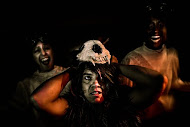
The Unheard of World. Joan Howard pictured center. Photo by Robbie Sweeny
(IN)COMPLETELY ABSURD
The Unheard of World
By Fabrice Melquiot
Translated by Michelle Haner
Exit Theater
San Francisco
A review by Christopher Bernard
Even with the best of intentions, to say nothing of energy, intelligence and talent, world premieres can be treacherous things. The premiere of an English translation of a modern French play can be more treacherous than most, given the great differences of premises and expectations between French and American audiences—including such things as their different senses of humor and attitudes toward philosophy, which can quickly become awkward in a philosophical comedy.
The latest production by one of San Francisco’s most audacious companies, foolsFURY, which in October premiered, as part of its Contemporary French Plays Project, Michelle Haner’s translation of Fabrice Melquiot’s magical realist Le Monde inouï is a textbook case. (Melquiot is a prominent contemporary French playwright; foolsFURY produced The Devil on All Sides, in artistic director Ben Yalom’s translation, to much acclaim in 2006.)
INCREASING the electricity tariff from the N16.11 per unit it is now, as has been announced in the news today, buried in the rubble
actually, would seem an acceptable idea until U consider how Nigeria works…
Whenever fuel, for example, becomes scarce or more expensive, the following happens: costs increase across board, and refuse to return
to baseline when the (fuel) crisis is resolved, or (fuel) price dropped.
In practical terms, when fuel becomes N97 from N87, fares that are N50 will become N100. U’ll be asked if U live in a different Nigeria when
U protest the disproportion. And when fuel price drops back to N87, U’ll be lucky to be ferried at N70, which becomes the new baseline for
the next crisis.
First I shovel
words, crackling
like churned earth. Forage
deep for those riches
buried in my depths. Then,
sift out pronouns and adjectives
as if grit from oil—perpetually
clogging one’s ingenuity.
Now shall I pan for imagery?
This nugget is a simile, here
a chunk of metaphor. Observe
how dense they both are
rising as they do
to the very top of my mind
when everything else simply sinks—
the clinks of dying lines
striking the bottom.
Their splendor is nearly blinding—
glimmers that speak of wealth and greed
and a need, always such a need
for something other. I’ve struck
gold—poem jazzing up
my page like pyrite.
For someone who enjoys a great story, is there anything better than a narrative that engages you from the very start? Imagine a world so rich you can almost smell the scents in the air, a delivery so clever it forces you to think in a way you never thought you would. I’m Ryan J. Hodge, author, and I’d like to talk to you about…Video Games.
Yes, Video Games. Those series of ‘bloops’ and blinking lights that –at least a while ago- society had seemed to convince itself had no redeeming qualities whatsoever. In this article series, I’m going to discuss how Donkey Kong, Grand Theft Auto, Call of Duty and even Candy Crush can change the way we tell stories forever.
What Videogames Teach Us About Writing Child Characters
When we imagine the ‘great’ characters of fiction, they don’t tend to be limited by class, race, or occupation. We can empathize just as much with the Corleones of the Godfather as we can with Kunta Kinte of Roots. And yet, there seems to be a strict ‘18 and over’ age limit for these timeless characters.
While we might look upon films like The Goonies or Sandlot with fondness, it cannot seriously be said that these titles delivered stirring, powerful performances from their child stars on the order of Godfather or Roots. Indeed, for a distressing number of works, any story featuring children that aren’t explicitly ‘about’ children have a tendency to turn in monotone and forgettable roles for their tykes.
This, of course, presents a vexing quandary for writers. Given that we were all children at some point; why does it appear to be so difficult to render at least a convincing portrayal of society’s most vulnerable population? And, for that matter, what could videogames possibly offer to remedy this?