“Coffee in My Cup”: An essay by Natalie (Neco) Haviland

Coffee in my Cup

by Natalie (Neco) Haviland

I have always believed that without adversity we would have no victories. When challenges arise in our lives, it is yet another opportunity for a victory. The greater the challenge, the greater is your victory. I learned this the hard way, and am hopeful I won’t need many more lessons on this matter.


It was these lessons and challenges that taught me a unique lesson in gratitude. Up until ten years ago, I lived a fairly normal life. I went to college and studied biological sciences. I raised my children on my own, working full time and hustling cars on the side. I made a fair living, between middle and upper middle class. My family wanted for nothing material, and our activities included camping, fishing, and traveling through California on various adventures. My ultimate goal was to create as many good and wonderful memories for my children as I possibly could.


As a family we did a lot of cooking, baking and canning of our own fruits, salsas, jams, jellies and chutneys. We would scavenge yard sales for mason jars, and assorted treasures, and really enjoy all life had to offer.


In one brief moment, my life changed. One bad decision, or perhaps a series of bad decisions, led me to a prison cell. It appeared to me that my life had pretty much ended at age forty. Because of California’s Three Strikes law, I faced a sentence of fifty years to life, because I had a past felony conviction when I was eighteen. Because I faced so much time in prison, I was held in a lockdown cell for security. I would exist in this cell 23 and a half hours a day for a period of 14 months. I was allowed a daily shower, a phone call, and on only a handful of occasions I was led to a concrete box without a roof for yard time. I was blessed just to go to court. As I was transported from the facility holding me to the County Superior Court, I was able to look around and see things such as trees, plants, streets, cars, an occasional dog, tract of homes. Just stuff, anything but the concrete walls, metal doors and wool blankets.


Inevitably, depression and a sensation of low self worth were a constant struggle during this time. I was mourning the loss of my family. While I felt very guilty about what I’d done, I also mourned my life in general. I would no longer be able to go out back and have a cup of coffee in the morning air, or eat ice cream in the evening before bed. I couldn’t see my children off to school, or share a meal with them and tell them I loved them every day. I missed my minivan and the music I’d listen to as I drove around running errands. I even missed washing dishes, folding laundry, and vacuuming. I missed my life.


My mind was spinning at about ninety miles per hour, while my body was pretty much shut down. I sought answers, hope and wisdom from the scriptures. I begged God to help me, to save me, and not to let this terrible thing happen to me. I did not realize that it had already happened, and I was in this. I’d one day learn to suck it up, and keep pushing. It is what it is, and I would learn to accept life on life’s terms, and pray continuously.


It took a little time, but I learned to acquire little things. I bought from the commissary, and had coffee in my cup. To sit and enjoy a hot cup of coffee is a good thing. It is a moment in time to be savored, and held onto for as long as it lasts. A good book is something to be experienced and cherished. Just to have the time in the day or evening to read something I relish. Those times in particular were very special, as I would get lost in the story. I traveled to countries I may never see in my physical life, but I’ve been there and I watched as story after story unfolded before me. I walked in the sand on beaches in Mexico and even sat in the mess hall of a nuclear submarine. I escaped my harsh reality and lived a little. The self-empowering books written by ministers, professors, doctors and psychiatrists helped me to establish some coping skills.


In all that was happening, I learned to be so very grateful for everything. I did have my prayers change from please God help me, to sincere gratitude that I still had eyes to see the good in all things and most people. The unique circumstance of living with absolutely nothing completely changes one’s perspective of things. Everything people take for granted every day has become cherished and valued in such a dramatic way. Living in a concrete box with very little human contact will lead you to a greater appreciation for anyone, even your coworker who simply never shuts up, or the family member who is always so critical and discouraging. Even they all have qualities you will miss. You can only sit staring at a wall for so long. One can only enjoy the quality time alone, briefly, before you begin to overthink things and become hypercritical of yourself. I spent a lot of time thinking, oh I should have done this, or I shouldn’t have done that. Situations repeated over and over in my mind, continuously reminding me that I’m not exactly the sharpest tool in the drawer. I learned I lacked some basic life skills, mostly in communication and managing my emotions. While life was beating me down, I’d managed to find ways to beat myself up emotionally even more.


During this time, I was also being sexually harassed by one of the officers who would somehow find time alone with me. He took full advantage of my low self esteem and broken spirit. He’d have his way with me, and then let me shower before locking me back in my cell. My head, and my heart were too far gone to even think of reporting him or realizing the severity of the situation. Every day during this trial, I would consider, plan, and contemplate suicide. I saw no possible way to recover and had no desire to awaken each morning.


One morning I awoke and decided I just couldn’t do another day like this. I took several razor blades I’d been collecting and began cutting. It was so gross and messy that i decided to swallow all the blades and start doing jumping jacks to get them moving to do their damage. I ate 12 in all, snapped them in half and downed them with a cup of coffee. I told God I was sorry but I gotta go. I started doing jumping jacks over and over. I did sets of 50ish until the cops came over the speaker in my cell telling me my attorney was there to visit me. I was kind of stunned by the visit and the timing. I went in and saw a woman who represented my court appointed public defender. She claimed she was there to get me out of that place. I was again stunned. My public defender had told me I was going to do life in prison. She now had hope to offer. I told her it was too late. I already got myself out. She asked me to explain myself, and thinking there was nothing to be done, I told her straight up what I’d done and that I was really okay with it. She pretty much freaked out as I calmly explained this. She ran for the officers to get me medical attention. I was stripped naked and placed in a rubber cell with a blue quilt cover to hide my nakedness. The rubberized cell contained a hole in the floor for restroom use. Again I did my jumping jacks. I kept wondering, and worrying, if perhaps I were going to hell for taking my own life. I kept waiting to feel something other than cuts in my throat or on my arm. I expected blood from my rectum or mouth or something. I waited for the pain. I was exhausted from the emotional drama and the jumping jacks. A doctor came to the door to see me. Everyone wanted to know why. My simple reply was, “Duh! My life sucks!” It was a matter of choice, fifty to life or razor blades for breakfast. Well pass me another shaver please. The taxpayers should be pleased. I saved them close to half a million dollars. I can rationalize anything.


Needless to say, I’d hit rock bottom. The doctors said that I’d be fine, and I was. I was devastated that nothing happened. No internal damage, no cutting, no bleeding, nothing. The razors had processed through, and even x-rays revealed absolute nothing. I lost a few pounds from the jumping jacks, and a lack of food, however, I was completely normal.


My public defender took me to court to tell the judge presiding over my case that he no longer wished to represent me. I was given a court appointed attorney and remained in isolation until I showed some signs of life. It was these severe circumstances that fostered a unique perspective in my life. I still believe that I have seen the worst moments in my life. I have been through hell on earth and I have experienced life’s worst. Praise God that no matter what life may bring from here on out, I should be able to endure it easily. That is a truly wonderful experience to have. Nothing much could be worse than what I have already endured.


I praise God daily for everything. In the mornings I praise God for another day of life. I should have been dead. I’ve had a dozen encounters with near death experiences and yet I am alive and well. I am healthy and strong. I celebrate life and have truly learned to live, not merely exist.


I have a job to go to every day. I praise God for that. I didn’t enjoy the sewing factory job here very much, but I still prayed and praised God for a chance to get out of my cell and do something productive with my time. I was grateful to earn 40 cents per hour to help pay for coffee, hygiene products and goodies. At the end of the month I receive 60-75 dollars. Mind you, I don’t pay rent, utilities, phone, cable, water, etc … I have humble needs and my meager wages cover that. Thank you, Jesus!


My cell has a window. I can not only see outside, but I can crank it open, and get fresh air. I praise God for my window, air, and even the harsh metal screen that keeps the insects out. Most prison cells have no window, while others may have a four foot by eight inch window with chicken wire. All air is recycled and pumped through vents that are not cleaned and maintained regularly. Some people live year after year in such conditions.


I figure if I had to go to prison and serve so many years, that I am so very grateful I came to this place. This is the best of all California women’s prisons. I am blessed beyond words to have come here where I see, and can walk barefoot on grass. Trees, flowers, bushes, and animals surround these grounds. In the other women’s penitentiaries I saw, sadly, very little signs of nature. I am grateful to see a dog walk by and see cats hunting squirrels and gophers. I find all these things to be peaceful and fulfilling to my soul. For these things I give thanks unto God.


I praise God for sunshine on my face. After months and months of dark, dank cells, I can appreciate sunlight and even a cold overcast morning. After so many months of darkness, I was sentenced and transported to the State Prison in Chowchilla, California. It only took three hours of sun exposure for me to get sun poisoning. My face became swollen and distorted within eighteen hours, and I was taken to the medical clinic for observation. I had up until that point never heard of sun poisoning. I’ve always loved my fun in the sun, regardless of the many warnings of harmful effects of excess sun exposure. Despite the slight scarring from the burn I received to my forehead that fateful day, I still relish my moments out in the sun. I love that I can go outside daily. I hardly notice that I am in a large cage. I’ve been so grateful to just not be in a cardboard box all day, every day.


My heart aches for those men and women who still live in such a way. Our men are treated so inhumanly. They live up to 10-20 years in such conditions.They are taunted and tormented by many of the guards and fellow inmates, given a cold shower two or three times a week, and their mail and phone privileges are used as forms of torment. Bear in mind that after this is done, these men are given $200 and released back into society, expected to become productive, successful citizens.


My heart truly bleeds for my fellow human beings, and this knowledge brings me to my knees frequently. Not just for mercy for them, but in the most sincere and reverent appreciation for my own circumstances.


No matter where my life may take me, nor what may come and go in my path, I will always remember that it could be worse. I could be in prison in Indonesia, Mexico or some other country where rape, starvation, and harsh weather are the norm. I thank my lord Jesus that I am here. Praise God I have a parole date. Glory be to God the Father that he poureth out wisdom to the wise and knowledge to the scholars. He reveals deep and mysterious things, though He Himself is surrounded by light. (Daniel 2: 21-22)


I will always lift my cup towards heaven and praise God for coffee in my cup, sunshine on my face, fresh air in my lungs, and all the good things in every circumstance and every person.


I can honestly say today that I’m grateful to have had this experience. I’ve learned so much about life, God and myself. I’ve experienced the worst of life, and circumstances, and seen the worst of humanity. The Jesus inside of me taught me to learn, to see, to believe, and now to write, to share these experiences in order to inspire others.


I am currently working on a manuscript called, “Prisons are a Crime.” It details the injustices of our current justice system, however, it speaks even more of worse prisons we experience in our lives. Prisons of depression, anger, addiction, poverty, and so much more. It should go to print in 2014, as I am still housed in a physical prison and am property of the State of California.


I wish to help anyone stuck in prisons. Any form of prison. I will seek and fight for freedom and justice until I leave this earth, all the while with an attitude of gratitude, sunshine on my face, and coffee in my cup.


I am humbled that you took the time to read my little story. I am thankful to and for you. God bless you abundantly.


Natalie (Neco) Haviland


Natalie may be reached at Natalie Neco Haviland #X00256 DOB: 4/17/61 

16756 Chino Corona Rd EB 526 Corona, CA 92880-9508 and looks forward to reconnecting with her family, continuing to write, advocating for others, and celebrating the great outdoors upon her release. 
“Lazy”: A poem by Avi Hoen


“lazy”
by Avi Hoen

I’ve gotten lazy
stopped putting my shoes on
when walking just
so I can feel the rough pavement
because cars don’t drive here often
and the bones in my heels pound
to the
gasoline dripped streets and
the white line that separates
where we drive from where we live
but my feet can’t tell the difference
since they have walked along here
before and they are callused
I don’t feel the stones anymore
and I’ve stopped feeling the
burnt out butts of cigarettes and the
cat litter spilled by the garbage men but
my bare toes still trip
over the picket fence nails
that have fallen into the streets
because they used to hold the wood but
thats decomposed and they aren’t rusting yet
so bored, they pop tires of trucks
and get stuck in paws
but since I’m aware I notice them
and although I still trip I
don’t get bit by the fangs of last
decades façade since
separation isn’t used or
at least we wish it wasn’t but
now we don’t aknowledge it like
back then when it was clear cut spinning
like vinyl records,
either touched by the diamond or not
So my shoes lay on the street for
someone else’s feet

“Pavement Ends”: A prose piece by Luca Foggini


PAVEMENT ENDS

by Luca Foggini

Think of the most ridiculous town.

It has a salon with swing open doors and streets where duels were started on the last chime of a

bell.

The F-15 fighter jets fly over out there, practicing bomb runs meant for some Middle Eastern

country.

It has a Super 8 and a Best Western. It has a pancake place, three gas stations, one grocery store.

Just a town with two long roads, so flat and long you can see places where snow is. Where you

are it is baking hot. The asphalt melts the soles of your shoes and tires pop in the sun.

Later we drive out to the sand dunes. The Joshua Trees stand sentinel, as if they move when you’re

not looking.

There’s tumbleweed, snakes, scorpions, and salt. The sand dunes vibrate, a deep sound like a

whale. You are above it all, washboard roads for mile, rusted over a personal shooting gallery of

cans and old televisions. Cathode tubes smashed around a “Pavement Ends” sign.

But you can see the place you stopped last where it was 30 degrees.

Warming hands on a hot chocolate, we waited in the car so that the heat would boot up and the

window would defrost. There is hard-packed dirty snow under the wheels.

And now the icicles are melting in the desert sun and there’s a pool of water flowing into the

gutter, evaporating on the pavement.

“Matches”: A microfiction piece by Hazel Mankin

Matches

by Hazel Mankin 

Her face glistened in the red sundown-light that angled through the kitchen window. Not as a cut-glass tumbler might, but more like a half-melted candle, the way the rays curved across her cheekbones in hazy highlights. She raised the mug to her lips, closing her eyes to drink. When she lowered her tea, condensation had formed a drop of water on the end of her nose. The sun seeped into its edges, dyeing it the same red as the candles that cluttered the tables and the mantle. Even unlit, they still breathed their thick, saccharine scent through the room. She curled a curious smile in my direction, eyes narrowed.

“What are you thinking about?” she asked, swiping the droplet from her nose.

I turned to stare out the window. “I was just thinking,” I mumbled, “that it must take the entire ocean to extinguish the sunset.” I turned quickly to see if she thought my words were foolish. She smiled at me before rising from her chair.

“Well, that’s a shame,” she laughed quietly, plucking a small cardboard box from the edge of the mantle. “Because, unless I’m mistaken, we’re a good hundred miles inland.” And she struck a match.

Book Review: Kelly Munoz on Doug Beube’s Breaking the Codex

Doug Beube: Breaking the Codex

Intriguing. If I was asked to use one adjective to describe Doug Beube: Breaking the Codex, or Mr. Beube’s art, it would be intriguing. As an avid book lover and someone who truly believes that printed books are still necessary even in this electronic age, my first reaction to Mr. Beube’s art work was shock. Here was someone who was manipulating and destroying printed books and atlases as a form of art. This went against years of being taught to protect and safeguard books. Getting past this initial thought and remembering that art is always an expression of the artist, I began really examining the artwork in this book, the wonderful essays on the work, and the composition of the book itself, and I was intrigued.

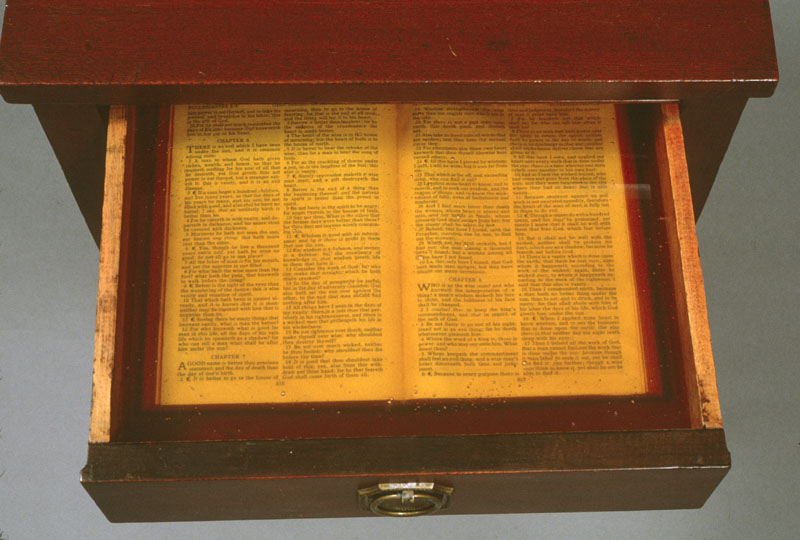
Mr. Beube uses books as others use canvas, paint, clay, etc., and he does it beautifully. The piece “Feast” (1993-ongoing) is a wonderful example. In this piece, Mr. Beube has placed a Bible open to the Ecclesiastes scripture that states, “To every thing there is a season, and a time to every purpose under heaven; a time to be born, and a time to die…a time to get, and a time to lose; a time to keep, and a time to cast away; a time to rend, and a time to sew; a time to keep silence, and a time to speak…” in a bedside table. He then poured honey over the bible, filling up the entire drawer and covering the bible completely. This is an ongoing piece that is still on display. Over the years, dust, bugs, hair, and all other manner of things floating in the air came to settle in the honey, and the honey began to crystallize and harden. The close photos are unfortunately only from the beginning of the project, but it is noted that now the the book is obscured and unreadable. Essayist Betty Bright speaks to this piece, saying, ” In Beube’s treatment, the message is literally hardened, even corrupted, suggesting how easily comforting words of scripture can become rigid beliefs in the minds of religious extremists, who then invoke these same words to denounce others.” The ability of Mr. Beube to create something so complex with such powerful underlying meanings while using such simple and common items in his art is inspirational.

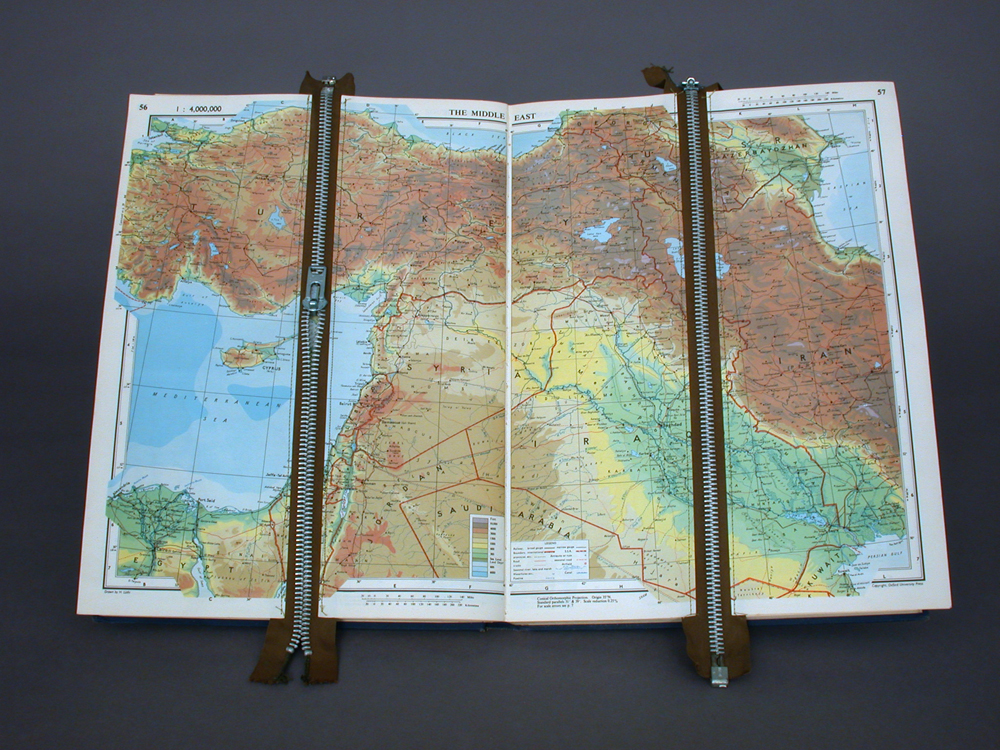
Maps, atlases–you use them to plan a trip, teach your child geography, and not a whole lot more. Where we see something for a basic purpose, Mr. Beube sees a way to create a political statement using art. In “Amendment” (2005), he cut the pages of an atlas into equal size strips and then added zippers to the end. The result is that now the viewer can change the entire political climate by moving country borders around attaching them in other places (such as moving a middle eastern country to be on a border with the United States…). With such an extensive ability to play with borders, this can spark conversation and debate for hours or days; not to mention the thoughts of peace that this promotes by trying to show that borders can just be things listed on a map.

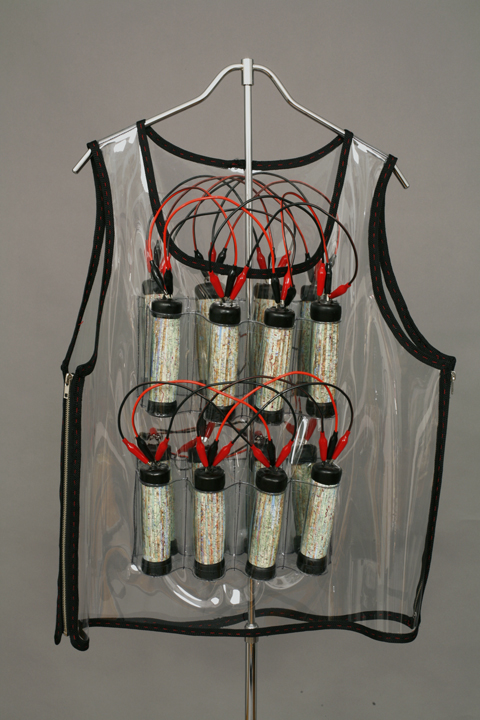
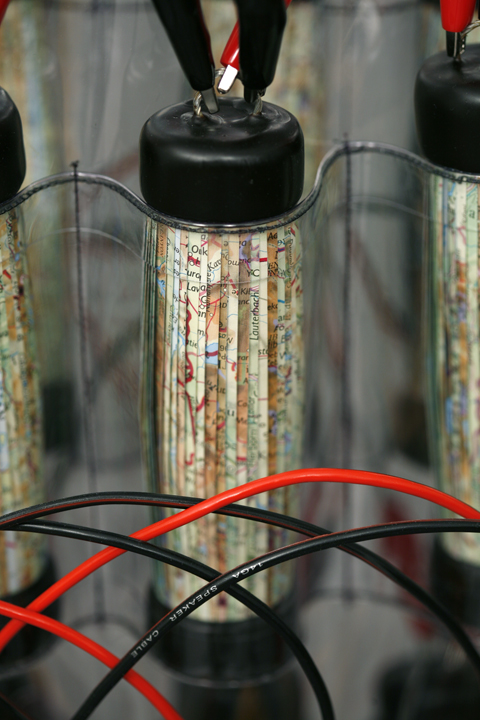
My personal favorite is “Vest for the New World” (2008). Can you imagine a book becoming a weapon? Mr. Beube did. Using volumes of the New World Atlas, he created a new kind of vest style bomb, one that can explode knowledge instead of destruction. The pages of the New World Atlas are rolled and stuffed into tubes that are attached to a plastic vest with wires attached at the end. With sixteen tubes in all, eight attached to the front and eight to the back, this vest very much resembles a vest bomb. As with a large number of his pieces, there are so many implications that can be drawn from this piece that you almost have to go back and consider it multiple times, over a period of time, just to cover a few of them.

Books inspire thought, new ideas, the sharing of those ideas, and so much more; by using this medium, Mr. Beube manages to accomplish the same things with his artwork. All of the photographs are of such amazing quality that some of them can show you the small granular detail of the very fibers in the books. There are so many views of most of the art that you get a full appreciation of the piece; not quite as good as being there, but about as close as a book can get. The artwork is enhanced even more by the essayists that Mr. Beube chose to include. These individuals have such a wonderful insightfulness into his work and great use of written word, that the combination of the words and images create a book that is easy for anyone to read and enjoy, but one that challenges your every day thinking. This book will be on my coffee table, starting conversations for years, I am certain.

Breaking the Codex is more than just a book about artwork; it is an expression on how books are viewed today and how they could be viewed. We are slowly phasing out the written word; in doing that are we going to lose all that our books have to offer? Will we lose our physical connection to books? Who knows for sure; but, this I can tell you with certainty, if you read Mr. Beube’s book (which I highly recommend you do) you will find yourself with a whole new perspective on books. Maybe the next time you pick up your favorite book you will see it in a different light.

You can contact the reviewer, Kelly Munoz, at kellycmunoz@yahoo.com.

“The Cowboy and His Lady Love”: A poem by J’Rie Elliott


“The cowboy and his lady love”
Dedicated to: Roy and Linda Davis


The cowboy told his lady love,
“For you I’d rope the stars.
I’d throw my lasso into the air,
and make their twinkle ours.
I’d keep them in a jar for you;
So their light could shine—
I’d keep them in that jar for you;
So they are yours and mine.”
But stars do not come easily,
Nor are ropes long enough to fly—
But that did not detour the cowboy
From getting those stars in the sky.

Years passed by and with the years,
Came gray hair and grandkids.
And with each year he tried to reach,
The stars that from him hid—

Until the day he could no longer wait;
And the stars he went to rope—
But he left behind his ladylove,
And she wondered how she’d cope.

But a promise he had made to her–
A twinkle in a jar,
And he went to grab that twinkle,
Then watch her from afar.

Though Ladylove, please do not cry,
But know your cowboy’s love was true,
He had to go to heaven,
To rope that star for you.


J’Rie Elliott is a mother, wife, daughter, and accomplished horseback rider from Alabama, USA. She can be reached at dixiepoet@gmail.com

“Dream Girl”: A story by J’Rie Elliott

“Dream Girl”

By: J.B. Elliott


I would begin this short tale with the phrase once upon a time; however, this is no fairy tale, nor is it a story for entertainment. This tale is a warning; a warning for anyone who is under the misguided conception that ghosts are only present on the silver screen, and the chill on your neck is only a cool breeze from the fan.

I was crashing at my brother and his wife’s house one night while I was traveling for work; I am naturally a frugal person so a hotel was out of the question—also this is the only time I get to see my little nephew. That evening had been uneventful; I had been playing with Tucker with his fire trucks and Tonka toys after super. When it was time for everyone to turn in I assumed my position on the couch like I always do. Tucker is terribly afraid of the dark—a fear that is bordering on pathological, so the house is dim–never dark. With a night light in each room and a fish tank glowing behind my head in the den it was easy to see my surroundings; but this house was a second home to me, I know every nook and cranny with my eyes shut. This was the first evening, however, when the filter on the fish tank was turned off, ridding the den of the perpetual babbling brook that I was accustomed to rocking me to sleep.

As I lie there listening to my brother snore down the hallway a strange noise found my ear. It was not a noise as much as it was a conversation; a conversation I could hear, but not hear. It was as though they were in the room with me but their volume had been turned down. I strained to listen to their conversation but to no avail; I was staring in the direction of the voices—in the corner beside the front door. I know it sounds strange, but I was not frightened by the events taking place around me; perhaps I was not completely aware of what was taking place in the room with me—I do not know. However what I do know is what happened next during the course of this night changed me forever…

After a few minutes the voices I had been listening to silenced while my sixteen-hour workday caught up with me and sleep made me its willing companion. My dreams swam with the images of my wife, from a time before we traded rings and she changed her last name. We were in this ethereal world that was full of autumn colors and a cool nip in the air; her jacket was only half buttoned, revealing the sensual curve of her collarbone and the paleness of her skin—I was truly content.  As we ran and reveled in the freedom that is youth we tumbled down, falling into each other’s arms, “I love you” I told her.  She leaned in and kissed me deep—a kiss of a dream where momentarily two souls feel like one; in real life these kisses are rare; just a few times is a person granted this magnitude of passion. I pulled her close closing my eyes tightly to capture every sensation, relishing every moment, but then something was wrong—she felt different. She became cold as the grave and her skin turned damp; I pulled away opening my eyes, “Hold me, I’m so cold…” I was horrified; this was not my wife!  I jerked back, her hair was wet and long, it clung to her face and her arms like sea weed stuck to a pear; her skin was ashen gray with black under tones as though her blood ran tar black through her veins. She smelt of mold and mud; she wore only a tattered nightshirt. She reached for me, “I’m so cold…” as she touched my arm I bolted awake.

Relief washed over me as I woke in my familiar surroundings; that was until I touched my shirt–my shirt was damp. Had I sweated through my shirt? I wondered; I could not have—I was not sweating. I removed my shirt and tossed it towards the laundry room and lay back down; I was too exhausted to even think in any clear manner. I closed my eyes, hoping to recapture the image of my wife again—no such luck.  I was aware of the fact that I was dreaming, but the world around me felt like nothing the dream world should.  I was still on the couch, but now I was sitting up and this mystery woman was seated beside me—her eyes were silent pleas of complete and utter desperation.  “I’m so cold and scared—hold me…” A single tear ran down her cheek. I put my arm around her shoulder—I was not scared by her, but for her. She moved close to me and my body shivered with the cold that radiated off of her like that of a frozen pond; her dampness touching my bare side. She slowly and softly began to weep into my chest—I cannot describe how this hurt every fiber of my being; her cries were so tormented it was torture to my dreaming ears simply to hear them. The conversation in the empty corner began again, this time with just enough volume for me to make out a few words—the girl, trouble and fix it. “Leave me alone!” she screamed into the empty conversation-filled corner.  Her sobs now came in deep ragged gasps; I forced myself to hold her as tightly as I could, trying to calm her, to soothe whatever it was that was tormenting her so.  Her coldness had traveled to the very core of my body. I was drained of energy and was fighting the urge to lean to the side and lay down. Time had no meaning in this world of dreams and tears.  I finally lay to the side, lying behind her with my arms wrapped around her, “Don’t let me go—I’m so cold…” Her weeping had slowed but not stopped.  “Shut up!” she yelled at the low conversation—I bolted awake.

The part I am about to relay to you turned my skin to goose flesh and my stomach to acid—I was turned the opposite direction on the couch than I had been when I fell asleep. The sheet was beneath me rather than over me and I could still feel her lying on my right arm. Shivers traveled down my neck making my teeth chatter in my skull; I touched my arm—water—on my arm, my chest, even my pajama pants were wet; not only wet but muddy too—the conversation in the corner continued. I decided to go into work extra early that day and forgo any more sleep—I had slept with the dead once that night; I was not going to do it again.


Newspaper Headline:

DECEMBER 23, 1936

POLICE BELIEVE THEY HAVE IDENTIFIED THE BODY OF LAST WEEK’S MURDERED FEMALE.

It is believed by authorities that Iris Parker, age 26, a woman of unfortunate reputation, is the identity of the female that was found last Wednesday in Suttler’s Pond. It is not known if Miss Parker was the victim of a violent crime or the victim of an illegal medical procedure. As Miss Parker’s chosen profession brought her into contact with shady characters, it is not hopeful that the investigation will provide any leads. Miss Parker’s family is unknown–her body will be interred by the county within the week.


J’Rie Elliott is a mother, wife, daughter, and accomplished horseback rider from Alabama, USA. She can be reached at dixiepoet@gmail.com